PUBLISHER: Mordor Intelligence | PRODUCT CODE: 2125740

PUBLISHER: Mordor Intelligence | PRODUCT CODE: 2125740
Educational Consulting And Training - Market Share Analysis, Industry Trends & Statistics, Growth Forecasts (2026 - 2031)
According to Mordor Intelligence, educational consulting and Training market size in 2026 is estimated at USD 81.72 billion, growing from 2025 value of USD 72.93 billion with 2031 projections showing USD 144.14 billion, growing at 12.02% CAGR over 2026-2031.
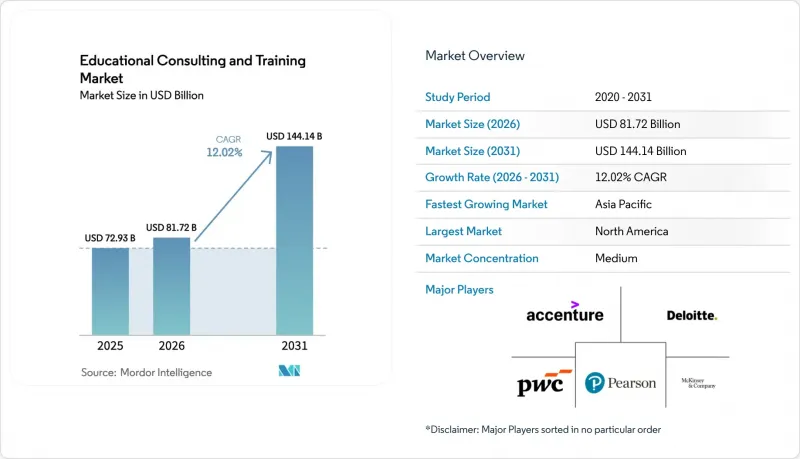
This report is Segmented by Type (Higher Education Consulting, K-12 Education Consulting), by Platform (Online, Offline), by Service Offering (Strategic & Operational Consulting, and Others), and by Geography (Asia-Pacific, North America, Europe, South America, and the Middle East and Africa). The Market Forecasts are Provided in Terms of Value (USD).
Global Educational Consulting And Training Market Trends and Insights
Rapid Digital-Learning Adoption Drives Platform Transformation
Hybrid delivery has become institutional policy rather than a contingency plan, which materially enlarges the Educational Consulting and Training market as clients seek partners who can unify pedagogy, technology, and change management. The United Kingdom appropriated USD 3.14 billion (GBP 2.5 billion) for national digital-skills development running through 2025. In 2024, Singapore's SkillsFuture initiative expanded its portfolio of online learning modules and introduced a requirement for outcome-tracking dashboards as a prerequisite for grant funding. This strategic move aims to enhance accountability and measure the effectiveness of funded programs. Such mandates shift consulting scopes from basic platform selection to enterprise-wide learner analytics integration, faculty enablement, and credential architecture. Corporations mirror this urgency by migrating legacy content into cloud-based learning-experience platforms that embed adaptive algorithms, thereby feeding a virtuous cycle in which data-rich environments help consultants demonstrate ROI and unlock follow-on assignments.
Government Upskilling Initiatives Reshape Market Demand
Governments now treat workforce skilling as macroeconomic policy. New Jersey's USD 50 million Workforce Development Initiative, launched in 2024, requires grantees to partner with external specialists for curriculum design and employer outreach. Queensland's Skills Strategy allocates co-investment grants to training consortia designed to align with industry requirements. These consortia are mandated to deliver annual impact reports, which undergo audits conducted by independent third-party consultants to ensure accountability and transparency. Similarly, Canada's Future Skills Centre has prioritized funding for experimental training pilots, with disbursement contingent upon the adoption of comprehensive and rigorous evaluation frameworks. These strategic initiatives are driving growth in the Educational Consulting and Training market, as a significant portion of colleges, vocational institutions, and employer coalitions lack the internal resources and expertise necessary to comply with the increasingly stringent evidence-based policy standards.
Budget Constraints Challenge Institutional Spending
The wind-down of Elementary and Secondary School Emergency Relief funding forces U.S. districts to trim discretionary services just as pandemic-related learning loss persists. Higher-education institutions confront flat tuition revenue and declining public appropriations, compelling CFOs to favor incremental, modular consulting scopes over transformational megaprojects. Providers seeking to defend their share of the Educational Consulting and Training market must therefore embed ROI calculators, flexible payment milestones, and grant-writing assistance into proposals.
Other drivers and restraints analyzed in the detailed report include:
- Corporate L&D Budget Expansion Fuels Reskilling Demand
- Outcome-Based Consulting Models Gain Traction
- Specialized Consultant Talent Shortage Limits Growth
For complete list of drivers and restraints, kindly check the Table Of Contents.
Segment Analysis
In 2025, Higher Education engagements accounted for 55.92% of the Educational Consulting and Training market share. This performance was attributed to universities prioritizing strategies to address declining enrolment rates, develop stackable micro-credential programs, and align academic curricula with labour-market trends and data-driven insights. Typical statements of work span diagnostic analytics, program-portfolio rationalization, and registrar-system integration. K-12, although representing a smaller share, will log an 13.1% CAGR, marking it the fastest-moving component of the Educational Consulting and Training market through 2031. State literacy mandates, science-of-reading implementations, and federally backed tutoring consortia anchor demand for professional-development sessions, coaching cycles, and curriculum mapping. District buyers favour short, grant-aligned projects, yet the cumulative volume of those engagements generates sizeable addressable revenue for regional specialists able to scale delivery across multiple school systems.
Higher Education clients typically sign multiyear master services agreements that cover enterprise resource planning, data-warehouse upgrades, and enrollment-marketing optimization, preserving high visibility for service revenue. Conversely, K-12 boards operate on annual budgets, driving providers to adopt modular toolkits and cost-sharing consortium models. Cross-selling potential emerges as higher-education consultancies downshift adjacent services, such as graduate-tracking dashboards, into K-12 markets, thereby expanding the Educational Consulting and Training market footprint without large marketing overhead.
Complete Report Scope:
- By Type
- Higher Education Consulting
- K-12 Education Consulting
- By Platform
- Online
- Offline
- By Service Offering
- Strategic & Operational Consulting
- Curriculum & Instructional Design
- Teacher Professional Development & Training
- Student Assessment & Support Services
- By Geography
- North America
- Canada
- United States
- Mexico
- South America
- Brazil
- Peru
- Chile
- Argentina
- Rest of South America
- Europe
- United Kingdom
- Germany
- France
- Spain
- Italy
- BENELUX (Belgium, Netherlands, Luxembourg)
- NORDICS (Denmark, Finland, Iceland, Norway, Sweden)
- Rest of Europe
- Asia-Pacific
- India
- China
- Japan
- Australia
- South Korea
- South-East Asia
- Rest of Asia-Pacific
- Middle East and Africa
- United Arab Emirates
- Saudi Arabia
- South Africa
- Nigeria
- Rest of Middle East and Africa
- North America
Geography Analysis
North America generated 38.95% of 2025 revenue, owing to substantial federal and state funds aligned to workforce programs and digital-infrastructure upgrades. The Infrastructure Investment and Jobs Act earmarked multibillion-dollar grants for community-college modernization, while state initiatives such as California's Strong Workforce Program stipulate mandatory third-party evaluations. Consulting engagements often encompass platform migration, workforce reskilling, and economic impact evaluations. These integrated service offerings contribute to an increase in the average size of deals, reflecting the growing demand for comprehensive and value-driven solutions in the market. Canadian provinces deploy stackable credential pilots and Indigenous education initiatives that further expand the Educational Consulting and Training market.
Asia-Pacific is projected to clock a 14.62% CAGR, fuelled by government digitization drives and demographic tailwinds. China's regional governments roll out AI-literacy certifications linked to industrial policy, forcing vocational institutes to seek external curriculum partners. India's National Education Policy mandates multidisciplinary curriculum conversion across colleges, generating sustained consulting demand for syllabus mapping, faculty coaching, and accreditation logistics. Southeast Asian ministries of education, notably Vietnam and Indonesia, allocate ed-tech subsidies aimed at English proficiency and STEM capacity, positioning foreign consultants as valued implementation guides.
Europe posts mid-single-digit growth on the strength of GDPR compliance projects and ESG-skills mandates. The Corporate Sustainability Reporting Directive requires companies to track employee competence in climate-impact topics, spawning specialized instructional-design engagements at. Nordic countries pilot lifelong-learning vouchers redeemable on approved course catalogs, necessitating audit mechanisms often outsourced to consultants. Mediterranean economies leverage EU cohesion funds to modernize vocational centers, creating cross-border collaboration opportunities that enlarge the Educational Consulting and Training market footprint. The Middle East & Africa show smaller but accelerating demand as Gulf states pivot to knowledge-economy strategies and African Union members prioritize teacher-capacity building, though budget volatility tempers near-term scale.
- Accenture plc
- Deloitte Touche Tohmatsu Ltd.
- PricewaterhouseCoopers (PwC)
- Ernst & Young (EY)
- KPMG International
- McKinsey & Company
- Boston Consulting Group (BCG)
- Bain & Company
- GP Strategies Corporation
- NIIT Limited
- Pearson plc
- Kaplan, Inc.
- Chegg, Inc.
- 2U, Inc.
- Blackboard Inc.
- Instructure Inc.
- Coursera Inc.
- Udacity, Inc.
- BYJU'S
- Cornerstone OnDemand, Inc.
- Skillsoft Corporation
- Franklin Covey Co.
Additional Benefits:
- The market estimate (ME) sheet in Excel format
- 3 months of analyst support
TABLE OF CONTENTS
1 Introduction
- 1.1 Study Assumptions & Market Definition
- 1.2 Scope of the Study
2 Research Methodology
3 Executive Summary
4 Market Landscape
- 4.1 Market Overview
- 4.2 Market Drivers
- 4.2.1 Rapid digital-learning adoption (post-pandemic)
- 4.2.2 Government upskilling initiatives & funding
- 4.2.3 Rising corporate L&D budgets for reskilling
- 4.2.4 Growing demand for outcome-based consulting
- 4.2.5 AI-assisted instructional design outsourcing
- 4.2.6 Demand for ESG-linked workforce training
- 4.3 Market Restraints
- 4.3.1 Budget constraints in educational institutions
- 4.3.2 Talent shortage of specialized consultants
- 4.3.3 Data-privacy compliance costs (GDPR, etc.)
- 4.3.4 Client fatigue from point-solution sprawl
- 4.4 Value / Supply-Chain Analysis
- 4.5 Regulatory Landscape
- 4.6 Technological Outlook
- 4.7 Porter's Five Forces
- 4.7.1 Bargaining Power of Suppliers
- 4.7.2 Bargaining Power of Buyers
- 4.7.3 Threat of New Entrants
- 4.7.4 Threat of Substitutes
- 4.7.5 Competitive Rivalry
5 Market Size & Growth Forecasts
- 5.1 By Type
- 5.1.1 Higher Education Consulting
- 5.1.2 K-12 Education Consulting
- 5.2 By Platform
- 5.2.1 Online
- 5.2.2 Offline
- 5.3 By Service Offering
- 5.3.1 Strategic & Operational Consulting
- 5.3.2 Curriculum & Instructional Design
- 5.3.3 Teacher Professional Development & Training
- 5.3.4 Student Assessment & Support Services
- 5.4 By Geography
- 5.4.1 North America
- 5.4.1.1 Canada
- 5.4.1.2 United States
- 5.4.1.3 Mexico
- 5.4.2 South America
- 5.4.2.1 Brazil
- 5.4.2.2 Peru
- 5.4.2.3 Chile
- 5.4.2.4 Argentina
- 5.4.2.5 Rest of South America
- 5.4.3 Europe
- 5.4.3.1 United Kingdom
- 5.4.3.2 Germany
- 5.4.3.3 France
- 5.4.3.4 Spain
- 5.4.3.5 Italy
- 5.4.3.6 BENELUX (Belgium, Netherlands, Luxembourg)
- 5.4.3.7 NORDICS (Denmark, Finland, Iceland, Norway, Sweden)
- 5.4.3.8 Rest of Europe
- 5.4.4 Asia-Pacific
- 5.4.4.1 India
- 5.4.4.2 China
- 5.4.4.3 Japan
- 5.4.4.4 Australia
- 5.4.4.5 South Korea
- 5.4.4.6 South-East Asia
- 5.4.4.7 Rest of Asia-Pacific
- 5.4.5 Middle East and Africa
- 5.4.5.1 United Arab Emirates
- 5.4.5.2 Saudi Arabia
- 5.4.5.3 South Africa
- 5.4.5.4 Nigeria
- 5.4.5.5 Rest of Middle East and Africa
- 5.4.1 North America
6 Competitive Landscape
- 6.1 Market Concentration
- 6.2 Strategic Moves
- 6.3 Market Share Analysis
- 6.4 Company Profiles
- 6.4.1 Accenture plc
- 6.4.2 Deloitte Touche Tohmatsu Ltd.
- 6.4.3 PricewaterhouseCoopers (PwC)
- 6.4.4 Ernst & Young (EY)
- 6.4.5 KPMG International
- 6.4.6 McKinsey & Company
- 6.4.7 Boston Consulting Group (BCG)
- 6.4.8 Bain & Company
- 6.4.9 GP Strategies Corporation
- 6.4.10 NIIT Limited
- 6.4.11 Pearson plc
- 6.4.12 Kaplan, Inc.
- 6.4.13 Chegg, Inc.
- 6.4.14 2U, Inc.
- 6.4.15 Blackboard Inc.
- 6.4.16 Instructure Inc.
- 6.4.17 Coursera Inc.
- 6.4.18 Udacity, Inc.
- 6.4.19 BYJU'S
- 6.4.20 Cornerstone OnDemand, Inc.
- 6.4.21 Skillsoft Corporation
- 6.4.22 Franklin Covey Co.
7 Market Opportunities & Future Outlook
- 7.1 Cross-border micro-credential partnerships
- 7.2 AI-driven skills-gap diagnostics services

