PUBLISHER: Mordor Intelligence | PRODUCT CODE: 2154202

PUBLISHER: Mordor Intelligence | PRODUCT CODE: 2154202
North America Ready To Drink Coffee - Market Share Analysis, Industry Trends & Statistics, Growth Forecasts (2026 - 2031)
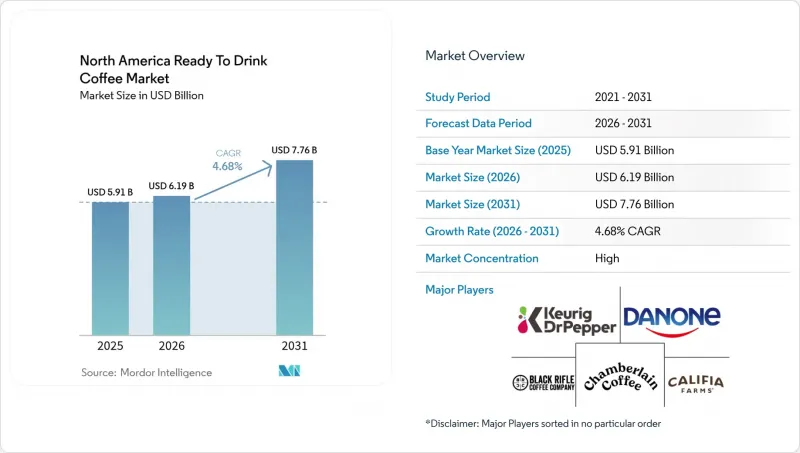
According to Mordor Intelligence, the North America Ready-to-Drink coffee market size is expected to grow from USD 5.91 billion in 2025 to USD 6.19 billion in 2026 and is forecast to reach USD 7.76 billion by 2031 at 4.68% CAGR over 2026-2031.
North America Ready To Drink Coffee Market Trends and Insights
Growing Consumer Preference for Convenience and On-the-Go Beverage Options
Convenience-driven consumption patterns are significantly influencing the demand for RTD (Ready-to-Drink) coffee, particularly among Gen Z and millennial consumers who prioritize grab-and-go options over traditional brewing methods. E-commerce grocery sales have seen consistent growth year-over-year, with delivery services playing a substantial role in driving monthly sales gains. This expansion in online channels benefits RTD coffee manufacturers by enhancing product accessibility and supporting subscription-based consumption models. The emphasis on convenience has also enabled premium RTD coffee formats to command higher prices, as consumers are willing to pay more for time-saving solutions. Delivery-focused promotional strategies have driven notable growth, with delivery monthly active users increasing at a faster rate compared to overall e-grocery platforms. Additionally, partnerships with convenience stores are becoming more strategic, as these outlets capture impulse purchases and cater to commuter traffic patterns that align with RTD coffee consumption occasions.
Rising Popularity of Cold Brew and Specialty Coffee Variants in RTD Format
Cold brew's growth trajectory, with a compound annual growth rate (CAGR) of 5.79%, underscores the increasing consumer awareness of its perceived health benefits and distinctive flavor profiles, which support premium pricing. Advances in technology have revolutionized the cold brew extraction process, with new equipment significantly reducing the traditional 24-hour steeping time to less than 1 hour. These innovations ensure flavor integrity, enhance extraction yields, lower production costs, and provide greater supply chain flexibility for manufacturers aiming to meet the rising demand. Studies on consumer perceptions indicate that a notable proportion of coffee drinkers associate cold brew with health benefits due to its lower acidity levels, creating opportunities for functional product positioning. Furthermore, nitrogen infusion technology enables the creation of a creamy texture without the use of dairy, making it particularly appealing to plant-based consumer segments and expanding market opportunities. Specialty roasters are increasingly forming partnerships with co-packers to scale ready-to-drink (RTD) production while maintaining strict quality control and preserving their artisanal brand identity.
Regulatory Challenges Concerning Labeling, Health Claims, and Food Safety
FDA compliance requirements for functional beverage claims present substantial barriers to market entry and impose ongoing compliance costs, which tend to impact smaller manufacturers more significantly. Labeling regulations for energy-infused products mandate specific disclosures, such as caffeine content and health warnings, which may restrict marketing options and reduce consumer appeal. Food safety standards for ready-to-drink (RTD) coffee production require the implementation of Hazard Analysis and Critical Control Points (HACCP) systems and regular facility inspections, adding to operational complexity and costs. Health claim substantiation regulations necessitate clinical evidence to validate the benefits of functional ingredients, leading to increased research and development expenses that benefit larger, established players with greater regulatory expertise. Additionally, the evolving regulatory framework for novel functional ingredients introduces uncertainty in product development timelines and market entry strategies, potentially delaying innovation and competitive responses.
Other drivers and restraints analyzed in the detailed report include:
- Increasing Health Consciousness Promoting Functional and Enhanced Coffee Offerings
- Consumer Desire for Unique and Innovative Flavors Enhancing Product Differentiation
- Shelf-Life Limitations of Refrigerated RTD Coffee Products
For complete list of drivers and restraints, kindly check the Table Of Contents.
Segment Analysis
Cold brew coffee is anticipated to be the fastest-growing segment, with a compound annual growth rate (CAGR) of 5.79% through 2031. This growth is largely driven by consumers' perception of its health benefits and its positioning as a premium product. The ability to command higher price points compared to traditional iced coffee formats has further contributed to its rising popularity. Additionally, advancements in technology have played a significant role in enhancing the cold brew production process. New equipment has significantly reduced the traditional 24-hour steeping time to under 1 hour, all while maintaining the flavor integrity that consumers expect from cold brew coffee.
Iced coffee, on the other hand, continues to dominate the market, with a projected 50.10% share in 2025. This dominance is supported by its established familiarity among consumers and its broad retail availability across various price points and packaging formats. Meanwhile, other ready-to-drink (RTD) coffee variants are finding niche opportunities by incorporating specialty formulations and functional ingredients. However, these variants face challenges in scaling up, which limits their growth potential when compared to the more mainstream cold brew and iced coffee categories.
PET bottles are anticipated to dominate the market with the largest share of 34.55% in 2025, while also achieving the fastest growth at a CAGR of 6.08%. This growth trajectory is supported by increasing sustainability efforts and advancements in supply chain efficiency, which collectively help reduce transportation costs and minimize environmental impact. Glass bottles, on the other hand, are often associated with premium positioning strategies, making them a preferred choice for high-end products. However, their heavier weight and susceptibility to breakage pose significant challenges in distribution, particularly in convenience and online retail channels, where durability and ease of handling are critical factors. Metal cans continue to gain traction due to their shelf-stability benefits and the ability to enhance brand identity through innovative designs, such as eye-catching graphics and tactile features. Despite these advantages, the volatility in aluminum prices remains a concern, as it can create pressure on profit margins for manufacturers relying on this material.
Aseptic packaging, including Tetra Pak, cartons, and pouches, is increasingly favored for its ability to extend shelf life without requiring refrigeration. This feature not only enables broader geographic distribution but also reduces the costs associated with maintaining a cold chain. Sustainability considerations are playing an ever-growing role in shaping packaging decisions, with major retailers setting ambitious plastic reduction targets that prioritize recyclable and lightweight materials. The PET segment, in particular, benefits from ongoing improvements in recycling infrastructure and consumer education campaigns, which further bolster its growth. At the same time, regulatory measures aimed at curbing single-use plastics are driving innovation in alternative materials. Meanwhile, disposable cups, though representing the smallest segment, fulfill a niche demand for on-premise consumption scenarios where convenience and portability are prioritized over environmental concerns.
Complete Report Scope:
- By Drink Type
- Cold Brew Coffee
- Iced Coffee
- Other RTD Coffee
- By Packaging Type
- PET Bottles
- Glass Bottles
- Metal Can
- Aseptic packages (tetra pak, cartons, pouches)
- Disposable Cups
- By Distribution Channel
- On-Trade
- Off-Trade
- Supermarket/Hypermarket
- Convenience Stores
- Specialty Stores
- Online Retail
- Other Distribution Channels
- By Functionality
- Protein-Enriched
- Energy-Infused
- Other
- By Geography
- United States
- Canada
- Mexico
- Rest of North America
List of Companies Covered in this Report:
- BRC Inc.
- Califia Farms LLC
- Chamberlain Coffee Inc.
- Danone S.A.
- Keurig Dr Pepper Inc.
- Chobani Inc.
- Luigi Lavazza S.p.A.
- Nestle S.A.
- Costco Wholesale Corporation
- PepsiCo Inc.
- The Central America Bottling Corporation
- The Coca-Cola Company
- Starbucks Corporation
- Monster Beverage Corporation
- JAB Holding Company
- High Brew Coffee Inc.
- RISE Brewing Co.
- UCC Ueshima Coffee Co. Ltd.
- Lucky Jack Organic Coffee Co.
- Illycaffe S.p.A.
Additional Benefits:
- The market estimate (ME) sheet in Excel format
- 3 months of analyst support
TABLE OF CONTENTS
1 INTRODUCTION
- 1.1 Study Assumptions and Market Definition
- 1.2 Scope of the Study
2 RESEARCH METHODOLOGY
3 EXECUTIVE SUMMARY
4 MARKET LANDSCAPE
- 4.1 Market Overview
- 4.2 Market Drivers
- 4.2.1 Growing consumer preference for convenience and on-the-go beverage options
- 4.2.2 Rising popularity of cold brew and specialty coffee variants in RTD format
- 4.2.3 Increasing health consciousness promoting functional and enhanced coffee offerings
- 4.2.4 Consumer desire for unique and innovative flavors enhancing product differentiation
- 4.2.5 Increased availability through online retailing enhancing access to RTD coffee
- 4.2.6 Inclusion of functional ingredients for health benefits
- 4.3 Market Restraints
- 4.3.1 Regulatory challenges concerning labeling, health claims, and food safety.
- 4.3.2 Shelf-life limitations of refrigerated RTD coffee products
- 4.3.3 Fluctuations in coffee bean quality and availability impacting product consistency.
- 4.3.4 Preference for freshly brewed coffee in certain consumer segments
- 4.4 Supply Chain Analysis
- 4.5 Regulatory Outlook
- 4.6 Porter's Five Forces
- 4.6.1 Threat of New Entrants
- 4.6.2 Bargaining Power of Buyers/Consumers
- 4.6.3 Bargaining Power of Suppliers
- 4.6.4 Threat of Substitute Products
- 4.6.5 Intensity of Competitive Rivalry
5 MARKET SIZE AND GROWTH FORECASTS (VALUE AND VOLUME)
- 5.1 By Drink Type
- 5.1.1 Cold Brew Coffee
- 5.1.2 Iced Coffee
- 5.1.3 Other RTD Coffee
- 5.2 By Packaging Type
- 5.2.1 PET Bottles
- 5.2.2 Glass Bottles
- 5.2.3 Metal Can
- 5.2.4 Aseptic packages (tetra pak, cartons, pouches)
- 5.2.5 Disposable Cups
- 5.3 By Distribution Channel
- 5.3.1 On-Trade
- 5.3.2 Off-Trade
- 5.3.2.1 Supermarket/Hypermarket
- 5.3.2.2 Convenience Stores
- 5.3.2.3 Specialty Stores
- 5.3.2.4 Online Retail
- 5.3.2.5 Other Distribution Channels
- 5.4 By Functionality
- 5.4.1 Protein-Enriched
- 5.4.2 Energy-Infused
- 5.4.3 Other
- 5.5 By Geography
- 5.5.1 United States
- 5.5.2 Canada
- 5.5.3 Mexico
- 5.5.4 Rest of North America
6 COMPETITIVE LANDSCAPE
- 6.1 Market Concentration
- 6.2 Strategic Moves
- 6.3 Market Ranking Analysis
- 6.4 Company Profiles (includes Global-level Overview, Market-level Overview, Core Segments, Financials (if available), Strategic Information, Market Rank/Share, Products and Services, Recent Developments)
- 6.4.1 BRC Inc.
- 6.4.2 Califia Farms LLC
- 6.4.3 Chamberlain Coffee Inc.
- 6.4.4 Danone S.A.
- 6.4.5 Keurig Dr Pepper Inc.
- 6.4.6 Chobani Inc.
- 6.4.7 Luigi Lavazza S.p.A.
- 6.4.8 Nestle S.A.
- 6.4.9 Costco Wholesale Corporation
- 6.4.10 PepsiCo Inc.
- 6.4.11 The Central America Bottling Corporation
- 6.4.12 The Coca-Cola Company
- 6.4.13 Starbucks Corporation
- 6.4.14 Monster Beverage Corporation
- 6.4.15 JAB Holding Company
- 6.4.16 High Brew Coffee Inc.
- 6.4.17 RISE Brewing Co.
- 6.4.18 UCC Ueshima Coffee Co. Ltd.
- 6.4.19 Lucky Jack Organic Coffee Co.
- 6.4.20 Illycaffe S.p.A.
7 MARKET OPPORTUNITIES AND FUTURE OUTLOOK

