PUBLISHER: Mordor Intelligence | PRODUCT CODE: 2154203

PUBLISHER: Mordor Intelligence | PRODUCT CODE: 2154203
Aircraft Seating - Market Share Analysis, Industry Trends & Statistics, Growth Forecasts (2026 - 2031)
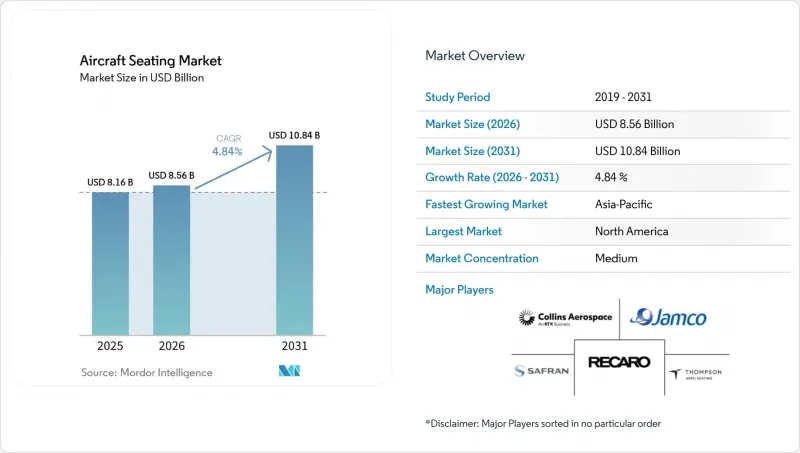
According to Mordor Intelligence, the aircraft seating market size was valued at USD 8.16 billion in 2025 and is forecast to grow from USD 8.56 billion in 2026 to reach USD 10.84 billion by 2031, at a 4.84% CAGR during the forecast period (2026-2031).
Global Aircraft Seating Market Trends and Insights
Growth in Commercial Aircraft Deliveries and Fleet Expansion
Airbus reported an order book of 9,352 aircraft in July 2026, including 7,574 A320neo-family commitments. Boeing also had more than 6,700 aircraft in backlog, with the B737 family representing a large share of its narrowbody pipeline. Each new narrowbody or widebody delivery requires a cabin seating program and ties suppliers to aircraft production schedules. Airbus delivered 793 commercial aircraft to 91 customers in 2025 and ended the year with a backlog of 8,754 aircraft. COMAC's C919 expansion also creates a separate qualification path in China, where domestic suppliers can build experience on local platforms. China handled 776.1 million passengers in 2025, making local aircraft programs relevant to long-term seating demand.
Premium-Cabin Reconfiguration and Retrofit Demand
Airlines are funding cabin upgrades to improve the value of long-haul premium travel and refresh older aircraft. Delta committed more than USD 1 billion for next-generation Delta One suites on incoming A350-1000 aircraft and A330-200/300 retrofits. Delta expects 90% of its Delta One seats to have sliding privacy doors by 2030. These programs create multi-year opportunities in the aircraft seating market for suppliers capable of meeting airline design and certification requirements. The work is especially important on widebody aircraft, where a delayed seat approval can defer an entire cabin conversion. EASA's Part 21 framework continues to shape the qualification process for aircraft products used by European operators.
High Seat Certification and Qualification Costs
Seat development requires testing against demanding safety standards before a new design can enter service. FAA requirements under 14 CFR Part 25.562 include 16g forward and 14g vertical dynamic impact testing. EASA design organization approval under Part 21J can require multi-year development work before commercial delivery. These costs make it harder for smaller firms to launch entirely new seat platforms. Longer qualification periods can postpone supplier revenue and constrain airline cabin schedules. The resulting barriers protect established manufacturers, but they can also slow product renewal across the aircraft seating market.
Other drivers and restraints analyzed in the detailed report include:
- Fleet Modernization and Military Procurement Programs
- Lightweighting and Fuel-Burn Reduction
- Aircraft Production and Defense Procurement Cyclicality
For complete list of drivers and restraints, kindly check the Table Of Contents.
Segment Analysis
Commercial aviation accounted for 52.45% of the aircraft seating market share in 2025, making it the largest aviation segment. Its position reflects the large number of narrowbody and widebody aircraft delivered through OEM production programs. Airbus delivered 793 commercial aircraft in 2025, and its backlog supports continued linefit activity. Airline cabin layouts, route networks, and the balance between economy and premium capacity shape commercial seat procurement. Suppliers must provide consistent volumes for narrowbody aircraft while meeting more customized requirements for widebody cabins.
General aviation is forecast to grow at a CAGR of 5.72% through 2031, the fastest rate among aviation types. Business jet owners and charter operators seek lightweight and ergonomic products that can be customized more extensively than many commercial seats. Fractional ownership also increases aircraft utilization and can shorten interior refresh cycles. AAM remains small in current revenue but adds a new path for seat qualification and production. RECARO's agreement with Eve Air Mobility covers 75,000 seats in shipsets of 5 for eVTOL aircraft, with each seat weighing less than 9 kg. The FAA and aviation authorities from Australia, Canada, New Zealand, and the UK issued a joint AAM certification roadmap in 2025.
Passenger seats held 51.38% of the aircraft seating market share in 2025 and are forecast to grow at a CAGR of 7.47% through 2031. This combination makes passenger seating the central volume and value category for most commercial suppliers. Economy seating provides the highest unit volumes, but airlines increasingly require lower weight and integrated power features. Premium economy has evolved into a distinct cabin tier that offers more differentiated seat options. RECARO's R4 premium economy product received ETSO certification for the B787 and was selected by All Nippon Airways (ANA). The aircraft seating market size for this class is supported by airline efforts to offer more choice between economy and business cabins.
Business-class products are moving toward suites with privacy features, direct aisle access, and greater passenger control. RECARO presented its R7 Horizon demonstrator in 2026 with voice control in more than 90 languages and circadian lighting. First-class capacity is declining at select airlines as operators convert the space to business- and premium-economy seats. American Airlines planned to remove first class from its B777-300ER retrofit configuration and add 70 business-class seats and 44 premium-economy seats. Pilot and crew seats remain a smaller but specialized class with separate safety and survivability requirements.
Complete Report Scope:
- By Aviation Type
- Commercial Aviation
- Narrowbody
- Widebody
- Regional Jets
- Military Aviation
- Combat
- Transport
- Special Mission
- Helicopters
- General Aviation
- Business Jets
- Commercial Helicopters
- Advanced Air Mobility (AAM)
- Commercial Aviation
- By Seat Class
- Passenger Seats
- Economy
- Premium Economy
- Business
- First
- Pilot and Crew Seats
- Passenger Seats
- By Fitment
- Linefit
- Retrofit
- By Component
- Structures
- Foams
- Actuators
- Electrical Fittings
- Others
- By Region
- North America
- United States
- Canada
- Europe
- United Kingdom
- France
- Germany
- Spain
- Italy
- Russia
- Rest of Europe
- South America
- Brazil
- Rest of South America
- Asia-Pacific
- China
- India
- Japan
- South Korea
- Indonesia
- Australia
- Rest of Asia-Pacific
- Middle East and Africa
- Middle East
- Saudi Arabia
- United Arab Emirates
- Qatar
- Rest of Middle East
- Africa
- South Africa
- Nigeria
- Rest of Africa
- Middle East
- North America
Geography Analysis
North America held 43.61% of the aircraft seating market share in 2025. The US handled 890.1 million passengers in 2025, supporting high aircraft utilization and recurring cabin replacement needs. The region benefits from the presence of major aircraft and seating suppliers. Delta's more than USD 1 billion cabin program shows the role of premium retrofit spending in the region. FAA Part 25 standards also influence seat engineering and certification approaches used worldwide.
Asia-Pacific is forecast to grow at a CAGR of 6.48% through 2031, the fastest rate among the geographic regions. China's registered commercial fleet reached 4,574 aircraft at the end of 2025 after adding 180 net aircraft during the year. IATA projected Asia-Pacific passenger traffic growth of 7.3% in 2026, supported by outbound travel from China, domestic traffic in India, and regional leisure demand. Airbus expects India's commercial fleet to reach 2,250 aircraft by 2035, while passenger traffic is expected to grow at 8.9% annually.
Europe has mature airline fleets, Airbus production sites, strong seat design capabilities, and established retrofit facilities. Germany, France, the UK, and Spain remain important locations for seat development and maintenance work. Middle Eastern carriers use premium-heavy long-haul configurations that increase the value of seating supplied per aircraft. South America is relevant through Embraer deliveries and Brazil's role in Eve Air Mobility's eVTOL program.
- Collins Aerospace (RTX Corporation)
- Safran S.A.
- RECARO Aircraft Seating GmbH & Co. KG (RECARO Holding GmbH)
- JAMCO Corporation
- STELIA Aerospace (Airbus SE)
- Thompson Aero Seating Limited (Aviation Industry Corporation of China)
- ZIM Aircraft Seating GmbH
- Expliseat S.A.S.
- Geven S.p.A.
- Aviointeriors S.p.A.
- Acro Aircraft Seating Ltd.
- Mirus Aircraft Seating Ltd.
- Unum Aircraft Seating Limited
- Elevate Aircraft Seating LLC
- Starling Aerospace Limited
- Martin-Baker Aircraft Co. Ltd.
- Golan Industries (Israel Aerospace Industries Ltd.)
- MG Seating Systems Pvt. Ltd.
Additional Benefits:
- The market estimate (ME) sheet in Excel format
- 3 months of analyst support
TABLE OF CONTENTS
1 INTRODUCTION
- 1.1 Study Assumptions and Market Definition
- 1.2 Scope of the Study
2 RESEARCH METHODOLOGY
3 EXECUTIVE SUMMARY
4 MARKET LANDSCAPE
- 4.1 Market Overview
- 4.2 Market Drivers
- 4.2.1 Growth in commercial aircraft deliveries and fleet expansion
- 4.2.2 Fleet modernization and military procurement programs
- 4.2.3 Premium-cabin reconfiguration and retrofit demand
- 4.2.4 Lightweighting and fuel-burn reduction
- 4.2.5 Crashworthiness and aircrew survivability upgrades
- 4.2.6 Modular mission reconfiguration for transport and MEDEVAC aircraft
- 4.3 Market Restraints
- 4.3.1 High seat certification and qualification costs
- 4.3.2 Aircraft production and defense procurement cyclicality
- 4.3.3 Export controls and sovereign-source requirements
- 4.3.4 Limited interoperability across legacy military platforms
- 4.4 Value Chain Analysis
- 4.5 Regulatory Landscape
- 4.6 Technological Outlook
- 4.7 Porter's Five Forces Analysis
- 4.7.1 Bargaining Power of Buyers
- 4.7.2 Bargaining Power of Suppliers
- 4.7.3 Threat of New Entrants
- 4.7.4 Threat of Substitutes
- 4.7.5 Intensity of Competitive Rivalry
5 MARKET SIZE AND GROWTH FORECASTS (VALUE)
- 5.1 By Aviation Type
- 5.1.1 Commercial Aviation
- 5.1.1.1 Narrowbody
- 5.1.1.2 Widebody
- 5.1.1.3 Regional Jets
- 5.1.2 Military Aviation
- 5.1.2.1 Combat
- 5.1.2.2 Transport
- 5.1.2.3 Special Mission
- 5.1.2.4 Helicopters
- 5.1.3 General Aviation
- 5.1.3.1 Business Jets
- 5.1.3.2 Commercial Helicopters
- 5.1.4 Advanced Air Mobility (AAM)
- 5.1.1 Commercial Aviation
- 5.2 By Seat Class
- 5.2.1 Passenger Seats
- 5.2.1.1 Economy
- 5.2.1.2 Premium Economy
- 5.2.1.3 Business
- 5.2.1.4 First
- 5.2.2 Pilot and Crew Seats
- 5.2.1 Passenger Seats
- 5.3 By Fitment
- 5.3.1 Linefit
- 5.3.2 Retrofit
- 5.4 By Component
- 5.4.1 Structures
- 5.4.2 Foams
- 5.4.3 Actuators
- 5.4.4 Electrical Fittings
- 5.4.5 Others
- 5.5 By Region
- 5.5.1 North America
- 5.5.1.1 United States
- 5.5.1.2 Canada
- 5.5.2 Europe
- 5.5.2.1 United Kingdom
- 5.5.2.2 France
- 5.5.2.3 Germany
- 5.5.2.4 Spain
- 5.5.2.5 Italy
- 5.5.2.6 Russia
- 5.5.2.7 Rest of Europe
- 5.5.3 South America
- 5.5.3.1 Brazil
- 5.5.3.2 Rest of South America
- 5.5.4 Asia-Pacific
- 5.5.4.1 China
- 5.5.4.2 India
- 5.5.4.3 Japan
- 5.5.4.4 South Korea
- 5.5.4.5 Indonesia
- 5.5.4.6 Australia
- 5.5.4.7 Rest of Asia-Pacific
- 5.5.5 Middle East and Africa
- 5.5.5.1 Middle East
- 5.5.5.1.1 Saudi Arabia
- 5.5.5.1.2 United Arab Emirates
- 5.5.5.1.3 Qatar
- 5.5.5.1.4 Rest of Middle East
- 5.5.5.2 Africa
- 5.5.5.2.1 South Africa
- 5.5.5.2.2 Nigeria
- 5.5.5.2.3 Rest of Africa
- 5.5.5.1 Middle East
- 5.5.1 North America
6 COMPETITIVE LANDSCAPE
- 6.1 Market Concentration
- 6.2 Strategic Moves
- 6.3 Market Share Analysis
- 6.4 Company Profiles (includes Global level Overview, Market level overview, Core Segments, Financials as available, Strategic Information, Market Rank/Share, Products and Services, and Recent Developments)
- 6.4.1 Collins Aerospace (RTX Corporation)
- 6.4.2 Safran S.A.
- 6.4.3 RECARO Aircraft Seating GmbH & Co. KG (RECARO Holding GmbH)
- 6.4.4 JAMCO Corporation
- 6.4.5 STELIA Aerospace (Airbus SE)
- 6.4.6 Thompson Aero Seating Limited (Aviation Industry Corporation of China)
- 6.4.7 ZIM Aircraft Seating GmbH
- 6.4.8 Expliseat S.A.S.
- 6.4.9 Geven S.p.A.
- 6.4.10 Aviointeriors S.p.A.
- 6.4.11 Acro Aircraft Seating Ltd.
- 6.4.12 Mirus Aircraft Seating Ltd.
- 6.4.13 Unum Aircraft Seating Limited
- 6.4.14 Elevate Aircraft Seating LLC
- 6.4.15 Starling Aerospace Limited
- 6.4.16 Martin-Baker Aircraft Co. Ltd.
- 6.4.17 Golan Industries (Israel Aerospace Industries Ltd.)
- 6.4.18 MG Seating Systems Pvt. Ltd.
7 MARKET OPPORTUNITIES AND FUTURE OUTLOOK
- 7.1 White-space and Unmet-need Assessment

