PUBLISHER: Mordor Intelligence | PRODUCT CODE: 2154204

PUBLISHER: Mordor Intelligence | PRODUCT CODE: 2154204
Chocolate - Market Share Analysis, Industry Trends & Statistics, Growth Forecasts (2026 - 2031)
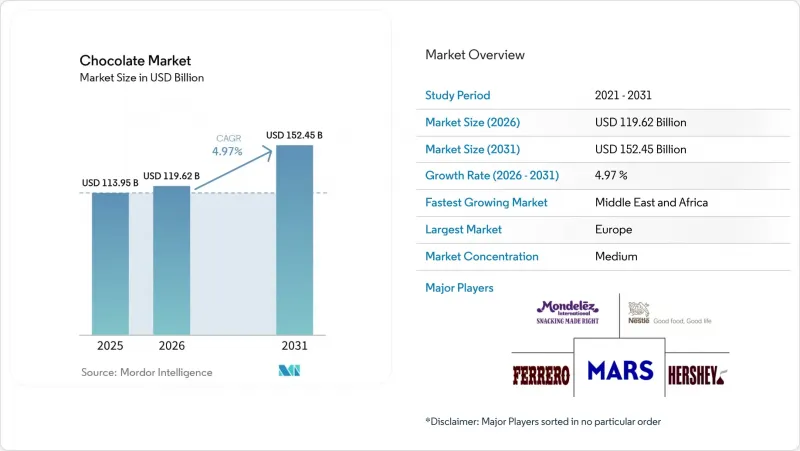
According to Mordor Intelligence, the chocolate market size was valued at USD 113.95 billion in 2025 and is estimated to grow to USD 119.62 billion in 2026, reaching USD 152.45 billion by 2031, with a CAGR of 4.97% during the period 2026-2031.
Global Chocolate Market Trends and Insights
Premiumization and craft chocolate movement
One of the key drivers of the global chocolate market is the increasing focus on premiumization and the craft chocolate movement. This reflects a growing consumer preference for high-quality, artisanal, and ethically sourced products over mass-produced alternatives. Consumers are increasingly drawn to chocolates with unique flavor profiles, higher cocoa content, and authentic origin stories, enhancing the indulgence experience and fostering a willingness to pay a premium. This trend is particularly prominent in mature markets, where demand for single-origin, bean-to-bar, and limited-edition chocolates is rising, often accompanied by transparent sourcing practices and sustainability credentials. The emotional and experiential appeal of craft chocolates further supports premiumization, as these products are positioned as both personal indulgences and gifting options. Brands differentiate themselves through storytelling, innovative packaging, and curated flavor offerings. For example, in June 2025, Cacao Hunters, a premium chocolate brand known for its award-winning single-origin chocolates and commitment to ethical sourcing, launched in the United States, highlighting the market potential for craft chocolates and the emphasis on premium, ethically focused products.
Flavor innovation and global taste exploration
Flavor innovation and global taste exploration are playing a pivotal role in driving the market as consumers increasingly seek unique, adventurous, and culturally inspired chocolate experiences that transcend traditional milk, dark, and white varieties. Manufacturers are pushing boundaries by incorporating an extensive array of exotic ingredients, such as spices, botanicals, fruits, nuts, and regional delicacies, to cater to evolving consumer preferences and craft distinctive products that stand out in highly competitive markets. This trend is further fueled by the rising demand for experiential consumption, where chocolate transforms into a medium for exploring diverse culinary influences and uncovering stories of origin. For example, in November 2024, Lindt unveiled its limited-edition Dubai-Inspired Pistachio Chocolate Bar in Dusseldorf, seamlessly blending Middle Eastern flavors with premium chocolate to captivate European consumers. This exemplifies how brands are strategically leveraging cultural inspirations to elevate product appeal, foster deeper consumer engagement, and expand their global reach.
Rising regulatory pressure on sugar and confectionery products
The chocolate market faces a significant restraint due to increasing regulatory pressures on sugar and confectionery products. Governments worldwide are implementing stricter measures to address health concerns such as obesity and diabetes. These measures include sugar taxes, front-of-pack nutritional labeling, restrictions on marketing to children, and limits on sugar content. Such regulations compel manufacturers to reformulate products, reduce sugar levels, or use alternative sweeteners, which may affect taste, texture, and consumer acceptance if not managed effectively. Additionally, compliance with these regulations imposes operational and cost challenges, particularly for large-scale producers managing diverse product portfolios across regions with varying regulatory requirements. These challenges are further compounded by the need to balance regulatory compliance with maintaining brand identity and consumer loyalty. Overall, these regulatory pressures constrain product development flexibility, raise production costs, and may reduce sales of traditional high-sugar chocolate products in key markets, potentially driving a shift toward healthier alternatives and innovative product offerings.
Other drivers and restraints analyzed in the detailed report include:
- Growth of gifting and seasonal consumption occasions
- Rising demand for sustainable and ethical cocoa sourcing
- Allergies and rising dietary restrictions
For complete list of drivers and restraints, kindly check the Table Of Contents.
Segment Analysis
Milk and white chocolate maintained their dominance in the chocolate market in 2025, accounting for approximately 64.54% of total sales. This performance was driven by strong consumer familiarity, broad demographic appeal, and versatility across various consumption occasions. Milk chocolate, in particular, remains the most widely accepted format due to its milder sweetness, creamy texture, and balanced cocoa-dairy profile. These attributes make it especially appealing to children, first-time consumers, and mass-market buyers in both developed and emerging regions. White chocolate, while smaller in market share, complements this segment with its indulgent positioning and flavor adaptability. It is often used as a base for inclusions such as nuts, fruits, caramel, and flavored fillings. Together, milk and white chocolates benefit from significant penetration in everyday snacking, gifting, seasonal assortments, and impulse purchases, particularly within supermarkets, convenience stores, and travel retail channels.
Dark chocolate is projected to grow at a robust CAGR of 5.34% during 2026-2031, reflecting a shift in consumer preferences toward products that combine indulgence with perceived health benefits. Unlike milk and white chocolates, dark chocolate is increasingly positioned as a healthier indulgence due to its higher cocoa content, lower sugar levels, and naturally occurring antioxidants such as flavonoids. These attributes resonate strongly with health-conscious and aging consumer groups. This positioning has allowed dark chocolate to transition from occasional consumption to more regular snacking and functional treat occasions, particularly in developed markets. Additionally, dark chocolate aligns well with clean-label, vegan, and plant-based trends, as many formulations are naturally dairy-free, making it an attractive option for lactose-intolerant and flexitarian consumers.
Tablets and bars accounted for approximately 48.18% of chocolate sales in 2025, highlighting their position as the leading and most widely consumed chocolate format. This dominance is primarily attributed to their convenience and ease of consumption, as tablets and bars are portable, mess-free, and suitable for on-the-go snacking across various consumer groups. Their standardized shapes and breakable portions also support portion control, enabling consumers to manage intake while indulging, aligning with the increasing focus on health awareness and mindful snacking habits. Additionally, tablets and bars cater to a wide range of preferences, offering diverse flavors, textures, and cocoa content levels, which appeal to both traditional and adventurous consumers. Their widespread availability in supermarkets, convenience stores, and online platforms further reinforces their accessibility and popularity among global consumers.
Pralines and truffles are projected to grow at a CAGR of 4.98%, driven by their strong positioning as premium, indulgent, and gift-oriented chocolate formats rather than everyday snacks. This growth is closely tied to the rising demand for celebratory and experiential consumption, particularly during festivals, holidays, and special occasions, where consumers prioritize products with higher perceived value and emotional appeal. The segment benefits from artisanal craftsmanship, innovative fillings, and sophisticated flavor profiles, including alcohol-infused, fruit, nut, and single-origin cocoa variants, which enhance differentiation and support premium pricing. Furthermore, luxury packaging, the expansion of specialty chocolate stores, travel retail, and premium online gifting platforms are increasing the visibility and accessibility of pralines and truffles.
Complete Report Scope:
- By Product Type
- Dark Chocolate
- Milk and White Chocolate
- By Form
- Tablets and Bars
- Molded Blocks
- Pralines and Truffles
- Other Forms
- By Price Range
- Mass
- Premium
- By Ingredient Type
- Dairy-based
- Plant-based
- Single Origin
- By Distribution Channel
- Supermarkets/Hypermarkets
- Online Retail Stores
- Convenience Store
- Other Distribution Channels
- By Geography
- North America
- United States
- Canada
- Mexico
- Rest of North America
- Europe
- Germany
- United Kingdom
- Italy
- France
- Spain
- Netherlands
- Poland
- Belgium
- Sweden
- Rest of Europe
- Asia-Pacific
- China
- India
- Japan
- Australia
- Indonesia
- South Korea
- Thailand
- Singapore
- Rest of Asia-Pacific
- South America
- Brazil
- Argentina
- Colombia
- Chile
- Peru
- Rest of South America
- Middle East and Africa
- South Africa
- Saudi Arabia
- United Arab Emirates
- Nigeria
- Egypt
- Morocco
- Turkey
- Rest of Middle East and Africa
- North America
Geography Analysis
Europe accounted for approximately 43.56% of total revenue in the chocolate market in 2025, driven by its deeply rooted chocolate consumption traditions and strong premium heritage. The region benefits from a long-standing cultural acceptance of chocolate as both an everyday indulgence and a popular gifting option, particularly in countries like Belgium, Germany, Switzerland, France, and the United Kingdom. Europe is also recognized globally for its artisanal craftsmanship, single-origin sourcing, and premium formulations, contributing to both volume and value growth. Highlighting this strength, Belgium exported chocolate worth EUR 4.02 billion in 2024, according to the Observatory of Economic Complexity (OEC), emphasizing the region's role as a major consumption hub and a significant exporter of high-value chocolate products worldwide .
The Middle East and Africa (MEA) is the fastest-growing chocolate market, with a CAGR of 5.96%, driven by a combination of cultural, demographic, and regulatory factors. Chocolate consumption in the region is closely tied to occasions such as Ramadan, Eid, weddings, and hospitality-led gifting, where premium boxed chocolates and assortments are highly favored. Growth is further supported by rising disposable incomes in Gulf Cooperation Council (GCC) economies, increasing demand for premium and imported brands, and the expanding retail presence of luxury and specialty chocolate stores. Additionally, the growing adoption of halal-certified chocolate formulations is enabling brands to cater to mass-market consumers while adhering to regional dietary norms, facilitating growth across both premium and mainstream segments.
North America and the Asia-Pacific exhibit contrasting yet complementary growth patterns in the chocolate market. North America maintains steady value-led growth by balancing high per-capita consumption with trends such as premiumization, increased adoption of dark chocolate, and innovation in plant-based and reduced-sugar formulations, despite the market's maturity. Conversely, Asia-Pacific is experiencing rapid growth, fueled by urbanization, the westernization of diets, and the increasing acceptance of chocolate as a snack and gifting product in countries like China, India, Japan, and Southeast Asia. Smaller pack sizes, localized flavors, and premium gifting assortments are helping brands expand consumption in the region, positioning Asia-Pacific as a key long-term growth driver, even as Europe continues to lead in overall market share.
- Mars, Incorporated
- Mondelez International Inc.
- Nestle S.A.
- Ferrero International SpA
- The Hershey Company
- Barry Callebaut AG
- Meiji Holdings Co., Ltd.
- Chocoladefabriken Lindt & Sprungli AG
- Yildiz Holding (Godiva / Ulker)
- Lotte Corporation
- Arcor S.A.I.C.
- August Storck KG
- ITC Limited
- Morinaga & Co., Ltd.
- Guan Chong Berhad
- Blommer Chocolate Company
- Valrhona S.A.S.
- Ritter Sport (Alfred Ritter GmbH & Co. KG)
- Fazer Group
- Ghirardelli Chocolate Company
Additional Benefits:
- The market estimate (ME) sheet in Excel format
- 3 months of analyst support
TABLE OF CONTENTS
1 INTRODUCTION
- 1.1 Study Assumptions and Market Definition
- 1.2 Scope of the Study
2 RESEARCH METHODOLOGY
3 EXECUTIVE SUMMARY
4 MARKET LANDSCAPE
- 4.1 Market Overview
- 4.2 Market Drivers
- 4.2.1 Premiumization and Craft Chocolate Movement
- 4.2.2 Flavor Innovation and Global Taste Exploration
- 4.2.3 Growth of Gifting and Seasonal Consumption Occasions
- 4.2.4 Rising Demand for Sustainable and Ethical Cocoa Sourcing
- 4.2.5 Clean-Label and Natural Ingredient Reformulation
- 4.2.6 Advancements in Chocolate Processing
- 4.3 Market Restraints
- 4.3.1 Rising Regulatory Pressure on Sugar and Confectionery Products
- 4.3.2 Allergies and rising dietary restrictions
- 4.3.3 Consumer shift toward low-sugar and low-calorie lifestyles
- 4.3.4 Cocoa price volatility and supply-chain disruptions
- 4.4 Consumer Behaviour Analysis
- 4.5 Regulatory Landscape
- 4.6 Technological Outlook
- 4.7 Porter's Five Forces Analysis
- 4.7.1 Threat of New Entrants
- 4.7.2 Bargaining Power of Buyers
- 4.7.3 Bargaining Power of Suppliers
- 4.7.4 Threat of Substitutes
- 4.7.5 Intensity of Competitive Rivalry
5 MARKET SIZE AND GROWTH FORECASTS (VALUE AND VOLUME)
- 5.1 By Product Type
- 5.1.1 Dark Chocolate
- 5.1.2 Milk and White Chocolate
- 5.2 By Form
- 5.2.1 Tablets and Bars
- 5.2.2 Molded Blocks
- 5.2.3 Pralines and Truffles
- 5.2.4 Other Forms
- 5.3 By Price Range
- 5.3.1 Mass
- 5.3.2 Premium
- 5.4 By Ingredient Type
- 5.4.1 Dairy-based
- 5.4.2 Plant-based
- 5.4.3 Single Origin
- 5.5 By Distribution Channel
- 5.5.1 Supermarkets/Hypermarkets
- 5.5.2 Online Retail Stores
- 5.5.3 Convenience Store
- 5.5.4 Other Distribution Channels
- 5.6 By Geography
- 5.6.1 North America
- 5.6.1.1 United States
- 5.6.1.2 Canada
- 5.6.1.3 Mexico
- 5.6.1.4 Rest of North America
- 5.6.2 Europe
- 5.6.2.1 Germany
- 5.6.2.2 United Kingdom
- 5.6.2.3 Italy
- 5.6.2.4 France
- 5.6.2.5 Spain
- 5.6.2.6 Netherlands
- 5.6.2.7 Poland
- 5.6.2.8 Belgium
- 5.6.2.9 Sweden
- 5.6.2.10 Rest of Europe
- 5.6.3 Asia-Pacific
- 5.6.3.1 China
- 5.6.3.2 India
- 5.6.3.3 Japan
- 5.6.3.4 Australia
- 5.6.3.5 Indonesia
- 5.6.3.6 South Korea
- 5.6.3.7 Thailand
- 5.6.3.8 Singapore
- 5.6.3.9 Rest of Asia-Pacific
- 5.6.4 South America
- 5.6.4.1 Brazil
- 5.6.4.2 Argentina
- 5.6.4.3 Colombia
- 5.6.4.4 Chile
- 5.6.4.5 Peru
- 5.6.4.6 Rest of South America
- 5.6.5 Middle East and Africa
- 5.6.5.1 South Africa
- 5.6.5.2 Saudi Arabia
- 5.6.5.3 United Arab Emirates
- 5.6.5.4 Nigeria
- 5.6.5.5 Egypt
- 5.6.5.6 Morocco
- 5.6.5.7 Turkey
- 5.6.5.8 Rest of Middle East and Africa
- 5.6.1 North America
6 COMPETITIVE LANDSCAPE
- 6.1 Market Concentration
- 6.2 Strategic Moves
- 6.3 Market Share Analysis
- 6.4 Company Profiles (includes Global level Overview, Market level overview, Core Segments, Financials as available, Strategic Information, Market Rank/Share for key companies, Products and Services, and Recent Developments)
- 6.4.1 Mars, Incorporated
- 6.4.2 Mondelez International Inc.
- 6.4.3 Nestle S.A.
- 6.4.4 Ferrero International SpA
- 6.4.5 The Hershey Company
- 6.4.6 Barry Callebaut AG
- 6.4.7 Meiji Holdings Co., Ltd.
- 6.4.8 Chocoladefabriken Lindt & Sprungli AG
- 6.4.9 Yildiz Holding (Godiva / Ulker)
- 6.4.10 Lotte Corporation
- 6.4.11 Arcor S.A.I.C.
- 6.4.12 August Storck KG
- 6.4.13 ITC Limited
- 6.4.14 Morinaga & Co., Ltd.
- 6.4.15 Guan Chong Berhad
- 6.4.16 Blommer Chocolate Company
- 6.4.17 Valrhona S.A.S.
- 6.4.18 Ritter Sport (Alfred Ritter GmbH & Co. KG)
- 6.4.19 Fazer Group
- 6.4.20 Ghirardelli Chocolate Company
7 MARKET OPPORTUNITIES AND FUTURE OUTLOOK

