PUBLISHER: Mordor Intelligence | PRODUCT CODE: 2154219

PUBLISHER: Mordor Intelligence | PRODUCT CODE: 2154219
India Fungicide - Market Share Analysis, Industry Trends & Statistics, Growth Forecasts (2026 - 2031)
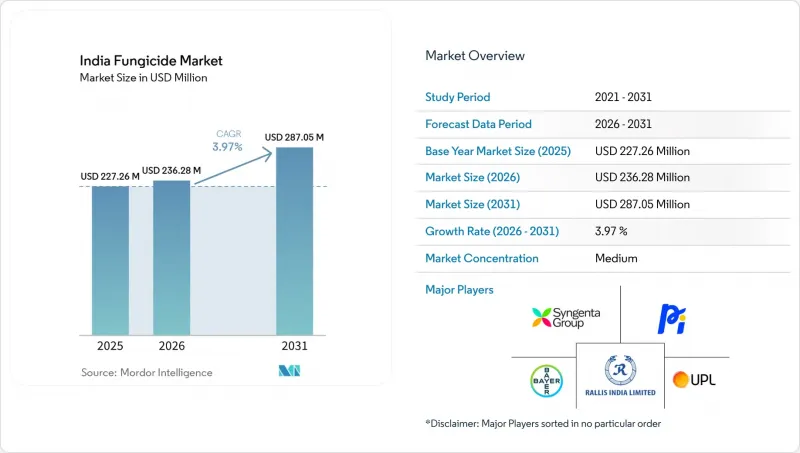
According to Mordor Intelligence, the India fungicide market size was valued at USD 227.26 million in 2025 and is forecast to grow from USD 236.28 million in 2026 to USD 287.05 million by 2031, at a CAGR of 3.97% from 2026 to 2031.
India Fungicide Market Trends and Insights
Climate-Driven Fungal Disease Pressure
India's diverse growing conditions expose crops to several fungal diseases across regions. Rice blast affects eastern and southern production areas, while wheat rust remains a concern in northern farming belts. Downy mildew creates recurring disease-management needs in Maharashtra's grape-growing areas. Horticulture output reached 370.9 million metric tons in 2025-26, compared with 370.7 million metric tons in 2024-25, highlighting the scale of crop production exposed to variable growing conditions. Increasing variability in temperature, humidity, and rainfall can alter disease development and expand disease pressure into crops or regions that previously faced lower risk. As a result, the India fungicide market sees demand for combination products that address more than one pathogen risk within a crop cycle.
Growing Adoption of Registered and Branded Fungicide Formulations
Registered and labeled fungicide formulations are gaining relevance as dealer networks deepen across key agricultural states. Increasing farmer awareness of product quality, dosage consistency, and crop-specific recommendations is reducing reliance on unbranded or locally blended products. A 2025 study published in Archives of Current Research International, covering 180 cumin farmers in Gujarat, identified brand image, agro-service-center recommendations, and product performance as key factors influencing fungicide purchase decisions. Field demonstrations and farmer engagement further support adoption by improving awareness of disease identification and appropriate fungicide use. This shift favors established manufacturers that can provide consistent product quality alongside agronomic guidance and reliable distribution. As a result, the India fungicide market is increasingly supported by the transition toward registered, branded formulations, particularly in commercially intensive crop-growing regions.
Other drivers and restraints analyzed in the detailed report include:
- Growth of High-Value Horticulture and Export Crops
- Increasing Adoption of Preventive Fungicide Programs
- Resistance to Azoles and Site-Specific Fungicides
- Residue Compliance and Product Registration Burden
For complete list of drivers and restraints, kindly check the Table Of Contents.
Segment Analysis
Foliar application accounted for 60.4% of the India fungicide market share in 2025 and is forecast to grow at a CAGR of 4.1% from 2026 to 2031. This application mode remains the primary disease-management method across major crops, including rice, wheat, grapes, and vegetables, due to its ability to provide direct canopy coverage. The adoption of precision spraying technologies, including agricultural drones, is also improving application efficiency in regions facing labor shortages and field-access constraints.
Seed treatment is gaining importance in pulses and oilseeds, where fungicidal treatment can protect seeds and emerging plants from soil- and seed-borne diseases. In August 2026, the Registration Committee approved Fluxapyroxad 333 g/L FS from Seedlings India Private Limited for use across sorghum, soybean, cotton, groundnut, and potato, supporting the expansion of registered seed-treatment solutions in India. Chemigation remains concentrated in drip-irrigated pomegranate orchards in Maharashtra and vegetable farms in Himachal Pradesh, where precision delivery can limit active-ingredient waste in these higher-spending crop systems. Fumigation remains concentrated in mushroom houses and nursery operations. Soil treatment has a smaller but growing role in intensive vegetable areas of the Deccan plateau.
Complete Report Scope:
- By Application Mode
- Chemigation
- Foliar
- Fumigation
- Seed Treatment
- Soil Treatment
- By Crop Type
- Commercial Crops
- Fruits and Vegetables
- Grains and Cereals
- Pulses and Oilseeds
- Turf and Ornamental
List of Companies Covered in this Report:
- BASF SE
- Bayer AG
- Bharat Certis AgriScience Ltd. (Mitsui & Co., Ltd.)
- Best Agrolife Limited
- Corteva Agriscience
- Dhanuka Agritech Limited
- FMC Corporation
- Gharda Chemicals Limited
- Godrej Agrovet Limited
- Indofil Industries Limited
- PI Industries Limited
- Rallis India Limited (Tata Chemicals Limited)
- Sumitomo Chemical Co., Ltd.
- Syngenta Group
- UPL Limited
Additional Benefits:
- The market estimate (ME) sheet in Excel format
- 3 months of analyst support
TABLE OF CONTENTS
1 INTRODUCTION
- 1.1 Study Assumptions and Market Definition
- 1.2 Scope of the Study
2 RESEARCH METHODOLOGY
3 EXECUTIVE SUMMARY
4 MARKET LANDSCAPE
- 4.1 Market Overview
- 4.2 Market Drivers
- 4.2.1 Climate-Driven Fungal Disease Pressure
- 4.2.2 Growing adoption of registered and branded fungicide formulations
- 4.2.3 Growth of High-Value Horticulture and Export Crops
- 4.2.4 Increasing adoption of preventive fungicide programs
- 4.2.5 Drone Spraying and Application-Window Compression
- 4.2.6 Local formulation and export manufacturing economies
- 4.3 Market Restraints
- 4.3.1 Resistance to Azoles and Site-Specific Fungicides
- 4.3.2 Residue Compliance and Product Registration Burden
- 4.3.3 Smallholder Cash-Flow and Weather-Linked Purchase Volatility
- 4.3.4 Counterfeit and Unregistered Product Leakage
- 4.4 Regulatory Landscape
- 4.5 Technological Outlook
- 4.6 Porter's Five Forces Analysis
- 4.6.1 Threat of New Entrants
- 4.6.2 Bargaining Power of Suppliers
- 4.6.3 Bargaining Power of Buyers
- 4.6.4 Threat of Substitutes
- 4.6.5 Competitive Rivalry
5 MARKET SIZE AND GROWTH FORECASTS (VALUE AND VOLUME)
- 5.1 By Application Mode
- 5.1.1 Chemigation
- 5.1.2 Foliar
- 5.1.3 Fumigation
- 5.1.4 Seed Treatment
- 5.1.5 Soil Treatment
- 5.2 By Crop Type
- 5.2.1 Commercial Crops
- 5.2.2 Fruits and Vegetables
- 5.2.3 Grains and Cereals
- 5.2.4 Pulses and Oilseeds
- 5.2.5 Turf and Ornamental
6 COMPETITIVE LANDSCAPE
- 6.1 Market Concentration
- 6.2 Strategic Moves
- 6.3 Market Share Analysis
- 6.4 Company Profiles (Includes Global Level Overview, Market Level Overview, Core Segments, Financials as Available, Strategic Information, Market Rank/Share, Products and Services, Recent Developments)
- 6.4.1 BASF SE
- 6.4.2 Bayer AG
- 6.4.3 Bharat Certis AgriScience Ltd. (Mitsui & Co., Ltd.)
- 6.4.4 Best Agrolife Limited
- 6.4.5 Corteva Agriscience
- 6.4.6 Dhanuka Agritech Limited
- 6.4.7 FMC Corporation
- 6.4.8 Gharda Chemicals Limited
- 6.4.9 Godrej Agrovet Limited
- 6.4.10 Indofil Industries Limited
- 6.4.11 PI Industries Limited
- 6.4.12 Rallis India Limited (Tata Chemicals Limited)
- 6.4.13 Sumitomo Chemical Co., Ltd.
- 6.4.14 Syngenta Group
- 6.4.15 UPL Limited
7 KEY STRATEGIC QUESTIONS FOR CROP PROTECTION CHEMICALS CEOS

