PUBLISHER: Mordor Intelligence | PRODUCT CODE: 2154220

PUBLISHER: Mordor Intelligence | PRODUCT CODE: 2154220
Sugar Confectionery - Market Share Analysis, Industry Trends & Statistics, Growth Forecasts (2026 - 2031)
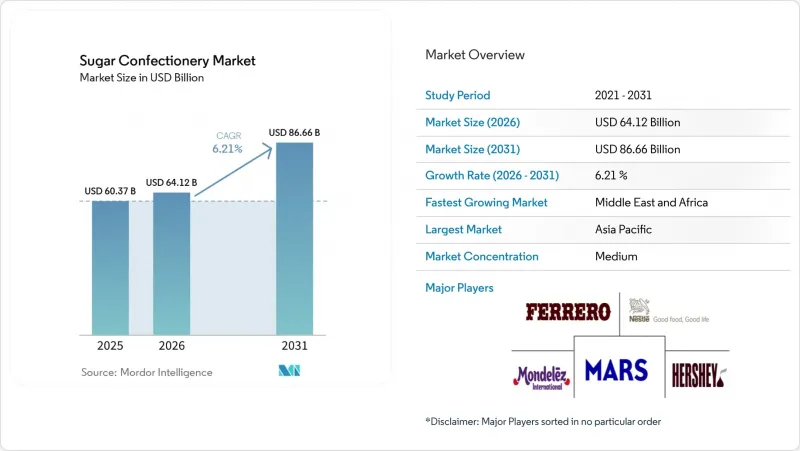
According to Mordor Intelligence, the sugar confectionery market stood at USD 60.37 billion in 2025 and is projected to reach USD 64.12 billion by 2026, further growing to USD 86.66 billion by 2031, registering a CAGR of 6.21%.
Global Sugar Confectionery Market Trends and Insights
Product innovation and flavor diversification
Product innovation and flavor diversification are significant drivers of the global sugar confectionery market. Brands are increasingly focusing on introducing new taste experiences, unique formats, and novelty-driven launches to sustain consumer engagement and encourage repeat purchases. Confectionery consumption is heavily influenced by impulse buying and emotional indulgence, making frequent innovation essential for maintaining visibility on crowded shelves, refreshing brand relevance, and attracting younger consumers who seek bold flavors and experiential candy formats. Flavor diversification also supports premiumization by making products appear more unique and suitable for gifting, while enabling manufacturers to expand consumption occasions beyond traditional snacking. For example, in July 2025, Neuro Gum launched a Strawberry Cake-flavored mint, showcasing how brands are incorporating indulgent dessert-style flavor concepts with benefit-oriented positioning to stand out in the market. Each mint contains 20 mg of natural caffeine, L-theanine to reduce jitters, and essential B vitamins, illustrating how innovation now extends beyond taste to combine sensory appeal with functional benefits.
Growing urbanization and on-the-go consumption
Urbanization and on-the-go consumption are significant drivers of the sugar confectionery market. Urban lifestyles increasingly prioritize portable, convenient, and instantly consumable products that align with fast-paced routines. In densely populated cities, factors such as frequent commuting, extended working hours, and a greater reliance on convenience-driven shopping contribute to the growing demand for sugar confectionery. These products serve as quick snacks, mood enhancers, or impulse purchases. Additionally, urban retail environments provide greater access to high-traffic purchase points, including convenience stores, transit outlets, and checkout counters, where sugar confectionery benefits from low decision-making time and affordability. For example, data from the National Bureau of Statistics of China indicates that approximately 67.9% of China's population was urban in 2025, underscoring the impact of urbanization on consumption patterns . As urbanization intensifies, there is a rising demand for confectionery products that are easy to carry, consume discreetly, and purchase quickly during short shopping trips.
Rising health concerns over high sugar consumption
Health concerns related to high sugar consumption continue to be a significant restraint for the sugar confectionery market. Consumers are increasingly aware of the link between excessive sugar intake and health issues such as weight gain, diabetes, and metabolic disorders. This heightened health consciousness is leading to a decline in discretionary candy consumption, particularly among adults who are actively reducing sugar in their daily diets. Furthermore, sugar confectionery is facing growing scrutiny from parents, who are more inclined to limit candy purchases for children and opt for healthier snack alternatives. The shift in consumer preferences is also driven by the rising availability of better-for-you options, which are perceived as healthier and more suitable for regular consumption. As a result, traditional sugar-rich products are experiencing demand challenges in regular consumption scenarios, prompting brands in the candy market to focus on portion-controlled formats, product reformulation, and functional positioning to remain relevant
Other drivers and restraints analyzed in the detailed report include:
- Expanding gifting culture and seasonal consumption occasions
- Shift toward sustainable and eco-friendly packaging
- Volatility in raw material prices
For complete list of drivers and restraints, kindly check the Table Of Contents.
Segment Analysis
Pastilles, gummies, and jellies accounted for a 39.06% share of the sugar confectionery market in 2025, driven by their alignment with key consumption behaviors such as repeat snacking, sensory-driven choices, and impulse-led purchases. Gummies and jellies provide an engaging consumption experience through their soft texture, chew satisfaction, and playful formats, making them appealing to a broad demographic, particularly children, teens, and young adults. Their market dominance is further supported by the segment's ability to offer a wide variety of options within the same product type, including fruit-based flavors, sour variants, dual-texture formats, filled centers, and novelty shapes, which encourage frequent trials and repeat purchases.
The mint segment is projected to grow at a 6.55% CAGR from 2026 to 2031, as mints are increasingly positioned as a functional, everyday-use confectionery rather than an occasional indulgence. This positioning enhances their repeat purchase potential compared to traditional sugar candies. Mints are closely associated with breath freshness, confidence, and personal hygiene routines, making them relevant to a diverse consumer base, including working professionals, travelers, students, and socially active individuals. This perception of daily utility supports frequent consumption across various occasions, such as after meals, during commutes, between meetings, and after beverages. As a result, the mint segment benefits from high consumption frequency and strong basket add-on behavior.
Complete Report Scope:
- By Product Type
- Hard Candy
- Mints
- Power Mints
- Standard Mints
- Pastilles, Gummies, and Jellies
- Toffees and Nougats
- Lollipops
- Others
- By Functional Benefit
- Novelty
- Fortified
- Digestive / Botanicals
- Others
- By Distribution Channel
- Supermarkets/Hypermarkets
- Online Retail Stores
- Convenience Stores
- Other Distribution Channels
- By Geography
- North America
- United States
- Canada
- Mexico
- Rest of North America
- Europe
- Germany
- United Kingdom
- Italy
- France
- Spain
- Netherlands
- Poland
- Belgium
- Sweden
- Rest of Europe
- Asia-Pacific
- China
- India
- Japan
- Australia
- Indonesia
- South Korea
- Thailand
- Singapore
- Rest of Asia-Pacific
- South America
- Brazil
- Argentina
- Colombia
- Chile
- Peru
- Rest of South America
- Middle East and Africa
- South Africa
- Saudi Arabia
- United Arab Emirates
- Nigeria
- Egypt
- Morocco
- Turkey
- Rest of Middle East and Africa
- North America
Geography Analysis
In 2025, Asia-Pacific accounted for 40.16% of the sugar confectionery market share, making it the largest regional contributor. This dominance is supported by a rapidly evolving consumer base and strong everyday consumption habits. The region's growth is primarily driven by China and India, where urban lifestyles and expanding modern retail ecosystems are increasing the frequency of on-the-go snacking and impulse purchases. Urbanization is influencing shopping behavior through greater exposure to convenience stores, supermarkets, and quick-commerce platforms. This trend is boosting demand for portable formats such as gummies, jellies, and novelty candies that cater to busy routines and family consumption occasions. Additionally, rising youth-driven demand for bold flavors, interactive formats, and seasonal novelty packs is reinforcing the region's leadership, driving product rotation and supporting both volume growth and new product adoption in metropolitan and semi-urban markets.
The Middle East and Africa are projected to grow at a 7.11% CAGR during 2026-2031, supported by strong cultural consumption patterns and the region's gifting traditions, where confectionery plays a central role in hospitality and celebrations. Rising tourism activity is further boosting sugar confectionery demand, particularly through travel hubs, convenience retail, and souvenir-driven purchases, with a focus on premium and gift-friendly formats. For example, according to UN Tourism, the Middle East recorded 3% growth in 2025, which increased footfall and retail activity, lifting confectionery sales across airports, entertainment zones, and urban shopping centers . With gifting-led demand, expanding modern trade, and tourism-linked impulse buying, the region is positioned as one of the fastest-growing markets for sugar confectionery.
Europe and North America represent mature markets where volume growth has largely plateaued. As a result, growth strategies in these regions are centered on premiumization, innovation, and portfolio diversification to sustain revenue. Manufacturers are focusing on differentiated novelty formats, sugar-reduced options, and premium giftable assortments to maintain consumer interest. Seasonal demand peaks and brand-led experiences are also being leveraged to drive value growth in these markets. South America exhibits heterogeneous growth, influenced by uneven retail development and varying consumer preferences across countries. Traditional sugar confectionery remains resilient in some markets, while modern formats and premium products are experiencing faster growth in urban centers. This diversity in consumer behavior and retail infrastructure shapes the region's growth trajectory.
- Mars, Incorporated
- Mondelez International, Inc.
- Nestle S.A.
- Ferrero International SpA
- The Hershey Company
- Haribo GmbH & Co. KG
- Perfetti Van Melle Holding B.V.
- Meiji Holdings Co. Ltd.
- Arcor S.A.I.C.
- August Storck KG
- Cloetta AB
- Oy Karl Fazer Ab
- Mount Franklin Foods LLC
- Tootsie Roll Industries
- Lotte Confectionery
- Roshen Confectionery
- Orkla ASA
- United Confectioners JSC
- Yildiz Holding (Ulker)
- Grupo Bimbo (Ricolino)
Additional Benefits:
- The market estimate (ME) sheet in Excel format
- 3 months of analyst support
TABLE OF CONTENTS
1 INTRODUCTION
- 1.1 Study Assumptions and Market Definition
- 1.2 Scope of the Study
2 RESEARCH METHODOLOGY
3 EXECUTIVE SUMMARY
4 MARKET LANDSCAPE
- 4.1 Market Overview
- 4.2 Market Drivers
- 4.2.1 Product innovation and flavor diversification
- 4.2.2 Growing urbanization and on-the-go consumption
- 4.2.3 Expanding gifting culture and seasonal consumption occasions
- 4.2.4 Shift toward sustainable and eco-friendly packaging
- 4.2.5 Strong brand and social media influence
- 4.2.6 Rising demand for premium and artisanal products
- 4.3 Market Restraints
- 4.3.1 Rising health concerns over high sugar consumption
- 4.3.2 Volatility in raw material prices
- 4.3.3 Competition from healthier alternatives and substitutes
- 4.3.4 Strong competitive intensity and brand saturation
- 4.4 Consumer Behaviour Analysis
- 4.5 Regulatory Landscape
- 4.6 Porter's Five Forces Analysis
- 4.6.1 Threat of New Entrants
- 4.6.2 Bargaining Power of Buyers
- 4.6.3 Bargaining Power of Suppliers
- 4.6.4 Threat of Substitutes
- 4.6.5 Intensity of Competitive Rivalry
5 MARKET SIZE AND GROWTH FORECASTS (VALUE AND VOLUME)
- 5.1 By Product Type
- 5.1.1 Hard Candy
- 5.1.2 Mints
- 5.1.2.1 Power Mints
- 5.1.2.2 Standard Mints
- 5.1.3 Pastilles, Gummies, and Jellies
- 5.1.4 Toffees and Nougats
- 5.1.5 Lollipops
- 5.1.6 Others
- 5.2 By Functional Benefit
- 5.2.1 Novelty
- 5.2.2 Fortified
- 5.2.3 Digestive / Botanicals
- 5.2.4 Others
- 5.3 By Distribution Channel
- 5.3.1 Supermarkets/Hypermarkets
- 5.3.2 Online Retail Stores
- 5.3.3 Convenience Stores
- 5.3.4 Other Distribution Channels
- 5.4 By Geography
- 5.4.1 North America
- 5.4.1.1 United States
- 5.4.1.2 Canada
- 5.4.1.3 Mexico
- 5.4.1.4 Rest of North America
- 5.4.2 Europe
- 5.4.2.1 Germany
- 5.4.2.2 United Kingdom
- 5.4.2.3 Italy
- 5.4.2.4 France
- 5.4.2.5 Spain
- 5.4.2.6 Netherlands
- 5.4.2.7 Poland
- 5.4.2.8 Belgium
- 5.4.2.9 Sweden
- 5.4.2.10 Rest of Europe
- 5.4.3 Asia-Pacific
- 5.4.3.1 China
- 5.4.3.2 India
- 5.4.3.3 Japan
- 5.4.3.4 Australia
- 5.4.3.5 Indonesia
- 5.4.3.6 South Korea
- 5.4.3.7 Thailand
- 5.4.3.8 Singapore
- 5.4.3.9 Rest of Asia-Pacific
- 5.4.4 South America
- 5.4.4.1 Brazil
- 5.4.4.2 Argentina
- 5.4.4.3 Colombia
- 5.4.4.4 Chile
- 5.4.4.5 Peru
- 5.4.4.6 Rest of South America
- 5.4.5 Middle East and Africa
- 5.4.5.1 South Africa
- 5.4.5.2 Saudi Arabia
- 5.4.5.3 United Arab Emirates
- 5.4.5.4 Nigeria
- 5.4.5.5 Egypt
- 5.4.5.6 Morocco
- 5.4.5.7 Turkey
- 5.4.5.8 Rest of Middle East and Africa
- 5.4.1 North America
6 COMPETITIVE LANDSCAPE
- 6.1 Market Concentration
- 6.2 Strategic Moves
- 6.3 Market Share Analysis
- 6.4 Company Profiles (includes Global level Overview, Market level overview, Core Segments, Financials as available, Strategic Information, Market Rank/Share for key companies, Products and Services, and Recent Developments)
- 6.4.1 Mars, Incorporated
- 6.4.2 Mondelez International, Inc.
- 6.4.3 Nestle S.A.
- 6.4.4 Ferrero International SpA
- 6.4.5 The Hershey Company
- 6.4.6 Haribo GmbH & Co. KG
- 6.4.7 Perfetti Van Melle Holding B.V.
- 6.4.8 Meiji Holdings Co. Ltd.
- 6.4.9 Arcor S.A.I.C.
- 6.4.10 August Storck KG
- 6.4.11 Cloetta AB
- 6.4.12 Oy Karl Fazer Ab
- 6.4.13 Mount Franklin Foods LLC
- 6.4.14 Tootsie Roll Industries
- 6.4.15 Lotte Confectionery
- 6.4.16 Roshen Confectionery
- 6.4.17 Orkla ASA
- 6.4.18 United Confectioners JSC
- 6.4.19 Yildiz Holding (Ulker)
- 6.4.20 Grupo Bimbo (Ricolino)
7 MARKET OPPORTUNITIES AND FUTURE OUTLOOK

