PUBLISHER: Mordor Intelligence | PRODUCT CODE: 2154222

PUBLISHER: Mordor Intelligence | PRODUCT CODE: 2154222
E-Rickshaw Battery - Market Share Analysis, Industry Trends & Statistics, Growth Forecasts (2026 - 2031)
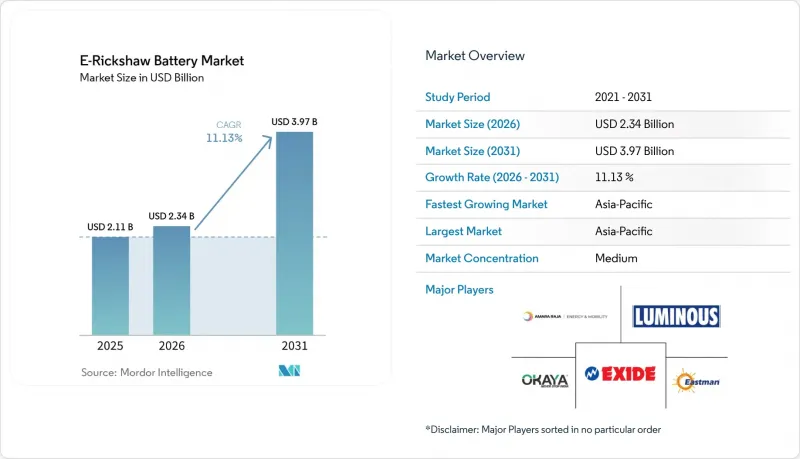
According to Mordor Intelligence, the e-rickshaw battery market size is projected to be USD 2.11 billion in 2025, USD 2.34 billion in 2026, and reach USD 3.97 billion by 2031, at a CAGR of 11.1% from 2026 to 2031.
Global E-Rickshaw Battery Market Trends and Insights
Government Incentives for Electric Three-Wheeler Adoption
India's PM E-DRIVE scheme extends purchase incentives for e-rickshaws and e-carts through March 2028. The scheme provides a per-vehicle cap of INR 25,000, equivalent to USD 300, and gives e-rickshaws a longer incentive window than electric two-wheelers. This support helps maintain vehicle demand and supports battery purchases in the E-rickshaw battery market. The 2025 allocation revision shifted INR 1.42 billion, equivalent to USD 16 million, from e-rickshaws and e-carts toward L5 commercial three-wheelers. The change reduces support for basic units while favoring vehicles that require batteries with greater capacity. Bangladesh's draft Electric Three-Wheeler Management Policy 2025 proposes registration requirements and BSTI-approved battery components for more than 2 million electric three-wheelers. If implemented, the policy could shift demand from informal packs to certified products and raise compliance requirements for suppliers.
Lower Total Cost of Ownership Than ICE Rickshaws
Lower running costs support the E-rickshaw battery market because operators can recover a larger initial battery investment through daily savings. Fleet operators in Delhi reported lithium-ion e-rickshaw payback periods of 18 to 24 months during 2025. Battery-as-a-Service arrangements separate battery ownership from vehicle ownership and reduce the immediate importance of pack price. Battery Smart reported FY25 revenue of INR 279 crore, with 49% year-over-year growth, indicating that swapping services can support an operating model built around repeated battery use. These models encourage decisions based on operating cost and battery availability rather than the purchase price alone. This gives the E-rickshaw battery market a route to adoption that does not depend on driver ownership of a battery.
Limited Charging and Swapping Coverage Outside Major Cities
India's swapping network has attracted more than USD 325 million in disclosed investment, but stations remain concentrated in large cities. Government estimates indicated a need for 26,000 swapping kiosks by the end of FY2026 and 111,000 by FY2030. The cited operating base was only 2,600 registered kiosks, leaving many rural and semi-urban operators dependent on conventional charging. This infrastructure gap limits vehicle availability and can force charging through unauthorized connections. Northeast India accounted for 1% of India's charging infrastructure in 2025 despite notable e-rickshaw use in Assam. The uneven network creates downtime risk for operators, even where electric vehicle operating economics remain favorable. It also limits the E-rickshaw battery market in locations where vehicle demand exists but dependable charging does not.
Other drivers and restraints analyzed in the detailed report include:
- Lithium-Ion Cost Declines and LFP Commercialization
- Last-Mile Delivery, Swapping Networks, and Fleet Electrification
- High Upfront Cost of Lithium-Ion Packs
For complete list of drivers and restraints, kindly check the Table Of Contents.
Segment Analysis
Lead-acid batteries held 63.1% of the E-rickshaw battery market share in 2025, supported by low purchase cost and extensive aftermarket availability. Their INR 8,000 to INR 15,000 price range remains accessible for drivers in India, Bangladesh, and Nepal. Mechanics across rural and semi-urban routes are familiar with lead-acid maintenance, which further supports their continued use. This chemistry also has a large installed base that produces recurring replacement demand. The E-rickshaw battery industry still relies on this replacement cycle because lead-acid packs often remain in commercial use for only 12 to 18 months. However, repeated replacements can make lifetime spending higher than the initial price suggests. Delhi's requirement for lithium-ion batteries in registered e-rickshaws and advisory guidance on AIS-189 and AIS-190 standards can narrow the space for noncompliant packs. Nickel-metal hydride and early solid-state batteries remain marginal options, while LFP is absorbing more of the addressable use case.
Lithium-ion batteries are forecast to grow at a 16.3% CAGR from 2026 to 2031, making them the fastest-growing battery type. Longer life, greater usable range, and better suitability for repeated charging support their adoption in commercial fleets. LFP batteries are especially relevant for e-rickshaws because they offer thermal stability and do not rely on cobalt. The E-rickshaw battery industry is also shaped by swapping platforms that choose the chemistry on behalf of individual drivers. That arrangement can overcome financing limits that delay upgrades among owner-operators. Exide's planned local cell output can support a more domestic supply chain for three-wheeler battery packs. Battery management systems and certified charging practices become more important as lithium-ion use increases. The shift does not remove lead-acid demand immediately because price-sensitive users still require affordable replacement options.
Complete Report Scope:
- By Battery Type
- Lead Acid Battery
- Lithium-Ion Battery
- Other Battery Types
- By Vehicle Type
- Passenger E-Rickshaw
- Cargo E-Rickshaw
- By Geography
- North America
- United States
- Canada
- Mexico
- Europe
- Germany
- France
- Italy
- Turkey
- Rest of Europe
- Asia-Pacific
- China
- India
- Bangladesh
- Indonesia
- Vietnam
- Thailand
- Rest of Asia-Pacific
- South America
- Brazil
- Argentina
- Chile
- Rest of South America
- Middle East and Africa
- Saudi Arabia
- United Arab Emirates
- Egypt
- South Africa
- Morocco
- Rest of Middle East and Africa
- North America
Geography Analysis
Asia-Pacific held 55.3% of the E-rickshaw battery market size in 2025 and is forecast to expand at a 15.3% CAGR from 2026 to 2031. India anchors regional demand through a large passenger e-rickshaw base and growing commercial three-wheeler use. E-rickshaws accounted for 8% of all Indian motor vehicle registrations in FY2025 to FY2026. Demand is concentrated in Uttar Pradesh, Bihar, West Bengal, Assam, and Delhi. PM E-DRIVE incentives support e-rickshaws and e-carts through March 2028 and help preserve demand for certified battery systems. Bangladesh had more than 2 million electric three-wheelers in 2025, most of which were unregistered. Its proposed registration and battery approval requirements could bring a significant informal battery base into formal supply channels.
China is both a source of battery cells and an important micro-electric vehicle ecosystem for the E-rickshaw battery market. Regional pack integrators use LFP cells from Chinese producers, including CATL and BYD. This supply position sets a competitive cost benchmark for battery manufacturers in India and neighboring countries. Vietnam, Indonesia, and Thailand are earlier-stage locations where cargo trikes are being introduced into FMCG distribution routes. These applications favor multi-cycle lithium-ion packs that can meet organized fleet requirements. India's swapping network has the most visible scale in the region, but its urban concentration limits the benefit for many smaller towns. The region's demand will continue to depend on the balance between affordable lead-acid replacement products and reliable lithium-ion infrastructure. That balance will shape the E-rickshaw battery market across both established and emerging regional corridors.
North America and Europe represent smaller demand pockets for the E-rickshaw battery market. In North America, use is concentrated in tourism corridors, university campuses, and urban micro-mobility trials. These applications commonly require lithium batteries because operators value range and reduced maintenance. European zero-emission freight zones have created a role for cargo trikes in last-mile delivery. Specifications often require certifications such as IEC 62133, which can raise the quality threshold for imported battery components. South America and the Middle East and Africa remain frontier regions for electric three-wheelers. Sun Mobility raised USD 135 million in 2025 to expand swapping networks in Africa and Southeast Asia, including activity in Kenya. Brazil, Argentina, Egypt, Morocco, and South Africa are exploring use cases in urban logistics or informal transit. Grid reliability, charging standards, and battery finance remain practical constraints in these markets.
- Exide Industries Ltd
- Amara Raja Energy & Mobility Limited
- Eastman Auto & Power Ltd
- Okaya Power Private Limited
- TATA AutoComp GY Batteries Pvt. Ltd.
- Luminous Power Technologies Pvt. Ltd.
- Livguard Energy Technologies Pvt. Ltd.
- HBL Power Systems Ltd.
- Microtex Energy Private Limited
- Sparco Batteries Pvt. Ltd.
- Gem Batteries Pvt. Ltd.
- Trontek Electronics Pvt. Ltd.
- Relicell Battery Pvt. Ltd.
- Amco Saft India Pvt. Ltd.
- Exicom Tele-Systems Ltd.
- Greenvision Technologies Pvt. Ltd.
- Sun Mobility
- Battery Smart
- BYD Co. Ltd.
- Contemporary Amperex Technology Co. Limited
Additional Benefits:
- The market estimate (ME) sheet in Excel format
- 3 months of analyst support
TABLE OF CONTENTS
1 INTRODUCTION
- 1.1 Study Assumptions and Market Definition
- 1.2 Scope of the Study
2 RESEARCH METHODOLOGY
3 EXECUTIVE SUMMARY
4 MARKET LANDSCAPE
- 4.1 Market Overview
- 4.2 Market Drivers
- 4.2.1 Government Incentives for Electric Three-Wheeler Adoption
- 4.2.2 Lower Total Cost of Ownership Than ICE Rickshaws
- 4.2.3 Lithium-Ion Cost Declines and LFP Commercialization
- 4.2.4 Last-Mile Delivery and Fleet Electrification
- 4.2.5 Battery-Swapping Networks Increasing Vehicle Utilization
- 4.2.6 Replacement Demand From Short Lead-Acid Battery Lifecycles
- 4.3 Market Restraints
- 4.3.1 Limited Charging and Swapping Coverage Outside Major Cities
- 4.3.2 High Upfront Cost of Lithium-Ion Packs
- 4.3.3 Battery-Swapping Interoperability Gaps
- 4.3.4 Informal Aftermarket Batteries and Thermal-Safety Risks
- 4.4 Supply-Chain Analysis
- 4.5 Porter's Five Forces Analysis
- 4.5.1 Bargaining Power of Suppliers
- 4.5.2 Bargaining Power of Buyers
- 4.5.3 Threat of New Entrants
- 4.5.4 Threat of Substitutes
- 4.5.5 Competitive Rivalry
- 4.6 Technology Outlook
- 4.7 Regulatory Landscape
- 4.8 Investment Analysis
5 MARKET SIZE AND GROWTH FORECASTS
- 5.1 By Battery Type
- 5.1.1 Lead Acid Battery
- 5.1.2 Lithium-Ion Battery
- 5.1.3 Other Battery Types
- 5.2 By Vehicle Type
- 5.2.1 Passenger E-Rickshaw
- 5.2.2 Cargo E-Rickshaw
- 5.3 By Geography
- 5.3.1 North America
- 5.3.1.1 United States
- 5.3.1.2 Canada
- 5.3.1.3 Mexico
- 5.3.2 Europe
- 5.3.2.1 Germany
- 5.3.2.2 France
- 5.3.2.3 Italy
- 5.3.2.4 Turkey
- 5.3.2.5 Rest of Europe
- 5.3.3 Asia-Pacific
- 5.3.3.1 China
- 5.3.3.2 India
- 5.3.3.3 Bangladesh
- 5.3.3.4 Indonesia
- 5.3.3.5 Vietnam
- 5.3.3.6 Thailand
- 5.3.3.7 Rest of Asia-Pacific
- 5.3.4 South America
- 5.3.4.1 Brazil
- 5.3.4.2 Argentina
- 5.3.4.3 Chile
- 5.3.4.4 Rest of South America
- 5.3.5 Middle East and Africa
- 5.3.5.1 Saudi Arabia
- 5.3.5.2 United Arab Emirates
- 5.3.5.3 Egypt
- 5.3.5.4 South Africa
- 5.3.5.5 Morocco
- 5.3.5.6 Rest of Middle East and Africa
- 5.3.1 North America
6 COMPETITIVE LANDSCAPE
- 6.1 Market Concentration
- 6.2 Strategic Moves
- 6.3 Market Share Analysis
- 6.4 Company Profiles (includes Global Level Overview, Market Level Overview, Core Segments, Financials as available, Strategic Information, Products and Services, Recent Developments)
- 6.4.1 Exide Industries Ltd
- 6.4.2 Amara Raja Energy & Mobility Limited
- 6.4.3 Eastman Auto & Power Ltd
- 6.4.4 Okaya Power Private Limited
- 6.4.5 TATA AutoComp GY Batteries Pvt. Ltd.
- 6.4.6 Luminous Power Technologies Pvt. Ltd.
- 6.4.7 Livguard Energy Technologies Pvt. Ltd.
- 6.4.8 HBL Power Systems Ltd.
- 6.4.9 Microtex Energy Private Limited
- 6.4.10 Sparco Batteries Pvt. Ltd.
- 6.4.11 Gem Batteries Pvt. Ltd.
- 6.4.12 Trontek Electronics Pvt. Ltd.
- 6.4.13 Relicell Battery Pvt. Ltd.
- 6.4.14 Amco Saft India Pvt. Ltd.
- 6.4.15 Exicom Tele-Systems Ltd.
- 6.4.16 Greenvision Technologies Pvt. Ltd.
- 6.4.17 Sun Mobility
- 6.4.18 Battery Smart
- 6.4.19 BYD Co. Ltd.
- 6.4.20 Contemporary Amperex Technology Co. Limited
7 MARKET OPPORTUNITIES AND FUTURE OUTLOOK
- 7.1 White-Space and Unmet-Need Assessment

