PUBLISHER: Mordor Intelligence | PRODUCT CODE: 2154226

PUBLISHER: Mordor Intelligence | PRODUCT CODE: 2154226
Pessary - Market Share Analysis, Industry Trends & Statistics, Growth Forecasts (2026 - 2031)
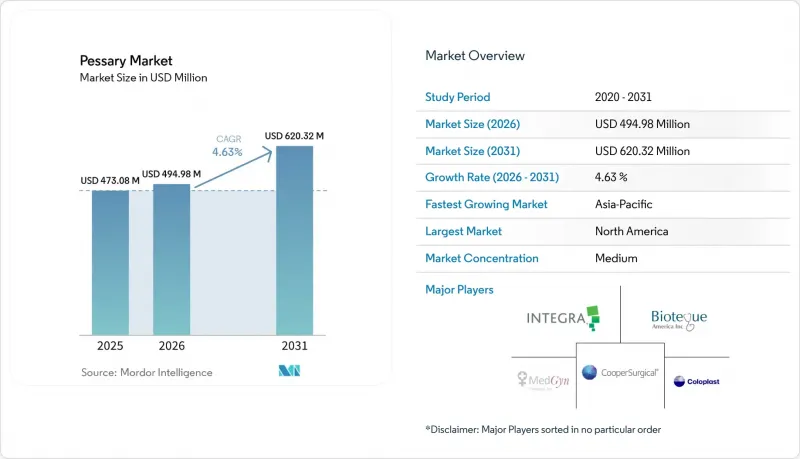
According to Mordor Intelligence, the pessary market size is expected to grow from USD 473.08 million in 2025 to USD 494.98 million in 2026 and is forecast to reach USD 620.32 million by 2031 at 4.63% CAGR over 2026-2031.
Global Pessary Market Trends and Insights
Growing Prevalence of POP & Urinary Incontinence
Pelvic organ prolapse (POP) cases are projected to climb 46% by 2050, with the steepest gains in women aged 70-79. Quality-of-life studies show 56% of affected women experience incontinence and 52% develop prolapse, highlighting unmet need. Annual U.S. surgical costs already top USD 1.523 billion, heightening payer interest in non-surgical alternatives. Eighty-two percent of prolapse surgeries now occur in ambulatory centers, settings that readily integrate pessary fitting. These clinical and economic facts underpin steady demand for conservative therapy, strengthening the long-term foundation of the pessary market. Source: Taryn Hall, "Pelvic Floor Disorder Symptom Burden Survey," Frontiers in Public Health, frontiersin.org
Shift Toward Non-Surgical Outpatient Management
Prospective studies record 40% symptom relief in voiding, 38% drop in urgency, and 29% reduction in urge incontinence among pessary users. The American Urogynecologic Society's 2024 consensus formalized care pathways, addressing earlier guideline gaps. Ergonomic upgrades such as collapsible rings cut insertion pain and support self-care. Tele-urogynecology platforms now permit remote prescribing, with follow-up protocols embedded in software workflows. Reimbursement recognition through HCPCS coding further validates outpatient conservative management as both clinically and economically viable.
Patient Discomfort, Complications & Fear
Recent multicenter work notes a 21% complication incidence; expulsion makes up 40.8%, and pain 26.6% of those events. Surgical resolution becomes necessary in 34.2% of complex cases, shaping clinicians' caution. Up to 30% of eligible women decline a trial due to anxiety over discomfort or dislodgment. Anatomical constraints, vaginal length under 7.5 cm, predict discontinuation yet require specialized assessment tools not ubiquitous in primary care. Cultural taboos further dampen uptake in certain geographies. Although collapsible and customized devices mitigate many issues, price and practitioner familiarization lag behind technical possibilities.
Other drivers and restraints analyzed in the detailed report include:
- Rising Awareness & Women-Health Initiatives
- Advances in Medical-Grade Silicone & Ergonomic Design
- Limited Reimbursement Coverage
For complete list of drivers and restraints, kindly check the Table Of Contents.
Segment Analysis
Ring pessaries generated 45.98% of pessary market share in 2025, underscoring deep provider familiarity and broad indication coverage. Cube devices, however, are projected to outpace the broader pessary market at a 6.12% CAGR to 2031, favored for advanced prolapse scenarios. Gellhorn and donut variants fill specific anatomical niches, whereas emerging collapsible and 3D-printed models inhabit the technological frontier.
Custom manufacturing is redefining clinical protocols. Cosm Medical's FDA-cleared Gynethotics platform delivers anatomical imaging, AI-assisted design and in-clinic 3D printing, a process that trims trial-and-error timelines and improves fit. As printing costs fall and clinical data mount, ring dominance could erode. Yet ring designs still benefit from lowest unit cost and entrenched reimbursement coding, positioning them as baseline solutions even as personalization gains ground across the pessary market.
Medical-grade silicone retained 78.02% of the pessary market size in 2025 owing to unrivaled biocompatibility, tensile resilience, and sterilizability. Latex/rubber's 6.45% CAGR reflects health-system cost constraints and patient demand for lower-priced options in emerging regions. Thermoplastic elastomers offer recyclability advantages but remain niche. Bio-resorbable polymers and composite 3D-prints lie at the R&D horizon, melding sustainability with individualized geometry.
EU environmental scoring is compelling procurement teams to weigh carbon footprint and end-of-life disposal alongside clinical efficacy. Health systems that adopt lifecycle tenders could gradually divert volume toward greener materials. Nevertheless, silicone's legacy validation keeps regulatory hurdles low and adoption friction minimal, sustaining its near-term primacy within the pessary market.
Complete Report Scope:
- By Type
- Ring
- Gellhorn
- Donut
- Cube
- Other Types
- By Material
- Medical-grade Silicone
- Thermoplastic Elastomer
- Latex / Rubber
- Bio-resorbable & 3-D printed Composites
- By Application
- POP - Stage I-II
- POP - Stage III-IV
- Stress Urinary Incontinence
- Other Applications
- By End User
- Hospitals
- Ambulatory Surgical Centers & Uro-gyn Clinics
- Other End Users
- Geography
- North America
- United States
- Canada
- Mexico
- Europe
- Germany
- United Kingdom
- France
- Italy
- Spain
- Rest of Europe
- Asia-Pacific
- China
- Japan
- India
- Australia
- South Korea
- Rest of Asia-Pacific
- Middle East & Africa
- GCC
- South Africa
- Rest of Middle East & Africa
- South America
- Brazil
- Argentina
- Rest of South America
- North America
Geography Analysis
North America led the pessary market with a 38.11% revenue share in 2025, buoyed by widespread urogynecology networks, targeted women-health funding and clear FDA pathways. The U.S. government's USD 100 million research allocation is fostering clinical trials and provider training that feed demand. CooperSurgical's 2024 revenue reached USD 1.286 billion, proof that established players can still grow 10% by harnessing clinician relationships and reimbursement savvy. Insurer fee compression and coverage disparities pose lingering obstacles, yet telehealth's regulatory normalization broadens patient reach. Canada and Mexico add incremental upside through healthcare system modernization.
Asia-Pacific is forecast to outpace all regions at a 5.18% CAGR to 2031. Aging demographics in Japan and South Korea mirror Western trends, while China's middle-class expansion and hospital build-outs unlock volume potential. The region's medtech revenues could touch USD 225 billion by 2030, supplying favorable context for the pessary market. Regulatory heterogeneity and cultural stigma complicate rollout, but social-commerce integration and rising FemTech literacy are easing adoption. Private-equity investment and public infrastructure funding in 2024 fortified domestic supply chains, setting a foundation for sustained gains.
Europe's universal healthcare coverage and evidence-based practice culture support stable, mid-single-digit growth. EU MDR and IVDR quality thresholds elevate compliance costs yet protect incumbents with established QMS footprints. Sustainability directives press manufacturers toward biodegradable inputs and circular-economy packaging, potentially sparking material innovation. Market conditions in the Middle East & Africa and South America remain nascent but promising, dependent on infrastructure upgrades, clinician education and broadened payer coverage to unlock their share of the global pessary market.
- The Cooper Companies
- Coloplast
- MedGyn Products
- Bioteque America, Inc.
- Panpac Medical Corp.
- Dr. Arabin
- Artisan Medical (Milex)
- Personal Medical Corp.
- Cosm Medical
- Mediplus Ltd.
- Integra LifeSciences
- Bray Group Ltd.
- Thomas Medical
- Bliss GVS Pharma Ltd.
- Shanghai Medical Corp.
- Cook Group
- FEG Textiltechnik
- Pelican Feminine Healthcare
- Utah Medical Products
- SRS Medical
Additional Benefits:
- The market estimate (ME) sheet in Excel format
- 3 months of analyst support
TABLE OF CONTENTS
1 Introduction
- 1.1 Study Assumptions & Market Definition
- 1.2 Scope of the Study
2 Research Methodology
3 Executive Summary
4 Market Landscape
- 4.1 Market Overview
- 4.2 Market Drivers
- 4.2.1 Growing Prevalence of POP & Urinary Incontinence
- 4.2.2 Shift Toward Non-Surgical Outpatient Management
- 4.2.3 Rising Awareness & Women-Health Initiatives
- 4.2.4 Advances In Medical-Grade Silicone & Ergonomic Design
- 4.2.5 AI-Driven 3D-Printed Custom Pessaries
- 4.2.6 Tele-Urogynecology Enabling Remote Self-Management
- 4.3 Market Restraints
- 4.3.1 Patient Discomfort, Complications & Fear
- 4.3.2 Limited Reimbursement Coverage
- 4.3.3 Medical-Grade Silicone Supply Fragility
- 4.3.4 Sustainability Pressure on Single-Use Plastics
- 4.4 Regulatory Landscape
- 4.5 Porter's Five Forces Analysis
- 4.5.1 Threat of New Entrants
- 4.5.2 Bargaining Power of Buyers
- 4.5.3 Bargaining Power of Suppliers
- 4.5.4 Threat of Substitute Products
- 4.5.5 Intensity of Competitive Rivalry
- 4.6 Complication & Recall Analysis
5 Market Size & Growth Forecasts (Value, USD)
- 5.1 By Type
- 5.1.1 Ring
- 5.1.2 Gellhorn
- 5.1.3 Donut
- 5.1.4 Cube
- 5.1.5 Other Types
- 5.2 By Material
- 5.2.1 Medical-grade Silicone
- 5.2.2 Thermoplastic Elastomer
- 5.2.3 Latex / Rubber
- 5.2.4 Bio-resorbable & 3-D printed Composites
- 5.3 By Application
- 5.3.1 POP - Stage I-II
- 5.3.2 POP - Stage III-IV
- 5.3.3 Stress Urinary Incontinence
- 5.3.4 Other Applications
- 5.4 By End User
- 5.4.1 Hospitals
- 5.4.2 Ambulatory Surgical Centers & Uro-gyn Clinics
- 5.4.3 Other End Users
- 5.5 Geography
- 5.5.1 North America
- 5.5.1.1 United States
- 5.5.1.2 Canada
- 5.5.1.3 Mexico
- 5.5.2 Europe
- 5.5.2.1 Germany
- 5.5.2.2 United Kingdom
- 5.5.2.3 France
- 5.5.2.4 Italy
- 5.5.2.5 Spain
- 5.5.2.6 Rest of Europe
- 5.5.3 Asia-Pacific
- 5.5.3.1 China
- 5.5.3.2 Japan
- 5.5.3.3 India
- 5.5.3.4 Australia
- 5.5.3.5 South Korea
- 5.5.3.6 Rest of Asia-Pacific
- 5.5.4 Middle East & Africa
- 5.5.4.1 GCC
- 5.5.4.2 South Africa
- 5.5.4.3 Rest of Middle East & Africa
- 5.5.5 South America
- 5.5.5.1 Brazil
- 5.5.5.2 Argentina
- 5.5.5.3 Rest of South America
- 5.5.1 North America
6 Competitive Landscape
- 6.1 Market Concentration
- 6.2 Market Share Analysis
- 6.3 Company Profiles (includes Global level Overview, Market level overview, Core Business Segments, Financials, Headcount, Key Information, Market Rank, Market Share, Products and Services, and analysis of Recent Developments)
- 6.3.1 CooperSurgical Inc.
- 6.3.2 Coloplast A/S
- 6.3.3 MedGyn Products, Inc.
- 6.3.4 Bioteque America, Inc.
- 6.3.5 Panpac Medical Corp.
- 6.3.6 Dr. Arabin GmbH & Co. KG
- 6.3.7 Artisan Medical (Milex)
- 6.3.8 Personal Medical Corp.
- 6.3.9 Cosm Medical
- 6.3.10 Mediplus Ltd.
- 6.3.11 Integra LifeSciences
- 6.3.12 Bray Group Ltd.
- 6.3.13 Thomas Medical
- 6.3.14 Bliss GVS Pharma Ltd.
- 6.3.15 Shanghai Medical Corp.
- 6.3.16 Cook Medical
- 6.3.17 FEG Textiltechnik
- 6.3.18 Pelican Feminine Healthcare
- 6.3.19 Utah Medical Products
- 6.3.20 SRS Medical
7 Market Opportunities & Future Outlook
- 7.1 White-space & Unmet-need Assessment

