PUBLISHER: Mordor Intelligence | PRODUCT CODE: 2154232

PUBLISHER: Mordor Intelligence | PRODUCT CODE: 2154232
Europe Planting Machinery - Market Share Analysis, Industry Trends & Statistics, Growth Forecasts (2026 - 2031)
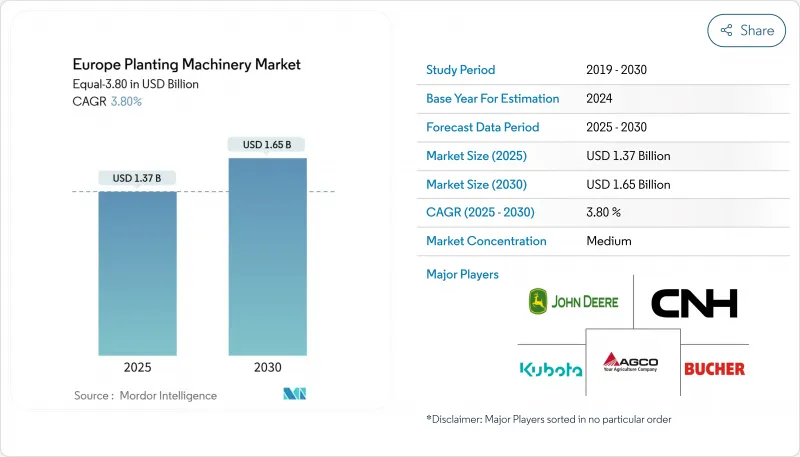
According to Mordor Intelligence, the Europe planting machinery market was valued at USD 1.37 billion in 2025 and is forecasted to grow from USD 1.42 billion in 2026 to USD 1.71 billion by 2031, at a CAGR of 3.79% during the forecast period 2026-2031.
Europe Planting Machinery Market Trends and Insights
European Union CAP Strategic Plans and national machinery grants
The Common Agricultural Policy (CAP) Strategic Plans for 2023-2027 support farm modernization through investment measures covering precision farming equipment and digital technologies. According to European Commission data in 2023, investment support under the approved CAP Strategic Plans was targeted to benefit close to 400,000 farms for modernization of infrastructure and practices. These measures strengthen the investment case for planting machinery with precision-control, data-capture, and input-management capabilities. As each European Union Member State implements its own CAP Strategic Plan according to national and regional priorities, the availability and design of machinery-support programs vary across Europe. This creates opportunities for planting-machinery manufacturers and dealers to align equipment specifications, financing options, and technical support with locally funded investment programs, supporting demand for modern planting machinery.
European Farm-Labor Shortages and Rising Agricultural Wages
A declining agricultural workforce is increasing the importance of mechanization and labor-saving technologies across European farms. According to Eurostat data published in 2026, agricultural employment in the European Union fell from 5.2% of total employment in 2013 to 3.9% in 2023, with 8.4 million people employed in agriculture. This reduction in available farm labor encourages growers to use planting machinery that can cover larger areas with fewer operators and reduce repetitive manual adjustments. Demand is therefore shifting toward equipment with automated seed metering, coulter-pressure adjustment, guidance, and in-cab controls that improve operating efficiency. As labor availability becomes more constrained, reliable and easy-to-operate planting equipment can help farms maintain planting capacity while reducing dependence on manual intervention, supporting demand for advanced planting machinery across Europe.
High Equipment Prices and Elevated European Farm Financing Costs
High equipment prices and financing costs can constrain investment in advanced planting machinery, particularly for farms operating with limited cash flow or uncertain profitability. Precision-capable planting systems typically require greater upfront investment than conventional equipment, while higher borrowing costs can further increase the total cost of equipment ownership. These conditions can encourage farmers to postpone machinery replacement, choose lower-specification configurations, or continue using existing equipment for longer. The Europe planting machinery market therefore faces greater pressure when equipment costs and financing constraints coincide with weaker farm profitability. Leasing, seasonal payment structures, and flexible equipment financing can help reduce the initial capital burden, while manufacturers and dealers offering financing support can improve access to advanced planting technologies.
Other drivers and restraints analyzed in the detailed report include:
- Climate Volatility and Compressed European Planting Windows
- Replacement Demand from Aging European Machinery Fleets
- Limited Technical Service Capacity for Connected Planting Equipment
For complete list of drivers and restraints, kindly check the Table Of Contents.
Segment Analysis
Automatic systems held 58.0% of the Europe planting machinery market by design in 2025, making them the largest design segment, and are forecast to expand at a 7.0% CAGR between 2026 and 2031. Their leading position reflects increasing demand for electronic seed metering, section control, and connected operation, particularly on larger arable farms seeking greater planting accuracy and reduced manual adjustments. Automatic configurations also align with the broader adoption of precision-farming technologies across Europe. In November 2025, LEMKEN GmbH & Co. KG introduced the Faya MF precision seed drill, featuring ISOBUS iQblue operation, individual row hoppers, and automatic section control, demonstrating the continued integration of automated functions into planting equipment. As European farms increasingly adopt precision-oriented planting practices, demand for automated systems is anticipated to support growth in the segment.
Semi-Automatic systems provide an intermediate option for farms seeking selected electronic functions without the full automation of higher-specification equipment. These systems can support features such as electronic monitoring and control while retaining greater reliance on operator intervention. Mechanical Systems remain relevant where equipment affordability, operational simplicity, and established servicing capabilities are important purchasing considerations. The availability of automatic, semi-automatic, and mechanical configurations allows manufacturers to address differences in farm size, investment capacity, technical requirements, and local service availability across European markets. This broad range of equipment configurations is anticipated to maintain demand across the design segment, even as adoption of automated planting technologies increases.
Complete Report Scope:
- By Design
- Mechanical
- Automatic
- Semi-Automatic
- By Operation
- Mounted equipment
- Trailed equipment
- Self-Propelled equipment
- Walk-Behind equipment
- Ride-On equipment
- By Crop Type
- Cereals and Grains
- Rice
- Wheat
- Maize
- Other Cereals and Grains
- Oilseeds and Pulses
- Soybean
- Groundnut
- Pulses
- Fruits and Vegetables
- Vegetables
- Fruit Crops
- Cotton
- Sugarcane
- Other Crop Types
- Cereals and Grains
- By Geography
- Germany
- United Kingdom
- France
- Italy
- Spain
- Netherlands
- Poland
- Russia
- Rest of Europe
List of Companies Covered in this Report:
- Deere & Company
- AGCO Corporation
- KUHN S.A. (Bucher Industries AG)
- Kverneland AS (Kubota Corporation)
- YANMAR HOLDINGS CO., LTD.
- Kubota Corporation
- Mahindra & Mahindra Limited
- CNH Industrial N.V.
- ISEKI & CO., LTD.
- DAEDONG CORPORATION
- YTO Group Corporation (China National Machinery Industry Corporation)
- Zoomlion Heavy Industry Science & Technology Co., Ltd.
- MASCHIO GASPARDO S.p.A.
- AMAZONEN-WERKE H. DREYER SE & Co. KG
- HORSCH Maschinen GmbH
Additional Benefits:
- The market estimate (ME) sheet in Excel format
- 3 months of analyst support
TABLE OF CONTENTS
1 INTRODUCTION
- 1.1 Study Assumptions and Market Definition
- 1.2 Scope of the Study
2 RESEARCH METHODOLOGY
3 EXECUTIVE SUMMARY
4 MARKET LANDSCAPE
- 4.1 Market Overview
- 4.2 Market Drivers
- 4.2.1 European Union CAP strategic plans and national machinery grants
- 4.2.2 European farm-labor shortages and rising agricultural wages
- 4.2.3 Climate volatility and compressed European planting windows
- 4.2.4 Precision seeding for EU input-reduction and sustainability targets
- 4.2.5 Replacement demand from aging European machinery fleets
- 4.2.6 Interoperable planting systems for fragmented European farms
- 4.3 Market Restraints
- 4.3.1 High equipment prices and elevated European farm financing costs
- 4.3.2 Small and fragmented holdings limiting annual machine utilization
- 4.3.3 Limited technical service capacity for connected planting equipment
- 4.3.4 Cross-brand data and implement compatibility gaps across European fleets
- 4.4 Regulatory Landscape
- 4.5 Technological Outlook
- 4.6 Porter's Five Forces Analysis
- 4.6.1 Supplier Bargaining Power
- 4.6.2 Buyer Bargaining Power
- 4.6.3 Threat of New Entrants
- 4.6.4 Threat of Substitutes
- 4.6.5 Intensity of Competitive Rivalry
5 MARKET SIZE AND GROWTH FORECASTS (VALUE)
- 5.1 By Design
- 5.1.1 Mechanical
- 5.1.2 Automatic
- 5.1.3 Semi-Automatic
- 5.2 By Operation
- 5.2.1 Mounted equipment
- 5.2.2 Trailed equipment
- 5.2.3 Self-Propelled equipment
- 5.2.4 Walk-Behind equipment
- 5.2.5 Ride-On equipment
- 5.3 By Crop Type
- 5.3.1 Cereals and Grains
- 5.3.1.1 Rice
- 5.3.1.2 Wheat
- 5.3.1.3 Maize
- 5.3.1.4 Other Cereals and Grains
- 5.3.2 Oilseeds and Pulses
- 5.3.2.1 Soybean
- 5.3.2.2 Groundnut
- 5.3.2.3 Pulses
- 5.3.3 Fruits and Vegetables
- 5.3.3.1 Vegetables
- 5.3.3.2 Fruit Crops
- 5.3.4 Cotton
- 5.3.5 Sugarcane
- 5.3.6 Other Crop Types
- 5.3.1 Cereals and Grains
- 5.4 By Geography
- 5.4.1 Germany
- 5.4.2 United Kingdom
- 5.4.3 France
- 5.4.4 Italy
- 5.4.5 Spain
- 5.4.6 Netherlands
- 5.4.7 Poland
- 5.4.8 Russia
- 5.4.9 Rest of Europe
6 COMPETITIVE LANDSCAPE
- 6.1 Market Concentration
- 6.2 Strategic Moves
- 6.3 Market Share Analysis
- 6.4 Company Profiles (Includes Global Level Overview, Market Level Overview, Core Segments, Financials as Available, Strategic Information, Market Rank/Share, Products and Services, Recent Developments)
- 6.4.1 Deere & Company
- 6.4.2 AGCO Corporation
- 6.4.3 KUHN S.A. (Bucher Industries AG)
- 6.4.4 Kverneland AS (Kubota Corporation)
- 6.4.5 YANMAR HOLDINGS CO., LTD.
- 6.4.6 Kubota Corporation
- 6.4.7 Mahindra & Mahindra Limited
- 6.4.8 CNH Industrial N.V.
- 6.4.9 ISEKI & CO., LTD.
- 6.4.10 DAEDONG CORPORATION
- 6.4.11 YTO Group Corporation (China National Machinery Industry Corporation)
- 6.4.12 Zoomlion Heavy Industry Science & Technology Co., Ltd.
- 6.4.13 MASCHIO GASPARDO S.p.A.
- 6.4.14 AMAZONEN-WERKE H. DREYER SE & Co. KG
- 6.4.15 HORSCH Maschinen GmbH
7 MARKET OPPORTUNITIES AND FUTURE OUTLOOK

