PUBLISHER: Mordor Intelligence | PRODUCT CODE: 2154243

PUBLISHER: Mordor Intelligence | PRODUCT CODE: 2154243
Europe, Middle East and Africa (EMEA) Elastomers - Market Share Analysis, Industry Trends & Statistics, Growth Forecasts (2026 - 2031)
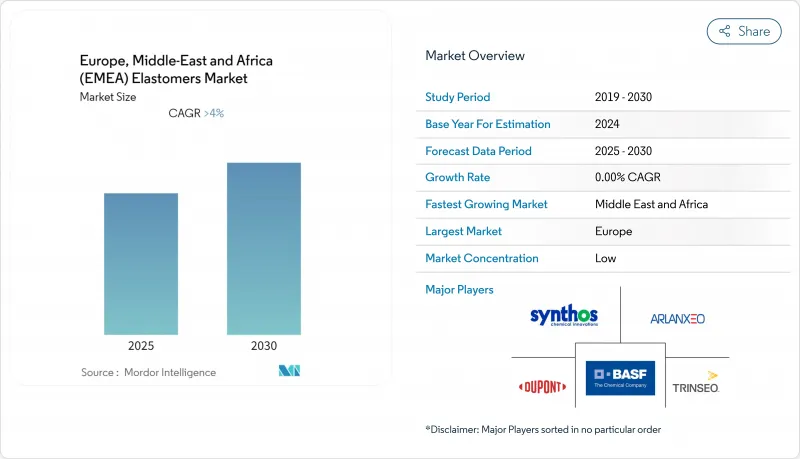
According to Mordor Intelligence, the Europe, Middle East and Africa (EMEA) elastomers market size was valued at USD 38.66 billion in 2025 and is estimated to grow from USD 40.64 billion in 2026 to reach USD 52.16 billion by 2031, at a CAGR of 5.12% during the forecast period (2026-2031).
Europe, Middle East and Africa (EMEA) Elastomers Market Trends and Insights
EV Lightweighting and High-Voltage Component Adoption
Vehicle electrification is creating a material upgrade cycle across the Europe, Middle East and Africa (EMEA) elastomers market, because new powertrain systems place different demands on sealing, insulation, thermal control, and flame resistance than conventional vehicle systems. An 800-volt battery pack requires higher dielectric strength and flame resistance than conventional weatherstrip applications, so material selection is moving beyond grades designed mainly for exterior sealing. Silicone, fluoroelastomer, and thermoplastic polyurethane are therefore gaining relevance in connector seals, battery thermal-interface gaskets, and other components exposed to electrical and heat-management demands. Germany recorded 545,000 battery electric vehicle registrations in 2025, equal to a 19.1% share, and registrations are projected to reach 740,000 units in 2026, or 25% of the total. The change raises the value of specified elastomers even where conventional engine-mount demand declines, and it increases the importance of suppliers that can qualify materials for demanding vehicle programs, support component designers, and meet the documentation requirements associated with automotive production.
Medical-Grade PVC-Free Tubing and Device Demand
Medical procurement is supporting specialty demand in the Europe, Middle East and Africa (EMEA) elastomers market, particularly where fluid-handling systems need materials with consistent performance, patient-safety credentials, and traceable production controls. Hospitals and device manufacturers are replacing plasticized polyvinyl chloride (PVC) in fluid-handling assemblies with thermoplastic elastomers and silicone, which can be selected for specific processing and application requirements. This transition applies to infusion tubing, catheterization systems, and diagnostic-device components, rather than to a single product category. The material selection process is shaped by chemical safety expectations, the need for reliable processing, and the strict documentation expected in regulated settings, which means that suppliers must demonstrate performance through qualification rather than through price alone. British National Health Service procurement benchmarks for phthalate-free tubing support wider consideration of similar requirements in European tenders and make certification capability more commercially relevant. International Organization for Standardization (ISO) 10993 and International Organization for Standardization 13485 requirements continue to create a high qualification threshold for healthcare suppliers, which favors companies with established validation and quality systems.
Crude Oil, Monomer and Petrochemical Feedstock Volatility
Feedstock exposure remains a material constraint for the Europe, Middle East and Africa (EMEA) elastomers market, because synthetic materials depend on petrochemical inputs that can change in price before selling contracts are adjusted. Synthetic elastomer producers depend on butadiene, styrene, and ethylene-propylene monomers whose costs reflect crude oil and naphtha movements across the wider chemical value chain. This issue is most acute for companies without integrated feedstock positions, since they have less ability to manage cost exposure internally or secure supply when conditions change quickly. Producers with captive access to key intermediates have more protection during abrupt changes in input costs and can better manage continuity of supply for strategically important customers. The supply concentration for specialty monomers and high-purity grades adds a longer-term procurement risk for EMEA compounders that source from Asia, especially where material qualifications limit the ability to switch suppliers quickly in the Europe, Middle East and Africa (EMEA) elastomers market.
Other drivers and restraints analyzed in the detailed report include:
- Asia-Pacific Construction and Infrastructure Expansion
- Demand for Recyclable and Circular-Ready Elastomer Grades
- Microplastic, Tire-Wear and Synthetic-Rubber Regulations
For complete list of drivers and restraints, kindly check the Table Of Contents.
Segment Analysis
Thermoplastic elastomers held 81.12% of the Europe, Middle East and Africa (EMEA) elastomers market share in 2025 and are projected to advance at a 5.67% CAGR through 2031. The position reflects processing advantages, a broad application base, and growing interest in materials that can be recovered after use. Thermoplastic elastomer grades can support short-cycle injection molding, in-line deburring, material recovery, and applications requiring both elastic performance and efficient production. These characteristics have helped them gain use in automotive weather seals, under-hood hose assemblies, and interior soft-touch surfaces, where manufacturers seek both functional performance and efficient fabrication. The Europe, Middle East and Africa (EMEA) elastomers market size represented by this category benefits from its fit with circular-material requirements and from demand for materials that can be processed in established high-volume manufacturing operations.
Thermoset elastomers continue to serve tires, heavy-duty conveyor belts, and industrial sealing systems, where product requirements often remain difficult to meet through direct substitution. These uses often require the dynamic mechanical properties provided through crosslinking, and their role remains relevant in applications where operating conditions place a premium on long-term resilience. However, crosslinked EPDM does not offer the same recovery options as many thermoplastic materials, which is relevant where customers are considering end-of-life material pathways. The gap supports continuing interest in thermoplastic alternatives in adjacent applications without eliminating the role of thermosets in demanding use cases. KURARAY CO., LTD.'s SEPTON BIO series uses sugarcane-sourced beta-farnesene and can contain up to 80% bio-based content while retaining properties associated with petroleum-derived hydrogenated styrene block copolymers.
Complete Report Scope:
- By Product Type
- Thermoplastic Elastomers
- Thermoset Elastomers
- By End-User Industry
- Automotive and Transportation
- Electrical and Electronics
- Medical and Healthcare
- Industrial Machinery and Equipment
- Consumer Goods and Footwear
- Adhesives, Sealants and Coatings
- Other End-User Industries
- By Geography
- Europe
- Germany
- United Kingdom
- France
- Italy
- Spain
- NORDIC Countries
- Russia
- Rest of Europe
- Middle East and Africa
- Saudi Arabia
- United Arab Emirates
- South Africa
- Egypt
- Nigeria
- Rest of Middle East and Africa
- Europe
List of Companies Covered in this Report:
- Arkema
- ARLANXEO
- BASF
- Covestro AG
- Dow
- Exxon Mobil Corporation
- Huntsman International LLC
- KCC Corporation
- KURARAY CO., LTD.
- LANXESS
- LG Chem
- Mitsui Chemicals, Inc.
- Momentive
- Shin-Etsu Chemical Co., Ltd.
- Wacker Chemie AG
Additional Benefits:
- The market estimate (ME) sheet in Excel format
- 3 months of analyst support
TABLE OF CONTENTS
1 Introduction
- 1.1 Study Assumptions and Market Definition
- 1.2 Scope of the Study
2 Research Methodology
3 Executive Summary
4 Market Landscape
- 4.1 Market Overview
- 4.2 Market Drivers
- 4.2.1 EV Lightweighting and High-Voltage Component Adoption
- 4.2.2 Medical-Grade PVC-Free Tubing and Device Demand
- 4.2.3 Asia-Pacific Construction and Infrastructure Expansion
- 4.2.4 Demand for Recyclable and Circular-Ready Elastomer Grades
- 4.2.5 Hydrogen Electrolyzer and Fuel-Cell Sealing Requirements
- 4.3 Market Restraints
- 4.3.1 Crude Oil, Monomer and Petrochemical Feedstock Volatility
- 4.3.2 Microplastic, Tire-Wear and Synthetic-Rubber Regulations
- 4.3.3 Concentrated Supply of Specialty Monomers and High-Purity Grades
- 4.4 Value Chain Analysis
- 4.5 Porter's Five Forces Analysis
- 4.5.1 Bargaining Power of Suppliers
- 4.5.2 Bargaining Power of Buyers
- 4.5.3 Threat of New Entrants
- 4.5.4 Threat of Substitutes
- 4.5.5 Degree of Competition
5 Market Size and Growth Forecasts (Value)
- 5.1 By Product Type
- 5.1.1 Thermoplastic Elastomers
- 5.1.2 Thermoset Elastomers
- 5.2 By End-User Industry
- 5.2.1 Automotive and Transportation
- 5.2.2 Electrical and Electronics
- 5.2.3 Medical and Healthcare
- 5.2.4 Industrial Machinery and Equipment
- 5.2.5 Consumer Goods and Footwear
- 5.2.6 Adhesives, Sealants and Coatings
- 5.2.7 Other End-User Industries
- 5.3 By Geography
- 5.3.1 Europe
- 5.3.1.1 Germany
- 5.3.1.2 United Kingdom
- 5.3.1.3 France
- 5.3.1.4 Italy
- 5.3.1.5 Spain
- 5.3.1.6 NORDIC Countries
- 5.3.1.7 Russia
- 5.3.1.8 Rest of Europe
- 5.3.2 Middle East and Africa
- 5.3.2.1 Saudi Arabia
- 5.3.2.2 United Arab Emirates
- 5.3.2.3 South Africa
- 5.3.2.4 Egypt
- 5.3.2.5 Nigeria
- 5.3.2.6 Rest of Middle East and Africa
- 5.3.1 Europe
6 Competitive Landscape
- 6.1 Market Concentration
- 6.2 Strategic Moves
- 6.3 Market Share (%)/Ranking Analysis
- 6.4 Company Profiles (includes Global Overview, Market Overview, Core Segments, Financials as available, Strategic Information, Products and Services, and Recent Developments)
- 6.4.1 Arkema
- 6.4.2 ARLANXEO
- 6.4.3 BASF
- 6.4.4 Covestro AG
- 6.4.5 Dow
- 6.4.6 Exxon Mobil Corporation
- 6.4.7 Huntsman International LLC
- 6.4.8 KCC Corporation
- 6.4.9 KURARAY CO., LTD.
- 6.4.10 LANXESS
- 6.4.11 LG Chem
- 6.4.12 Mitsui Chemicals, Inc.
- 6.4.13 Momentive
- 6.4.14 Shin-Etsu Chemical Co., Ltd.
- 6.4.15 Wacker Chemie AG
7 Market Opportunities and Future Outlook
- 7.1 White-Space and Unmet-Need Assessment

