PUBLISHER: Mordor Intelligence | PRODUCT CODE: 2154244

PUBLISHER: Mordor Intelligence | PRODUCT CODE: 2154244
Europe Used Construction Machinery - Market Share Analysis, Industry Trends & Statistics, Growth Forecasts (2026 - 2031)
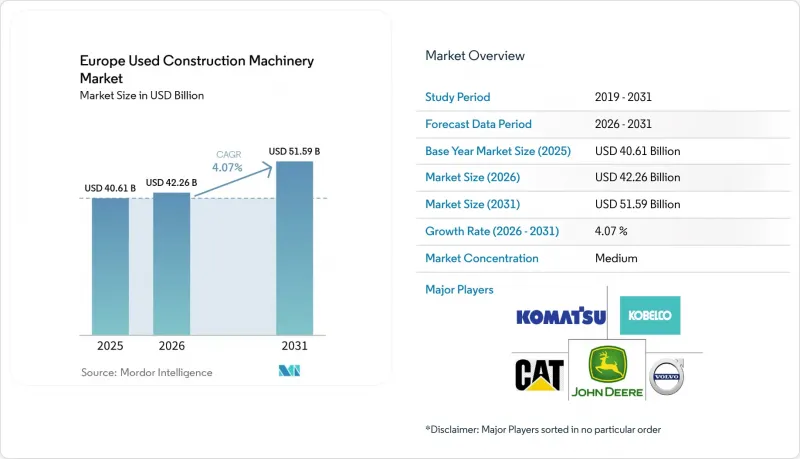
According to Mordor Intelligence, the European used construction machinery market size was valued at USD 40.61 billion in 2025, is estimated at USD 42.26 billion in 2026, and is projected to reach USD 51.59 billion by 2031, growing at a CAGR of 4.07% from 2026 to 2031.
Europe Used Construction Machinery Market Trends and Insights
Accelerated EU Infrastructure Stimulus
The EU's NextGenerationEU and updated TEN-T guidelines allocate substantial funding to rail tunnels, ports, and highways, favoring high-hour excavators and articulated haulers sourced from the secondary market . Poland's Recovery & Resilience Facility budget has fast-tracked contracts for the Via Carpatia highway, leading to a surge in demand for pre-owned dozers. In Spain, a railway modernization package is driving the acquisition of compact excavators for upgrades at urban stations. Public contractors, navigating procurement limits, are gravitating towards Stage IV machines. This choice not only safeguards the machines' residual value but also encourages more frequent fleet turnover. With a steady project pipeline in sight, resale prices have stabilized, motivating owners to auction off their assets sooner.
Shift to Stage V-Compliant Fleets
The enforcement of Stage V off-road regulations compelled rental firms and major contractors to phase out Tier 3 and Tier 4 interim equipment to sidestep penalties. These regulations limit particulate emissions to below a specific threshold and reduce NOx emissions for engines exceeding a certain power output. Volvo CE revealed that the majority of its deliveries were Stage V machines . However, many pre-Stage V units still operate and are set for resale in the coming years. Stage V units command a significant premium at auctions, while non-compliant diesel units find their way to export markets with more lenient regulations, highlighting a distinct two-tier market. Furthermore, the push for telematics is on the rise, driven by buyers' demands for documented histories of engine hours and emission systems.
Construction-Capex Volatility Amid High Rates
The European Central Bank held its deposit rate steady after significant tightening, leading mortgage rates to surpass levels seen in major markets. Eurostat highlighted a decline in eurozone construction output, driven primarily by falls in the residential sector . Dealers, facing higher inventories, exert downward pressure on mid-tier residual values. Countries like Italy and Greece grapple with widening sovereign-debt spreads, postponed infrastructure tenders, and extended replacement cycles. While rental firms shifted their fleets toward logistics and warehouse projects, the change in equipment mix only partially mitigated the downturn in civil works. In the electric vehicle market, rental firms are increasingly focusing on integrating EVs into their fleets to align with sustainability goals and evolving consumer preferences.
Other drivers and restraints analyzed in the detailed report include:
- Digital Auction Platforms Deepen Liquidity
- Energy-Efficient Renovation Boom
- Ultra-Low-Emission Zones Depress Older-Diesel Values
For complete list of drivers and restraints, kindly check the Table Of Contents.
Segment Analysis
The excavator category captured 35.92% of the European used construction equipment market in 2025, reflecting a broad installed base and versatility across civil works, demolition, and utilities. Fleet owners capitalized on excavators, achieving the highest resale liquidity. This allowed them to rotate units periodically at robust prices. Following excavators and loaders, the category of loaders captured a significant share, primarily serving quarries and material-handling tasks. Meanwhile, cranes and graders occupied mid-single-digit market positions.
Dump trucks are the fastest-growing segment, with a 4.59% CAGR to 2031, as contractors favor articulated haulers that navigate Scandinavian fjord terrain and Alpine gradients. Volvo's A45G, boasting a six-wheel drive, makes its debut on the secondary market after several rental cycles. Even with a significant discount, it still delivers notable payload productivity. As the articulated segment grows, it's reshaping residual-value curves. This change has prompted auctioneers in Germany and Belgium to launch dedicated hauler rings in their quarterly events.
Internal-combustion powertrains retained 89.16% market share in 2025, underscoring diesel's superior energy density for heavy machines deployed on multi-shift quarry operations. However, the hybrid-and-battery cohort is expanding at 6.78% per year, led by compact excavators where overnight charging suffices for daily duty cycles. In European trials, Caterpillar's diesel-electric D6 XE dozer showcased significant fuel savings. However, its steeper upfront price tag has confined its adoption primarily to larger contractors with a sustainability focus.
Electric adoption is surging, particularly in mini-excavators and skid-steers. Volvo's ECR25 Electric is fetching premium prices at auctions, largely because its low-hour units allow urban contractors to sidestep emissions-related fees. While buyers typically discount electrics with higher charge cycles to account for potential battery-pack replacements, the pricing process is becoming more refined. This is largely due to the increasing standardization of telematics data disclosures, which now commonly include state-of-charge and cycle history at auctions.
Heavy units above 11 tonnes accounted for 46.23% of 2025 transactions, owing to large-scale infrastructure projects such as the Fehmarnbelt Tunnel between Germany and Denmark, while sub-6-tonne compacts will post the fastest 4.69% CAGR on urban-infill and renovation demand.
Rental companies typically refresh their compact fleets on regular cycles. This routine results in a significant influx of low-hour Takeuchi TB216 and Bobcat E10e units entering auction channels. Meanwhile, in the heavy machinery segment, Liebherr's R 980 SME mining excavator, after extended use at quarry sites, makes its debut in the secondary market. Despite trading at a discount to its new list price, the excavator continues to see robust demand, particularly from Polish and Portuguese operators seeking bucket capacities exceeding 6 m3.
Complete Report Scope:
- By Equipment Type
- Excavator
- Loader
- Mobile Cranes
- Motor Graders
- Bulldozers
- Road Rollers
- Dump Trucks
- Others
- By Propulsion Type
- Internal Combustion
- Hybrid / Battery-Electric
- Hydrogen Fuel-Cell
- By Equipment Size
- Heavy (Above 11 t)
- Medium (6-11 t)
- Compact / Mini (Below 6 t)
- By Power Output
- Up to 250 HP
- 250 - 500 HP
- Above 500 HP
- By Application
- Infrastructure
- Residential and Commercial Construction
- Mining and Quarrying
- Oil and Gas / Pipelines
- Industrial and Manufacturing
- Others
- By Equipment Age
- Below 5 Years
- 5 - 10 Years
- 10 - 15 Years
- Above 15 Years
- By Sales Channel
- Dealer / Broker
- Auction
- Online Platforms
- By Country
- Germany
- United Kingdom
- France
- Italy
- Spain
- Sweden
- Rest of Europe
List of Companies Covered in this Report:
- Caterpillar Inc.
- Volvo Construction Equipment
- Liebherr-International Deutschland GmbH
- Komatsu Ltd.
- JCB Ltd.
- Hitachi Construction Machinery
- Deere & Company
- Kobelco Construction Machinery
- CNH Industrial (CASE)
- Wacker Neuson SE
- Kubota Corp.
- Doosan Infracore
- Hyundai Construction Equipment
- SANY Group
- Manitou Group
- Terex Corporation
- Yanmar CE
- Atlas GmbH
Additional Benefits:
- The market estimate (ME) sheet in Excel format
- 3 months of analyst support
TABLE OF CONTENTS
1 Introduction
- 1.1 Study Assumptions and Market Definition
- 1.2 Scope of the Study
2 Research Methodology
3 Executive Summary
4 Market Landscape
- 4.1 Market Overview
- 4.2 Market Drivers
- 4.2.1 Accelerated EU Infrastructure Stimulus (NextGen, TEN-T)
- 4.2.2 Shift To Stage V-Compliant Fleets Drives Renewal
- 4.2.3 Digital Auction Platforms Deepen Liquidity
- 4.2.4 Energy-Efficient Renovation Boom (EU Green Deal)
- 4.2.5 MEA Buyers Exploiting Weak Euro Via Online Bids
- 4.2.6 OEM Refurbishment + Telematics Subscriptions
- 4.3 Market Restraints
- 4.3.1 Construction-Capex Volatility Amid High Rates
- 4.3.2 Ultra-Low-Emission Zones Hurt Older Diesel Values
- 4.3.3 Export Freight-Rate Spikes Squeeze Margins
- 4.3.4 Influx of Low-Cost Rebuilt Chinese Equipment
- 4.4 Value / Supply-Chain Analysis
- 4.5 Regulatory Landscape
- 4.6 Technological Outlook
- 4.7 Porter's Five Forces Analysis
- 4.7.1 Threat of New Entrants
- 4.7.2 Bargaining Power of Suppliers
- 4.7.3 Bargaining Power of Buyers
- 4.7.4 Threat of Substitutes
- 4.7.5 Competitive Rivalry
5 Market Size and Growth Forecasts (Value (USD), Volume (Units))
- 5.1 By Equipment Type
- 5.1.1 Excavator
- 5.1.2 Loader
- 5.1.3 Mobile Cranes
- 5.1.4 Motor Graders
- 5.1.5 Bulldozers
- 5.1.6 Road Rollers
- 5.1.7 Dump Trucks
- 5.1.8 Others
- 5.2 By Propulsion Type
- 5.2.1 Internal Combustion
- 5.2.2 Hybrid / Battery-Electric
- 5.2.3 Hydrogen Fuel-Cell
- 5.3 By Equipment Size
- 5.3.1 Heavy (Above 11 t)
- 5.3.2 Medium (6-11 t)
- 5.3.3 Compact / Mini (Below 6 t)
- 5.4 By Power Output
- 5.4.1 Up to 250 HP
- 5.4.2 250 - 500 HP
- 5.4.3 Above 500 HP
- 5.5 By Application
- 5.5.1 Infrastructure
- 5.5.2 Residential and Commercial Construction
- 5.5.3 Mining and Quarrying
- 5.5.4 Oil and Gas / Pipelines
- 5.5.5 Industrial and Manufacturing
- 5.5.6 Others
- 5.6 By Equipment Age
- 5.6.1 Below 5 Years
- 5.6.2 5 - 10 Years
- 5.6.3 10 - 15 Years
- 5.6.4 Above 15 Years
- 5.7 By Sales Channel
- 5.7.1 Dealer / Broker
- 5.7.2 Auction
- 5.7.3 Online Platforms
- 5.8 By Country
- 5.8.1 Germany
- 5.8.2 United Kingdom
- 5.8.3 France
- 5.8.4 Italy
- 5.8.5 Spain
- 5.8.6 Sweden
- 5.8.7 Rest of Europe
6 Competitive Landscape
- 6.1 Market Concentration
- 6.2 Strategic Moves
- 6.3 Market Share Analysis
- 6.4 Company Profiles {(Includes Global level Overview, Market level overview, Core Segments, Financials as available, Strategic Information, Market Rank/Share for key companies, Products & Services, and Recent Developments)}
- 6.4.1 Caterpillar Inc.
- 6.4.2 Volvo Construction Equipment
- 6.4.3 Liebherr-International Deutschland GmbH
- 6.4.4 Komatsu Ltd.
- 6.4.5 JCB Ltd.
- 6.4.6 Hitachi Construction Machinery
- 6.4.7 Deere & Company
- 6.4.8 Kobelco Construction Machinery
- 6.4.9 CNH Industrial (CASE)
- 6.4.10 Wacker Neuson SE
- 6.4.11 Kubota Corp.
- 6.4.12 Doosan Infracore
- 6.4.13 Hyundai Construction Equipment
- 6.4.14 SANY Group
- 6.4.15 Manitou Group
- 6.4.16 Terex Corporation
- 6.4.17 Yanmar CE
- 6.4.18 Atlas GmbH
7 Market Opportunities and Future Outlook
- 7.1 White-space and Unmet-Need Assessment

