PUBLISHER: Mordor Intelligence | PRODUCT CODE: 2154245

PUBLISHER: Mordor Intelligence | PRODUCT CODE: 2154245
North America Homeland Security and Emergency Management - Market Share Analysis, Industry Trends & Statistics, Growth Forecasts (2026 - 2031)
According to Mordor Intelligence, the North America homeland security and emergency management market size was valued at USD 1.39 billion in 2025, and is forecast to grow from USD 1.50 billion in 2026 to USD 2.23 billion by 2031, registering a 8.27% CAGR during the forecast period (2026-2031).
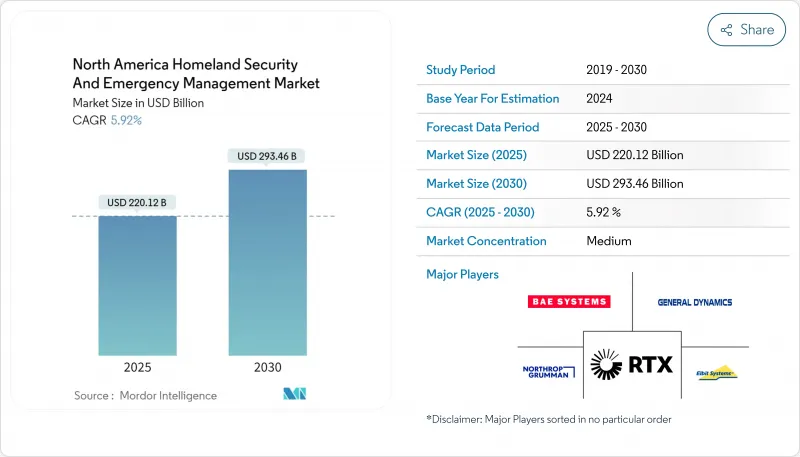
North America Homeland Security and Emergency Management Market Trends and Insights
Federal Preparedness and Homeland Security Grant Funding
Federal grants have shifted from a pass-through funding approach toward technology procurement tied to compliance requirements. FEMA distributed USD 1.01 billion through its FY2025 Homeland Security Grant Program. The State Homeland Security Program received USD 373.50 million, the Urban Area Security Initiative received USD 553.50 million, and Operation Stonegarden received USD 81 million. Recipients must direct at least 30% of awards across five national priority areas, including cybersecurity and border crisis response. This requirement supports demand for vendors whose products meet grant and authorization requirements. The DHS FY2026 discretionary budget of USD 66.40 billion was USD 1.30 billion above the FY2025 enacted level, supporting multiyear programs for integrators and analytics providers.
Rising Frequency and Cost of Extreme-Weather Disasters
The US averaged USD 23 billion in weather events annually between 2020 and 2024, with an average annual cost of USD 149.30 billion. These events keep risk analytics and operational continuity systems relevant to preparedness planning. The January 2025 Los Angeles wildfires increased attention to predictive wildfire management, evacuation analytics, and AI-supported incident coordination. FEMA preparedness requirements also require after-action reporting that identifies capability gaps. Those documented gaps can shape the specifications used in future grant-funded purchases. The result is sustained demand for situation awareness systems, resilient communications, and next-generation 911 capabilities in the North America homeland security and emergency management market.
Fragmented Federal, State, Local, Tribal, and Territorial Procurement
Procurement is split among many federal, state, local, tribal, and territorial authorities, each with different rules and timelines. DHS programs for states, urban areas, regions, nonprofits, and tribal governments have separate eligibility and reporting structures. Vendors may need to repeat FedRAMP assessments, state privacy reviews, and tribal consultations for different opportunities. This raises entry costs and can concentrate competition around firms with established government authorizations. Smaller jurisdictions can also purchase grant-eligible point solutions instead of long-term interoperable platforms. These factors can slow coordinated deployments in the North America homeland security and emergency management market.
Other drivers and restraints analyzed in the detailed report include:
- Zero-Trust and Critical-Infrastructure Cybersecurity Modernization
- Modernization of Legacy Emergency Communications and Public Safety Systems
- Budget Pressure from Legacy-System Operations and Maintenance
For complete list of drivers and restraints, kindly check the Table Of Contents.
Segment Analysis
Aviation security accounted for 43.82% of the North America homeland security and emergency management market size by solution type in 2025. TSA allocated USD 215 million for CT scanner procurement and deployment and USD 20 million for biometrics research and development in FY2026. CT scanner deployment began in 2025 at Atlanta, Denver, Orlando, and Boston airports. Deployment expands in 2026 to Los Angeles, Dallas-Fort Worth, Seattle, and more than 20 mid-sized airports. Critical infrastructure security, perimeter security, border security, maritime security, and risk services reflect other federal responsibilities.
Cybersecurity is projected to expand at a 10.48% CAGR from 2026 to 2031, the highest rate within the solution mix. Connected operational technology has widened the security needs of public agencies and critical infrastructure operators. Federal requirements include FISMA, CMMC 2.0, FedRAMP, and BOD 26-02 for end-of-support edge devices. CISA's 2026 AI material addresses security issues associated with AI use. Teledyne FLIR Defense launched CheMSense Protect in June 2026, a continuous air monitor that detects chemical warfare agent threats in under 20 seconds.
Complete Report Scope:
- By Solution Type
- Critical Infrastructure Security
- CBRNE Detection and Protection
- Perimeter and Physical Security
- Cybersecurity
- Border Security and Immigration Control
- Maritime and Port Security
- Aviation Security
- Risk and Emergency Services
- By Technology
- AI and Machine Learning
- IoT and Smart Sensors
- Big-Data Analytics
- 5G and Secure Communications
- Cloud Security Platforms
- Biometric Identification
- By End-Use Vertical
- Government and Public Sector
- Critical Infrastructure (Energy and Utilities)
- Military and Defense
- Transportation (Aviation, Maritime, and Rail)
- Commercial and Industrial Facilities
- Healthcare and Emergency Medical Services
- By Geography
- United States
- Canada
- Mexico
List of Companies Covered in this Report:
- Northrop Grumman Corporation
- RTX Corporation
- General Dynamics Information Technology, Inc. (General Dynamics Corporation)
- Thales Group
- International Business Machines Corporation (IBM)
- Honeywell Aerospace Inc.
- BAE Systems plc
- Elbit Systems Ltd.
- Cisco Systems, Inc.
- Palantir Technologies Inc.
- Booz Allen Hamilton, Inc.
- Fortinet, Inc.
- AT&T Inc.
- MOOG Inc.
Additional Benefits:
- The market estimate (ME) sheet in Excel format
- 3 months of analyst support
TABLE OF CONTENTS
1 INTRODUCTION
- 1.1 Study Assumptions and Market Definition
- 1.2 Scope of the Study
2 RESEARCH METHODOLOGY
3 EXECUTIVE SUMMARY AND KEY FINDINGS
4 MARKET LANDSCAPE
- 4.1 Market Overview
- 4.2 Market Drivers
- 4.2.1 Federal preparedness and Homeland Security Grant funding
- 4.2.2 Zero-trust and critical infrastructure cybersecurity modernization
- 4.2.3 Rising frequency and cost of extreme weather disasters
- 4.2.4 Modernization of legacy emergency communications and public safety systems
- 4.2.5 Grant eligibility digitization and compliance-driven software procurement
- 4.2.6 Cross-jurisdiction data interoperability for tribal, rural, and border communities
- 4.3 Market Restraints
- 4.3.1 Fragmented federal, state, local, tribal, and territorial procurement
- 4.3.2 Budget pressure from legacy system operations and maintenance
- 4.3.3 Uneven access to preparedness funding for rural and tribal communities
- 4.3.4 Workforce scarcity for cybersecurity, emergency communications, and incident management
- 4.4 Value Chain Analysis
- 4.5 Regulatory Outlook
- 4.6 Technological Outlook
- 4.7 Porter's Five Forces Analysis
- 4.7.1 Bargaining Power of Buyers/Consumers
- 4.7.2 Bargaining Power of Suppliers
- 4.7.3 Threat of New Entrants
- 4.7.4 Threat of Substitute Products
- 4.7.5 Intensity of Competitive Rivalry
5 MARKET SIZE AND GROWTH FORECASTS (VALUE)
- 5.1 By Solution Type
- 5.1.1 Critical Infrastructure Security
- 5.1.2 CBRNE Detection and Protection
- 5.1.3 Perimeter and Physical Security
- 5.1.4 Cybersecurity
- 5.1.5 Border Security and Immigration Control
- 5.1.6 Maritime and Port Security
- 5.1.7 Aviation Security
- 5.1.8 Risk and Emergency Services
- 5.2 By Technology
- 5.2.1 AI and Machine Learning
- 5.2.2 IoT and Smart Sensors
- 5.2.3 Big-Data Analytics
- 5.2.4 5G and Secure Communications
- 5.2.5 Cloud Security Platforms
- 5.2.6 Biometric Identification
- 5.3 By End-Use Vertical
- 5.3.1 Government and Public Sector
- 5.3.2 Critical Infrastructure (Energy and Utilities)
- 5.3.3 Military and Defense
- 5.3.4 Transportation (Aviation, Maritime, and Rail)
- 5.3.5 Commercial and Industrial Facilities
- 5.3.6 Healthcare and Emergency Medical Services
- 5.4 By Geography
- 5.4.1 United States
- 5.4.2 Canada
- 5.4.3 Mexico
6 COMPETITIVE LANDSCAPE
- 6.1 Market Concentration
- 6.2 Strategic Moves
- 6.3 Market Share Analysis
- 6.4 Company Profiles (includes Global level Overview, Market level Overview, Core Segments, Financials as available, Strategic Information, Market Rank/Share for key companies, Products and Services, and Recent Developments)
- 6.4.1 Northrop Grumman Corporation
- 6.4.2 RTX Corporation
- 6.4.3 General Dynamics Information Technology, Inc. (General Dynamics Corporation)
- 6.4.4 Thales Group
- 6.4.5 International Business Machines Corporation (IBM)
- 6.4.6 Honeywell Aerospace Inc.
- 6.4.7 BAE Systems plc
- 6.4.8 Elbit Systems Ltd.
- 6.4.9 Cisco Systems, Inc.
- 6.4.10 Palantir Technologies Inc.
- 6.4.11 Booz Allen Hamilton, Inc.
- 6.4.12 Fortinet, Inc.
- 6.4.13 AT&T Inc.
- 6.4.14 MOOG Inc.
7 MARKET OPPORTUNITIES AND FUTURE OUTLOOK
- 7.1 White-Space and Unmet-Need Assessment

