PUBLISHER: Mordor Intelligence | PRODUCT CODE: 2154280

PUBLISHER: Mordor Intelligence | PRODUCT CODE: 2154280
Germany Mineral Processing Equipment - Market Share Analysis, Industry Trends & Statistics, Growth Forecasts (2026 - 2031)
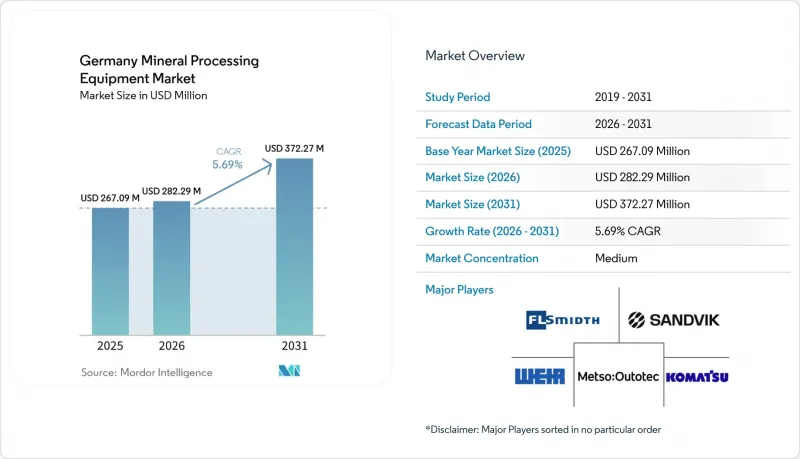
According to Mordor Intelligence, the Germany mineral processing equipment market is expected to grow from USD 267.09 million in 2025 to USD 282.29 million in 2026 and reach USD 372.27 million by 2031, registering a CAGR of 5.69% during the forecast period (2026-2031).
Germany Mineral Processing Equipment Market Trends and Insights
European Critical Raw Materials Act (2024) Fast-Tracks Funding
The Act has shortened environmental-impact reviews to roughly one year and unlocked access to European Investment Bank guarantees, accelerating equipment orders for lithium hydroxide, converter, and graphite-substitution facilities. German suppliers are pre-engineering modular crushing and hydrometallurgical circuits so that projects can be erected within the compressed approval window. The policy spill-over now extends to rare-earth separation and battery-recycling ventures. This creates a reliable backlog for vendors with experience in critical-mineral flowsheets and pressures, while late movers remain tied to legacy bulk-commodity plants. As more projects secure the Act's "strategic" label, buyers are stipulating shorter delivery schedules and placing a premium on domestic production footprints.
Government Support via German Raw Materials Strategy 2024
Berlin's strategy elevates domestic extraction to a security priority, channeling public-bank capital toward exploration and pilot-scale plants. Funding for geophysical surveys is reviving historical copper-silver and tin belts, prompting interest in relocatable crushers and screens. Procurement rules that require a portion of aggregates to come from recycled sources further stimulate demand for secondary-crushing circuits. In parallel, the strategy mandates that any state-funded project must embed lifecycle climate metrics, steering mines to specify equipment with lower embedded emissions. Collectively, these provisions anchor a multi-year replacement cycle skewed toward efficient, modular systems.
High Energy Costs Following Coal-Power Phase-Out
Industrial power averaged 10.04 cents per kWh in 2025, well above earlier levels, squeezing margins even with a temporary subsidy cap. Operators are therefore favoring equipment fitted with variable-frequency drives and regenerative braking that can ride negative-price periods on the power exchange. Vendors highlighting kilowatt-hour savings in total-cost-of-ownership models are gaining bidding advantages. Nonetheless, higher network charges expected toward 2030 may defer greenfield mill installations, lengthening replacement cycles in bulk-tonnage mines.
Other drivers and restraints analyzed in the detailed report include:
- Digitally Integrated Plants Enabled by Industrie 4.0 Adoption
- Circular-Economy Push Driving Secondary-Raw-Material Processing
- Skilled Labor Shortages in Mechanical & Mechatronic Trades
For complete list of drivers and restraints, kindly check the Table Of Contents.
Segment Analysis
Potash and salt mining held 29.15% of the Germany mineral processing equipment market share in 2025, a position underpinned by long-running fertilizer operations that sustain stable replacement demand. Equipment suppliers servicing this segment focus on incremental efficiency gains-such as dry-stack tailings and lower-profile conveyors-rather than wholesale plant overhauls. Lithium is the fastest-growing sub-segment at a 5.97% CAGR to 2031, fueled by multiple hard-rock and geothermal brine projects slated to supply Europe's battery corridor. Developers are specifying rotary calciners, leach reactors, and crystallizers purpose-built for battery-grade purity, giving premium German vendors a first-mover edge.
Exploration for rare earths and specialty metals in Saxony's Erzgebirge is also beginning to shape order books, with feasibility studies calling for solvent-extraction cells and fine-grinding mills tailored to smaller, high-grade ore bodies. These emerging flowsheets reward modular packages that can be expanded as resource confidence increases. Over the outlook period, the German mineral processing equipment market is expected to balance a steady potash backbone with surging lithium demand, a combination that encourages suppliers to diversify portfolios across bulk and critical minerals.
Crushers held the largest Germany mineral processing equipment market share at 25.47% in 2025, reaffirming their indispensable role in first-stage size reduction. Yet conveyors are growing at a 6.28% CAGR through 2031 as operators retrofit belts with regenerative drives and load-monitoring sensors to cut electricity spend. Buyers are also upgrading feeders and screens in tandem with these belt systems to maintain synchronized throughput, favoring manufacturers that can bundle control software with mechanical hardware.
Grinding-mill replacement remains muted because predictive wear algorithms now let mines stretch liner life, deferring capital spend. Meanwhile, drills, breakers, and smart surface miners grouped under "others" are benefiting from autonomy packages that lower manpower per operating hour. Across the category, value migrates toward digitally enabled ancillaries rather than monolithic mills, highlighting how the German mineral processing equipment market prizes incremental, high-return retrofits over greenfield megaprojects.
Complete Report Scope:
- By Mineral Mining Sector
- Bauxite
- Iron
- Lithium
- Potash & Salt
- Rare Earths
- By Equipment Type
- Crushers
- Feeders
- Conveyors
- Drills & Breakers
- Screens & Separators
- Grinding Mills
- Others
- By Mining Method
- Surface Mining
- Underground Mining
- By Automation Level
- Manual
- Semi-Automated
- Fully Automated
List of Companies Covered in this Report:
- Metso Outotec
- Sandvik AB
- FLSmidth A/S
- Thyssenkrupp Industrial Solutions AG
- Weir Group PLC
- Komatsu Ltd.
- Schenck Process GmbH
- TAKRAF GmbH
- Hazemag & EPR GmbH
- RHEWUM GmbH
Additional Benefits:
- The market estimate (ME) sheet in Excel format
- 3 months of analyst support
TABLE OF CONTENTS
1 Introduction
- 1.1 Study Assumptions & Market Definition
- 1.2 Scope of the Study
2 Research Methodology
3 Executive Summary
4 Market Landscape
- 4.1 Market Overview
- 4.2 Market Drivers
- 4.2.1 European Critical Raw Materials Act (2024) Fast-Tracks Funding
- 4.2.2 Government Support via German Raw Materials Strategy 2024
- 4.2.3 Digitally Integrated Plants Enabled by Industrie 4.0 Adoption
- 4.2.4 Circular-Economy Push Driving Secondary-Raw-Material Processing
- 4.2.5 Increasing Mineral Production in Germany
- 4.2.6 Accelerated Brownfield Mine Expansions in Saxony & Thuringia
- 4.3 Market Restraints
- 4.3.1 High Energy Costs Following Coal-Power Phase-Out
- 4.3.2 Skilled Labor Shortages in Mechanical & Mechatronic Trades
- 4.3.3 Stringent EU Environmental & Permitting Regulations
- 4.3.4 Raw-Material Price Volatility Has Tightened CAPEX Budgets for New German Mineral-Processing Lines
- 4.4 Value / Supply-Chain Analysis
- 4.5 Regulatory Landscape
- 4.6 Technological Outlook
- 4.7 Porter's Five Forces
- 4.7.1 Bargaining Power of Suppliers
- 4.7.2 Bargaining Power of Buyers
- 4.7.3 Threat of New Entrants
- 4.7.4 Threat of Substitutes
- 4.7.5 Degree of Competition
5 Market Size & Growth Forecasts (Value (USD) and Volume (Units))
- 5.1 By Mineral Mining Sector
- 5.1.1 Bauxite
- 5.1.2 Iron
- 5.1.3 Lithium
- 5.1.4 Potash & Salt
- 5.1.5 Rare Earths
- 5.2 By Equipment Type
- 5.2.1 Crushers
- 5.2.2 Feeders
- 5.2.3 Conveyors
- 5.2.4 Drills & Breakers
- 5.2.5 Screens & Separators
- 5.2.6 Grinding Mills
- 5.2.7 Others
- 5.3 By Mining Method
- 5.3.1 Surface Mining
- 5.3.2 Underground Mining
- 5.4 By Automation Level
- 5.4.1 Manual
- 5.4.2 Semi-Automated
- 5.4.3 Fully Automated
6 Competitive Landscape
- 6.1 Market Concentration
- 6.2 Strategic Moves
- 6.3 Market Share Analysis
- 6.4 Company Profiles (Includes Global Level Overview, Market Level Overview, Core Segments, Financials as Available, Strategic Information, Market Rank/Share for Key Companies, Products and Services, SWOT Analysis, and Recent Developments)
- 6.4.1 Metso Outotec
- 6.4.2 Sandvik AB
- 6.4.3 FLSmidth A/S
- 6.4.4 Thyssenkrupp Industrial Solutions AG
- 6.4.5 Weir Group PLC
- 6.4.6 Komatsu Ltd.
- 6.4.7 Schenck Process GmbH
- 6.4.8 TAKRAF GmbH
- 6.4.9 Hazemag & EPR GmbH
- 6.4.10 RHEWUM GmbH
7 Market Opportunities & Future Outlook
- 7.1 White-space & Unmet-Need Assessment

