PUBLISHER: Mordor Intelligence | PRODUCT CODE: 2154285

PUBLISHER: Mordor Intelligence | PRODUCT CODE: 2154285
Europe Tire Manufacturing Equipment - Market Share Analysis, Industry Trends & Statistics, Growth Forecasts (2026 - 2031)
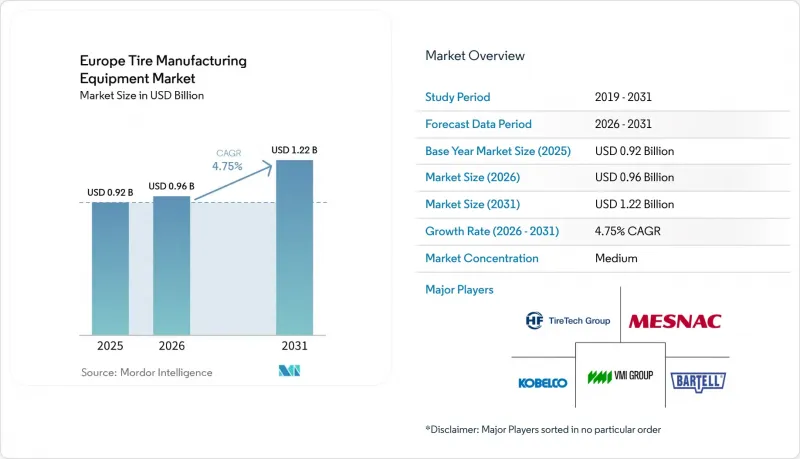
According to Mordor Intelligence, the European tire manufacturing equipment market size is expected to increase from USD 0.92 billion in 2025 to USD 0.96 billion in 2026 and reach USD 1.22 billion by 2031, growing at a 4.75% CAGR over 2026-2031.
Europe Tire Manufacturing Equipment Market Trends and Insights
EV-Led Surge in High-Silica Radial Compounds Needs Advanced Mixing and Extrusion Lines
Mixers now demand higher shear to prevent scorching, as electric-vehicle tires are heavier per axle and incorporate silica. Kobelco's 5THR rotor raises productivity by 43%, enabling OEMs to meet EV delivery windows without extra mixers . At Michelin's Magnolia plant, an AI-controlled screw speed manages silica agglomeration, achieving an efficient extrusion rate. Bridgestone's Burgos facility increased its capacity for high-rim EV sizes, necessitating the use of wider extrusion heads. Evonik's new precipitated-silica grades, which have tighter dispersion tolerances, have made rotor hardfacing a standard practice. As manufacturers aim for improved defect rates, the implementation of digital twins and predictive-maintenance algorithms has significantly enhanced uptime.
Tire-Maker Capacity Expansions Across Europe Drive Fresh Capex for Building Area Machines
Bridgestone, with a significant investment in Spain, is set to enhance its production capacity. This expansion necessitates the use of modular drums and servo ply feeders, enabling swift SKU transitions. Meanwhile, Apollo and Nokian are ramping up production in Hungary and Romania, leading to a surge in demand for new building machines by 2028. HF TireTech's HF ONE technology improves changeover efficiency and accommodates a wide range of SKUs. MESNAC's NPS one-stage builder offers a rapid cycle, perfectly suited for small-batch needs. According to The European Rubber Journal, substantial capital expenditures have been announced for 2025, with a significant portion of the budget allocated to building-area equipment.
Volatile Natural-Rubber and Petrochemical Prices Delay Equipment Purchases
In 2024, rubber prices reached their highest levels in over a decade, with significant spot-market fluctuations. This volatility has tightened margins for tire manufacturers and halted orders for high-value mixers. Meanwhile, synthetic feedstocks, closely tracking crude oil movements, introduced additional uncertainty in input costs. As a result, Sentury has put its Spanish greenfield project on hold, re-evaluating its assumptions. Furthermore, many mid-tier companies are now insisting on a period of stable pricing before they commit to new production lines. Given that raw materials account for a substantial portion of tire costs, any rise in feedstock risk directly impacts capital budgets.
Other drivers and restraints analyzed in the detailed report include:
- Smart-Factory and Industry 4.0 Retrofits for Productivity and Traceability
- Euro 7 Tire-Particle Limits Accelerate Uptake of Precision Curing and Inspection Machines
- High Capex and Long Payback Horizons Deter Smaller Manufacturers
For complete list of drivers and restraints, kindly check the Table Of Contents.
Segment Analysis
Curing and Inspection lines are projected to outpace all other categories at a 9.33% CAGR as plants electrify presses and tighten particle-emission control. The European tire manufacturing equipment market size for Building-area machines remains large, with 42.35% share in 2025, yet its share declines as OEMs divert budgets to energy-saving vulcanizers. Electric-heating retrofits that slot into existing frames allow fast swaps without civil works. Inspection systems using AI image analytics are bundled with new presses, giving suppliers like HF and VMI a cross-selling opportunity.
Upstream mixers and calenders still matter, especially with high-silica EV recipes. Kobelco's 5THR and Comerio's ZEUS calendars demonstrate that incremental productivity and footprint savings win orders even when headline growth lags. Strip winders and bead winders get uplift from Bridgestone and Nokian expansions, but overall growth trails that of curing lines because the latter tackle both Euro 7 compliance and carbon-neutral targets.
Radial machinery captured 89.04% revenue in 2025 and will maintain a 5.45% CAGR growth trajectory through 2031. The European tire manufacturing equipment market share for bias tooling remains marginal, serving two-wheeler and niche off-road segments that now source many tires from Asia. Radial builders must handle wider belts for 18-to-24-inch passenger EV sizes, driving upgrades to servo tensioning and real-time belt tracking.
Bias presses are inexpensive and simple, yet demand is too low to entice most European OEMs. Plants that still need bias capability retrofit radial drums rather than buy standalone lines. Consequently, suppliers concentrate R&D on radial innovations such as AI-assisted foreign-object detection that can cut scrap by double digits.
Complete Report Scope:
- By Equipment Type
- Upstream (Mixer and Component Preparation)
- Mixing Machines / Rubber Mixers
- Calendaring Machines
- Extrusion Machines
- Cutting Machines
- Others (Cooling Units, etc.)
- Building Area
- Bead Winding Machines
- Tire Building Machines
- Others (Strip Winding Machines, etc.)
- Curing and Inspection (Testing Area)
- Curing Press Machines
- Tire Painting Machines
- Others (Inspection Machines, etc.)
- Upstream (Mixer and Component Preparation)
- By Tire Design
- Bias
- Radial
- By Vehicle Type
- Two-Wheelers
- Three-Wheelers
- Passenger Cars
- Light Commercial Vehicles
- Medium and Heavy Commercial Vehicles
- Off-Road Vehicles
- By Rim Size
- Up to 12 inches
- 12 to 18 inches
- Above 18 inches
- By End-User
- Original Equipment Manufacturers (OEMs)
- Replacement / Aftermarket
- By Country
- Germany
- United Kingdom
- Spain
- Italy
- France
- Netherlands
- Rest of Europe
List of Companies Covered in this Report:
- HF TireTech Group
- VMI Group
- Kobelco Stewart Bolling
- MESNAC Co., Ltd.
- Bartell Machinery Systems
- Comerio Ercole S.p.A.
- KONSTRUKTA-TireTech
- Colmec S.p.A.
- Herbert Maschinenbau
- Pelmar Engineering
- Marangoni Meccanica
- Mitsubishi Heavy Industries Machinery Systems
- Siempelkamp Maschinenbau
- Uzer Makina
- Hebert Maschinen
- Yiyang Rubber and Plastics Machinery
- Tianjin Saixiang Technology
- Larsen and Toubro Rubber Machinery
Additional Benefits:
- The market estimate (ME) sheet in Excel format
- 3 months of analyst support
TABLE OF CONTENTS
1 Introduction
- 1.1 Study Assumptions and Market Definition
- 1.2 Scope of the Study
2 Research Methodology
3 Executive Summary
4 Market Landscape
- 4.1 Market Overview
- 4.2 Market Drivers
- 4.2.1 EV-Led Surge in High-Silica Radial Compounds Needs Advanced Mixing and Extrusion Lines
- 4.2.2 Tire-Maker Capacity Expansions Across Europe Drive Fresh Capex for Building Area Machines
- 4.2.3 Smart-Factory and Industry 4.0 Retrofits for Productivity and Traceability
- 4.2.4 Euro 7 Tire-Particle Limits Accelerate Uptake of Precision Curing and Inspection Machines
- 4.2.5 Energy-Cost Spikes Push Migration to Energy-Efficient All-Electric Presses
- 4.2.6 EU Circular-Economy Rules Spur Investment in Mixing Lines That Handle Recycled/Bio Fillers
- 4.3 Market Restraints
- 4.3.1 Volatile Natural-Rubber and Petrochemical Prices Delay Equipment Purchases
- 4.3.2 High Capex and Long Payback Horizons Deter Smaller Manufacturers
- 4.3.3 Skilled-Maintenance Shortage Limits Adoption of Integrated, Complex Machinery
- 4.3.4 Proposed PFAS Ban Clouds Equipment-Seal Specifications and Upgrade Timing
- 4.4 Value / Supply-Chain Analysis
- 4.5 Regulatory Landscape
- 4.6 Technological Outlook
- 4.7 Porter's Five Forces Analysis
- 4.7.1 Threat of New Entrants
- 4.7.2 Bargaining Power of Suppliers
- 4.7.3 Bargaining Power of Buyers
- 4.7.4 Threat of Substitution
- 4.7.5 Intensity of Competitive Rivalry
5 Market Size and Growth Forecasts (Value, USD)
- 5.1 By Equipment Type
- 5.1.1 Upstream (Mixer and Component Preparation)
- 5.1.1.1 Mixing Machines / Rubber Mixers
- 5.1.1.2 Calendaring Machines
- 5.1.1.3 Extrusion Machines
- 5.1.1.4 Cutting Machines
- 5.1.1.5 Others (Cooling Units, etc.)
- 5.1.2 Building Area
- 5.1.2.1 Bead Winding Machines
- 5.1.2.2 Tire Building Machines
- 5.1.2.3 Others (Strip Winding Machines, etc.)
- 5.1.3 Curing and Inspection (Testing Area)
- 5.1.3.1 Curing Press Machines
- 5.1.3.2 Tire Painting Machines
- 5.1.3.3 Others (Inspection Machines, etc.)
- 5.1.1 Upstream (Mixer and Component Preparation)
- 5.2 By Tire Design
- 5.2.1 Bias
- 5.2.2 Radial
- 5.3 By Vehicle Type
- 5.3.1 Two-Wheelers
- 5.3.2 Three-Wheelers
- 5.3.3 Passenger Cars
- 5.3.4 Light Commercial Vehicles
- 5.3.5 Medium and Heavy Commercial Vehicles
- 5.3.6 Off-Road Vehicles
- 5.4 By Rim Size
- 5.4.1 Up to 12 inches
- 5.4.2 12 to 18 inches
- 5.4.3 Above 18 inches
- 5.5 By End-User
- 5.5.1 Original Equipment Manufacturers (OEMs)
- 5.5.2 Replacement / Aftermarket
- 5.6 By Country
- 5.6.1 Germany
- 5.6.2 United Kingdom
- 5.6.3 Spain
- 5.6.4 Italy
- 5.6.5 France
- 5.6.6 Netherlands
- 5.6.7 Rest of Europe
6 Competitive Landscape
- 6.1 Market Concentration
- 6.2 Strategic Moves
- 6.3 Market Share Analysis
- 6.4 Company Profiles (includes Global Level Overview, Market Level Overview, Core Segments, Financials as Available, Strategic Information, Market Rank/Share for Key Companies, Products and Services, SWOT Analysis, and Recent Developments)
- 6.4.1 HF TireTech Group
- 6.4.2 VMI Group
- 6.4.3 Kobelco Stewart Bolling
- 6.4.4 MESNAC Co., Ltd.
- 6.4.5 Bartell Machinery Systems
- 6.4.6 Comerio Ercole S.p.A.
- 6.4.7 KONSTRUKTA-TireTech
- 6.4.8 Colmec S.p.A.
- 6.4.9 Herbert Maschinenbau
- 6.4.10 Pelmar Engineering
- 6.4.11 Marangoni Meccanica
- 6.4.12 Mitsubishi Heavy Industries Machinery Systems
- 6.4.13 Siempelkamp Maschinenbau
- 6.4.14 Uzer Makina
- 6.4.15 Hebert Maschinen
- 6.4.16 Yiyang Rubber and Plastics Machinery
- 6.4.17 Tianjin Saixiang Technology
- 6.4.18 Larsen and Toubro Rubber Machinery
7 Market Opportunities and Future Outlook
- 7.1 White-space and Unmet-Need Assessment

