PUBLISHER: Mordor Intelligence | PRODUCT CODE: 2154302

PUBLISHER: Mordor Intelligence | PRODUCT CODE: 2154302
Autonomous Driving Software - Market Share Analysis, Industry Trends & Statistics, Growth Forecasts (2026 - 2031)
According to Mordor Intelligence, the autonomous driving software market size was valued at USD 11.63 billion in 2025 and is estimated to grow from USD 14.75 billion in 2026 to reach USD 50.25 billion by 2031, at a CAGR of 27.78% during the forecast period (2026-2031).
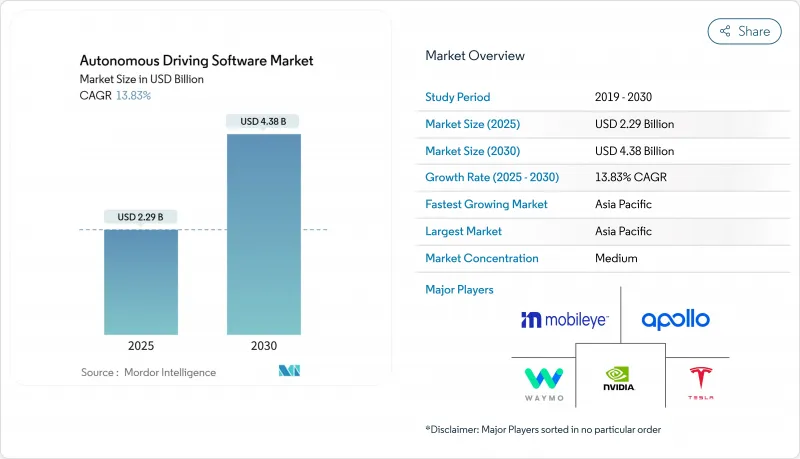
Global Autonomous Driving Software Market Trends and Insights
OEM Pivot To Software-Defined Vehicles
Global automakers are reorganizing around over-the-air feature delivery and subscription revenue. General Motors finalized full ownership of Cruise, while Volkswagen aligned with a ride-hailing platform to accelerate robotaxi rollout. Tesla gained significantly from its Full Self-Driving package in 2024, proving out monetization at scale. As per the company, the software's latest version boasts "enhanced data and training compute, a fivefold boost in parameter count, and various architectural enhancements". Partnerships with public cloud providers support continuous integration pipelines, allowing weekly software releases that iterate perception and planning algorithms faster than traditional model-year cycles. Competitive pressure is therefore shifting capital expenditure from mechanical engineering toward data pipelines, synthetic-simulation tooling, and safety-case automation.
Expanding ADAS Mandates in Europe, China and United States
The European Union's General Safety Regulation now requires emergency braking and lane-keeping on every new vehicle, effectively guaranteeing baseline demand for perception software. China's C-NCAP 2024 protocol applies similar pressure by tying five-star ratings to comprehensive driver-assist suites. In the United States, a mix of state-level testing programs and NHTSA safety guidelines supplies a federal framework that supports commercial pilots while maintaining consumer protection. The harmonization of core ADAS functions establishes a stepping-stone toward higher autonomy because suppliers can amortize R&D across multiple geographic programs, shaving cost per vehicle and accelerating feature road-maps.
Scarcity Of Functional-Safety Talent For ISO 26262 And SOTIF
Industry demand for engineers qualified under ISO 26262 and SOTIF outstrips supply. Certification combines deep automotive safety know-how with machine-learning validation skills, a profile cultivated over multiple years of project experience. Leading suppliers report open positions unfilled for up to one year, stretching project timelines and raising salary costs. University programs are expanding, yet the talent gap will persist through the decade. Limited staffing slows safety-case preparation, which in turn delays regulatory clearance for Level 3-plus functions.
Other drivers and restraints analyzed in the detailed report include:
- Rapid Decline In LiDAR And Compute-Unit Costs Post-2025
- Advanced Traffic-Management Pilots Enabling L4 Geo-Fenced Robo-Taxis
- Fragmented Regulatory Approval Across U.S. States
For complete list of drivers and restraints, kindly check the Table Of Contents.
Segment Analysis
Level 2 held a 47.15% share in 2025 within the autonomous driving software market, anchored by adaptive cruise control and lane-centering functions rolled out across high-volume passenger platforms. Revenue flows from subscription packages that unlock enhanced driving convenience, creating steady cash flows while accustoming drivers to supervised automation features. Mandates in Europe and China force OEMs to embed these capabilities as standard equipment, ensuring baseline volume and predictable integration roadmaps.
Higher-autonomy Level 4 and 5 software is set to grow at a 30.45% CAGR during the forecast period (2026-2031), as commercial robotaxi and hub-to-hub freight services scale beyond pilot volume. Geo-fenced operating domains, combined with remote-assistance safety protocols, allow revenue operations without an in-vehicle driver. Regulatory pathways remain stringent, yet successful safety-case filings in select cities signal accelerating approvals. Investment funnels toward perception redundancy, behavioral prediction fidelity, and real-time fail-over mechanisms that meet functional safety targets.
Internal-combustion platforms held a 63.01% share of the autonomous driving software market in 2025, as legacy fleet architectures continue to dominate global sales. Hybrid systems face power management complexities that complicate the implementation of autonomous driving software. OEMs retrofit ADAS features via distributed electronic-control units, but thermal envelopes and 12-volt wiring constrain compute scalability. Software upgrades, therefore, face physical bottlenecks that limit roadmap agility.
Electric vehicles will advance at a 31.48% CAGR during the forecast period (2026-2031), leveraging high-voltage electrics and centralized compute to accommodate multi-sensor arrays and GPU-class processors. Cooling loops originally designed for battery packs now dissipate heat from AI workloads, solving a critical thermal hurdle. Over-the-air firmware orchestrates battery management and autonomous functions through a unified software stack, supporting continuous feature extension and heightening customer lifetime value.
Complete Report Scope:
- By Level of Autonomy
- Level 1
- Level 2
- Level 3
- Level 4 and 5
- By Propulsion Type
- Internal Combustion Engine
- Electric
- By Vehicle Type
- Passenger Vehicle
- Commercial Vehicle
- By Software Type
- Perception and Planning Software
- Chauffeur Software
- Interior Sensing Software
- Supervision / Monitoring Software
- By Geography
- North America
- United States
- Canada
- Rest of North America
- South America
- Brazil
- Argentina
- Rest of South America
- Europe
- United Kingdom
- Germany
- Spain
- Italy
- France
- Russia
- Rest of Europe
- Asia-Pacific
- India
- China
- Japan
- South Korea
- Rest of Asia-Pacific
- Middle East and Africa
- United Arab Emirates
- Saudi Arabia
- Turkey
- Egypt
- South Africa
- Rest of Middle East and Africa
- North America
Geography Analysis
Asia-Pacific led with a 36.72% share of the autonomous driving software market in 2025 and is projected to grow at a 28.11% CAGR during the forecast period (2026-2031). Policymakers in China authorize large-scale pilot zones that cover mixed traffic, night conditions, and adverse weather. Domestic technology champions secure preferential access to public road-test mileage, amassing proprietary datasets that differentiate their perception models. Japan targets autonomous shuttles for rural mobility, while South Korea integrates 5G cellular vehicle-to-everything backbones to enhance situational awareness. Manufacturing scale in the region reduces hardware costs and accelerates the global diffusion of next-generation sensor stacks.
North America is expected to experience significant growth over the years. Silicon Valley start-ups leverage substantial venture capital to explore diverse autonomy niches, including sidewalk robots and autonomous middle-mile logistics. Regulatory sandboxes in California and Arizona allow public-road passenger services and ride-hailing integrations, helping validate commercial viability. Canada further supports the ecosystem through cold-weather testing corridors, which diversify data coverage and stress-test perception stacks under snow and ice conditions.
Europe maintains a coordinated regulatory environment and is set to witness significant growth during the forecast period. The General Safety Regulation requires uniform ADAS deployment, enabling suppliers to amortize development costs across the region's large passenger-car base. Germany's tier-one supplier cluster provides hardware-software integration expertise, while Scandinavian countries experiment with autonomous public transit pilots that feed operational insights back to the broader market. Harmonized privacy laws clarify data-handling obligations, smoothing cross-border fleet operations.
- NVIDIA Corporation
- Mobileye (Intel Corporation)
- Waymo LLC
- Tesla, Inc.
- Baidu, Inc.
- Continental AG
- Robert Bosch GmbH
- Aptiv PLC
- ZF Friedrichshafen AG
- Huawei Technologies Co., Ltd.
- Cruise LLC (General Motor Company)
- Oxa Autonomy Limited
- Qualcomm Technologies, Inc.
- Valeo SA
Additional Benefits:
- The market estimate (ME) sheet in Excel format
- 3 months of analyst support
TABLE OF CONTENTS
1 Introduction
- 1.1 Study Assumptions and Market Definition
- 1.2 Scope of the Study
2 Research Methodology
3 Executive Summary
4 Market Landscape
- 4.1 Market Overview
- 4.2 Market Drivers
- 4.2.1 OEM Pivot to Software-Defined Vehicles (SDVs)
- 4.2.2 Expanding ADAS Mandates in Europe, China and United States
- 4.2.3 Rapid Decline in LiDAR and Compute-Unit Costs Post-2025
- 4.2.4 Advanced Traffic-Management Pilots Enabling L4 Geo-Fenced Robo-Taxis
- 4.2.5 Cloud-Native Simulation Platforms Shortening Dev Cycles
- 4.2.6 Deployment of HD-Map-Free Perception Stacks in China
- 4.3 Market Restraints
- 4.3.1 Scarcity of Functional-Safety Talent for ISO 26262 and SOTIF
- 4.3.2 Fragmented Regulatory Approval Across U.S. States
- 4.3.3 High-Performance Computing Thermal-Management Limits in EVs
- 4.3.4 Cyber-Security Liability for Over-The-Air (OTA) Updates
- 4.4 Value / Supply-Chain Analysis
- 4.5 Regulatory Landscape
- 4.6 Technological Outlook
- 4.7 Porter's Five Forces Analysis
- 4.7.1 Threat of New Entrants
- 4.7.2 Bargaining Power of Suppliers
- 4.7.3 Bargaining Power of Buyers
- 4.7.4 Threat of Substitutes
- 4.7.5 Intensity of Competitive Rivalry
5 Market Size and Growth Forecasts (Value (USD))
- 5.1 By Level of Autonomy
- 5.1.1 Level 1
- 5.1.2 Level 2
- 5.1.3 Level 3
- 5.1.4 Level 4 and 5
- 5.2 By Propulsion Type
- 5.2.1 Internal Combustion Engine
- 5.2.2 Electric
- 5.3 By Vehicle Type
- 5.3.1 Passenger Vehicle
- 5.3.2 Commercial Vehicle
- 5.4 By Software Type
- 5.4.1 Perception and Planning Software
- 5.4.2 Chauffeur Software
- 5.4.3 Interior Sensing Software
- 5.4.4 Supervision / Monitoring Software
- 5.5 By Geography
- 5.5.1 North America
- 5.5.1.1 United States
- 5.5.1.2 Canada
- 5.5.1.3 Rest of North America
- 5.5.2 South America
- 5.5.2.1 Brazil
- 5.5.2.2 Argentina
- 5.5.2.3 Rest of South America
- 5.5.3 Europe
- 5.5.3.1 United Kingdom
- 5.5.3.2 Germany
- 5.5.3.3 Spain
- 5.5.3.4 Italy
- 5.5.3.5 France
- 5.5.3.6 Russia
- 5.5.3.7 Rest of Europe
- 5.5.4 Asia-Pacific
- 5.5.4.1 India
- 5.5.4.2 China
- 5.5.4.3 Japan
- 5.5.4.4 South Korea
- 5.5.4.5 Rest of Asia-Pacific
- 5.5.5 Middle East and Africa
- 5.5.5.1 United Arab Emirates
- 5.5.5.2 Saudi Arabia
- 5.5.5.3 Turkey
- 5.5.5.4 Egypt
- 5.5.5.5 South Africa
- 5.5.5.6 Rest of Middle East and Africa
- 5.5.1 North America
6 Competitive Landscape
- 6.1 Market Concentration
- 6.2 Strategic Moves
- 6.3 Market Share Analysis
- 6.4 Company Profiles (Includes Global Level Overview, Market Level Overview, Core Segments, Financials as Available, Strategic Information, Market Rank/Share for Key Companies, Products and Services, SWOT Analysis, and Recent Developments)
- 6.4.1 NVIDIA Corporation
- 6.4.2 Mobileye (Intel Corporation)
- 6.4.3 Waymo LLC
- 6.4.4 Tesla, Inc.
- 6.4.5 Baidu, Inc.
- 6.4.6 Continental AG
- 6.4.7 Robert Bosch GmbH
- 6.4.8 Aptiv PLC
- 6.4.9 ZF Friedrichshafen AG
- 6.4.10 Huawei Technologies Co., Ltd.
- 6.4.11 Cruise LLC (General Motor Company)
- 6.4.12 Oxa Autonomy Limited
- 6.4.13 Qualcomm Technologies, Inc.
- 6.4.14 Valeo SA
7 Market Opportunities and Future Outlook
- 7.1 White-space and Unmet-Need Assessment

