PUBLISHER: Mordor Intelligence | PRODUCT CODE: 2154303

PUBLISHER: Mordor Intelligence | PRODUCT CODE: 2154303
India Small Commercial Vehicle - Market Share Analysis, Industry Trends & Statistics, Growth Forecasts (2026 - 2031)
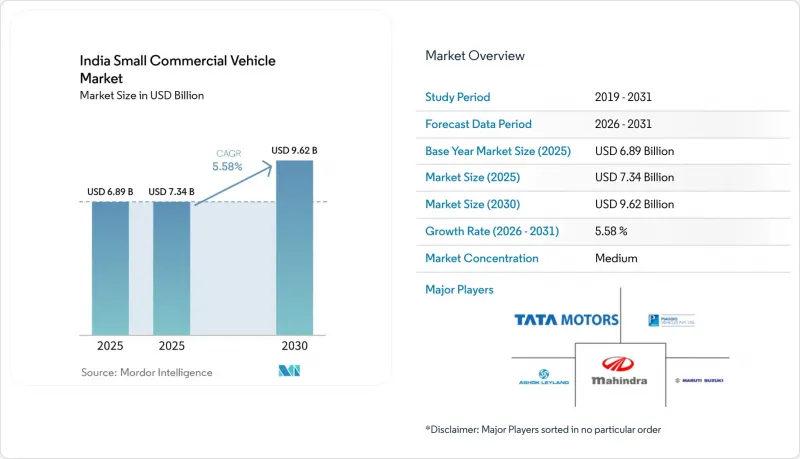
According to Mordor Intelligence, the India small commercial vehicle market size was valued at USD 6.89 billion in 2025 and is estimated to grow from USD 7.27 billion in 2026 to reach USD 9.54 billion by 2031, at a CAGR of 5.58% during the forecast period (2026-2031).
India Small Commercial Vehicle Market Trends and Insights
Accelerated E-Commerce Penetration Into Tier-2/3 Cities
E-commerce is spreading demand beyond the largest metropolitan areas and is creating more regular delivery activity in smaller cities. This change supports the India small commercial vehicle market because delivery networks need vehicles that can make repeated stops on constrained local roads. Jaipur, Indore, Lucknow, and Bhubaneswar illustrate the type of markets where denser multi-drop routes can favor compact cargo vehicles. Better fulfillment quality also makes demand more repeatable for operators, rather than dependent on a short period of online customer acquisition. Local service coverage and financing access can become important differentiators for manufacturers serving these areas. This setting gives fleet operators a reason to add vehicles suited to local delivery patterns instead of relying only on larger regional trucks.
Rapid Post-GST Hub-and-Spoke Logistics Expansion
The goods and services tax framework has supported distribution models that use regional hubs and local spokes. These models require frequent freight movement between warehouses and neighborhood delivery points, which fits the operating role of small commercial vehicles. Bhiwandi, Tauru, Hosur, Nagpur, and Bhubaneswar are examples of locations where regional distribution can connect to dense local routes. The India small commercial vehicle market gains when operators centralize inventory and use smaller vehicles for the final stages of distribution. Shorter feeder trips can improve the usefulness of mini trucks and light pickups where the route pattern is regular. The resulting replacement cycle depends on whether fleet owners see a clear operating advantage from purpose-built local vehicles.
High TCO Gap Between BEV & ICE in Sub-1-Tonne Range
The ownership case for electric vehicles remains uneven in the sub-2.5-ton cargo category. Electric cargo three-wheelers are better suited to short and predictable urban loops where depot charging is available. Mini trucks often face more variable routes and may need charging options outside the depot, which are not consistently available. This makes route flexibility a central concern for operators comparing electric and internal-combustion-engine vehicles. The India small commercial vehicle market will see faster electric adoption, where daily mileage and charging access allow operators to recover the initial investment. Outside those conditions, conventional powertrains and alternative-fuel models remain important options for small fleet owners.
Other drivers and restraints analyzed in the detailed report include:
- Growth of Organized Retail & Kirana Aggregation Platforms
- Government FAME-II & State EV Subsidy Schemes
- Fragmented Financing Ecosystem for First-Time Buyers
For complete list of drivers and restraints, kindly check the Table Of Contents.
Segment Analysis
Mini trucks held 49.56% of the India small commercial vehicle market in 2025 and are forecast to grow at a 6.71% CAGR through 2031. They connect distribution centers to neighborhood delivery points and support a broad range of goods movement. Their compact size helps operators navigate dense urban and peri-urban roads. They also suit routes that require regular stops and moderate loads. The Tata Ace platform has established a long operating presence among small transport operators. This installed base supports continued demand for service, replacement, and model upgrades.
Pickup trucks serve users who need greater carrying capacity and longer load beds for construction supplies, rural distribution, and cold-chain activities. They give operators a path to handle larger consignments while retaining flexibility on regional and local roads. Vans remain relevant where goods need protection from the weather or where enclosed bodies are required. Pharmaceutical distribution, consumer goods supply, and hospitality logistics are among the applications where this format is useful. Cargo three-wheelers occupy a separate role in dense urban delivery, especially where low operating costs and short routes matter most. Together, these formats allow the India small commercial vehicle market to serve operating needs that differ by cargo type, road conditions, and delivery frequency.
The sub-2.5-ton category accounted for 54.37% of the India small commercial vehicle market size in 2025 and is forecast to expand at a 6.28% CAGR through 2031. It covers the compact vehicle formats used on frequent urban and local distribution runs. The category fits operations where vehicle frequency matters more than moving the largest possible load on each trip. It also aligns with delivery routes that return to a hub or depot within the day. Electric configurations can be relevant on these predictable routes when charging is available. The segment consequently serves logistics providers, retailers, and small operators with diverse cargo requirements.
Vehicles in the 2.5- to 3.5-ton range serve users who need a higher payload while maintaining access to local roads. They can support fleet upgrades when operators seek better load utilization on established routes. The 3.5-tonne-and-above category sits near the boundary between small and medium commercial vehicle use. It can be useful when a single higher-capacity vehicle replaces several lower-capacity trips. This choice may limit demand for the smallest formats on some routes, although it can improve transport productivity. The India small commercial vehicle market, therefore, includes a range of payload choices rather than a uniform shift toward larger vehicles.
Complete Report Scope:
- By Vehicle Type
- Mini Trucks
- Pickup Trucks
- Vans
- Three-Wheelers
- By Payload Capacity
- Sub-2.5 Ton
- 2.5 Ton to 3.5 Ton
- 3.5 Ton and Above
- By Propulsion Type
- Internal Combustion Engine
- Battery Electric Vehicle
- Plug-in Hybrid Electric Vehicle
- Fuel Cell Electric Vehicle
- By End-Use Industry
- Logistics & Courier
- E-Commerce Last-Mile
- FMCG & Consumer Durables
- Agriculture & Dairy
- Construction & Infrastructure
- Retail
- Pharmaceuticals & Healthcare Distribution
- Hospitality & Catering
- Municipal Services
List of Companies Covered in this Report:
- Tata Motors Ltd.
- Mahindra & Mahindra Ltd.
- Ashok Leyland Ltd.
- Piaggio Vehicles Pvt Ltd.
- Maruti Suzuki India Ltd.
- Force Motors Ltd.
- Atul Auto Ltd.
- Omega Seiki Mobility
- Eicher Motors Ltd.
- Isuzu Motors India Pvt Ltd.
- Kinetic Green Energy & Power Solutions Ltd.
- Greaves Electric Mobility
- TVS Motor Company Ltd.
- Bajaj Auto Ltd.
- Euler Motors
- Altigreen Propulsion Labs
- Saera Electric Auto
- Infraprime LogiServices
Additional Benefits:
- The market estimate (ME) sheet in Excel format
- 3 months of analyst support
TABLE OF CONTENTS
1 Introduction
- 1.1 Study Assumptions & Market Definition
- 1.2 Scope of the Study
2 Research Methodology
3 Executive Summary
4 Market Landscape
- 4.1 Market Overview
- 4.2 Market Drivers
- 4.2.1 Accelerated E-Commerce Penetration Into Tier-2/3 Cities
- 4.2.2 Rapid Post-GST Hub-And-Spoke Logistics Expansion
- 4.2.3 Growth Of Organised Retail & Kirana Aggregation Platforms
- 4.2.4 Government Fame-LI & State EV Subsidy Schemes
- 4.2.5 Digital Freight Platforms Optimising LCV Utilisation
- 4.2.6 Food-Cold-Chain Grants Pushing Insulated Mini-Truck Demand
- 4.3 Market Restraints
- 4.3.1 High TCO Gap Between BEV & ICE In Sub-1-Tonne Range
- 4.3.2 Fragmented Financing Ecosystem For First-Time Buyers
- 4.3.3 Payload Derating Due To Battery Mass
- 4.3.4 Slow Rollout Of Hydrogen Refuelling Corridor
- 4.4 Value / Supply-Chain Analysis
- 4.5 Regulatory Landscape
- 4.6 Technological Outlook
- 4.7 Porter's Five Forces Analysis
- 4.7.1 Threat of New Entrants
- 4.7.2 Bargaining Power of Suppliers
- 4.7.3 Bargaining Power of Buyers
- 4.7.4 Threat of Substitutes
- 4.7.5 Intensity of Competitive Rivalry
5 Market Size & Growth Forecasts (Value (USD) and Volume (Units))
- 5.1 By Vehicle Type
- 5.1.1 Mini Trucks
- 5.1.2 Pickup Trucks
- 5.1.3 Vans
- 5.1.4 Three-Wheelers
- 5.2 By Payload Capacity
- 5.2.1 Sub-2.5 Ton
- 5.2.2 2.5 Ton to 3.5 Ton
- 5.2.3 3.5 Ton and Above
- 5.3 By Propulsion Type
- 5.3.1 Internal Combustion Engine
- 5.3.2 Battery Electric Vehicle
- 5.3.3 Plug-in Hybrid Electric Vehicle
- 5.3.4 Fuel Cell Electric Vehicle
- 5.4 By End-Use Industry
- 5.4.1 Logistics & Courier
- 5.4.2 E-Commerce Last-Mile
- 5.4.3 FMCG & Consumer Durables
- 5.4.4 Agriculture & Dairy
- 5.4.5 Construction & Infrastructure
- 5.4.6 Retail
- 5.4.7 Pharmaceuticals & Healthcare Distribution
- 5.4.8 Hospitality & Catering
- 5.4.9 Municipal Services
6 Competitive Landscape
- 6.1 Market Concentration
- 6.2 Strategic Moves
- 6.3 Market Share Analysis
- 6.4 Company Profiles (Includes Global Level Overview, Market Level Overview, Core Segments, Financials as Available, Strategic Information, Market Rank/Share for Key Companies, Products and Services, SWOT Analysis, and Recent Developments)
- 6.4.1 Tata Motors Ltd.
- 6.4.2 Mahindra & Mahindra Ltd.
- 6.4.3 Ashok Leyland Ltd.
- 6.4.4 Piaggio Vehicles Pvt Ltd.
- 6.4.5 Maruti Suzuki India Ltd.
- 6.4.6 Force Motors Ltd.
- 6.4.7 Atul Auto Ltd.
- 6.4.8 Omega Seiki Mobility
- 6.4.9 Eicher Motors Ltd.
- 6.4.10 Isuzu Motors India Pvt Ltd.
- 6.4.11 Kinetic Green Energy & Power Solutions Ltd.
- 6.4.12 Greaves Electric Mobility
- 6.4.13 TVS Motor Company Ltd.
- 6.4.14 Bajaj Auto Ltd.
- 6.4.15 Euler Motors
- 6.4.16 Altigreen Propulsion Labs
- 6.4.17 Saera Electric Auto
- 6.4.18 Infraprime LogiServices
7 Market Opportunities & Future Outlook
- 7.1 White-space & Unmet-Need Assessment

