PUBLISHER: Mordor Intelligence | PRODUCT CODE: 2154311

PUBLISHER: Mordor Intelligence | PRODUCT CODE: 2154311
Cardiovascular Diagnostics - Market Share Analysis, Industry Trends & Statistics, Growth Forecasts (2026 - 2031)
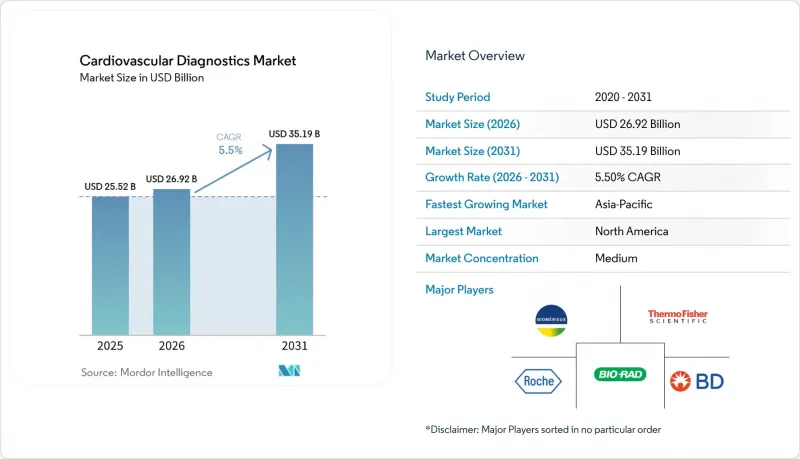
According to Mordor Intelligence, the cardiovascular diagnostics market size is expected to grow from USD 25.52 billion in 2025 to USD 26.92 billion in 2026 and is forecast to reach USD 35.19 billion by 2031 at 5.5% CAGR over 2026-2031.
Global Cardiovascular Diagnostics Market Trends and Insights
Rising Cardiovascular Disease Burden and Population Aging
The cardiovascular diagnostics market has a broad demand base, as cardiovascular conditions require ongoing monitoring. A 2025 analysis in the Journal of the American College of Cardiology reported 626 million prevalent cardiovascular disease cases worldwide in 2023, compared with 311 million in 1990. Population aging and the continued prevalence of hypertension, obesity, and dyslipidemia are increasing screening and follow-up requirements. Patients may require electrocardiography, biomarker testing, imaging, and stress testing across different stages of care. Screening programs in India and Japan also support the early identification and referral of at-risk individuals.
High-Sensitivity Cardiac Biomarker Adoption
High-sensitivity troponin assays are improving acute coronary syndrome triage by delivering more precise results earlier in the care pathway. Roche reported that its Elecsys Troponin T hs Gen 6 test achieved a 99.7% negative predictive value in the TSIX study and supported the discharge of 56.6% of emergency department patients within the first hours of presentation. The company also reported a 10-fold improvement in resistance to hemolysis compared with the prior formulation. Standardized sample handling and clinical cutoffs can support consistent laboratory use, while European rapid rule-out guidelines are influencing adoption across Asia-Pacific. This trend is increasing demand for high-throughput immunoassay analyzers and point-of-care platforms.
Capital Cost, Workflow Integration, and Digital Risk
Premium cardiac imaging systems require substantial capital planning, which can delay adoption outside well-funded medical centers. Secondary and tertiary hospitals in sub-Saharan Africa, Southeast Asia, and Latin America may need public funding or development financing to procure advanced systems. Implementation can also require links with imaging archives and electronic health records, staff training, and cybersecurity validation. These tasks can extend deployment by 6 to 18 months at a site. Leasing and long-term partnership models can reduce upfront costs, but smaller institutions may not qualify for these arrangements. Multimodal testing can also create false-positive findings, while algorithm drift and data exchange failures increase clinical and legal risk for connected platforms.
Other drivers and restraints analyzed in the detailed report include:
- Point-of-Care Testing and Care Continuity
- AI-Enabled Imaging and Electrocardiography
- Reimbursement Pressure and Evidence Requirements
For complete list of drivers and restraints, kindly check the Table Of Contents.
Segment Analysis
Electrocardiography Systems held 52.56% of the cardiovascular diagnostics market share in 2025. The segment supports applications ranging from resting 12-lead ECGs to Holter monitoring and implantable loop recorders. Its broad adoption reflects established clinical use, lower unit costs, and demand across acute and routine care. Wearable ECG devices and implantable recorders are expanding continuous monitoring beyond episodic testing. iRhythm Technologies received FDA 510(k) clearance for its ZEUS Platform in June 2026 and stated that its third-generation algorithm could reduce clinician review time by 50% and generate USD 100 million in cumulative cost savings over five years.
Echocardiography Systems are forecast to grow at a 7.15% CAGR from 2026 to 2031. Growth is driven by automation that reduces operator dependence and supports broader adoption. GE HealthCare stated that Vivid Pioneer reduced ejection fraction analysis to less than nine seconds through Easy AFI, while 4D Auto LHQ automated left-heart quantification workflows. Three-dimensional and four-dimensional imaging support structural heart procedure planning, including TAVI and MitraClip. Cardiac imaging systems, vascular diagnostic devices, ECG electrodes, and contrast media support diagnostic applications, recurring testing, and procedure volumes across the cardiovascular diagnostics industry.
Analyzers accounted for 47.76% of point-of-care testing revenue in 2025. In emergency departments, troponin, BNP, and D-dimer results directly influence patient disposition decisions. Faster results can reduce overcrowding, lower episode costs, and mitigate risks associated with delayed triage. Clinical guidance on high-sensitivity troponin implementation provides analytical criteria for system validation, creating a clearer procurement path for smaller institutions. Analyzers strengthen the cardiovascular diagnostics market by delivering central-laboratory-quality results closer to patients.
Angiotensin Test Kits are forecast to grow at an 8.80% CAGR through 2031. Growth reflects a shift toward more comprehensive cardiovascular risk assessment beyond acute diagnostic thresholds. Research on renin-angiotensin system peptide panels supports sex- and ethnicity-specific reference ranges when standardized sample protocols are used. Lipoprotein Test Kits and High-Sensitivity CRP Kits remain relevant for dyslipidemia and inflammation assessment, while Fibrinogen and Serum Uric Acid Test Kits support growing cardiovascular risk protocols in Europe and Asia-Pacific. These tests expand the cardiovascular diagnostics industry into primary care risk management.
Complete Report Scope:
- By Product and Modality
- Electrocardiography Systems
- Resting Electrocardiography Systems
- Stress ECG
- Holter Monitoring Devices
- Event Monitoring Devices
- Implantable Loop Recorders
- Mobile and Wearable ECG Devices
- Echocardiography Systems
- 2D Echocardiography
- 3D/4D Echocardiography
- Doppler Echocardiography
- Stress Echocardiography
- Cardiac Imaging System
- Cardiac CT
- Cardiac MRI
- Nuclear Cardiac Imaging
- Coronary Angiography
- Vascular Diagnostics Devices
- Doppler ultrasound
- Vascular ultrasound
- Ankle-brachial index (ABI) systems
- Peripheral vascular testing systems
- Cardiac Diagnostic Consumables & Accessories
- ECG electrodes
- ECG cables/leads
- Contrast media
- Imaging consumables
- Other accessories
- Electrocardiography Systems
- By Point Of Care Testing
- Analyzers
- Lipoprotein Test Kit
- Angiotensin Test Kit
- Fribrinogen Test Kit
- Serum Uric Acid Test Kit
- High Sensitivity CRP Kits
- Others
- By Disease
- Coronary Artery Disease
- Heart Failure
- Arrhythmias
- Valvular Heart Disease
- Cardiomyopathy
- Congenital Heart Disease
- Peripheral Artery Disease
- Hypertension
- Atherosclerosis
- Other Cardiovascular Diseases
- By End User
- Hospitals & Health systems
- Diagnostic Laboratories
- Specialty Cardiology Clinics
- Ambulatory Surgical Centers
- Physician Offices
- Academic and Research Institutes
- Home Care Settings
- By Geography
- North America
- United States
- Canada
- Mexico
- Europe
- Germany
- United Kingdom
- France
- Italy
- Spain
- Rest of Europe
- Asia-Pacific
- China
- India
- Japan
- Australia
- South Korea
- Rest of Asia-Pacific
- Middle East and Africa
- GCC
- South Africa
- Rest of Middle East and Africa
- South America
- Brazil
- Argentina
- Rest of South America
- North America
Geography Analysis
North America held 39.44% of global revenue in 2025, supported by a high concentration of acute cardiac care centers and an established reimbursement environment for cardiac technologies. The region's diagnostic infrastructure enabled the integration of imaging, biomarkers, electrocardiography, and software across care pathways. GE HealthCare launched Flyrcado, or flurpiridaz F 18, PET myocardial perfusion imaging in the United States at the ACC Annual Session in March 2025. Canada and Mexico expanded diagnostic laboratory capacity, while the United States remained the primary source of regional demand.
Europe demonstrated mature demand for cardiovascular diagnostics, supported by large hospital systems and specialist cardiology centers. Germany, the United Kingdom, and France remained key demand centers, while stringent health technology assessment requirements favored clinically validated products. Roche received CE Mark for Elecsys Troponin T hs Gen 6 in 2025, and the TSIX program included more than 4,000 patients. The EU Medical Device Regulation strengthened quality requirements through post-market surveillance but extended approval timelines. Siemens Healthineers equipped the Heart and Vascular Center at University Medical Center Hamburg-Eppendorf with 13 angiography systems, a photon-counting CT system, and a 3T MRI in 2025.
Asia-Pacific is forecast to grow at an 8.88% CAGR through 2031, representing the fastest regional growth rate in the cardiovascular diagnostics market. China's Healthy China 2030 initiative, India's expanding diagnostic chain network, and the adoption of AI-enabled monitoring supported demand. China had 310 million people aged 60 and above by 2025, increasing the need for large-scale screening. Japan and South Korea directed resources toward earlier detection and referral, while Siemens Healthineers Korea signed an MOU with Phantomics in 2025 to integrate Myomics AI-based cardiac MRI analysis into clinical workflows. Middle East & Africa and South America remained earlier-stage regions, although Gulf Cooperation Council investments and hospital modernization in Brazil supported adoption in urban centers.
- Abbott Laboratories
- AliveCor
- Beckton Dickinson
- bioMerieux
- Bio-Rad Laboratories
- Boston Scientific
- Canon
- Danaher
- DiaSorin
- Edward Lifesciences
- Roche
- FUJIFILM
- GE HealthCare Technologies Inc.
- HeartFlow, Inc.
- Koninklijke Philips
- Masimo
- Medtronic
- Midmark
- Powerful Medical s.r.o.
- QuidelOrtho
- Schiller
- Mindray
- Siemens Healthineers
- Thermo Fisher Scientific
- Ultromics Ltd.
- Werfen SA
Additional Benefits:
- The market estimate (ME) sheet in Excel format
- 3 months of analyst support
TABLE OF CONTENTS
1 INTRODUCTION
- 1.1 Study Assumptions and Market Definition
- 1.2 Scope of the Study
2 RESEARCH METHODOLOGY
3 EXECUTIVE SUMMARY
4 MARKET LANDSCAPE
- 4.1 Market Overview
- 4.2 Market Drivers
- 4.2.1 Rising Cardiovascular Disease Burden and Population Aging
- 4.2.2 High-Sensitivity Cardiac Biomarker Adoption [Mainstream]
- 4.2.3 Shift Toward Point-of-Care and Decentralized Testing
- 4.2.4 AI-Enabled Imaging and Electrocardiography
- 4.2.5 Longitudinal Hospital-to-Home Diagnostic Continuity
- 4.2.6 Ambient-Temperature Assays and Tier-2/Tier-3 Distribution
- 4.3 Market Restraints
- 4.3.1 High Capital Cost and Workflow-Integration Complexity
- 4.3.2 Reimbursement Pressure and Evidence Uncertainty
- 4.3.3 False-Positive Cascades From Multimodal AI and Biomarker Testing
- 4.3.4 Cybersecurity, Algorithm Drift and Interoperability Liability
- 4.4 Value/Supply-Chain Analysis
- 4.5 Regulatory Landscape
- 4.6 Technological Outlook
- 4.7 Porter's Five Forces Analysis
- 4.7.1 Bargaining Power of Suppliers
- 4.7.2 Bargaining Power of Buyers
- 4.7.3 Threat of New Entrants
- 4.7.4 Threat of Substitutes
- 4.7.5 Competitive Rivalry
5 MARKET SIZE AND GROWTH FORECASTS (VALUE, USD)
- 5.1 By Product and Modality
- 5.1.1 Electrocardiography Systems
- 5.1.1.1 Resting Electrocardiography Systems
- 5.1.1.2 Stress ECG
- 5.1.1.3 Holter Monitoring Devices
- 5.1.1.4 Event Monitoring Devices
- 5.1.1.5 Implantable Loop Recorders
- 5.1.1.6 Mobile and Wearable ECG Devices
- 5.1.2 Echocardiography Systems
- 5.1.2.1 2D Echocardiography
- 5.1.2.2 3D/4D Echocardiography
- 5.1.2.3 Doppler Echocardiography
- 5.1.2.4 Stress Echocardiography
- 5.1.3 Cardiac Imaging System
- 5.1.3.1 Cardiac CT
- 5.1.3.2 Cardiac MRI
- 5.1.3.3 Nuclear Cardiac Imaging
- 5.1.3.4 Coronary Angiography
- 5.1.4 Vascular Diagnostics Devices
- 5.1.4.1 Doppler ultrasound
- 5.1.4.2 Vascular ultrasound
- 5.1.4.3 Ankle-brachial index (ABI) systems
- 5.1.4.4 Peripheral vascular testing systems
- 5.1.5 Cardiac Diagnostic Consumables & Accessories
- 5.1.5.1 ECG electrodes
- 5.1.5.2 ECG cables/leads
- 5.1.5.3 Contrast media
- 5.1.5.4 Imaging consumables
- 5.1.5.5 Other accessories
- 5.1.1 Electrocardiography Systems
- 5.2 By Point Of Care Testing
- 5.2.1 Analyzers
- 5.2.2 Lipoprotein Test Kit
- 5.2.3 Angiotensin Test Kit
- 5.2.4 Fribrinogen Test Kit
- 5.2.5 Serum Uric Acid Test Kit
- 5.2.6 High Sensitivity CRP Kits
- 5.2.7 Others
- 5.3 By Disease
- 5.3.1 Coronary Artery Disease
- 5.3.2 Heart Failure
- 5.3.3 Arrhythmias
- 5.3.4 Valvular Heart Disease
- 5.3.5 Cardiomyopathy
- 5.3.6 Congenital Heart Disease
- 5.3.7 Peripheral Artery Disease
- 5.3.8 Hypertension
- 5.3.9 Atherosclerosis
- 5.3.10 Other Cardiovascular Diseases
- 5.4 By End User
- 5.4.1 Hospitals & Health systems
- 5.4.2 Diagnostic Laboratories
- 5.4.3 Specialty Cardiology Clinics
- 5.4.4 Ambulatory Surgical Centers
- 5.4.5 Physician Offices
- 5.4.6 Academic and Research Institutes
- 5.4.7 Home Care Settings
- 5.5 By Geography
- 5.5.1 North America
- 5.5.1.1 United States
- 5.5.1.2 Canada
- 5.5.1.3 Mexico
- 5.5.2 Europe
- 5.5.2.1 Germany
- 5.5.2.2 United Kingdom
- 5.5.2.3 France
- 5.5.2.4 Italy
- 5.5.2.5 Spain
- 5.5.2.6 Rest of Europe
- 5.5.3 Asia-Pacific
- 5.5.3.1 China
- 5.5.3.2 India
- 5.5.3.3 Japan
- 5.5.3.4 Australia
- 5.5.3.5 South Korea
- 5.5.3.6 Rest of Asia-Pacific
- 5.5.4 Middle East and Africa
- 5.5.4.1 GCC
- 5.5.4.2 South Africa
- 5.5.4.3 Rest of Middle East and Africa
- 5.5.5 South America
- 5.5.5.1 Brazil
- 5.5.5.2 Argentina
- 5.5.5.3 Rest of South America
- 5.5.1 North America
6 COMPETITIVE LANDSCAPE
- 6.1 Market Concentration
- 6.2 Market Share Analysis
- 6.3 Company Profiles (includes Global Level Overview, Market Level Overview, Core Segments, Financials as available, Strategic Information, Market Rank/Share, Products and Services, Recent Developments)
- 6.3.1 Abbott Laboratories
- 6.3.2 AliveCor, Inc.
- 6.3.3 Becton, Dickinson and Company
- 6.3.4 bioMerieux SA
- 6.3.5 Bio-Rad Laboratories, Inc.
- 6.3.6 Boston Scientific Corporation
- 6.3.7 Canon Medical Systems Corporation
- 6.3.8 Danaher Corporation
- 6.3.9 DiaSorin S.p.A.
- 6.3.10 Edwards Lifesciences Corporation
- 6.3.11 F. Hoffmann-La Roche Ltd
- 6.3.12 Fujifilm Holdings Corporation
- 6.3.13 GE HealthCare Technologies Inc.
- 6.3.14 HeartFlow, Inc.
- 6.3.15 Koninklijke Philips N.V.
- 6.3.16 Masimo Corporation
- 6.3.17 Medtronic plc
- 6.3.18 Midmark Corporation
- 6.3.19 Powerful Medical s.r.o.
- 6.3.20 QuidelOrtho Corporation
- 6.3.21 Schiller AG
- 6.3.22 Shenzhen Mindray Bio-Medical Electronics Co., Ltd.
- 6.3.23 Siemens Healthineers AG
- 6.3.24 Thermo Fisher Scientific Inc.
- 6.3.25 Ultromics Ltd.
- 6.3.26 Werfen SA
7 MARKET OPPORTUNITIES AND FUTURE OUTLOOK
- 7.1 White-Space and Unmet-Need Assessment

