PUBLISHER: Mordor Intelligence | PRODUCT CODE: 2154324

PUBLISHER: Mordor Intelligence | PRODUCT CODE: 2154324
Testing Equipment and Services - Market Share Analysis, Industry Trends & Statistics, Growth Forecasts (2026 - 2031)
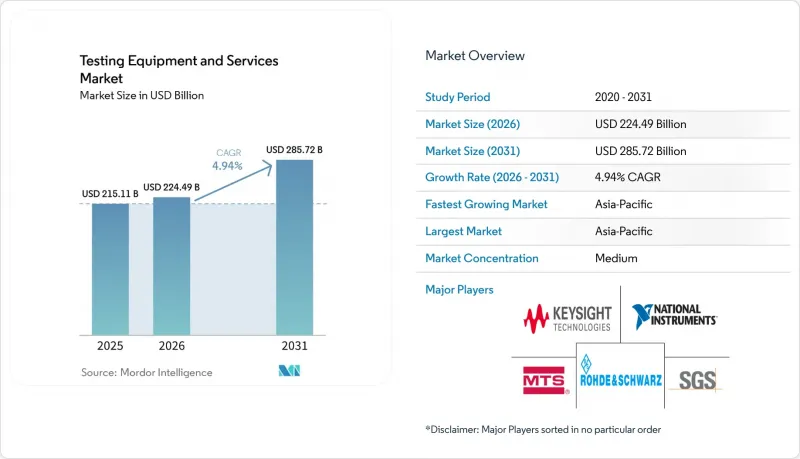
According to Mordor Intelligence, the testing equipment and services market size was valued at USD 215.11 billion in 2025 and estimated to grow from USD 224.49 billion in 2026 to reach USD 285.72 billion by 2031, at a CAGR of 4.94% during the forecast period (2026-2031).
Global Testing Equipment and Services Market Trends and Insights
Increasing Product Quality and Safety Regulations
Mandatory safety rules are making testing a condition of market access rather than a discretionary quality step. The EU AI Act, enacted in 2024, introduced conformity assessment requirements for AI-enabled systems. Those requirements affect electronics manufacturers, automotive suppliers, and industrial equipment producers before they release products. DEKRA became the first accredited certification body for biometric AI systems under the EU AI Act in 2025, showing how new rules can create specialized validation work. Digital product passport requirements under the EU Ecodesign Regulation framework also extend assessment from functional safety to material traceability. ISO/IEC 17025 supports laboratory competence requirements across geographies and strengthens buyer preference for certified providers.
Expansion of Electronics, Semiconductor, and EV Industries
The testing equipment and services market benefits from higher test intensity as semiconductor devices become more complex. The testing equipment and services market also requires suppliers to maintain current capabilities as device architectures evolve. Global semiconductor equipment billings reached USD 135.1 billion in 2025, up 15% from the prior year. Test equipment billings rose 55% as AI accelerator and high-bandwidth memory requirements increased testing precision. Migration to 3-nanometer nodes and heterogeneous chiplet packaging requires wafer-level defect detection beyond the capability of older platforms. Electric vehicle programs also require battery-pack integrity, charging compliance, electromagnetic compatibility, and functional safety testing. Keysight Technologies and the CATARC New Energy Vehicle Inspection Center established a joint charging-test laboratory in May 2026 for China's National Standard 2024 and combined charging system frameworks.
High Initial Investment and Maintenance Costs
Capital costs limit laboratory operators' entry and expansion, especially in price-sensitive economies. Environmental simulation chambers and semiconductor automated test equipment can require six- to seven-figure unit investments. Annual maintenance, calibration, and software licensing can represent 15-25% of the purchase price each year. This burden concentrates advanced capacity within established markets and large TIC networks. Mid-sized manufacturers in South America, Africa, and parts of Southeast Asia may find it difficult to upgrade internal facilities to recognized international standards. The resulting cost base can constrain reinvestment even when manufacturers need more capable testing capacity.
Other drivers and restraints analyzed in the detailed report include:
- Growth of Advanced Manufacturing and Industrial Automation
- Rising Adoption of Non-Destructive Testing Technologies
- Short Technology Lifecycles and Rapid Equipment Obsolescence
For complete list of drivers and restraints, kindly check the Table Of Contents.
Segment Analysis
Testing services held 56.31% of the testing equipment and services market share in 2025 and are projected to grow at a 5.34% CAGR through 2031. Manufacturers are increasingly using external providers when formal conformity outcomes require accredited third-party participation. Outsourced laboratories can handle changing rules across several jurisdictions without requiring every manufacturer to maintain specialized internal capacity. This model is particularly useful for companies that have limited testing volumes or sell products across several regulated markets. Laboratory testing is a major source of TIC revenue because many assessments require controlled conditions and calibrated instruments. The services segment also benefits when clients need independent records for regulators, customers, or cross-border distribution.
Testing equipment remains important for in-process control and for service providers seeking technical differentiation. Equipment ownership allows manufacturers to identify production issues before products reach an external laboratory. Original equipment manufacturers are adding AI-enabled instrumentation, digital connectivity modules, and software subscriptions to their platforms. These additions can improve traceability and support recurring revenue for equipment suppliers. They also help hardware vendors respond as service spending takes a larger role in the testing equipment and services market. The offering split reflects a practical balance between internal quality control and outsourced work that requires external credibility.
Electrical and electronic testing equipment accounted for 23.67% of the testing equipment and services market size in 2025. Semiconductor fabrication, consumer electronics production, and electric vehicle battery validation support demand for this equipment. Device complexity increases the need for tools that measure performance, connectivity, safety, and reliability. Semiconductor producers require finer defect detection as they move to smaller nodes and advanced packaging. Electric vehicle programs add test requirements across battery integrity, charging, electromagnetic compatibility, and functional safety. These applications place electrical and electronic equipment at the center of equipment demand.
Optical and imaging testing equipment is projected to grow at a 5.89% CAGR through 2031. Machine vision is becoming more common in automated factories, while CT imaging supports 3D verification of aerospace and automotive components. Mechanical equipment remains necessary for structural safety certification. Environmental equipment supports reliability testing for electronics in demanding automotive and industrial conditions. Non-destructive testing equipment is progressing with phased-array ultrasonics and digital radiography. Chemical and analytical, safety and compliance, and material testing systems continue to serve separate technical needs across the testing equipment and services market.
Complete Report Scope:
- By Offering
- Testing Equipment
- Testing Services
- By Equipment Type
- Electrical and Electronic Testing Equipment
- Mechanical Testing Equipment
- Material Testing Equipment
- Environmental Testing Equipment
- Non-Destructive Testing (NDT) Equipment
- Optical and Imaging Testing Equipment
- Chemical and Analytical Testing Equipment
- Safety and Compliance Testing Equipment
- Other Testing Equipment Types
- By Service Type
- Laboratory Testing
- On-Site Testing
- By Accreditation
- Accredited Testing
- Non-Accredited Testing
- By End-user Industry
- Industrial Manufacturing
- Aerospace and Defense
- Automotive and Transportation
- Oil and Gas
- Pharmaceuticals and Biotechnology
- Chemicals and Materials
- Electronics and Semiconductor
- Energy and Power
- Food and Beverage
- Construction and Infrastructure
- Other End-User Industries
- By Geography
- North America
- United States
- Canada
- Mexico
- South America
- Brazil
- Argentina
- Rest of South America
- Europe
- Germany
- United Kingdom
- France
- Italy
- Spain
- Rest of Europe
- Asia-Pacific
- China
- Japan
- India
- South Korea
- ASEAN
- Rest of Asia-Pacific
- Middle East and Africa
- Middle East
- Saudi Arabia
- United Arab Emirates
- Turkey
- Rest of the Middle East
- Africa
- South Africa
- Nigeria
- Rest of Africa
- Middle East
- North America
Geography Analysis
Asia-Pacific held 33.20% of the testing equipment and services market share in 2025 and is projected to grow at a 5.68% CAGR through 2031. China supports regional demand through semiconductor manufacturing capacity and its domestic electric vehicle supply chain. Both activities require intensive testing across components, systems, and production processes. South Korea's semiconductor and display sectors provide consistent demand for testing equipment. India is becoming an important demand center as Production Linked Incentive programs support investment in electronics and pharmaceutical manufacturing. This growth creates demand for outsourced laboratory work that local and international TIC providers seek to serve.
TUV SUD inaugurated a SGD 100 million regional hub in Singapore in 2026, equal to USD 75 million at the 2024 average exchange rate. The hub illustrates ASEAN's role as both a service base and a regional compliance center. Federal regulation, defense and aerospace requirements, and the expansion of semiconductor capacity under the CHIPS and Science Act support North America. SGS completed its acquisition of Applied Technical Services in January 2026. The transaction delivered 80% of SGS's goal to more than double North American sales by 2027. Element Materials Technology received U.S. Nationally Recognized Testing Laboratory recognition for hazardous-location certification in March 2026, the first UK-based facility to receive that status.
Europe is supported by Germany, the United Kingdom, and France, where automotive, aerospace, and industrial production sustain demand for testing. DEKRA reported EUR 4.4 billion (USD USD 4.8 billion) in revenue in 2025, and grew 3.4% during a difficult European automotive period. TUV Rheinland invested EUR 87.2 million (USD 100.82 million) in laboratory expansion and digitalization in 2025, including facilities in Taicang and Shenzhen. South America is attracting formal TIC investment, as shown by Intertek's February 2026 acquisition of QTEST, a Colombian electrical testing and certification provider. Middle East and Africa activity is concentrated in extractive-industry inspection, product import certification, and renewable-energy certification linked to national industrial agendas.
- Keysight Technologies, Inc.
- Rohde and Schwarz GmbH and Co. KG
- National Instruments Corporation
- SGS SA
- MTS Systems Corporation
- Fluke Corporation
- Anritsu Corporation
- Yokogawa Electric Corporation
- Mitutoyo Corporation
- Illinois Tool Works Inc.
- Tektronix, Inc.
- Bureau Veritas SA
- Intertek Group plc
- TUV SUD AG
- TUV Rheinland AG
- Eurofins Scientific SE
- UL LLC
- Applus Services, S.A.
- Element Materials Technology Group Limited
- DEKRA SE
Additional Benefits:
- The market estimate (ME) sheet in Excel format
- 3 months of analyst support
TABLE OF CONTENTS
1 INTRODUCTION
- 1.1 Study Assumptions and Market Definition
- 1.2 Scope of the Study
2 RESEARCH METHODOLOGY
3 EXECUTIVE SUMMARY
4 MARKET LANDSCAPE
- 4.1 Market Overview
- 4.2 Market Drivers
- 4.2.1 Increasing Product Quality and Safety Regulations
- 4.2.2 Growth of Advanced Manufacturing and Industrial Automation
- 4.2.3 Expansion of Electronics, Semiconductor, and EV Industries
- 4.2.4 Rising Adoption of Non-Destructive Testing (NDT) Technologies
- 4.2.5 Increasing Outsourcing of Testing Activities
- 4.2.6 Growing Focus on Product Reliability and Lifecycle Testing
- 4.3 Market Restraints
- 4.3.1 High Initial Investment and Maintenance Costs
- 4.3.2 Short Technology Lifecycles and Rapid Equipment Obsolescence
- 4.3.3 Shortage of Skilled Testing Professionals
- 4.3.4 Fragmented and Competitive Testing Services Landscape
- 4.4 Industry Value-Chain Analysis
- 4.5 Regulatory Landscape
- 4.6 Technological Outlook
- 4.7 Porter's Five Forces Analysis
- 4.7.1 Bargaining Power of Suppliers
- 4.7.2 Bargaining Power of Buyers
- 4.7.3 Threat of New Entrants
- 4.7.4 Threat of Substitutes
- 4.7.5 Intensity of Competitive Rivalry
- 4.8 Assessment of Macroeconomic Trends on the Market
5 MARKET SIZE AND GROWTH FORECASTS (VALUE)
- 5.1 By Offering
- 5.1.1 Testing Equipment
- 5.1.2 Testing Services
- 5.2 By Equipment Type
- 5.2.1 Electrical and Electronic Testing Equipment
- 5.2.2 Mechanical Testing Equipment
- 5.2.3 Material Testing Equipment
- 5.2.4 Environmental Testing Equipment
- 5.2.5 Non-Destructive Testing (NDT) Equipment
- 5.2.6 Optical and Imaging Testing Equipment
- 5.2.7 Chemical and Analytical Testing Equipment
- 5.2.8 Safety and Compliance Testing Equipment
- 5.2.9 Other Testing Equipment Types
- 5.3 By Service Type
- 5.3.1 Laboratory Testing
- 5.3.2 On-Site Testing
- 5.4 By Accreditation
- 5.4.1 Accredited Testing
- 5.4.2 Non-Accredited Testing
- 5.5 By End-user Industry
- 5.5.1 Industrial Manufacturing
- 5.5.2 Aerospace and Defense
- 5.5.3 Automotive and Transportation
- 5.5.4 Oil and Gas
- 5.5.5 Pharmaceuticals and Biotechnology
- 5.5.6 Chemicals and Materials
- 5.5.7 Electronics and Semiconductor
- 5.5.8 Energy and Power
- 5.5.9 Food and Beverage
- 5.5.10 Construction and Infrastructure
- 5.5.11 Other End-User Industries
- 5.6 By Geography
- 5.6.1 North America
- 5.6.1.1 United States
- 5.6.1.2 Canada
- 5.6.1.3 Mexico
- 5.6.2 South America
- 5.6.2.1 Brazil
- 5.6.2.2 Argentina
- 5.6.2.3 Rest of South America
- 5.6.3 Europe
- 5.6.3.1 Germany
- 5.6.3.2 United Kingdom
- 5.6.3.3 France
- 5.6.3.4 Italy
- 5.6.3.5 Spain
- 5.6.3.6 Rest of Europe
- 5.6.4 Asia-Pacific
- 5.6.4.1 China
- 5.6.4.2 Japan
- 5.6.4.3 India
- 5.6.4.4 South Korea
- 5.6.4.5 ASEAN
- 5.6.4.6 Rest of Asia-Pacific
- 5.6.5 Middle East and Africa
- 5.6.5.1 Middle East
- 5.6.5.1.1 Saudi Arabia
- 5.6.5.1.2 United Arab Emirates
- 5.6.5.1.3 Turkey
- 5.6.5.1.4 Rest of the Middle East
- 5.6.5.2 Africa
- 5.6.5.2.1 South Africa
- 5.6.5.2.2 Nigeria
- 5.6.5.2.3 Rest of Africa
- 5.6.5.1 Middle East
- 5.6.1 North America
6 COMPETITIVE LANDSCAPE
- 6.1 Market Concentration
- 6.2 Strategic Moves
- 6.3 Market Share Analysis
- 6.4 Company Profiles (includes Global level Overview, Market level overview, Core Segments, Financials as available, Strategic Information, Market Rank/Share for key companies, Products and Services, and Recent Developments)
- 6.4.1 Keysight Technologies, Inc.
- 6.4.2 Rohde and Schwarz GmbH and Co. KG
- 6.4.3 National Instruments Corporation
- 6.4.4 SGS SA
- 6.4.5 MTS Systems Corporation
- 6.4.6 Fluke Corporation
- 6.4.7 Anritsu Corporation
- 6.4.8 Yokogawa Electric Corporation
- 6.4.9 Mitutoyo Corporation
- 6.4.10 Illinois Tool Works Inc.
- 6.4.11 Tektronix, Inc.
- 6.4.12 Bureau Veritas SA
- 6.4.13 Intertek Group plc
- 6.4.14 TUV SUD AG
- 6.4.15 TUV Rheinland AG
- 6.4.16 Eurofins Scientific SE
- 6.4.17 UL LLC
- 6.4.18 Applus Services, S.A.
- 6.4.19 Element Materials Technology Group Limited
- 6.4.20 DEKRA SE
7 MARKET OPPORTUNITIES AND FUTURE OUTLOOK
- 7.1 White-space and Unmet-Need Assessment

