PUBLISHER: Mordor Intelligence | PRODUCT CODE: 2154325

PUBLISHER: Mordor Intelligence | PRODUCT CODE: 2154325
Vocal Cord Paralysis Treatment - Market Share Analysis, Industry Trends & Statistics, Growth Forecasts (2026 - 2031)
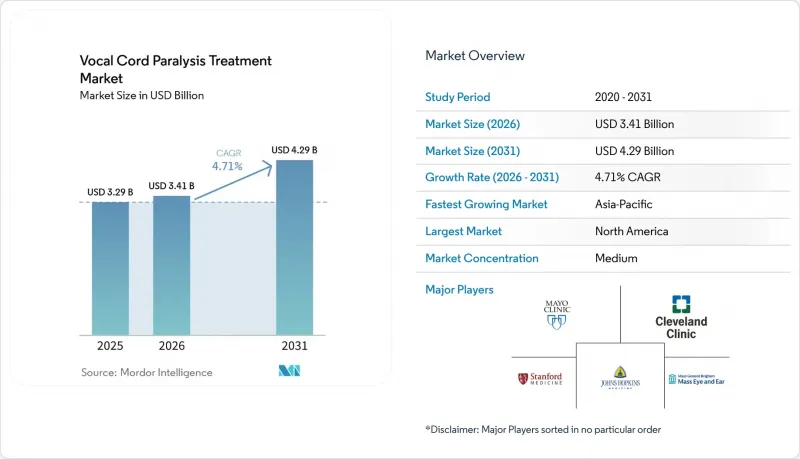
According to Mordor Intelligence, the vocal cord paralysis treatment market size was valued at USD 3.29 billion in 2025 and is estimated to grow from USD 3.41 billion in 2026 to reach USD 4.29 billion by 2031, at a CAGR of 4.71% during the forecast period (2026-2031).
Global Vocal Cord Paralysis Treatment Market Trends and Insights
Rising Volume of Thyroid, Cervical Spine and Cardiothoracic Surgery
Iatrogenic injury during thyroid, parathyroid, and anterior cervical spine procedures remains a major path into the vocal cord paralysis treatment market. Recurrent laryngeal nerve injury occurs in 3%-8% of temporary cases and 1%-3% of permanent cases after thyroid surgery.A 2025 randomized trial found that intraoperative neuromonitoring reduced temporary paralysis from 10% to 2% during open thyroid cancer surgery. The same study found that monitored patients recovered their voice nearly 11 days sooner. Wider monitoring use can reduce new injuries, but it also supports demand for monitoring hardware, electromyography endotracheal tubes, and software. Integration with robotic and navigation systems, including Medtronic's Stealth AXiS platform, may lower adoption barriers for these technologies.
Growing Neurological and Malignancy-Associated Vocal Fold Dysfunction
Neurological and oncology-related cases are expanding faster than surgical trauma cases in the vocal cord paralysis treatment market. Stroke, Parkinson's disease, and head and neck malignancies can impair or compress recurrent laryngeal nerve pathways. A 2024 tertiary-center study identified neoplastic causes in 32.9% of cases and neurological causes in 8.2% of cases. Lung cancer was the most frequent primary cancer within the neoplastic group. These patients often experience progressive or fluctuating symptoms rather than an immediate postsurgical loss of voice. Delayed presentation can increase treatment intensity and support closer laryngeal screening within neurology and oncology care.
High Procedure Costs and Reimbursement Variability
Reimbursement differences create major access gaps for voice therapy, even when emergency airway procedures remain available. A 2025 study found that nearly half of patients referred for voice therapy did not start treatment. Insurance was the primary reason cited by those patients. Medicaid and several commercial plans can limit the number of sessions before functional recovery is complete. Site-neutral payment reforms are also reducing the historic reimbursement premium for hospital-based medialization thyroplasty. Documentation requirements for CPT 31591 and HCPCS L8607 can concentrate procedures in high-volume practices with stronger coding capacity.
Other drivers and restraints analyzed in the detailed report include:
- Shift Toward Office-Based Injectable Laryngoplasty
- Earlier Intervention to Reduce Aspiration and Functional Loss
- Shortage of Laryngologists and Specialized Speech-Language Pathologists
For complete list of drivers and restraints, kindly check the Table Of Contents.
Segment Analysis
Unilateral vocal cord paralysis held 82.32% of the type segment in 2025 and is projected to expand at a 5.12% CAGR through 2031. The vocal cord paralysis treatment market centers on this form because it has the highest case frequency and several treatment routes. Those routes include temporary hyaluronic acid injection, medialization thyroplasty, and laryngeal reinnervation, each with different devices and materials. A pooled analysis of 967 patients across 5 studies found that unilateral cases occurred 3 times as often as bilateral cases, with iatrogenic surgical trauma as the leading cause.
Surgical treatment commanded 68.32% of the vocal cord paralysis treatment market size in 2025. It includes medialization thyroplasty, injection laryngoplasty, reinnervation, arytenoid adduction, and tracheotomy. These procedures remain important for persistent impairment or airway compromise. A 2025 meta-analysis of 896 patients across 13 studies compared injection laryngoplasty with medialization thyroplasty. It found comparable improvement in key voice measures, while injection laryngoplasty improved short-term jitter and thyroplasty improved long-term shimmer.
Non-surgical treatment is forecast to grow at a 5.82% CAGR through 2031. Digital and tele-speech therapy can extend care beyond specialist centers in the vocal cord paralysis treatment market. A 2026 study validated a high-sensitivity AI model for laryngeal lesion screening using the Bridge2AI-Voice dataset. The result supports telemedicine-ready assessment in underserved areas. A 2026 survey of 119 otorhinolaryngologists found that Korea and Taiwan favored injection laryngoplasty, while Japan favored laryngeal framework surgery.
Complete Report Scope:
- By Type
- Unilateral Vocal Cord Paralysis
- Left-Sided Unilateral Vocal Cord Paralysis
- Right-Sided Unilateral Vocal Cord Paralysis
- Bilateral Vocal Cord Paralysis
- Acute Bilateral Vocal Cord Paralysis
- Chronic Bilateral Vocal Cord Paralysis
- Unilateral Vocal Cord Paralysis
- By Treatment
- Surgical Treatment
- Medialization Thyroplasty
- Injection Laryngoplasty
- Laryngeal Reinnervation Surgery
- Arytenoid Adduction
- Tracheotomy
- Other Surgical Treatments
- Non-Surgical Treatment
- Voice Therapy
- Observation and Conservative Management
- Electromyography-Guided Treatment
- Digital and Tele-Speech Therapy
- Surgical Treatment
- By Etiology
- Surgical Trauma
- Neurological Disorders
- Malignancies
- Idiopathic and Post-Viral Conditions
- Trauma and Mechanical Injury
- Infections and Inflammatory Disorders
- Others
- By Treatment Provider
- Hospitals
- Ambulatory Surgical Centers
- Specialty ENT and Voice Clinics
- Rehabilitation Centers
- By Geography
- North America
- United States
- Canada
- Mexico
- Europe
- Germany
- United Kingdom
- France
- Italy
- Spain
- Rest of Europe
- Asia-Pacific
- China
- India
- Japan
- Australia
- South Korea
- Rest of Asia-Pacific
- Middle East and Africa
- GCC
- South Africa
- Rest of Middle East and Africa
- South America
- Brazil
- Argentina
- Rest of South America
- North America
Geography Analysis
North America held 40.32% of regional revenue in 2025. The vocal cord paralysis treatment market benefits in the region from specialist capacity, established reimbursement, and coverage for injectable bulking agents. The United States has many tertiary voice centers but uneven access beyond major metropolitan areas. The lack of an active primary laryngologist in 63% of hospital referral regions supports tele-speech therapy and AI-enabled office diagnostics. Canada covers core procedures at major academic centers, while Mexico's private hospitals are expanding ENT surgical capacity.
Europe is the second-largest regional area in the vocal cord paralysis treatment market, with Germany, France, the United Kingdom, and Italy anchoring demand. Germany's formal voice therapy framework supports rehabilitation after diagnosis. Asia-Pacific is projected to grow at a 6.45% CAGR through 2031, the fastest regional pace in the vocal cord paralysis treatment market. Japan, South Korea, and China have expanding laryngology communities and rising procedure awareness. A 2026 survey found that Japan preferred laryngeal framework surgery, while Korea and Taiwan preferred injection laryngoplasty.
- All India Institute of Medical Sciences
- Apollo Hospitals Enterprise Limited
- Charite - Universitatsmedizin Berlin
- Cleveland Clinic
- Johns Hopkins Medicine
- King Faisal Specialist Hospital and Research Centre
- Mass General Brigham
- Mayo Clinic
- Mount Sinai Health System
- NYU Langone Health
- Royal National Ear, Nose and Throat Hospital
- Sheba Medical Center
- Singapore General Hospital
- Stanford Health Care
- Toronto General Hospital
- UCSF Health
- University Hospital Heidelberg
- University Hospital Zurich
- University of Michigan Health
- University of Pittsburgh Medical Center
Additional Benefits:
- The market estimate (ME) sheet in Excel format
- 3 months of analyst support
TABLE OF CONTENTS
1 Introduction
- 1.1 Study Assumptions & Market Definition
- 1.2 Scope of the Study
2 Research Methodology
3 Executive Summary
4 Market Landscape
- 4.1 Market Overview
- 4.2 Market Drivers
- 4.2.1 Rising Volume of Thyroid, Cervical Spine and Cardiothoracic Surgery
- 4.2.2 Growing Neurological and Malignancy-Associated Vocal Fold Dysfunction
- 4.2.3 Shift Toward Office-Based Injectable Laryngoplasty
- 4.2.4 Earlier Intervention to Reduce Aspiration and Functional Loss
- 4.2.5 Continuous Recurrent Laryngeal Nerve Monitoring Adoption
- 4.2.6 AI-Assisted Laryngeal Imaging and Voice Assessment
- 4.3 Market Restraints
- 4.3.1 High Procedure Costs and Reimbursement Variability
- 4.3.2 Shortage of Laryngologists and Specialized Speech-Language Pathologists
- 4.3.3 Variable Recovery and Treatment Outcomes
- 4.3.4 Limited Interoperability of Voice, Imaging and Outcome Data
- 4.4 Value Chain Analysis
- 4.5 Regulatory Landscape
- 4.6 Technological Outlook
- 4.7 Porter's Five Forces
- 4.7.1 Threat of New Entrants
- 4.7.2 Bargaining Power of Suppliers
- 4.7.3 Bargaining Power of Buyers
- 4.7.4 Threat of Substitutes
- 4.7.5 Industry Rivalry
5 Market Size & Growth Forecasts (Value, USD)
- 5.1 By Type
- 5.1.1 Unilateral Vocal Cord Paralysis
- 5.1.1.1 Left-Sided Unilateral Vocal Cord Paralysis
- 5.1.1.2 Right-Sided Unilateral Vocal Cord Paralysis
- 5.1.2 Bilateral Vocal Cord Paralysis
- 5.1.2.1 Acute Bilateral Vocal Cord Paralysis
- 5.1.2.2 Chronic Bilateral Vocal Cord Paralysis
- 5.1.1 Unilateral Vocal Cord Paralysis
- 5.2 By Treatment
- 5.2.1 Surgical Treatment
- 5.2.1.1 Medialization Thyroplasty
- 5.2.1.2 Injection Laryngoplasty
- 5.2.1.3 Laryngeal Reinnervation Surgery
- 5.2.1.4 Arytenoid Adduction
- 5.2.1.5 Tracheotomy
- 5.2.1.6 Other Surgical Treatments
- 5.2.2 Non-Surgical Treatment
- 5.2.2.1 Voice Therapy
- 5.2.2.2 Observation and Conservative Management
- 5.2.2.3 Electromyography-Guided Treatment
- 5.2.2.4 Digital and Tele-Speech Therapy
- 5.2.1 Surgical Treatment
- 5.3 By Etiology
- 5.3.1 Surgical Trauma
- 5.3.2 Neurological Disorders
- 5.3.3 Malignancies
- 5.3.4 Idiopathic and Post-Viral Conditions
- 5.3.5 Trauma and Mechanical Injury
- 5.3.6 Infections and Inflammatory Disorders
- 5.3.7 Others
- 5.4 By Treatment Provider
- 5.4.1 Hospitals
- 5.4.2 Ambulatory Surgical Centers
- 5.4.3 Specialty ENT and Voice Clinics
- 5.4.4 Rehabilitation Centers
- 5.5 By Geography
- 5.5.1 North America
- 5.5.1.1 United States
- 5.5.1.2 Canada
- 5.5.1.3 Mexico
- 5.5.2 Europe
- 5.5.2.1 Germany
- 5.5.2.2 United Kingdom
- 5.5.2.3 France
- 5.5.2.4 Italy
- 5.5.2.5 Spain
- 5.5.2.6 Rest of Europe
- 5.5.3 Asia-Pacific
- 5.5.3.1 China
- 5.5.3.2 India
- 5.5.3.3 Japan
- 5.5.3.4 Australia
- 5.5.3.5 South Korea
- 5.5.3.6 Rest of Asia-Pacific
- 5.5.4 Middle East and Africa
- 5.5.4.1 GCC
- 5.5.4.2 South Africa
- 5.5.4.3 Rest of Middle East and Africa
- 5.5.5 South America
- 5.5.5.1 Brazil
- 5.5.5.2 Argentina
- 5.5.5.3 Rest of South America
- 5.5.1 North America
6 Competitive Landscape
- 6.1 Market Concentration
- 6.2 Market Share Analysis
- 6.3 Company Profiles (includes Global level Overview, Market level overview, Core Segments, Financials as available, Strategic Information, Market Rank/Share for key companies, Products & Services, and Recent Developments)
- 6.3.1 All India Institute of Medical Sciences
- 6.3.2 Apollo Hospitals Enterprise Limited
- 6.3.3 Charite - Universitatsmedizin Berlin
- 6.3.4 Cleveland Clinic
- 6.3.5 Johns Hopkins Medicine
- 6.3.6 King Faisal Specialist Hospital and Research Centre
- 6.3.7 Mass General Brigham
- 6.3.8 Mayo Clinic
- 6.3.9 Mount Sinai Health System
- 6.3.10 NYU Langone Health
- 6.3.11 Royal National Ear, Nose and Throat Hospital
- 6.3.12 Sheba Medical Center
- 6.3.13 Singapore General Hospital
- 6.3.14 Stanford Health Care
- 6.3.15 Toronto General Hospital
- 6.3.16 UCSF Health
- 6.3.17 University Hospital Heidelberg
- 6.3.18 University Hospital Zurich
- 6.3.19 University of Michigan Health
- 6.3.20 University of Pittsburgh Medical Center
7 Market Opportunities & Future Outlook
- 7.1 White-space & unmet-need assessment

