PUBLISHER: Mordor Intelligence | PRODUCT CODE: 2154327

PUBLISHER: Mordor Intelligence | PRODUCT CODE: 2154327
Embryo Incubator - Market Share Analysis, Industry Trends & Statistics, Growth Forecasts (2026 - 2031)
According to Mordor Intelligence, the embryo incubator market size is expected to increase from USD 106.20 million in 2025 to USD 110.20 million in 2026 and reach USD 140.60 million by 2031, growing at a CAGR of 4.98% over 2026-2031.
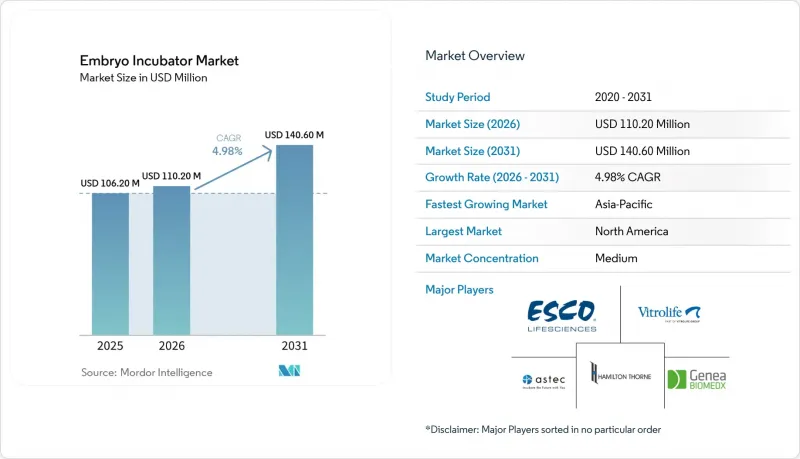
Global Embryo Incubator Market Trends and Insights
Rising Infertility and Delayed Parenthood
Delayed parenthood increases the need for careful embryo culture and monitoring during IVF treatment. Patients beginning treatment at older ages may require closer clinical assessment and more stable culture conditions. This supports demand for systems that manage temperature, carbon dioxide, oxygen, and humidity consistently. Public support programs in several Asian markets are bringing new patients into fertility care rather than serving only returning patients. New patient cohorts can lead to new clinic openings and complete laboratory installations, not only replacement purchases. The resulting combination of patient demand, new laboratory capacity, and higher equipment requirements provides a stable basis for the embryo incubator market over the forecast period.
Expansion of IVF and ICSI Workloads
IVF and ICSI workloads are increasing as fertility clinic networks add capacity in developing and established care markets. India had 2,616 registered IVF centers in December 2025, showing the scale of clinic infrastructure that now requires standardized laboratory equipment. ICSI requires precise post-injection culture conditions because embryos are sensitive to temperature, pH, and gas variation. Tri-gas and multiroom formats can support faster gas recovery and separate culture environments during busy laboratory schedules. Clinics that combine IVF and ICSI protocols therefore have a stronger reason to invest in systems with independent chambers and reliable environmental control. This relationship helps explain why ICSI is growing faster than the overall embryo incubator market even though IVF remains the larger application.
High Capital Cost and Limited Reimbursement
Time-lapse and tri-gas systems require a larger initial investment than conventional carbon dioxide incubators. Their cost may be difficult to justify in clinics with low cycle volumes or limited financing. Reimbursement for time-lapse monitoring remains uneven, so some clinics must recover the cost through patient fees. Quality management, validation, and regulatory documentation can add further operating expenses for smaller providers. This produces a two-tier purchasing pattern in which large fertility chains can spread investment across many cycles while independent clinics retain conventional systems. The embryo incubator market consequently has stronger premium-system penetration in urban, high-volume, and better-funded care settings.
Other drivers and restraints analyzed in the detailed report include:
- Undisturbed Time-Lapse Culture
- AI-Enabled Morphokinetic Decision Support
- Shortage of Skilled Embryologists and Service Engineers
For complete list of drivers and restraints, kindly check the Table Of Contents.
Segment Analysis
Tri-gas incubators held 30.32% of embryo incubator market share in 2025, supported by their controlled oxygen, carbon dioxide, and nitrogen environment. Their clinical appeal rests on the ability to maintain lower oxygen conditions that more closely match the reproductive tract. The 2026 study of tri-gas blending methods reported higher clinical pregnancy outcomes for the lumen-blending configuration.
Tri-gas incubators with camera are the fastest-growing product category, with the embryo incubator market size for this segment projected to grow at an 8.36% CAGR through 2031. The format combines controlled gas conditions with continuous image capture. It reduces the tradeoff between stable culture and access to developmental observations.
Time-lapse imaging accounted for 35.46% of embryo incubator market share in 2025. It has become a leading monitoring option in clinics that can support the capital cost and data review process. The technology records embryo development inside the incubator and reduces routine dish removal for microscopy. This supports consistent observation while maintaining controlled culture conditions. Standard incubation remains widely used in lower-volume facilities and research-oriented laboratories.
AI-enabled embryo assessment is projected to grow at an 8.79% CAGR through 2031. The segment uses image data to support embryo selection and reduce reliance on manual morphokinetic review. Research published in 2025 and 2026 has shown the potential of deep-learning models to analyze time-lapse images for embryo characteristics.
Complete Report Scope:
- By Product Type
- Tri-Gas Incubators
- Tri-Gas Incubators with Camera
- Conventional CO2 Incubators
- Portable and Compact Incubators
- Benchtop Embryo Incubators
- Floor-Standing Embryo Incubators
- By Technology
- Time-Lapse Imaging
- Standard Incubation
- Microprocessor-Controlled Incubation
- AI-Enabled Embryo Assessment
- Others (Automated Environmental Monitoring, Remote Monitoring and Data Management)
- By Chamber Configuration
- Single-Chamber Incubators
- Multiroom Incubators
- Individual Embryo Chambers
- By Capacity
- Single-Embryo Incubators
- Multi-Embryo Incubators
- High-Capacity Floor-Standing Incubators
- By Application
- In Vitro Fertilization (IVF)
- Intracytoplasmic Sperm Injection (ICSI)
- Embryo Research
- Embryo Storage Support
- Others (Preimplantation Genetic Testing (PGT) Support, Fertility Preservation Procedures)
- By End User
- Fertility Clinics
- Hospitals and Research Laboratories
- Private Embryology Laboratories
- Cryobanks
- Other End Users
- By Geography
- North America
- United States
- Canada
- Mexico
- Europe
- Germany
- United Kingdom
- France
- Italy
- Spain
- Rest of Europe
- Asia-Pacific
- China
- India
- Japan
- Australia
- South Korea
- Rest of Asia-Pacific
- Middle East and Africa
- GCC
- South Africa
- Rest of Middle East and Africa
- South America
- Brazil
- Argentina
- Rest of South America
- North America
Geography Analysis
North America held 43.21% of global embryo incubator market share in 2025. The region has a dense network of commercial fertility clinics and a strong base of premium laboratory equipment users. United States clinics often adopt time-lapse imaging and AI-supported tools early when regulatory and clinical requirements are met. The concentration of specialized clinics also supports vendor training, maintenance, and distribution networks. Insurance coverage changes in some states can expand the number of patients seeking multiple IVF cycles. This strengthens the case for clinic capacity and equipment investment. Workforce shortages in embryology also create interest in systems that can improve observation consistency and workflow efficiency.
Europe was the second-largest regional market in 2025. Scandinavia has an established culture of time-lapse use, while Germany, Spain, and the United Kingdom have large fertility clinic networks. The European Medical Device Regulation affects procurement because software and hardware vendors must meet defined regulatory requirements.
Asia-Pacific is the fastest-growing geography, with the embryo incubator market size in the region projected to grow at an 8.76% CAGR through 2031. Clinic expansion, public support measures, and a large group of underserved patients support this growth. Japan recorded 3,630 assisted reproduction cycles per million inhabitants, compared with 30 cycles per million in Indonesia, indicating substantial differences in access across the region.
- ASTEC Co., Ltd.
- Binder
- Cook Group
- The Cooper Companies
- Eppendorf
- Esco Lifesciences
- Fullei Medical
- Genea Biomedx Pty Ltd.
- Hamilton Thorne Ltd.
- Heal Force Bio-Meditech Holdings Ltd.
- Kivex Biotec Ltd.
- LABOTECT GmbH
- Merck
- PHC Holdings
- Planer PLC
- Thermo Fisher Scientific
- Vitrolife
- Weigao Group
Additional Benefits:
- The market estimate (ME) sheet in Excel format
- 3 months of analyst support
TABLE OF CONTENTS
1 Introduction
- 1.1 Study Assumptions & Market Definition
- 1.2 Scope of the Study
2 Research Methodology
3 Executive Summary
4 Market Landscape
- 4.1 Market Overview
- 4.2 Market Drivers
- 4.2.1 Rising Infertility and Delayed Parenthood
- 4.2.2 Expansion of IVF and Intracytoplasmic Sperm Injection Workloads
- 4.2.3 Migration From Disturbing Spot Checks to Undisturbed Time-Lapse Culture
- 4.2.4 Fertility Clinic Capacity Expansion in Asia-Pacific and the Middle East
- 4.2.5 AI-Enabled Morphokinetic Decision Support
- 4.2.6 Lower Gas Consumption and Modular Multiroom Designs
- 4.3 Market Restraints
- 4.3.1 High Capital Cost and Limited Reimbursement
- 4.3.2 Shortage of Skilled Embryologists and Service Engineers
- 4.3.3 Validation Burden for Imaging and Embryo-Assessment Software
- 4.3.4 Gas, Sensor, and Replacement-Part Supply Concentration
- 4.4 Supply-Chain Analysis
- 4.5 Regulatory Landscape
- 4.6 Technological Outlook
- 4.7 Porter's Five Forces Analysis
- 4.7.1 Threat of New Entrants
- 4.7.2 Bargaining Power of Suppliers
- 4.7.3 Bargaining Power of Buyers
- 4.7.4 Threat of Substitutes
- 4.7.5 Industry Rivalry
5 Market Size & Growth Forecasts (Value, USD)
- 5.1 By Product Type
- 5.1.1 Tri-Gas Incubators
- 5.1.2 Tri-Gas Incubators with Camera
- 5.1.3 Conventional CO2 Incubators
- 5.1.4 Portable and Compact Incubators
- 5.1.5 Benchtop Embryo Incubators
- 5.1.6 Floor-Standing Embryo Incubators
- 5.2 By Technology
- 5.2.1 Time-Lapse Imaging
- 5.2.2 Standard Incubation
- 5.2.3 Microprocessor-Controlled Incubation
- 5.2.4 AI-Enabled Embryo Assessment
- 5.2.5 Others (Automated Environmental Monitoring, Remote Monitoring and Data Management)
- 5.3 By Chamber Configuration
- 5.3.1 Single-Chamber Incubators
- 5.3.2 Multiroom Incubators
- 5.3.3 Individual Embryo Chambers
- 5.4 By Capacity
- 5.4.1 Single-Embryo Incubators
- 5.4.2 Multi-Embryo Incubators
- 5.4.3 High-Capacity Floor-Standing Incubators
- 5.5 By Application
- 5.5.1 In Vitro Fertilization (IVF)
- 5.5.2 Intracytoplasmic Sperm Injection (ICSI)
- 5.5.3 Embryo Research
- 5.5.4 Embryo Storage Support
- 5.5.5 Others (Preimplantation Genetic Testing (PGT) Support, Fertility Preservation Procedures)
- 5.6 By End User
- 5.6.1 Fertility Clinics
- 5.6.2 Hospitals and Research Laboratories
- 5.6.3 Private Embryology Laboratories
- 5.6.4 Cryobanks
- 5.6.5 Other End Users
- 5.7 By Geography
- 5.7.1 North America
- 5.7.1.1 United States
- 5.7.1.2 Canada
- 5.7.1.3 Mexico
- 5.7.2 Europe
- 5.7.2.1 Germany
- 5.7.2.2 United Kingdom
- 5.7.2.3 France
- 5.7.2.4 Italy
- 5.7.2.5 Spain
- 5.7.2.6 Rest of Europe
- 5.7.3 Asia-Pacific
- 5.7.3.1 China
- 5.7.3.2 India
- 5.7.3.3 Japan
- 5.7.3.4 Australia
- 5.7.3.5 South Korea
- 5.7.3.6 Rest of Asia-Pacific
- 5.7.4 Middle East and Africa
- 5.7.4.1 GCC
- 5.7.4.2 South Africa
- 5.7.4.3 Rest of Middle East and Africa
- 5.7.5 South America
- 5.7.5.1 Brazil
- 5.7.5.2 Argentina
- 5.7.5.3 Rest of South America
- 5.7.1 North America
6 Competitive Landscape
- 6.1 Market Concentration
- 6.2 Market Share Analysis
- 6.3 Company Profiles {(includes Global level Overview, Market level overview, Core Segments, Financials as available, Strategic Information, Market Rank/Share for key companies, Products & Services, and Recent Developments)}
- 6.3.1 ASTEC Co., Ltd.
- 6.3.2 Binder GmbH
- 6.3.3 Cook Medical LLC
- 6.3.4 CooperSurgical, Inc.
- 6.3.5 Eppendorf SE
- 6.3.6 Esco Lifesciences Group
- 6.3.7 Fullei Medical
- 6.3.8 Genea Biomedx Pty Ltd.
- 6.3.9 Hamilton Thorne Ltd.
- 6.3.10 Heal Force Bio-Meditech Holdings Ltd.
- 6.3.11 Kivex Biotec Ltd.
- 6.3.12 LABOTECT GmbH
- 6.3.13 Merck KGaA
- 6.3.14 PHC Holdings Corporation
- 6.3.15 Planer PLC
- 6.3.16 Thermo Fisher Scientific Inc.
- 6.3.17 Vitrolife AB
- 6.3.18 Weigao Group
7 Market Opportunities & Future Outlook
- 7.1 White-space & unmet-need assessment

