PUBLISHER: Mordor Intelligence | PRODUCT CODE: 2154328

PUBLISHER: Mordor Intelligence | PRODUCT CODE: 2154328
Advance Directives - Market Share Analysis, Industry Trends & Statistics, Growth Forecasts (2026 - 2031)
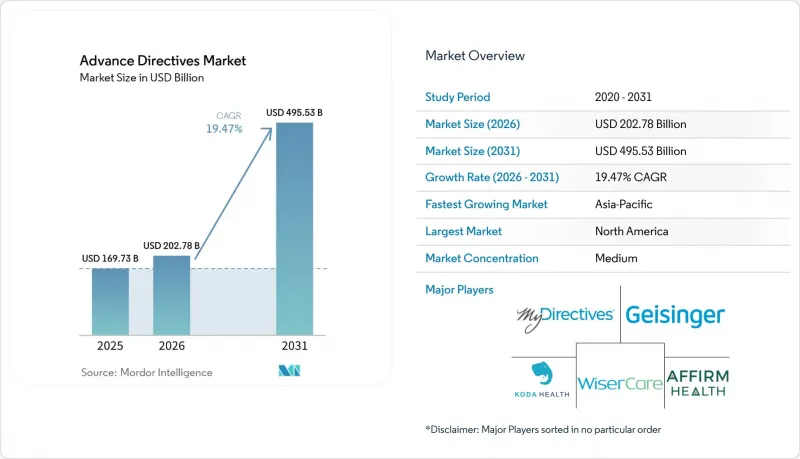
According to Mordor Intelligence, the advance directives market size was valued at USD 169.73 billion in 2025 and is estimated to grow from USD 202.78 billion in 2026 to reach USD 495.53 billion by 2031, at a CAGR of 19.47% during the forecast period (2026-2031).
Global Advance Directives Market Trends and Insights
Aging Population and Chronic, Life-Limiting Disease Burden
The World Health Organization projects that the global population aged 60 and older will reach 1.4 billion by 2030 and 2.1 billion by 2050. Adults aged 80 and older have a higher chance of sudden incapacity and often need documented decisions before an acute event occurs, making early discussion more useful than documentation completed during a hospital crisis. The advance directives market, therefore, reaches people before a serious illness begins, as well as patients already receiving complex care. The WHO European Region strategy for 2026 to 2030 calls for wider advance care planning within person-centered and integrated care. In China, a 2025 public health study linked the aging population and the financial burden of unwanted life-sustaining treatment with a stronger need for planning conversations. People with several chronic conditions also face repeated care transitions, giving clinicians more chances to begin or update these conversations across primary care, specialist visits, hospital stays, home care, and post-acute settings.
Government Support and Reimbursement for Advance Care Planning
Reimbursement makes advanced care planning more practical for providers who must allocate clinician time to these discussions, particularly when payment recognizes the work of explaining options, recording preferences, and engaging family members. The National Association of Community Health Centers lists a 2026 telehealth rate of USD 97.5 for ACP service G2025, with cost sharing waived when the service is billed with an Annual Wellness Visit. In Germany, Section 132g of the Social Code Book V allows long-term care facilities to bill statutory health insurance for ACP consultations. The national electronic patient record, or ePA, provides a common path for uploading patient documents across care settings, which can reduce dependence on paper files and locally held records. The advance directives market can gain when payment and documentation rules move ACP from an optional service to a regular part of the provider workflow. This setting can shorten procurement decisions for health systems that need compliant, retrievable documentation and must demonstrate that planning is available within regular care pathways.
Low Public Awareness, Cultural Reluctance, and Low Completion Rates
Low public awareness remains a major limit on adoption because planning often begins only after a crisis, when patients and relatives have less time to consider options without pressure. A 2026 systematic review protocol reported that 20% to 40% of adults in developed countries had completed some form of advance directive. Family-led decision making can reduce individual completion where cultural or religious customs give relatives a larger role in end-of-life choices, even when people have access to formal directive templates. A 2024 study of palliative care in Asia noted that Japan promoted ACP but still lacked a formal legal framework for advance directives and surrogate decision making. The study also described the role of unspoken expectations in Japan, which can make formal documentation less common. The Johns Hopkins findings showed weaker or absent protective effects among Black patients, indicating that trust, access, and culturally appropriate facilitation remain important alongside completion campaigns.
Other drivers and restraints analyzed in the detailed report include:
- Digital Health, Cloud Platforms, and EHR Integration
- Value-Based Care and Patient-Autonomy Quality Measures
- Jurisdictional Variation in Legal Forms and Execution Requirements
For complete list of drivers and restraints, kindly check the Table Of Contents.
Segment Analysis
Living Will held 38.45% share of the advance directives market in 2025. Its position reflects broad relevance across adult age groups and health conditions, as well as acceptance across U.S. states, which makes it a familiar starting point for patients and clinicians. A living will is often the first document used by consumer-facing ACP platforms because it can be completed before a serious illness. Healthcare Power of Attorney, also called a healthcare proxy, is often completed with a living will. Digital services such as FreeWill, Everplans, and MyDirectives commonly support this paired workflow. Mental health advance directives serve a separate need because a person may have capacity when drafting the document but lose it during a psychiatric episode, creating a documented record for a clinically distinct situation.
POLST/MOLST forms are projected to grow at a 19.89% CAGR from 2026 to 2031, the fastest rate among directive types. The advance directives market size for POLST/MOLST is supported by use in post-acute care, hospice, and serious illness settings. These forms are tied more closely to medical orders and immediate treatment decisions than living wills, so their value depends heavily on timely access by emergency and post-acute care teams. The PACIO FHIR work supports the ability to retrieve structured directive data through connected systems. In December 2025, MyDirectives announced that Oregon's POLST Registry became accessible nationwide through its A|D Vault Exchange and major exchange networks. DNR orders remain clinically important, but they are usually authored by practitioners within inpatient or hospice workflows and represent a narrower standalone software opportunity because they are commonly handled within existing clinical documentation processes.
Cloud-based systems accounted for 68.23% of the advance directives market in 2025. Their lead reflects the need for national, anytime access to directives during unexpected care events, when patients may receive treatment away from the organization where they completed their plan. Centralized cloud systems can support document storage, exchange connections, and access across different provider organizations. MyDirectives reports that its cloud-based exchange serves more than 90% of the U.S. healthcare ecosystem through national exchange networks. Japan also began a public digital directive pilot in Tsukuba City in 2025. The initiative tests data sharing among emergency, acute care, and home care settings through an ICT platform, addressing the same continuity problem that has shaped U.S. registry development.
On-premises deployment is forecast to grow at a 20.32% CAGR from 2026 to 2031. Large integrated delivery networks, Veterans Affairs facilities, and government-operated systems may prefer direct control of preference data because of their data governance duties. This buyer group can face contractual or regulatory limits on third-party data custody, and may also need control over local security policies, technical configurations, and internal access rules. Germany's national ePA architecture provides a related example of a nationally governed approach to health information. The German Federal Ministry of Health stated that GeDIG strengthens digital infrastructure and interoperability obligations. The advance directives market is therefore likely to retain both cloud registries for broad access and locally managed deployments for institutions with stricter governance needs, rather than moving entirely toward a single delivery model.
Complete Report Scope:
- By Directive Type
- Living Will
- Healthcare Power of Attorney (Healthcare Proxy)
- Do-Not-Resuscitate (DNR) Orders
- POLST/MOLST Forms
- Mental Health Advance Directives
- Others
- By Deployment
- Cloud-Based
- On-Premises
- By Component
- Software
- Services
- By End User
- Hospitals
- Long-Term Care Facilities
- Hospice & Palliative Care Centers
- Ambulatory Care Centers
- Others
- By Geography
- North America
- United States
- Canada
- Mexico
- Europe
- Germany
- United Kingdom
- France
- Italy
- Spain
- Rest of Europe
- Asia-Pacific
- China
- India
- Japan
- Australia
- South Korea
- Rest of Asia-Pacific
- Middle East and Africa
- GCC
- South Africa
- Rest of Middle East and Africa
- South America
- Brazil
- Argentina
- Rest of South America
- North America
Geography Analysis
North America held 36.72% share of the advance directives market in 2025. The region benefits from ACP reimbursement, established health information exchange networks, and a concentration of digital ACP platform providers, which together support both provider adoption and consumer-facing services. The PACIO implementation guide offers a U.S. framework for structured advance directive data exchange. MyDirectives states that its exchange reaches more than 90% of the U.S. healthcare ecosystem through national networks. Canada has a different pattern because provincial law can vary, which complicates national deployments and requires suppliers to adapt documentation and processes to local statutory settings. Mexico remains at an earlier stage because digital health infrastructure and ACP reimbursement are less developed in the supplied material.
Europe is a strategically important region because digital health rules and national health records can create paths for secure document access, although legal forms and clinical practices still vary across countries. Germany's electronic patient record became an important national infrastructure for sharing patient documents in 2025. The German Federal Ministry of Health stated in July 2026 that GeDIG expands the ePA infrastructure and supports further interoperability obligations. The United Kingdom has established ACP frameworks and a legal basis through the Mental Capacity Act. France, Italy, and Spain have developed different approaches to directive and patient-rights law. Cross-border data rules can improve portability for providers operating across European countries, provided suppliers can align their technology with local documentation and consent requirements.
Asia-Pacific is projected to grow at a 22.49% CAGR from 2026 to 2031. The advance directives market size in the region is shaped by aging populations, digital health programs, and broader attention to palliative care, although legal maturity and infrastructure differ widely among countries. Japan's Cabinet Office selected IIJ in August 2025 for a Tsukuba City pilot on data sharing across emergency, acute, and home care settings. China remains constrained by the lack of a nationwide legal ACP framework, while India's data protection law adds compliance considerations for multi-state deployments. Australia and South Korea provide more accessible settings because of stronger digital health infrastructure and end-of-life care frameworks, giving international entrants clearer routes to partnership and deployment. The Middle East and Africa remain early in adoption, with Saudi Arabia and the UAE identified in the supplied material as nearer opportunities through health digitalization programs. South America is also early in development, with Brazil and Argentina building awareness through hospice and palliative care advocacy.
- MyDirectives (ADVault)
- VyncaCare (formerly Vynca)
- WiserCare Inc.
- Koda Health
- Everplans
- FreeWill Co.
- ThoroughCare, Inc.
- thanacare
- Vital Decisions LLC (Evolent Health LLC)
- Affirm Health Inc.
- Honor My Decisions LLC
- ACP Decisions (a DBA of Nous Foundation, Inc.)
- Five Wishes
- MIDEO Health
- Backline by DrFirst
- CaringInfo (National Hospice and Palliative Care Organization)
- Geisinger
- Sharp HealthCare
- Bronson Healthcare
- Island Health
- Cake Software Inc.
- LegalZoom.com Inc.
- GoodTrust Corporation
- OneAccord Health LLC
- KanTime
Additional Benefits:
- The market estimate (ME) sheet in Excel format
- 3 months of analyst support
TABLE OF CONTENTS
1 Introduction
- 1.1 Study Assumptions & Market Definition
- 1.2 Scope of the Study
2 Research Methodology
3 Executive Summary
4 Market Landscape
- 4.1 Market Overview
- 4.2 Market Drivers
- 4.2.1 Aging Population and Chronic, Life-Limiting Disease Burden
- 4.2.2 Government Support and Reimbursement for Advance Care Planning
- 4.2.3 Digital Health, Cloud Platforms, and EHR Integration
- 4.2.4 Value-Based Care and Patient-Autonomy Quality Measures
- 4.2.5 EHR-Native Retrieval of Verifiable POLST and Advance Directive Data
- 4.2.6 Consumer-Generated, Continuously Updated Care-Preference Data
- 4.3 Market Restraints
- 4.3.1 Low Public Awareness, Cultural Reluctance, and Low Completion Rates
- 4.3.2 Jurisdictional Variation in Legal Forms and Execution Requirements
- 4.3.3 Fragmented Document Portability, Identity Matching, and Security Liability
- 4.3.4 AI Interpretation Liability and Provenance Risk in Clinical Decision Support
- 4.4 Value / Supply-Chain Analysis
- 4.5 Regulatory Landscape
- 4.6 Technological Outlook
- 4.7 Porter's Five Forces Analysis
- 4.7.1 Threat of New Entrants
- 4.7.2 Bargaining Power of Buyers
- 4.7.3 Bargaining Power of Suppliers
- 4.7.4 Threat of Substitutes
- 4.7.5 Competitive Rivalry
5 Market Size & Growth Forecasts (Value, USD)
- 5.1 By Directive Type
- 5.1.1 Living Will
- 5.1.2 Healthcare Power of Attorney (Healthcare Proxy)
- 5.1.3 Do-Not-Resuscitate (DNR) Orders
- 5.1.4 POLST/MOLST Forms
- 5.1.5 Mental Health Advance Directives
- 5.1.6 Others
- 5.2 By Deployment
- 5.2.1 Cloud-Based
- 5.2.2 On-Premises
- 5.3 By Component
- 5.3.1 Software
- 5.3.2 Services
- 5.4 By End User
- 5.4.1 Hospitals
- 5.4.2 Long-Term Care Facilities
- 5.4.3 Hospice & Palliative Care Centers
- 5.4.4 Ambulatory Care Centers
- 5.4.5 Others
- 5.5 By Geography
- 5.5.1 North America
- 5.5.1.1 United States
- 5.5.1.2 Canada
- 5.5.1.3 Mexico
- 5.5.2 Europe
- 5.5.2.1 Germany
- 5.5.2.2 United Kingdom
- 5.5.2.3 France
- 5.5.2.4 Italy
- 5.5.2.5 Spain
- 5.5.2.6 Rest of Europe
- 5.5.3 Asia-Pacific
- 5.5.3.1 China
- 5.5.3.2 India
- 5.5.3.3 Japan
- 5.5.3.4 Australia
- 5.5.3.5 South Korea
- 5.5.3.6 Rest of Asia-Pacific
- 5.5.4 Middle East and Africa
- 5.5.4.1 GCC
- 5.5.4.2 South Africa
- 5.5.4.3 Rest of Middle East and Africa
- 5.5.5 South America
- 5.5.5.1 Brazil
- 5.5.5.2 Argentina
- 5.5.5.3 Rest of South America
- 5.5.1 North America
6 Competitive Landscape
- 6.1 Market Concentration
- 6.2 Market Share Analysis
- 6.3 Company Profiles (includes Global Level Overview, Market Level Overview, Core Segments, Financials as Available, Strategic Information, Market Rank/Share for Key Companies, Products & Services, and Recent Developments)
- 6.3.1 MyDirectives (ADVault)
- 6.3.2 VyncaCare (formerly Vynca)
- 6.3.3 WiserCare Inc.
- 6.3.4 Koda Health
- 6.3.5 Everplans
- 6.3.6 FreeWill Co.
- 6.3.7 ThoroughCare, Inc.
- 6.3.8 thanacare
- 6.3.9 Vital Decisions LLC (Evolent Health LLC)
- 6.3.10 Affirm Health Inc.
- 6.3.11 Honor My Decisions LLC
- 6.3.12 ACP Decisions (a DBA of Nous Foundation, Inc.)
- 6.3.13 Five Wishes
- 6.3.14 MIDEO Health
- 6.3.15 Backline by DrFirst
- 6.3.16 CaringInfo (National Hospice and Palliative Care Organization)
- 6.3.17 Geisinger
- 6.3.18 Sharp HealthCare
- 6.3.19 Bronson Healthcare
- 6.3.20 Island Health
- 6.3.21 Cake Software Inc.
- 6.3.22 LegalZoom.com Inc.
- 6.3.23 GoodTrust Corporation
- 6.3.24 OneAccord Health LLC
- 6.3.25 KanTime
7 Market Opportunities & Future Outlook
- 7.1 White-space & Unmet-need Assessment

