PUBLISHER: Mordor Intelligence | PRODUCT CODE: 2154346

PUBLISHER: Mordor Intelligence | PRODUCT CODE: 2154346
Pickling Inhibitors - Market Share Analysis, Industry Trends & Statistics, Growth Forecasts (2026 - 2031)
According to Mordor Intelligence, the pickling inhibitors market size is projected to be USD 335.85 million in 2025, USD 352.64 million in 2026, and reach USD 462.42 million by 2031, at a CAGR of 5.57% from 2026 to 2031.
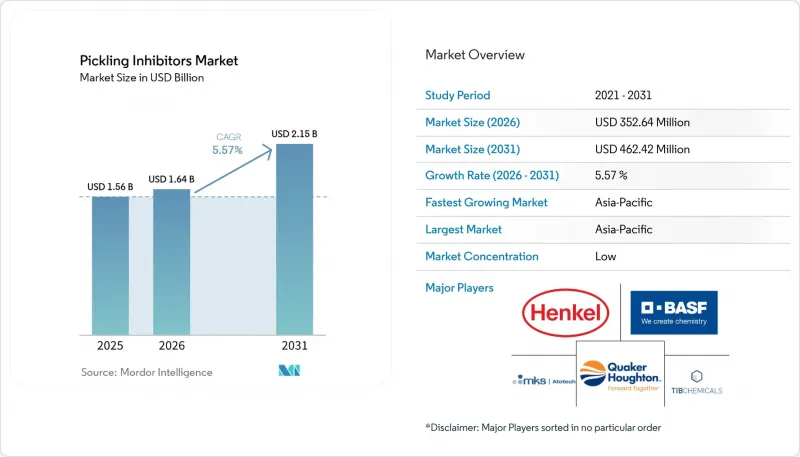
Global Pickling Inhibitors Market Trends and Insights
Growth in High-Quality Coated Steel Demand
Tighter requirements for galvanized and electrogalvanized steel are pushing producers toward inhibited acid baths to deliver clean, uniform surfaces. Capacity investments in automotive steel processing are increasing the need for controlled pickling before downstream coating and forming. Advanced high-strength steel grades require careful process control, as hydrogen uptake can affect material performance. A 2025 journal study found that novel N-heterocyclic compounds achieved 42.80% hydrogen permeation inhibition and 91.45% corrosion inhibition at the reported optimum concentration. Automotive surface requirements make inhibitor selection a process-control decision in the pickling inhibitors market. Suppliers with validated hydrogen-control performance are better positioned to serve demanding steel grades.
Expansion of Steel Pickling Capacity in Asia-Pacific
New steel processing investments across Asia-Pacific are increasing demand for inhibitor quantities linked to plant commissioning. In September 2025, Tata Steel awarded John Cockerill India a contract for a 350,000-TPA (tons per annum) push-pull pickling line and a closed-loop acid regeneration plant at Jamshedpur. The facility was designed to achieve more than 99.5% acid regeneration efficiency. New lines require formulations matched to specific acid types, temperatures, strip speeds, and regeneration conditions. This qualification work gives suppliers an opportunity to establish a presence before routine production begins. The pickling inhibitors market benefits when these commissioning relationships develop into multiyear supply arrangements.
Qualification Cycles for New Inhibitor Packages
Steel producers and metal fabricators typically take 12 to 18 months to approve a new inhibitor chemistry. Each package must be assessed against the site's acid type, concentration, temperature, steel grades, scale load, and regeneration process. Integrated mills face a greater burden because changes in surface quality can require downstream review with automotive customers. The approval process favors incumbent suppliers with established performance records and delays the point at which a new entrant can convert trials into revenue. This timing gap can slow growth in the Pickling Inhibitors Market, even when new plant capacity is being added rapidly.
Other drivers and restraints analyzed in the detailed report include:
- Sensor-Enabled Bath Monitoring and Automated Dosing
- Low-Hazard Inhibitors for Hydrogen-Embrittlement Control
- Substitution by Mechanical and Alternative Descaling
For complete list of drivers and restraints, kindly check the Table Of Contents.
Segment Analysis
Organic pickling inhibitors held a 60.13% revenue share in 2025, and their 5.92% CAGR through 2031 makes them both the largest and fastest-growing type. Organic formulations create protective films on freshly exposed steel through nitrogen, sulfur, and oxygen-containing compounds. These films preserve the scale removal process while limiting attack on the base metal. A 2025 study reported corrosion inhibition above 93% for imidazole-based compounds in mixed hydrochloric and sulfuric acid pickling environments. This finding supports the use of these compounds as a basis for product differentiation. The pickling inhibitors market size for organic formulations is supported by their ability to address both pickling efficiency and metal protection. Their role is further strengthened where processors require reliable results across different steel grades.
Plant-derived organic inhibitors are also receiving research attention as mills respond to chemical hazard requirements and procurement standards. A 2025 study reported that cinnamon leaf extract performed effectively as an inhibitor for mild steel in pickling bath environments. The same source identified Ocimum americanum extract as a candidate in academic research. These options could create a distinct product tier for sites seeking lower-hazard chemistry. Inorganic inhibitors still play a role in high-acid and high-temperature applications, particularly in wire and rod mills operating at sulfuric acid temperatures above 60°C. However, their limited control over hydrogen embrittlement and more difficult waste handling reduce their appeal as high-strength steel processing grows. This leaves organic suppliers competing on performance, certification, and technical service, while inorganic products serve established price-sensitive and thermally demanding applications.
Liquid concentrate retained 57.36% of revenue in 2025 because large integrated mills can manage dilution and control bath strength internally. The format provides unit-cost advantages where output is high, and operators have chemistry laboratories. It also allows plants to adjust dosing in response to inline bath measurements. This flexibility suits multi-tank pickling lines that process varied steel grades and scale conditions. The segment remains important to the pickling inhibitors market because continuous mills require a dependable supply in bulk quantities. It is particularly relevant where sensor arrays and automated replenishment are already integrated into line controls. Concentrates also allow technical teams to optimize inhibitor addition as bath conditions change. These characteristics keep the format central to high-throughput steel processing.
Liquid ready-to-use formulations recorded the highest forecast CAGR of 6.21% through 2031. Smaller job shops and contract metal processors often lack dedicated bath-chemistry expertise but still face strict surface-quality requirements. Pre-diluted solutions can reduce dosing errors and improve repeatability at the point of use. They allow suppliers to price based on surface quality, metal-loss reduction, and acid-use savings rather than on chemical content alone. Powder and granular products remain relevant in locations where liquid distribution is difficult or expensive. Gel and paste products are used to remove localized scale from fabricated steel and welded assemblies before hot-dip galvanizing. The International Zinc Association's regional technical guidance states that acid pickling must produce a chemically active surface prior to flux treatment. AD Chemicals markets Corrosion Inhibitor 04C for continuous hydrochloric acid picklers used in hot-dip galvanizing preparation.
Complete Report Scope:
- By Type
- Organic Pickling Inhibitors
- Inorganic Pickling Inhibitors
- By Product Form
- Liquid Concentrate
- Liquid Ready-to-Use
- Powder and Granular
- Others (Gel and Paste)
- By Application
- Carbon Steel Pickling
- Stainless Steel Pickling and Passivation
- Wire and Tube Pickling
- Hot-Dip Galvanizing Pretreatment
- Others (Electroplating Pretreatment, Industrial Descaling and Other Metal Surface Preparation)
- By End-User Industry
- Steel and Metallurgy
- Automotive
- Metal Fabrication
- Oil and Gas
- Others (Chemical and Petrochemical, Power Generation, Construction and Infrastructure, General Industrial Manufacturing)
- By Geography
- Asia-Pacific
- China
- India
- Japan
- South Korea
- ASEAN Countries
- Rest of Asia-Pacific
- North America
- United States
- Canada
- Mexico
- Europe
- Germany
- United Kingdom
- France
- Italy
- Spain
- NORDIC Countries
- Russia
- Rest of Europe
- South America
- Brazil
- Argentina
- Rest of South America
- Middle-East and Africa
- Saudi Arabia
- South Africa
- Rest of Middle-East and Africa
- Asia-Pacific
Geography Analysis
Asia-Pacific accounted for 44.28% of revenue in 2025 and is forecast to grow at a CAGR of 6.24% through 2031. The region combines new steel capacity with existing demand from automotive, appliance, and infrastructure supply chains. India is a major source of new investment in integrated pickling capacity. Tata Steel's Jamshedpur project adds a push-pull pickling line with closed-loop regeneration. These projects increase demand for formulations adapted to line design and acid recovery processes. New capacity also increases demand for suppliers capable of supporting qualification during commissioning. The pickling inhibitors market size in the region is therefore linked to both capacity additions and higher process-control requirements.
China remains important in the Asia-Pacific region, as large flat-steel producers are investing in throughput and control systems. A large push-pull pickling line at HBIS Tangsteel's Laoting site was commissioned in 2026. Japan and South Korea are mature markets with high inhibitor specifications shaped by automotive export standards. South Korea's early 2025 trade measures on certain imported hot-rolled products may affect regional steel sourcing and line utilization. ASEAN markets are attracting stainless steel investment, including Jindal Stainless's 1.2-Million Tonnes Per Annum (MTPA) melt shop in Indonesia. This investment adds demand in markets that had previously relied more heavily on imported finished steel. Asia-Pacific's position in the pickling inhibitors market is supported by its combination of scale, new processing assets, and broad end-user demand.
North America and Europe are mature regions where output growth is lower but product value is higher. Automotive and aerospace quality requirements support demand for higher-specification, lower-toxicity formulations. Germany, France, and Italy remain important European end markets due to their automotive manufacturing bases. In North America, the nearshoring of automotive manufacturing to Mexico is increasing activity along the Midwest-Mexico supply corridor. The United States applied 25% tariffs on steel imports in 2025, which supported domestic mill utilization. South America, the Middle-East, and Africa are smaller but growing markets for pickling inhibitors. Brazil has the largest steel pickling capacity in South America, while the Middle-East has specialized demand for oil and gas pipeline descaling. South Africa serves as an entry point for sub-Saharan demand, although infrastructure constraints limit growth in the region.
- AFCL
- Atotech
- BASF
- Chemetall GmbH
- Columbia Chemical
- Crown Technology, Inc.
- DFE Chemie GmbH
- Henkel AG & Co. KGaA
- Hong Kong Honor & Honest International Co., Limited
- Hubbard-Hall Inc.
- Keller & Bohacek GmbH & Co. KG
- PEISUN CHEMICAL CO., LTD.
- Quaker Houghton
- Schloetter Company Limited
- SurTec International GmbH
- TIB Chemicals AG
Additional Benefits:
- The market estimate (ME) sheet in Excel format
- 3 months of analyst support
TABLE OF CONTENTS
1 Introduction
- 1.1 Study Assumptions and Market Definition
- 1.2 Scope of the Study
2 Research Methodology
3 Executive Summary
4 Market Landscape
- 4.1 Market Overview
- 4.2 Market Drivers
- 4.2.1 Growth in High-Quality Coated Steel Demand
- 4.2.2 Acid Consumption and Fume Reduction Economics
- 4.2.3 Acid Regeneration-Compatible Formulations
- 4.2.4 Expansion of Steel Pickling Capacity in Asia-Pacific
- 4.2.5 Sensor-Enabled Bath Monitoring and Automated Dosing
- 4.2.6 Low-Hazard Inhibitors for Hydrogen-Embrittlement Control
- 4.3 Market Restraints
- 4.3.1 Qualification Cycles for New Inhibitor Packages
- 4.3.2 Variability in Acid Baths and Scale Loads
- 4.3.3 Volatility in Amine, Surfactant, and Solvent Inputs
- 4.3.4 Substitution by Mechanical and Alternative Descaling
- 4.4 Value Chain Analysis
- 4.5 Porter's Five Forces Analysis
- 4.5.1 Threat of New Entrants
- 4.5.2 Bargaining Power of Suppliers
- 4.5.3 Bargaining Power of Buyers
- 4.5.4 Threat of Substitutes
- 4.5.5 Competitive Rivalry
5 Market Size and Growth Forecasts (Value)
- 5.1 By Type
- 5.1.1 Organic Pickling Inhibitors
- 5.1.2 Inorganic Pickling Inhibitors
- 5.2 By Product Form
- 5.2.1 Liquid Concentrate
- 5.2.2 Liquid Ready-to-Use
- 5.2.3 Powder and Granular
- 5.2.4 Others (Gel and Paste)
- 5.3 By Application
- 5.3.1 Carbon Steel Pickling
- 5.3.2 Stainless Steel Pickling and Passivation
- 5.3.3 Wire and Tube Pickling
- 5.3.4 Hot-Dip Galvanizing Pretreatment
- 5.3.5 Others (Electroplating Pretreatment, Industrial Descaling and Other Metal Surface Preparation)
- 5.4 By End-User Industry
- 5.4.1 Steel and Metallurgy
- 5.4.2 Automotive
- 5.4.3 Metal Fabrication
- 5.4.4 Oil and Gas
- 5.4.5 Others (Chemical and Petrochemical, Power Generation, Construction and Infrastructure, General Industrial Manufacturing)
- 5.5 By Geography
- 5.5.1 Asia-Pacific
- 5.5.1.1 China
- 5.5.1.2 India
- 5.5.1.3 Japan
- 5.5.1.4 South Korea
- 5.5.1.5 ASEAN Countries
- 5.5.1.6 Rest of Asia-Pacific
- 5.5.2 North America
- 5.5.2.1 United States
- 5.5.2.2 Canada
- 5.5.2.3 Mexico
- 5.5.3 Europe
- 5.5.3.1 Germany
- 5.5.3.2 United Kingdom
- 5.5.3.3 France
- 5.5.3.4 Italy
- 5.5.3.5 Spain
- 5.5.3.6 NORDIC Countries
- 5.5.3.7 Russia
- 5.5.3.8 Rest of Europe
- 5.5.4 South America
- 5.5.4.1 Brazil
- 5.5.4.2 Argentina
- 5.5.4.3 Rest of South America
- 5.5.5 Middle-East and Africa
- 5.5.5.1 Saudi Arabia
- 5.5.5.2 South Africa
- 5.5.5.3 Rest of Middle-East and Africa
- 5.5.1 Asia-Pacific
6 Competitive Landscape
- 6.1 Market Concentration
- 6.2 Strategic Moves
- 6.3 Market Share (%)/Ranking Analysis
- 6.4 Company Profiles (includes Global Overview, Market Overview, Core Segments, Financials as available, Strategic Information, Products and Services, and Recent Developments)
- 6.4.1 AFCL
- 6.4.2 Atotech
- 6.4.3 BASF
- 6.4.4 Chemetall GmbH
- 6.4.5 Columbia Chemical
- 6.4.6 Crown Technology, Inc.
- 6.4.7 DFE Chemie GmbH
- 6.4.8 Henkel AG & Co. KGaA
- 6.4.9 Hong Kong Honor & Honest International Co., Limited
- 6.4.10 Hubbard-Hall Inc.
- 6.4.11 Keller & Bohacek GmbH & Co. KG
- 6.4.12 PEISUN CHEMICAL CO., LTD.
- 6.4.13 Quaker Houghton
- 6.4.14 Schloetter Company Limited
- 6.4.15 SurTec International GmbH
- 6.4.16 TIB Chemicals AG
7 Market Opportunities and Future Outlook
- 7.1 White-Space and Unmet-Need Assessment

