PUBLISHER: Mordor Intelligence | PRODUCT CODE: 2154365

PUBLISHER: Mordor Intelligence | PRODUCT CODE: 2154365
Chagas Disease Treatment - Market Share Analysis, Industry Trends & Statistics, Growth Forecasts (2026 - 2031)
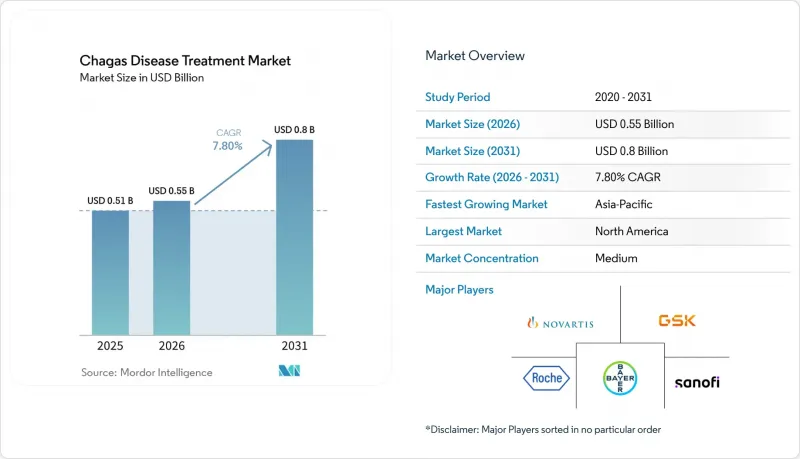
According to Mordor Intelligence, the chagas disease treatment market size is expected to increase from USD 0.51 billion in 2025 to USD 0.55 billion in 2026 and reach USD 0.8 billion by 2031, growing at a CAGR of 7.80% over 2026-2031.
Global Chagas Disease Treatment Market Trends and Insights
Migrant Screening Mandates Create High-Conversion Treatment Demand in Non-Endemic Markets
In July 2025, Washington State issued a provider alert recommending Chagas screening for patients who had lived in Mexico, Central America, or South America for 6 months or longer. The alert expanded institutional screening protocols used at Boston Medical Center and NYC Health + Hospitals. A 2026 study reported 7.8% seroprevalence among screened migrants in Barcelona, including 12.9% among Bolivian nationals. Specialist settings in non-endemic countries initiated treatment for 80% to 85% of confirmed diagnoses, compared with less than 30% in parts of Latin America, strengthening the Chagas disease treatment market through faster specialist care and reimbursement access.
Congenital Test-And-Treat Programs Accelerate Pediatric Formulation Demand
Congenital transmission remained a leading route for new Chagas infections in non-endemic countries. Treatment during the first year of life achieved cure rates above 90%, compared with 10% to 20% in the chronic phase. PAHO's 2025 program framework set a 95% etiological treatment target for children under 14 who tested positive for T. cruzi, as well as pregnant women and newborns under its EMTCT Plus approach. The 12.5 mg pediatric benznidazole tablet developed by DNDi, Laboratorio ELEA Phoenix, and Mundo Sano Foundation improved dosing precision, while DNDi's collaboration with CONICET evaluated MultiCruzi-measured antibody decline in children as a surrogate regulatory endpoint.
Asymptomatic Presentation Suppresses Diagnosis-To-Treatment Conversion Rates
Only 10% of people living with Chagas disease had received a diagnosis, and 1% had received timely treatment, limiting the addressable patient pool. Up to 70% of chronic patients remained asymptomatic for years or decades. A 2026 DNDi-supported field study in Santiago del Estero, Argentina, identified fewer than 50 infections among 1,380 people screened through active community rapid testing, despite trained staff. Guatemala clinic records covering 590 patients showed that 77.5% initiated therapy, highlighting the need for health-system investment to improve diagnosis-to-care conversion.
Other drivers and restraints analyzed in the detailed report include:
- WHO And PAHO Programs Sustain Volume While Setting Endemic-Market Pricing Ceilings
- Pediatric Drug Registrations Unlock Commercial Formulary Access in High-Value Markets
- Adverse-Event Burden Drives Discontinuation And Limits Effective Utilization
For complete list of drivers and restraints, kindly check the Table Of Contents.
Segment Analysis
Benznidazole held 68.40% of product-type revenue in 2025, supported by its WHO first-line designation, pediatric approval, and manufacturing base in Argentina and Brazil. It accounted for the largest share of the Chagas disease treatment market within the product category. Price differences between North American and European pharmacies and PAHO-supported supply in endemic countries limited revenue capture. Its US orphan-drug exclusivity expired in August 2024, although limited manufacturer interest has constrained generic competition.
Nifurtimox is forecast to expand at a CAGR of 10.23% through 2031, the fastest rate in this product category. Spain added the product to its formulary in October 2025, broadening patient access, while Bayer's 30 mg disintegrating pediatric tablet supports treatment for younger patients. WHO and PAHO access programs continue to sustain availability in endemic countries. Growth depends on screening, reimbursement, and providers' ability to manage treatment tolerability.
Etiological antiparasitic treatment accounted for 61.45% of treatment-type revenue in 2025. The segment led revenue because parasite elimination remains the clinical priority in acute and pediatric cases, with cure rates approaching or exceeding 90% when treatment begins early. Medicines targeting T. cruzi directly remain central to clinical care and public procurement. Public programs also prioritize treatment for diagnosed children and newborns.
Symptomatic and organ-specific treatment is forecast to grow at a CAGR of 9.80% through 2031. Growth is supported by cardiomyopathy and gastrointestinal complications affecting 20% to 30% of chronic patients. In April 2026, Brazil's Ministry of Health and Fiocruz launched Phase 2 of a selenium trial for chronic chagasic cardiomyopathy, committing BRL 8.6 million, equivalent to USD 1.6 million. Dedicated cardiac therapies could broaden the revenue base, while long-term follow-up supports demand among patients with chronic complications.
Complete Report Scope:
- By Product Type
- Benznidazole
- Nifurtimox
- By Treatment Type
- Etiological Antiparasitic Treatment
- Symptomatic and Organ-Specific Treatment
- By Disease Phase and Clinical Form
- Acute Chagas Disease
- Chronic Chagas Disease
- By Dosage Form
- Tablet
- Injectables
- Others
- By End User
- Hospitals
- Specialty Infectious-Disease Clinics
- Primary-Care and Community Health Centers
- Home-Based Treatment and Follow-Up
- By Geography
- North America
- United States
- Canada
- Mexico
- Europe
- Germany
- United Kingdom
- France
- Italy
- Spain
- Rest of Europe
- Asia-Pacific
- China
- India
- Japan
- Australia
- South Korea
- Rest of Asia-Pacific
- Middle East and Africa
- GCC
- South Africa
- Rest of Middle East and Africa
- South America
- Brazil
- Argentina
- Rest of South America
- North America
Geography Analysis
North America held 39.44% of the Chagas disease treatment market share in 2025, making it the largest regional contributor. The United States supported this position through FDA-approved medicines, specialist infectious disease networks, and private insurance reimbursement. An estimated 300,000 people with T. cruzi infection live in the United States. CDC training and state provider alerts improved physician awareness, while higher diagnosis-to-treatment conversion supported commercial medicine use. Canada benefited from growing Latin American immigration, while Mexico contributed to the endemic demand, partly served through PAHO procurement.
South America carried the largest endemic patient burden, but donation and public procurement programs limited its commercial revenue share. Brazil remained the largest treatment setting by patient volume, reporting 8,106 chronic cases in preliminary 2025 data, concentrated in Minas Gerais, Bahia, and Goias. In April 2026, Brazil committed BRL 12 million, equivalent to USD 2.2 million, for surveillance and vector control in 155 priority municipalities across 17 states. Argentina produced benznidazole, the active pharmaceutical ingredient, and the 12.5 mg pediatric tablet, while Laboratorio ELEA Phoenix co-sponsored the NuestroBen Phase III trial. In 2025, Colombia adopted rapid diagnostic tests into its official Chagas algorithm, potentially expanding detection from hospitals to community settings.
Asia-Pacific is projected to grow at an 11.88% CAGR through 2031, representing the fastest regional growth rate in the Chagas disease treatment market. Japan and Australia improved detection among Latin American migrants through tertiary infectious disease departments, while commercial distribution generated higher revenue per treated patient than donation-based supply. Europe also expanded, as Spain's October 2025 formulary decision provided a reference for other countries, and the Italian screening analysis supported national programs. The Middle East and Africa remained at an early awareness stage, with cases primarily linked to Latin American labor migrants in Gulf Cooperation Council countries.
- AN2 Therapeutics, Inc.
- Anacor Pharmaceuticals, Inc.
- AstraZeneca
- Bayer
- Collaborations Pharmaceuticals, Inc.
- Daiichi Sankyo
- Eisai
- Epichem Pty Ltd
- Roche
- GlaxoSmithKline
- Grupo Praxis Pharmaceutical S.A.
- Insud Pharma, S.L.U.
- Johnson & Johnson
- Kancera AB
- Laboratorio Elea Phoenix S.A.
- Maprimed S.A.
- Merck
- Nortec Quimica S.A.
- Novartis
- Oblita Therapeutics BVBA
- Pfizer
- Sanofi
Additional Benefits:
- The market estimate (ME) sheet in Excel format
- 3 months of analyst support
TABLE OF CONTENTS
1 INTRODUCTION
- 1.1 Study Assumptions and Market Definition
- 1.2 Scope of the Study
2 RESEARCH METHODOLOGY
3 EXECUTIVE SUMMARY
4 MARKET LANDSCAPE
- 4.1 Market Overview
- 4.2 Market Drivers
- 4.2.1 Screening of Migrant and At-Risk Populations
- 4.2.2 Expansion of Congenital Chagas Test-and-Treat Programs
- 4.2.3 WHO and PAHO Drug-Access and Elimination Programs
- 4.2.4 Commercialization of Pediatric Benznidazole Presentations
- 4.2.5 Decentralized Care Pathways and Remote-Area Treatment Delivery
- 4.2.6 Shorter-Duration and Lower-Dose Regimen Development
- 4.3 Market Restraints
- 4.3.1 Asymptomatic Infection and Low Diagnosis-to-Treatment Conversion
- 4.3.2 Adverse-Event Burden and Treatment Discontinuation
- 4.3.3 Fragile and Donor-Dependent Product Supply Chains
- 4.3.4 Weak Commercial Incentives for New Chemical Entities
- 4.4 Value / Supply-Chain Analysis
- 4.5 Regulatory Landscape
- 4.6 Technological Outlook
- 4.7 Porter's Five Forces Analysis
- 4.7.1 Competitive Rivalry Analysis
- 4.7.2 Supplier Power Analysis
- 4.7.3 Buyer Power Analysis
- 4.7.4 Threat of New Entrants Analysis
- 4.7.5 Threat of Substitutes Analysis
5 MARKET SIZE AND GROWTH FORECASTS (VALUE, USD)
- 5.1 By Product Type
- 5.1.1 Benznidazole
- 5.1.2 Nifurtimox
- 5.2 By Treatment Type
- 5.2.1 Etiological Antiparasitic Treatment
- 5.2.2 Symptomatic and Organ-Specific Treatment
- 5.3 By Disease Phase and Clinical Form
- 5.3.1 Acute Chagas Disease
- 5.3.2 Chronic Chagas Disease
- 5.4 By Dosage Form
- 5.4.1 Tablet
- 5.4.2 Injectables
- 5.4.3 Others
- 5.5 By End User
- 5.5.1 Hospitals
- 5.5.2 Specialty Infectious-Disease Clinics
- 5.5.3 Primary-Care and Community Health Centers
- 5.5.4 Home-Based Treatment and Follow-Up
- 5.6 By Geography
- 5.6.1 North America
- 5.6.1.1 United States
- 5.6.1.2 Canada
- 5.6.1.3 Mexico
- 5.6.2 Europe
- 5.6.2.1 Germany
- 5.6.2.2 United Kingdom
- 5.6.2.3 France
- 5.6.2.4 Italy
- 5.6.2.5 Spain
- 5.6.2.6 Rest of Europe
- 5.6.3 Asia-Pacific
- 5.6.3.1 China
- 5.6.3.2 India
- 5.6.3.3 Japan
- 5.6.3.4 Australia
- 5.6.3.5 South Korea
- 5.6.3.6 Rest of Asia-Pacific
- 5.6.4 Middle East and Africa
- 5.6.4.1 GCC
- 5.6.4.2 South Africa
- 5.6.4.3 Rest of Middle East and Africa
- 5.6.5 South America
- 5.6.5.1 Brazil
- 5.6.5.2 Argentina
- 5.6.5.3 Rest of South America
- 5.6.1 North America
6 COMPETITIVE LANDSCAPE
- 6.1 Market Concentration
- 6.2 Market Share Analysis
- 6.3 Company Profiles (includes Global Level Overview, Market Level Overview, Core Segments, Financials as available, Strategic Information, Market Rank/Share, Products and Services, Recent Developments)
- 6.3.1 AN2 Therapeutics, Inc.
- 6.3.2 Anacor Pharmaceuticals, Inc.
- 6.3.3 AstraZeneca plc
- 6.3.4 Bayer AG
- 6.3.5 Collaborations Pharmaceuticals, Inc.
- 6.3.6 Daiichi Sankyo Company, Limited
- 6.3.7 Eisai Co., Ltd.
- 6.3.8 Epichem Pty Ltd
- 6.3.9 F. Hoffmann-La Roche Ltd
- 6.3.10 GlaxoSmithKline plc
- 6.3.11 Grupo Praxis Pharmaceutical S.A.
- 6.3.12 Insud Pharma, S.L.U.
- 6.3.13 Johnson & Johnson
- 6.3.14 Kancera AB
- 6.3.15 Laboratorio Elea Phoenix S.A.
- 6.3.16 Maprimed S.A.
- 6.3.17 Merck KGaA
- 6.3.18 Nortec Quimica S.A.
- 6.3.19 Novartis AG
- 6.3.20 Oblita Therapeutics BVBA
- 6.3.21 Pfizer Inc.
- 6.3.22 Sanofi
7 MARKET OPPORTUNITIES AND FUTURE OUTLOOK
- 7.1 White-Space and Unmet-Need Assessment

