PUBLISHER: Mordor Intelligence | PRODUCT CODE: 2154375

PUBLISHER: Mordor Intelligence | PRODUCT CODE: 2154375
Spatial Audio Software - Market Share Analysis, Industry Trends & Statistics, Growth Forecasts (2026 - 2031)
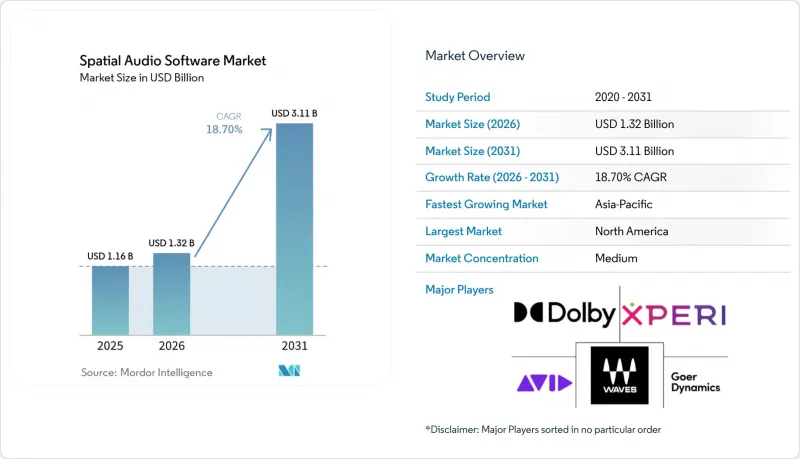
According to Mordor Intelligence, the spatial audio software market size was valued at USD 1.16 billion in 2025 and is estimated to expand from USD 1.32 billion in 2026 to USD 3.11 billion by 2031, at a CAGR of 18.70% during the forecast period 2026-2031.
Global Spatial Audio Software Market Trends and Insights
Immersive Gaming and XR Content Expansion
Spatial sound has become a standard technical capability in many AAA game development workflows, rather than an optional feature. Unreal Engine 5 and Unity include spatial audio capabilities, which shifts middleware providers toward acoustic modeling and advanced authoring functions. This change increases demand for specialized tools when engine-level functions cannot resolve detailed acoustic requirements. Head-tracked binaural rendering remains necessary to maintain spatial coherence in virtual environments. Research on graph neural field approaches shows continued work on HRTF personalization for these settings. Middleware providers continue to align their products with game-engine release cycles, which keeps spatial authoring tools closely tied to development workflows.
Streaming Platforms Mandating Spatial-Audio Deliverables
Platform requirements are making spatial delivery a production requirement for labels, studios, and independent creators. Apple Music requires Dolby Atmos submissions to come from genuine multichannel sessions rather than stereo upmixes. Apple introduced the Apple Spatial Audio Format and mandated APAC for Apple Immersive Video at WWDC 2025. These requirements can make a Dolby Atmos workflow insufficient for Apple-native output. Studios may therefore maintain more than 1 toolchain and incur repeated upgrade costs. In June 2026, Peacock used Dolby AC-4 for its FIFA World Cup 2026 coverage, extending immersive delivery into live sports.
Fragmented Object-Based and Scene-Based Audio Standards
Dolby Atmos, MPEG-H 3D Audio, Apple Spatial Audio Format, AURO-3D, and DTS:X require content teams to address multiple delivery paths. This raises the cost of encoding and validation compared with a single common production format. SMPTE 2110-41 supports Dolby AC-4 and MPEG-H metadata in broadcast pipelines, but device support is not consistent across formats. Recent television decisions by Samsung and LG to move away from DTS:X show that device support can change quickly. Studios may retain parallel digital audio workstations, plugins, and conversion systems to meet customer needs. The Spatial audio software market consequently carries extra licensing and engineering costs even as demand expands.
Other drivers and restraints analyzed in the detailed report include:
- AI-Assisted Real-Time Rendering and HRTF Personalization
- Cloud-Based Production and Remote Collaboration
- High Cost of Certified Immersive-Audio Rooms
For complete list of drivers and restraints, kindly check the Table Of Contents.
Segment Analysis
Software held 75.80% of the component segment in 2025. This position reflects the central role of plugins, middleware, and rendering engines in spatial production. Every workflow begins with a software license before it requires associated hardware or professional support. The Spatial audio software market size for the software component therefore rests on a durable entry point in the production chain. Services are projected to expand at a 19.14% CAGR through 2031. Integration, calibration, and workflow design are becoming more important alongside software purchases.
The need for services comes from multiformat delivery and digital audio workstation integration. Even experienced production teams may need help with format conversion and system configuration. Service work also becomes more valuable when a studio connects on-premises production with cloud access. Sony AI and Audiokinetic introduced an AI-powered Similar Sound Search capability in Wwise, bringing a workflow function into a professional authoring environment. This direction shows how recurring services can sit beside license revenue. The spatial audio software industry can therefore support software and expertise together rather than relying solely on perpetual software sales.
Spatial audio rendering software held 35.40% of product-type revenue in 2025. It serves as the processing core for production pipelines in gaming, broadcast, and other immersive workflows. Binaural and HRTF plugins are projected to expand at a 19.42% CAGR through 2031. Headphone delivery can reach consumers without requiring dedicated speaker systems. This lowers the practical barrier for creators that want spatial output on common listening devices. The Spatial audio software market benefits when producers can deliver immersive sound without a specialized hardware installation.
Neural-field HRTF research may widen the role of these plugins by supporting individualized playback. Binaural tools are particularly relevant for remote listening, virtual reality, and consumer streaming. Ambisonics production plugins continue to serve virtual reality content and live-event workflows. Object-based mixing and authoring tools remain necessary for Dolby Atmos, MPEG-H, and Apple Spatial Audio Format delivery. Other products include AI-assisted tools and conversion functions that do not fit established categories. Product vendors must balance broad format coverage with tools that remain straightforward for production teams.
Complete Report Scope:
- By Component
- Software
- Services
- By Product Type
- Spatial Audio Rendering Software
- Binaural and HRTF Plugins
- Ambisonics Production Plugins
- Object-Based Mixing and Authoring Tools
- Other Product Types
- By Deployment Mode
- On-Premises
- Cloud-Based
- By Application
- Gaming
- Music Production and Streaming
- Film, Television, and Postproduction
- Virtual Reality and Augmented Reality
- Live Events and Broadcast
- Automotive
- Enterprise Collaboration and Training
- By End User
- Studios and Postproduction Houses
- Game Developers and Publishers
- Streaming and Media Platforms
- Enterprises and Educational Institutions
- Individual Professionals
- By Geography
- North America
- United States
- Canada
- Mexico
- South America
- Brazil
- Argentina
- Rest of South America
- Europe
- Germany
- United Kingdom
- France
- Russia
- Rest of Europe
- Asia-Pacific
- China
- Japan
- South Korea
- India
- Southeast Asia
- Oceania
- Rest of Asia-Pacific
- Middle East
- United Arab Emirates
- Saudi Arabia
- Turkey
- Rest of Middle East
- Africa
- South Africa
- Nigeria
- Rest of Africa
- North America
Geography Analysis
North America held 38.42% of revenue in 2025. The region brings together major platform operators, game studios, and spatial-audio vendors. Requirements issued by North American technology companies can affect content producers worldwide. Apple's APAC requirement for Immersive Video was a significant platform decision in the current cycle. ATSC 3.0 includes next-generation audio frameworks such as Dolby AC-4 and MPEG-H. This creates a compliance-related need for the Spatial audio software market in U.S. broadcast facilities.
Asia-Pacific is projected to expand at a 19.64% CAGR through 2031. China, South Korea, and Japan each contribute through different demand patterns. In March 2026, QQ Music became the first major music platform to deploy the latest Dolby AC-4 enhancements. South Korea's TTA standard requires MPEG-H Audio for next-generation television. Japan supports demand through gaming hardware, automotive relationships, and consumer electronics. Fraunhofer IDMT's Audiofields entered series production in Mercedes-Benz vehicles in February 2026.
Europe has a significant position in the Spatial audio software market because Fraunhofer-Gesellschaft contributes to MPEG-H standards development. Specialist suppliers in Germany and Poland also support the regional production base. The European Broadcasting Union's Audio Definition Model supports channel-based, object-based, and scene-based audio workflows. Dolby and Audi completed Dolby Atmos integration for selected Audi models in July 2025. South America, the Middle East, and Africa remain smaller but emerging markets. Brazil's SBTVD TV 3.0 standard includes MPEG-H Audio, while OTT investment and mobile-first content may add demand over time.
- Dolby Laboratories, Inc.
- Xperi Holding Corporation
- Goerdyna Group
- Waves Audio Ltd.
- Dear Reality GmbH
- Avid Technology, Inc.
- Fraunhofer-Gesellschaft zur Forderung der angewandten Forschung e. V.
- Blue Ripple Sound Limited
- Sound Particles, Lda.
- Audiokinetic Inc.
- Firelight Technologies Pty Ltd
- VisiSonics Corporation
- Spatial Inc.
- G'Audio Lab, Inc.
- Mach1, Inc.
- Envelop VR, Inc.
- APL-HUD GmbH
- atmoky GmbH
- Ceva, Inc.
- Brandenburg Labs GmbH
- New Audio Technology GmbH
- Wave Arts, Inc.
- SoundField Limited
- Zylia Sp. z o.o.
Additional Benefits:
- The market estimate (ME) sheet in Excel format
- 3 months of analyst support
TABLE OF CONTENTS
1 INTRODUCTION
- 1.1 Study Assumptions and Market Definition
- 1.2 Scope of the Study
2 RESEARCH METHODOLOGY
3 EXECUTIVE SUMMARY
4 MARKET LANDSCAPE
- 4.1 Market Overview
- 4.2 Market Drivers
- 4.2.1 Immersive Gaming and XR Content Expansion
- 4.2.2 Streaming Platforms Mandating Spatial-Audio Deliverables
- 4.2.3 AI-Assisted Real-Time Rendering and HRTF Personalization
- 4.2.4 Cloud-Based Production and Remote Collaboration
- 4.2.5 Premium Device Standardization of Spatial Audio
- 4.2.6 Automotive and Enterprise Immersive-Audio Integration
- 4.3 Market Restraints
- 4.3.1 Fragmented Object-Based and Scene-Based Audio Standards
- 4.3.2 High Cost of Certified Immersive-Audio Rooms
- 4.3.3 Shortage of Spatial-Audio Engineering Talent
- 4.3.4 Platform Gatekeeping and Format-Conversion Dependency
- 4.4 Impact of Macroeconomic Factors on the Market
- 4.5 Industry Value Chain Analysis
- 4.6 Regulatory Landscape
- 4.7 Technological Outlook
- 4.8 Porter's Five Forces Analysis
- 4.8.1 Bargaining Power of Suppliers
- 4.8.2 Bargaining Power of Buyers
- 4.8.3 Threat of New Entrants
- 4.8.4 Threat of Substitutes
- 4.8.5 Competitive Rivalry
5 MARKET SIZE AND GROWTH FORECASTS (VALUE)
- 5.1 By Component
- 5.1.1 Software
- 5.1.2 Services
- 5.2 By Product Type
- 5.2.1 Spatial Audio Rendering Software
- 5.2.2 Binaural and HRTF Plugins
- 5.2.3 Ambisonics Production Plugins
- 5.2.4 Object-Based Mixing and Authoring Tools
- 5.2.5 Other Product Types
- 5.3 By Deployment Mode
- 5.3.1 On-Premises
- 5.3.2 Cloud-Based
- 5.4 By Application
- 5.4.1 Gaming
- 5.4.2 Music Production and Streaming
- 5.4.3 Film, Television, and Postproduction
- 5.4.4 Virtual Reality and Augmented Reality
- 5.4.5 Live Events and Broadcast
- 5.4.6 Automotive
- 5.4.7 Enterprise Collaboration and Training
- 5.5 By End User
- 5.5.1 Studios and Postproduction Houses
- 5.5.2 Game Developers and Publishers
- 5.5.3 Streaming and Media Platforms
- 5.5.4 Enterprises and Educational Institutions
- 5.5.5 Individual Professionals
- 5.6 By Geography
- 5.6.1 North America
- 5.6.1.1 United States
- 5.6.1.2 Canada
- 5.6.1.3 Mexico
- 5.6.2 South America
- 5.6.2.1 Brazil
- 5.6.2.2 Argentina
- 5.6.2.3 Rest of South America
- 5.6.3 Europe
- 5.6.3.1 Germany
- 5.6.3.2 United Kingdom
- 5.6.3.3 France
- 5.6.3.4 Russia
- 5.6.3.5 Rest of Europe
- 5.6.4 Asia-Pacific
- 5.6.4.1 China
- 5.6.4.2 Japan
- 5.6.4.3 South Korea
- 5.6.4.4 India
- 5.6.4.5 Southeast Asia
- 5.6.4.6 Oceania
- 5.6.4.7 Rest of Asia-Pacific
- 5.6.5 Middle East
- 5.6.5.1 United Arab Emirates
- 5.6.5.2 Saudi Arabia
- 5.6.5.3 Turkey
- 5.6.5.4 Rest of Middle East
- 5.6.6 Africa
- 5.6.6.1 South Africa
- 5.6.6.2 Nigeria
- 5.6.6.3 Rest of Africa
- 5.6.1 North America
6 COMPETITIVE LANDSCAPE
- 6.1 Market Concentration
- 6.2 Strategic Moves
- 6.3 Market Share Analysis
- 6.4 Company Profiles (includes Global Level Overview, Market Level Overview, Core Segments, Financials as available, Strategic Information, Market Rank/Share, Products and Services, Recent Developments)
- 6.4.1 Dolby Laboratories, Inc.
- 6.4.2 Xperi Holding Corporation
- 6.4.3 Goerdyna Group
- 6.4.4 Waves Audio Ltd.
- 6.4.5 Dear Reality GmbH
- 6.4.6 Avid Technology, Inc.
- 6.4.7 Fraunhofer-Gesellschaft zur Forderung der angewandten Forschung e. V.
- 6.4.8 Blue Ripple Sound Limited
- 6.4.9 Sound Particles, Lda.
- 6.4.10 Audiokinetic Inc.
- 6.4.11 Firelight Technologies Pty Ltd
- 6.4.12 VisiSonics Corporation
- 6.4.13 Spatial Inc.
- 6.4.14 G'Audio Lab, Inc.
- 6.4.15 Mach1, Inc.
- 6.4.16 Envelop VR, Inc.
- 6.4.17 APL-HUD GmbH
- 6.4.18 atmoky GmbH
- 6.4.19 Ceva, Inc.
- 6.4.20 Brandenburg Labs GmbH
- 6.4.21 New Audio Technology GmbH
- 6.4.22 Wave Arts, Inc.
- 6.4.23 SoundField Limited
- 6.4.24 Zylia Sp. z o.o.
7 MARKET OPPORTUNITIES AND FUTURE OUTLOOK
- 7.1 White-Space and Unmet-Need Assessment

