PUBLISHER: Mordor Intelligence | PRODUCT CODE: 2154379

PUBLISHER: Mordor Intelligence | PRODUCT CODE: 2154379
Electronic-Grade Nitric Acid - Market Share Analysis, Industry Trends & Statistics, Growth Forecasts (2026 - 2031)
According to Mordor Intelligence, the electronic-grade nitric acid market size is estimated at USD 91.46 million in 2025 and is estimated to grow from USD 96.08 million in 2026 to USD 124.68 million by 2031, at a CAGR of 5.35% during the forecast period (2026-2031).
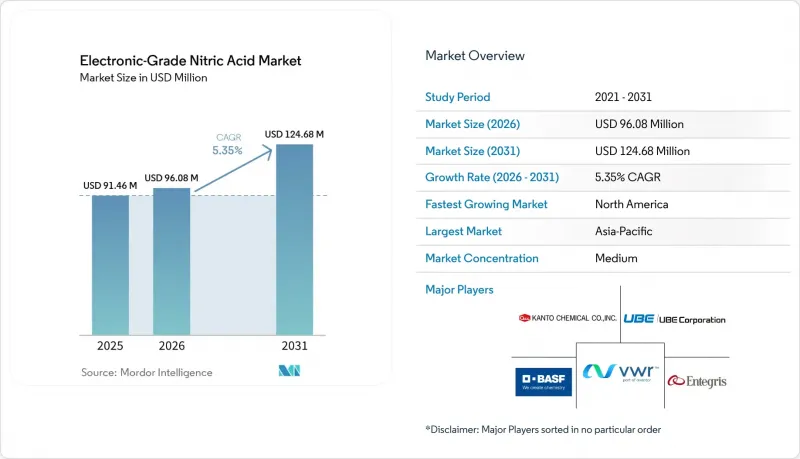
Global Electronic-Grade Nitric Acid Market Trends and Insights
Semiconductor Fab Capacity Expansion and Localized Supply
Each greenfield fab that enters pilot production can become a long-term wet-chemical customer. The electronic-grade nitric acid market benefits when new fabs require recurring quantities for Radio Corporation of America (RCA) cleaning, piranha etching, and oxide-strip processes. TSMC in Arizona, Samsung in Texas, Intel in Ohio, and TSMC in Dresden represent major fab projects that are increasing demand for qualified materials suppliers. A supplier that secures an initial qualification can build a durable position, as replacing a chemical source requires significant process validation. Local purification, packaging, and inventory close to fab clusters can therefore be as important as upstream acid production. In November 2024, UBE Corporation announced a further 30% capacity expansion for high-purity nitric acid, following a 1.5-fold capacity increase in spring 2024, linking its investment to demand from AI processors and quantum computing applications.
Advanced Nodes and Higher Wet-Chemical Use
Advanced-node manufacturing raises both purity requirements and chemical use per wafer. Smaller geometries require more cleaning and etching steps, so demand can increase faster than wafer-start counts alone would suggest. As a result, the electronic-grade nitric acid market is moving toward tighter control of particle and metal content, filling conditions, and container quality. Fabs also require closer cooperation with suppliers when process changes alter the required chemical profile. In December 2025, Merck inaugurated its semiconductor solutions megasite in Kaohsiung, with production beginning in 2026, bringing manufacturing and research closer to semiconductor customers in Taiwan. This type of local presence can shorten feedback loops between material development, qualification work, and fab operations.
Hazardous Material Regulation and Environmental Compliance Costs
Nitric acid handling requires specialized packaging, transport controls, documentation, and trained personnel, making its logistics more costly than those of many other industrial chemicals. Environmental regulations add testing, labeling, and operating obligations at production and storage sites. High-purity suppliers in the electronic-grade nitric acid market must maintain compliance while preserving material quality across every transfer point. Semiconductor producers in new locations may face procurement delays while local permits and approvals for controlled chemicals are still being established. These obligations can delay capacity additions and reduce the financial returns from expansion projects.
Other drivers and restraints analyzed in the detailed report include:
- AI, High-Performance Computing, 5G, and Automotive Demand
- Government Semiconductor Localization Programs
- High Purification, Qualification, and Contamination-Control Costs
For complete list of drivers and restraints, kindly check the Table Of Contents.
Segment Analysis
EL Grade accounted for 50.42% of the electronic-grade nitric acid market share in 2025. Its broad use across legacy and mid-node fabs provides a stable demand base for automotive, industrial, and Internet of Things devices. These fabs commonly operate across node ranges where purity requirements fall below the most demanding levels. EL Grade remains relevant because a large portion of global wafer capacity serves applications that do not require the most specialized grade. ULSI Grade sits above EL Grade and serves fabs moving toward more stringent process conditions. Demand for this grade continues as manufacturers transition from mature processes toward smaller geometries.
VLSI Grade is the fastest-growing purity tier, with a forecast CAGR of 5.90% through 2031. The electronic-grade nitric acid market size for VLSI Grade is supported by the shift of leading-edge production from 7 nm toward 3 nm and below. Each node transition can add wet-cleaning and etching steps rather than simply tightening existing chemical specifications. UPSS Grade and other custom ultra-high-purity grades serve specialized applications such as Micro-Electro-Mechanical Systems (MEMS), advanced packaging, and compound semiconductors. These applications can require chemical development agreements tailored to a customer's process conditions. Japanese suppliers, including UBE Corporation, Tokuyama Corporation, and Sumitomo Chemical, have long supported high-purity production for domestic semiconductor customers. Their established quality practices continue to influence supply expectations for VLSI and ULSI materials.
Complete Report Scope:
- By Purity Grade
- EL Grade (Electronic Level)
- ULSI Grade
- VLSI Grade
- Others (UPSS Grade and Custom Ultra-High-Purity Grades)
- By Application
- Semiconductor Manufacturing
- Printed Circuit Boards (PCBs)
- Flat Panel Displays
- Photovoltaics and Solar Cells
- Others (LEDs, MEMS, Electronic Components)
- By Geography
- Asia-Pacific
- China
- India
- Japan
- South Korea
- ASEAN Countries
- Rest of Asia-Pacific
- North America
- United States
- Canada
- Mexico
- Europe
- Germany
- United Kingdom
- France
- Italy
- NORDIC Countries
- Russia
- Rest of Europe
- South America
- Brazil
- Argentina
- Rest of South America
- Middle-East and Africa
- Saudi Arabia
- South Africa
- Rest of Middle-East and Africa
- Asia-Pacific
Geography Analysis
Asia-Pacific accounted for 40.17% of revenue in 2025. The region has a dense base of wafer fabs, solar-cell lines, PCB factories, and display plants across China, South Korea, Japan, Taiwan, and Southeast Asia. Japan remains an important quality center, as its chemical producers have built extensive experience in higher-purity materials for domestic semiconductor operations. South Korea adds demand from memory and logic manufacturing, particularly as high-bandwidth memory and advanced DRAM processes require more chemically intensive steps. China is a major regional consumer of mid-node integrated circuits, photovoltaics, and displays.
North America is projected to record a 6.80% CAGR through 2031, the fastest regional growth rate in the electronic-grade nitric acid market. New US fabs are changing regional purchasing patterns for electronic materials and wet chemicals. In the near term, imported material may be warehoused, repackaged, and distributed while local production capacity is developed. This sequence can create early demand before domestic chemical plants are fully operational. Samsung's Taylor, Texas, fab illustrates this transition, with ENF Technology having begun commercial shipments of semiconductor chemicals from Kyle, Texas, in 2026, and Samsung's trial production expected by the end of 2026. Europe is developing its own regional materials base alongside semiconductor investment related to the CHIPS Act. BASF's planned Ludwigshafen plants demonstrate how chemical producers are positioning themselves to meet local semiconductor material demand.
South America, the Middle-East, and Africa represent smaller demand areas in the electronic-grade nitric acid market. Current use in these regions centers on PCB fabrication, semiconductor assembly, solar cell manufacturing, LEDs, and consumer electronics production. Brazil and Argentina are the primary South American locations due to their electronics assembly and renewable energy manufacturing activities. Saudi Arabia is developing advanced manufacturing under Vision 2030, which may gradually increase demand for controlled electronic chemicals. South Africa has a smaller electronics base, resulting in limited demand for PCB and LED applications. These regions currently contribute modestly to overall revenue, but supplier and customer diversification could increase their importance later in the forecast period.
- ASIA UNION ELECTRONIC CHEMICAL CORP.
- Avantor, Inc.
- BASF
- Columbus Chemicals
- Entegris
- FUJIFILM Wako Pure Chemical Corporation
- Jiangyin Jianghua Microelectronic Materials Co., Ltd.
- KANTO KAGAKU
- Merck KGaA
- Moses Lake Industries, Inc.
- Solstice Advanced Materials US, Inc.
- Sumitomo Chemical Co., Ltd.
- TNC Chemicals Philippines Inc.
- Tokuyama Corporation
- UBE Corporation
Additional Benefits:
- The market estimate (ME) sheet in Excel format
- 3 months of analyst support
TABLE OF CONTENTS
1 Introduction
- 1.1 Study Assumptions and Market Definition
- 1.2 Scope of the Study
2 Research Methodology
3 Executive Summary
4 Market Landscape
- 4.1 Market Overview
- 4.2 Market Drivers
- 4.2.1 Semiconductor Fab Capacity Expansion and Wafer-Start Growth, Mainstream
- 4.2.2 Advanced-Node Miniaturization and Higher Wet-Chemical Intensity, Mainstream
- 4.2.3 AI, High-Performance Computing, 5G, and Automotive Semiconductor Demand, Mainstream
- 4.2.4 Government-Led Semiconductor Localization Programs, Mainstream
- 4.2.5 Node-Specific Chemical Qualification and Joint Process Development, Under-Reported
- 4.2.6 Fab-Cluster Localization of Purification, Packaging, and Inventory, Under-Reported
- 4.3 Market Restraints
- 4.3.1 Hazardous-Material Regulations and Environmental Compliance Costs, Mainstream
- 4.3.2 High Purification, Qualification, and Contamination-Control Costs, Mainstream
- 4.3.3 Long Supplier Qualification Cycles and Limited Second-Source Flexibility, Under-Reported
- 4.3.4 Recontamination Risk Across Containers, Transport, and Fab Delivery Systems, Under-Reported
- 4.4 Value Chain Analysis
- 4.5 Porter's Five Forces Analysis
- 4.5.1 Threat of New Entrants
- 4.5.2 Bargaining Power of Suppliers
- 4.5.3 Bargaining Power of Buyers
- 4.5.4 Threat of Substitutes
- 4.5.5 Competitive Rivalry
5 Market Size and Growth Forecasts (Value)
- 5.1 By Purity Grade
- 5.1.1 EL Grade (Electronic Level)
- 5.1.2 ULSI Grade
- 5.1.3 VLSI Grade
- 5.1.4 Others (UPSS Grade and Custom Ultra-High-Purity Grades)
- 5.2 By Application
- 5.2.1 Semiconductor Manufacturing
- 5.2.2 Printed Circuit Boards (PCBs)
- 5.2.3 Flat Panel Displays
- 5.2.4 Photovoltaics and Solar Cells
- 5.2.5 Others (LEDs, MEMS, Electronic Components)
- 5.3 By Geography
- 5.3.1 Asia-Pacific
- 5.3.1.1 China
- 5.3.1.2 India
- 5.3.1.3 Japan
- 5.3.1.4 South Korea
- 5.3.1.5 ASEAN Countries
- 5.3.1.6 Rest of Asia-Pacific
- 5.3.2 North America
- 5.3.2.1 United States
- 5.3.2.2 Canada
- 5.3.2.3 Mexico
- 5.3.3 Europe
- 5.3.3.1 Germany
- 5.3.3.2 United Kingdom
- 5.3.3.3 France
- 5.3.3.4 Italy
- 5.3.3.5 NORDIC Countries
- 5.3.3.6 Russia
- 5.3.3.7 Rest of Europe
- 5.3.4 South America
- 5.3.4.1 Brazil
- 5.3.4.2 Argentina
- 5.3.4.3 Rest of South America
- 5.3.5 Middle-East and Africa
- 5.3.5.1 Saudi Arabia
- 5.3.5.2 South Africa
- 5.3.5.3 Rest of Middle-East and Africa
- 5.3.1 Asia-Pacific
6 Competitive Landscape
- 6.1 Market Concentration
- 6.2 Strategic Moves
- 6.3 Market Share (%)/Ranking Analysis
- 6.4 Company Profiles (includes Global Overview, Market Overview, Core Segments, Financials as available, Strategic Information, Products and Services, and Recent Developments)
- 6.4.1 ASIA UNION ELECTRONIC CHEMICAL CORP.
- 6.4.2 Avantor, Inc.
- 6.4.3 BASF
- 6.4.4 Columbus Chemicals
- 6.4.5 Entegris
- 6.4.6 FUJIFILM Wako Pure Chemical Corporation
- 6.4.7 Jiangyin Jianghua Microelectronic Materials Co., Ltd.
- 6.4.8 KANTO KAGAKU
- 6.4.9 Merck KGaA
- 6.4.10 Moses Lake Industries, Inc.
- 6.4.11 Solstice Advanced Materials US, Inc.
- 6.4.12 Sumitomo Chemical Co., Ltd.
- 6.4.13 TNC Chemicals Philippines Inc.
- 6.4.14 Tokuyama Corporation
- 6.4.15 UBE Corporation
7 Market Opportunities and Future Outlook
- 7.1 White-Space and Unmet-Need Assessment

