PUBLISHER: Mordor Intelligence | PRODUCT CODE: 2154380

PUBLISHER: Mordor Intelligence | PRODUCT CODE: 2154380
Earthen Plasters - Market Share Analysis, Industry Trends & Statistics, Growth Forecasts (2026 - 2031)
According to Mordor Intelligence, the earthen plasters market size was valued at USD 90.24 billion in 2025 and is estimated to grow from USD 94.17 billion in 2026 to reach USD 116.57 billion by 2031, at a CAGR of 4.36% during the forecast period (2026-2031).
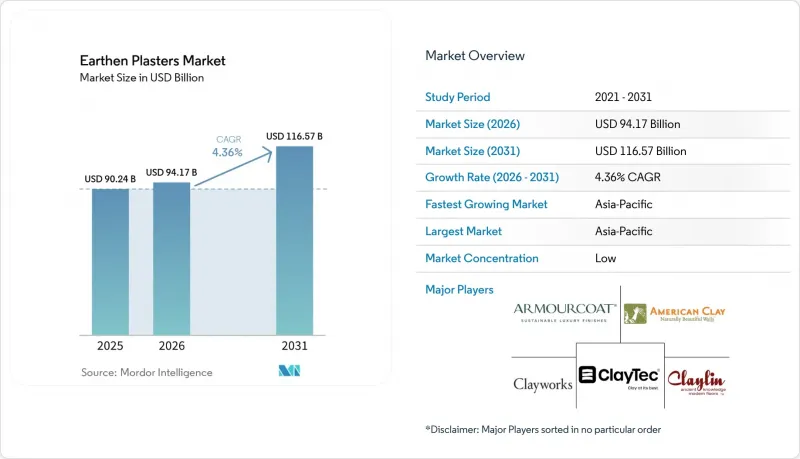
Global Earthen Plasters Market Trends and Insights
Low-Carbon and Healthy-Building Material Adoption
Earth-based wall finishes can reduce the carbon burden of a wall assembly when compared with concrete-based alternatives. A 2025 study found that clay-based plaster on wood-frame walls improved thermal inertia while reducing the assembly's environmental impact. The earthen plasters market, therefore, has a practical case in projects where material choices must demonstrate lower emissions as well as adequate thermal performance. A 2026 review reported that earthen systems can achieve U-values of 0.45 - 0.80 W/m2*K without added insulation. These values support use in residential and commercial envelopes that require passive thermal performance and robust material evidence, helping to narrow the practical specification gap with conventional finish systems. Zero Volatile Organic Compound (VOC) emissions, natural humidity regulation, and the absence of synthetic additives support health-focused procurement and can reinforce demand when sustainability and wellness requirements are considered together.
Green-Building and Embodied-Carbon Disclosure Requirements
Mandatory disclosure requirements are moving embodied carbon from a voluntary consideration into a documented building-performance measure. The European Commission's December 2025 framework under the Energy Performance of Buildings Directive (EPBD) 2024/1275 requires life-cycle Global Warming Potential (GWP) disclosure in energy performance certificates for buildings above 1,000 m2 from 2028 and for all new buildings from 2030. The earthen plasters market is positioned to benefit because low-carbon finishes can be assessed alongside other materials in a project's life-cycle calculation. This framework makes verified product information and environmental documentation more useful for producers seeking commercial specifications, particularly where design teams must compare materials line by line. The revised Construction Products Regulation became generally applicable on January 8, 2026, and began the transition toward digital product passports and climate-impact reporting for construction product families. Suppliers with established Environmental Product Declaration (EPD) systems can be better placed to meet documentation needs and explain the cost of an earthen finish against compliance and life-cycle considerations.
Installer Skill Scarcity and Application Variability
Earthen plastering requires material knowledge that standard plastering training does not always provide. Clay workability, shrinkage, and surface quality depend on mixing consistency, ambient humidity, substrate preparation, and applicator experience. The earthen plasters market can lose repeat commercial specifications when an installation produces uneven results or raises durability concerns that remain associated with the material rather than the installation process. The European Construction Blueprint 2 reported in March 2026 that specialist finishing trades were among the urgent skills needs identified across 10 European Union countries. Factory-calibrated premixes and prefabricated panel systems can reduce some application variability. However, predictable outcomes in mainstream projects still depend on trained installers, clear trade certification pathways, and a widely recognized system that buyers can use to manage application risk.
Other drivers and restraints analyzed in the detailed report include:
- Indoor Humidity and Air-Quality Performance Demand
- Heritage Renovation and Traditional-Building Conservation
- Moisture, Drying-Time, and Durability Perception
For complete list of drivers and restraints, kindly check the Table Of Contents.
Segment Analysis
Clay-based plasters held a 42.45% share in 2025 and remained the leading product category because clay is widely available, installers are familiar with the material, and the systems align with natural-building requirements. Fiber-reinforced earthen plasters are projected to advance at a 5.38% CAGR through 2031. A 2025 review found that hemp, jute, straw, and cellulose fibers at concentrations of up to 5% by weight can improve tensile strength, crack resistance, and moisture buffering in earthen composites. This performance improvement supports the earthen plasters market by addressing a technical concern in commercial specifications. It also expands the range of interior and exterior applications that can be considered without materially increasing embodied carbon.
Clay-lime plasters have a meaningful position in European projects because lime additions improve formulation stability and support conservation work. SAINT-ASTIER upgraded BATICHANVRE PLUS in December 2025 with higher Natural Hydraulic Lime content to reduce its carbon footprint and improve site application. The earthen plasters industry also includes gypsum-clay blends, lime-stabilized earthen plasters, and specialty decorative earthen plasters for projects needing particular textural stability or better weather resistance. Hospitality projects use decorative finishes, while heritage projects select compatible formulations to avoid damage to original substrates and to preserve the physical behavior of older wall systems. Product development focuses on lower application risk while retaining low-carbon and breathable material characteristics.
Complete Report Scope:
- By Product Type
- Clay-Based Plasters
- Clay-Lime Plasters
- Fiber-Reinforced Earthen Plasters
- Other Product Types (Gypsum-Clay Blends, Lime-Stabilized Earthen Plasters, Specialty Decorative Earthen Plasters)
- By Application
- Interior Wall Finishes
- Exterior Wall Finishes
- Restoration and Heritage Buildings
- Other Applications (Ceilings, Decorative Textured Finishes, Adobe and Cob Construction)
- By End-Use
- Residential Buildings
- Commercial Buildings
- Institutional Buildings
- Other End-Uses (Hospitality, Cultural Buildings, Community Structures)
- By Geography
- Asia-Pacific
- China
- India
- Japan
- South Korea
- ASEAN Countries
- Rest of Asia-Pacific
- North America
- United States
- Canada
- Mexico
- Europe
- Germany
- United Kingdom
- France
- Italy
- NORDIC Countries
- Rest of Europe
- South America
- Brazil
- Argentina
- Rest of South America
- Middle-East and Africa
- Saudi Arabia
- South Africa
- Rest of Middle-East and Africa
- Asia-Pacific
Geography Analysis
Asia-Pacific held 41.03% of the earthen plasters market share in 2025 and is projected to advance at a 5.04% CAGR through 2031. China provides a large base of residential and commercial construction activity for clay-based interior finishes, while India's expanding middle class is supporting demand for higher-value interior materials in green-building-certified housing. The United Nations Economic and Social Commission for Asia and the Pacific reported that governments in the region are strengthening indoor air quality frameworks. This creates a policy basis for non-emitting and hygroscopic materials in residential and institutional buildings. Japan and South Korea remain specialty markets where traditional plastering techniques are being used in curated residential and boutique hospitality projects, while Vietnam and Indonesia are also emerging as urbanization and awareness of material health credentials increase.
Europe held a substantial regional position and remains the most policy-driven geography in the earthen plasters market. The EPBD requires life cycle GWP disclosure for larger new buildings from 2028 and all new buildings from 2030. This framework supports consideration of low-carbon finishes across building procurement decisions. Germany has a mature natural-building materials base and established clay-plaster practices, while France is seeing interest in rammed earth and earthen plasters for public architecture. A community space extension in Marcoussis, Ile-de-France, used pise in October 2025 and highlighted low-carbon production and end-of-life recyclability.
North America is shaped by premium residential and commercial specifications, with domestic producers using local mineral supply and documented product systems. The earthen plasters market in South America has long-term potential because traditional construction knowledge can support low-carbon housing approaches. A 2025 study in Andean Ecuador found that bahareque wood-clay shear-wall construction reduced building carbon footprints by 30%-40% compared with conventional masonry. The Middle-East and Africa benefit from heritage conservation activity and institutional construction that uses vernacular materials, while UNESCO's work in Iraq and regional training programs support technical capability.
- American Clay Enterprises, LLC
- Armourcoat
- BioLime
- CLAYLIN
- ClayTec GmbH & Co. KG
- CLAYWORKS
- Earthaus Plaster
- KREIDEZEIT Naturfarben GmbH
- Lehm-Laden GmbH & Co. KG
- LESANDO GmbH
- SAINT-ASTIER
- Tierrafino
- UKU Pure Earth
Additional Benefits:
- The market estimate (ME) sheet in Excel format
- 3 months of analyst support
TABLE OF CONTENTS
1 Introduction
- 1.1 Study Assumptions and Market Definition
- 1.2 Scope of the Study
2 Research Methodology
3 Executive Summary
4 Market Landscape
- 4.1 Market Overview
- 4.2 Market Drivers
- 4.2.1 Low-Carbon and Healthy-Building Material Adoption
- 4.2.2 Green-Building and Embodied-Carbon Disclosure Requirements
- 4.2.3 Indoor Humidity and Air-Quality Performance Demand
- 4.2.4 Heritage Renovation and Traditional-Building Conservation
- 4.2.5 Standardized Premixes and Application-System Innovation
- 4.2.6 Local Clay Mineralogy Digitization and Formulation Optimization
- 4.3 Market Restraints
- 4.3.1 Installer Skill Scarcity and Application Variability
- 4.3.2 Moisture, Drying-Time, and Durability Perception
- 4.3.3 Inconsistent Regional Standards and Fire-Rating Evidence
- 4.3.4 Local Raw-Material Variability and Logistics Exposure
- 4.4 Value Chain Analysis
- 4.5 Porter's Five Forces Analysis
- 4.5.1 Threat of New Entrants
- 4.5.2 Bargaining Power of Suppliers
- 4.5.3 Bargaining Power of Buyers
- 4.5.4 Threat of Substitutes
- 4.5.5 Competitive Rivalry
5 Market Size and Growth Forecasts (Value)
- 5.1 By Product Type
- 5.1.1 Clay-Based Plasters
- 5.1.2 Clay-Lime Plasters
- 5.1.3 Fiber-Reinforced Earthen Plasters
- 5.1.4 Other Product Types (Gypsum-Clay Blends, Lime-Stabilized Earthen Plasters, Specialty Decorative Earthen Plasters)
- 5.2 By Application
- 5.2.1 Interior Wall Finishes
- 5.2.2 Exterior Wall Finishes
- 5.2.3 Restoration and Heritage Buildings
- 5.2.4 Other Applications (Ceilings, Decorative Textured Finishes, Adobe and Cob Construction)
- 5.3 By End-Use
- 5.3.1 Residential Buildings
- 5.3.2 Commercial Buildings
- 5.3.3 Institutional Buildings
- 5.3.4 Other End-Uses (Hospitality, Cultural Buildings, Community Structures)
- 5.4 By Geography
- 5.4.1 Asia-Pacific
- 5.4.1.1 China
- 5.4.1.2 India
- 5.4.1.3 Japan
- 5.4.1.4 South Korea
- 5.4.1.5 ASEAN Countries
- 5.4.1.6 Rest of Asia-Pacific
- 5.4.2 North America
- 5.4.2.1 United States
- 5.4.2.2 Canada
- 5.4.2.3 Mexico
- 5.4.3 Europe
- 5.4.3.1 Germany
- 5.4.3.2 United Kingdom
- 5.4.3.3 France
- 5.4.3.4 Italy
- 5.4.3.5 NORDIC Countries
- 5.4.3.6 Rest of Europe
- 5.4.4 South America
- 5.4.4.1 Brazil
- 5.4.4.2 Argentina
- 5.4.4.3 Rest of South America
- 5.4.5 Middle-East and Africa
- 5.4.5.1 Saudi Arabia
- 5.4.5.2 South Africa
- 5.4.5.3 Rest of Middle-East and Africa
- 5.4.1 Asia-Pacific
6 Competitive Landscape
- 6.1 Market Concentration
- 6.2 Strategic Moves
- 6.3 Market Share (%)/Ranking Analysis
- 6.4 Company Profiles (includes Global Overview, Market Overview, Core Segments, Financials as available, Strategic Information, Products and Services, and Recent Developments)
- 6.4.1 American Clay Enterprises, LLC
- 6.4.2 Armourcoat
- 6.4.3 BioLime
- 6.4.4 CLAYLIN
- 6.4.5 ClayTec GmbH & Co. KG
- 6.4.6 CLAYWORKS
- 6.4.7 Earthaus Plaster
- 6.4.8 KREIDEZEIT Naturfarben GmbH
- 6.4.9 Lehm-Laden GmbH & Co. KG
- 6.4.10 LESANDO GmbH
- 6.4.11 SAINT-ASTIER
- 6.4.12 Tierrafino
- 6.4.13 UKU Pure Earth
7 Market Opportunities and Future Outlook
- 7.1 White-Space and Unmet-Need Assessment

