PUBLISHER: Mordor Intelligence | PRODUCT CODE: 2154389

PUBLISHER: Mordor Intelligence | PRODUCT CODE: 2154389
Location-Based Entertainment (LBE) XR Software Platforms - Market Share Analysis, Industry Trends & Statistics, Growth Forecasts (2026 - 2031)
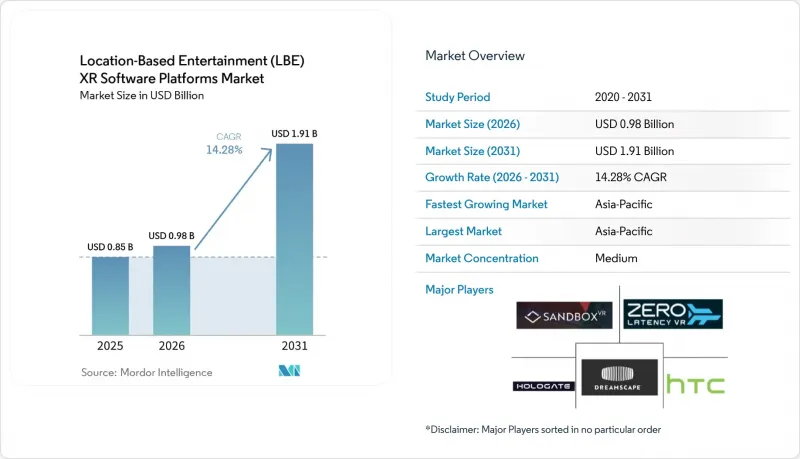
According to Mordor Intelligence, the location-based entertainment (LBE) XR software platforms market size is projected to expand from USD 0.85 billion in 2025 and USD 0.98 billion in 2026 to USD 1.91 billion by 2031, registering a CAGR of 14.28% between 2026 to 2031.
Global Location-Based Entertainment (LBE) XR Software Platforms Market Trends and Insights
Falling XR Hardware Costs Improving Venue Payback
Falling prices for standalone headsets reduce the hardware share of a venue's initial investment. Operators can redirect more of their budget toward content licensing, device management, analytics, and venue operations tools. SynthesisVR stated that a commercial 10-headset fleet with device management software can reduce daily staff intervention by up to 60 minutes per unit compared with consumer hardware deployments. This operational saving can improve the value of subscription software because staff time becomes available for guest service and additional sessions. Multi-site franchises are also better placed to request common application programming interfaces before approving a rollout. As headset hardware becomes less differentiated, the location-based entertainment (LBE) XR software platforms market places greater value on interoperable management systems.
Demand For Social and Shared Out-Of-Home Experiences
Group XR attractions respond to consumer demand for social experiences outside the home. Free-roam formats require reliable coordination of several players, headset status, and session timing. These operating needs make platform reliability relevant to ticket revenue and venue capacity. Operators also need systems that connect session behavior with customer relationship management and loyalty programs. Such records can help a venue identify repeat visitors, season-pass opportunities, and content preferences. The location-based entertainment (LBE) XR software platforms market therefore benefits when software supports both group play and post-session customer engagement.
High Upfront Capex and Maintenance Requirements
Initial capital requirements remain a barrier for independent operators and venues with limited financing access. SynthesisVR reported that a 10-headset free-roam fleet can understate initial investment by 15-30% when planning excludes space build-out, network infrastructure, and integration labor. Commercial device-management tools also add recurring costs, even when they reduce longer-term staffing needs. Operators that select an unsuitable platform can face significant switching costs after launch. SynthesisVR estimated payroll expenses of USD 97,333 over 24 months for a 10-headset fleet in its operating comparison. The location-based entertainment (LBE) XR software platforms market must therefore serve operators that need flexible licensing, financing support, and managed-service options.
Other drivers and restraints analyzed in the detailed report include:
- Blockbuster IP Partnerships Increasing Conversion
- 5G And Edge Rendering Reducing Venue Compute Costs
- Limited Premium Multiplayer Content Supply
For complete list of drivers and restraints, kindly check the Table Of Contents.
Segment Analysis
Experience Design and Orchestration accounted for 28.32% of the location-based entertainment (LBE) XR software platforms market size in 2025. The module manages synchronized multi-user environments across different headset fleets. This capability provides the basic operating layer for commercial session delivery. Content Management and Licensing is becoming more relevant as operators add titles and locations. Venue Operations, Ticketing, and Membership tools also support multi-site revenue reconciliation and guest administration.
Analytics, Monitoring, and Predictive Diagnostics is projected to expand at a 14.88% CAGR through 2031. Operators use session records such as dwell time, replay behavior, group composition, and hardware faults to guide pricing and maintenance. Real-time diagnostics can help staff address device issues before peak operating periods. Platforms that combine analytics, content administration, and ticketing can reduce reliance on disconnected vendor tools. The Others category includes safety monitoring, training overlays, and localization capabilities that become more relevant as international deployments increase.
Cloud-Hosted deployment accounted for 58.62% of the location-based entertainment (LBE) XR software platforms market size in 2025. It is also projected to expand at a 14.74% CAGR through 2031. Centralized delivery lets a franchise send software updates and configuration changes to many venues without on-site visits. Hydra's Experiencenet platform was designed for XR venues and was developed in partnership with HP and Citymesh.
On-Premises deployment remains relevant where connectivity is limited, data rules are stringent, or equipment needs local processing. Museum networks, theme parks, and training facilities may retain local systems because of these requirements. Edge-connected venues create a hybrid option that combines streamed rendering with local session control. A consistent interface across cloud, edge, and on-premises configurations can help operators use different infrastructure across their portfolios. This flexibility is increasingly important when enterprise buyers evaluate platform contracts.
Complete Report Scope:
- By Software Module
- Content Management and Licensing
- Experience Design and Orchestration
- Analytics, Monitoring, and Predictive Diagnostics
- Venue Operations, Ticketing, and Membership
- Other Software Modules
- By Deployment Model
- Cloud-Hosted
- On-Premises
- By Experience Type
- Free-Roam Multiplayer
- Room-Scale Multiplayer
- Seated and Cinematic VR
- Augmented and Mixed Reality Attractions
- Interactive Projection and Spatial Computing
- By Venue Type
- VR Arcades and Family Entertainment Centers
- Free-Roam Arenas
- Theme Parks and Immersive Attractions
- Cinemas, Malls, and Retail Venues
- Museums, Cultural Centers, and Educational Venues
- Hotels, Resorts, Cruise Ships, and Hospitality Venues
- By Business Model
- Software License and Royalty
- Subscription and Software-as-a-Service
- Revenue Share and Franchise
- Turnkey Attraction and Managed Service
- By Content and IP Type
- Original Game IP
- Film, Television, and Streaming IP
- Sports and Esports
- Music, Live Events, and Performing Arts
- Education, Training, and Cultural Content
- By Geography
- North America
- United States
- Canada
- Mexico
- South America
- Brazil
- Argentina
- Rest of South America
- Europe
- Germany
- United Kingdom
- France
- Spain
- Italy
- Russia
- Rest of Europe
- Asia-Pacific
- China
- Japan
- South Korea
- India
- Australia
- Rest of Asia-Pacific
- Middle East
- United Arab Emirates
- Saudi Arabia
- Turkey
- Rest of Middle East
- Africa
- South Africa
- Egypt
- Nigeria
- Rest of Africa
- North America
Geography Analysis
North America accounted for 39.42% of the location-based entertainment (LBE) XR software platforms market size in 2025. The region has a dense base of branded free-roam venues, established franchise licensing, and consumer demand for premium experiences. The United States remains the main source of regional software demand in urban entertainment districts and high-traffic malls. Canada and Mexico are secondary markets for family entertainment center deployments in mixed-use retail projects. Europe is an active deployment region, led by Germany, the United Kingdom, and France. HOLOGATE reported in July 2026 that its team had exceeded 100 members, reflecting further investment in AI-based development tools and enterprise training content.
Asia-Pacific is projected to expand at a 14.62% CAGR through 2031. Government digital infrastructure initiatives, higher leisure spending, and locally competitive XR hardware manufacturing support venue development. China's 5G rollout supports edge-rendered multiplayer experiences in mall venues. South Korea's advanced connectivity supports cloud-hosted models for esports-linked and K-pop themed attractions. Japan offers a developed IP licensing environment across anime, games, and live events. India presents an important country opportunity as organized retail entertainment and urbanization support new venue formation.
South America remains at an earlier stage, with Brazil offering the region's largest addressable base because of its urban population and organized retail entertainment activity. Currency volatility and import duties on XR equipment can constrain initial venue budgets and software spending. The Middle East is strategically important as entertainment projects create potential sites for immersive experiences. Saudi Arabia's Public Investment Fund launched QSAS in 2024 to develop immersive experiences inspired by the country's heritage, culture, and history. Africa remains nascent, although Zero Latency's 2025 Rabat opening established its presence across all 6 inhabited continents.
- Sandbox VR
- Zero Latency VR
- HOLOGATE
- Dreamscape Immersive, Inc.
- VRstudios Inc.
- Vertigo Games Holding B.V.
- EXIT VR GmbH
- Survios, Inc.
- Tyffon Inc.
- Neurogaming Limited
- Ctrl V Inc.
- IMAX Corporation
- Spaces LLC
- Nomadic Inc.
- The VOID LLC
- HTC Corporation
- Facebook Technologies LLC
- Disney Parks, Experiences and Products Inc.
- Pico Interactive Inc.
- DPVR Co. Ltd.
- SynthesisVR, Inc.
- Univrse
- 4Experience sp. z o.o.
Additional Benefits:
- The market estimate (ME) sheet in Excel format
- 3 months of analyst support
TABLE OF CONTENTS
1 INTRODUCTION
- 1.1 Study Assumptions and Market Definition
- 1.2 Scope of the Study
2 RESEARCH METHODOLOGY
3 EXECUTIVE SUMMARY
4 MARKET LANDSCAPE
- 4.1 Market Overview
- 4.2 Impact of Macroeconomic Factors on the Market
- 4.3 Market Drivers
- 4.3.1 Falling XR Hardware Costs Improving Venue Payback
- 4.3.2 Demand for Social and Shared Out-of-Home Experiences
- 4.3.3 Blockbuster IP Partnerships Increasing Conversion
- 4.3.4 5G and Edge Rendering Reducing Venue Compute Costs
- 4.3.5 Machine-Generated Content Lowering Experience Refresh Costs
- 4.3.6 Cross-Venue Identity and Persistent Progress Increasing Repeat Visits
- 4.4 Market Restraints
- 4.4.1 High Upfront Capex and Maintenance Requirements
- 4.4.2 Limited Premium Multiplayer Content Supply
- 4.4.3 Shared-Headset Hygiene and Turnover Friction
- 4.4.4 Fragmented Safety, Insurance, and Liability Standards
- 4.5 Industry Value Chain Analysis
- 4.6 Regulatory Landscape
- 4.7 Technological Outlook
- 4.8 Porter's Five Forces Analysis
- 4.8.1 Bargaining Power of Suppliers
- 4.8.2 Bargaining Power of Buyers
- 4.8.3 Threat of New Entrants
- 4.8.4 Threat of Substitutes
- 4.8.5 Competitive Rivalry
5 MARKET SIZE AND GROWTH FORECASTS (VALUE)
- 5.1 By Software Module
- 5.1.1 Content Management and Licensing
- 5.1.2 Experience Design and Orchestration
- 5.1.3 Analytics, Monitoring, and Predictive Diagnostics
- 5.1.4 Venue Operations, Ticketing, and Membership
- 5.1.5 Other Software Modules
- 5.2 By Deployment Model
- 5.2.1 Cloud-Hosted
- 5.2.2 On-Premises
- 5.3 By Experience Type
- 5.3.1 Free-Roam Multiplayer
- 5.3.2 Room-Scale Multiplayer
- 5.3.3 Seated and Cinematic VR
- 5.3.4 Augmented and Mixed Reality Attractions
- 5.3.5 Interactive Projection and Spatial Computing
- 5.4 By Venue Type
- 5.4.1 VR Arcades and Family Entertainment Centers
- 5.4.2 Free-Roam Arenas
- 5.4.3 Theme Parks and Immersive Attractions
- 5.4.4 Cinemas, Malls, and Retail Venues
- 5.4.5 Museums, Cultural Centers, and Educational Venues
- 5.4.6 Hotels, Resorts, Cruise Ships, and Hospitality Venues
- 5.5 By Business Model
- 5.5.1 Software License and Royalty
- 5.5.2 Subscription and Software-as-a-Service
- 5.5.3 Revenue Share and Franchise
- 5.5.4 Turnkey Attraction and Managed Service
- 5.6 By Content and IP Type
- 5.6.1 Original Game IP
- 5.6.2 Film, Television, and Streaming IP
- 5.6.3 Sports and Esports
- 5.6.4 Music, Live Events, and Performing Arts
- 5.6.5 Education, Training, and Cultural Content
- 5.7 By Geography
- 5.7.1 North America
- 5.7.1.1 United States
- 5.7.1.2 Canada
- 5.7.1.3 Mexico
- 5.7.2 South America
- 5.7.2.1 Brazil
- 5.7.2.2 Argentina
- 5.7.2.3 Rest of South America
- 5.7.3 Europe
- 5.7.3.1 Germany
- 5.7.3.2 United Kingdom
- 5.7.3.3 France
- 5.7.3.4 Spain
- 5.7.3.5 Italy
- 5.7.3.6 Russia
- 5.7.3.7 Rest of Europe
- 5.7.4 Asia-Pacific
- 5.7.4.1 China
- 5.7.4.2 Japan
- 5.7.4.3 South Korea
- 5.7.4.4 India
- 5.7.4.5 Australia
- 5.7.4.6 Rest of Asia-Pacific
- 5.7.5 Middle East
- 5.7.5.1 United Arab Emirates
- 5.7.5.2 Saudi Arabia
- 5.7.5.3 Turkey
- 5.7.5.4 Rest of Middle East
- 5.7.6 Africa
- 5.7.6.1 South Africa
- 5.7.6.2 Egypt
- 5.7.6.3 Nigeria
- 5.7.6.4 Rest of Africa
- 5.7.1 North America
6 COMPETITIVE LANDSCAPE
- 6.1 Market Concentration
- 6.2 Strategic Moves
- 6.3 Market Share Analysis
- 6.4 Company Profiles (includes Global Level Overview, Market Level Overview, Core Segments, Financials as available, Strategic Information, Market Rank/Share, Products and Services, Recent Developments)
- 6.4.1 Sandbox VR
- 6.4.2 Zero Latency VR
- 6.4.3 HOLOGATE
- 6.4.4 Dreamscape Immersive, Inc.
- 6.4.5 VRstudios Inc.
- 6.4.6 Vertigo Games Holding B.V.
- 6.4.7 EXIT VR GmbH
- 6.4.8 Survios, Inc.
- 6.4.9 Tyffon Inc.
- 6.4.10 Neurogaming Limited
- 6.4.11 Ctrl V Inc.
- 6.4.12 IMAX Corporation
- 6.4.13 Spaces LLC
- 6.4.14 Nomadic Inc.
- 6.4.15 The VOID LLC
- 6.4.16 HTC Corporation
- 6.4.17 Facebook Technologies LLC
- 6.4.18 Disney Parks, Experiences and Products Inc.
- 6.4.19 Pico Interactive Inc.
- 6.4.20 DPVR Co. Ltd.
- 6.4.21 SynthesisVR, Inc.
- 6.4.22 Univrse
- 6.4.23 4Experience sp. z o.o.
7 MARKET OPPORTUNITIES AND FUTURE OUTLOOK
- 7.1 White-Space and Unmet-Need Assessment

