PUBLISHER: Mordor Intelligence | PRODUCT CODE: 2154401

PUBLISHER: Mordor Intelligence | PRODUCT CODE: 2154401
Remote Inspection Platforms - Market Share Analysis, Industry Trends & Statistics, Growth Forecasts (2026 - 2031)
According to Mordor Intelligence, the remote inspection platforms market size was valued at USD 2.27 billion in 2025 and estimated to grow from USD 2.56 billion in 2026 to reach USD 4.24 billion by 2031, at a CAGR of 10.62% during the forecast period (2026-2031).
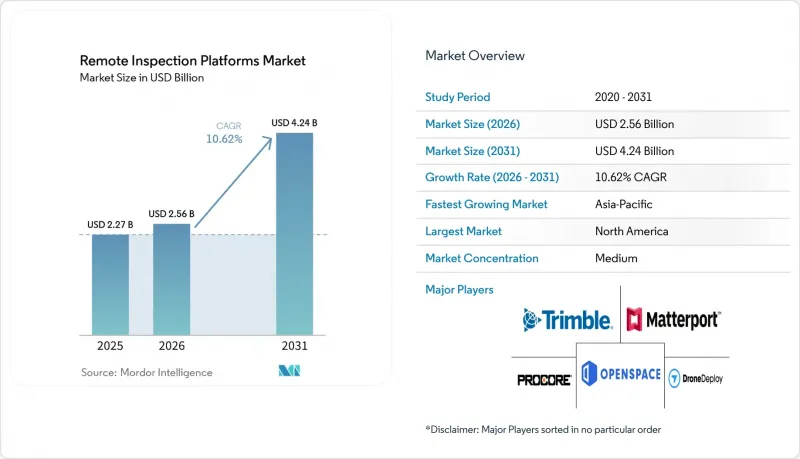
Global Remote Inspection Platforms Market Trends and Insights
Integration of AI, Drones, Robotics, and 5G Connectivity
The remote inspection platforms market is benefiting from the closer integration of computer vision, aerial platforms, ground robots, and faster network connections. These tools can reduce inspection cycles from weeks to hours by capturing and reviewing visual information more quickly across routine surveillance, planned maintenance, and condition-assessment activities. This supports wider use of the remote inspection platforms market in asset-intensive work. The main competitive issue is increasingly the ability to connect inspection outputs with enterprise asset management and computerized maintenance systems, where findings can be converted into follow-up work and documented decisions. DroneDeploy introduced Inspection AI in October 2025 for oil and gas, rail, renewable energy, and utility assets, using AI agents to review visual data and rank defect severity for asset teams. Amazon Web Services described the use of drones and on-device computer vision for wind turbines, pipelines, and telecom towers, showing that cloud providers are participating in inspection workflows. Toshiba reported in September 2025 that its image anomaly detection approach could halve false positives in infrastructure and plant inspections, which supports more dependable visual analysis across physical assets.
Aging Industrial and Infrastructure Assets
Aging bridges, plants, and other infrastructure are making the remote inspection platforms market more relevant to maintenance planning. Asset owners face a growing need to identify cracks, spalling, and corrosion before a repair becomes more difficult or expensive, particularly where assets are older and replacement budgets remain limited. A 2025 review of autonomous robotic systems found that manual bridge inspections can be subjective, offer limited coverage, and cannot readily access key structural elements. The same limitations create a clear role for drones and robots that collect consistent visual records over time. National Grid deployed centralized autonomous BVLOS drone inspections across its England and Wales transmission network in September 2025 after a 4-year innovation program. That implementation shows that major asset operators can adopt digital inspection at network scale when operational rules and the commercial case are clear.
Shortage of Certified Inspection and Data-Analytics Personnel
The remote inspection platforms market faces a shortage of people who can validate data quality, interpret unusual findings, and meet certification requirements. Automation can reduce routine effort, but many maintenance actions and permit processes still require an accredited inspector to approve the result and provide the necessary professional accountability. The shortage is especially important when experienced inspectors retire faster than organizations can train replacements. A semi-autonomous workflow also requires skilled staff to plan missions, assess exceptions, and manage compliance. This need is creating demand for personnel who combine inspection qualifications, drone operating skills, and data analysis capability. Guided workflows and AI-supported interpretation can help, but they do not fully remove the need for human certification during the forecast period.
Other drivers and restraints analyzed in the detailed report include:
- Demand for Safer Inspection of Hazardous and Inaccessible Assets
- Expansion of Digital Twin-Based Inspection
- Cybersecurity and Data-Residency Risks
For complete list of drivers and restraints, kindly check the Table Of Contents.
Segment Analysis
Software held 62.48% of the overall market revenue in 2025. This result reflected a move away from perpetual licenses toward subscriptions that include data processing, model training, and report generation. Software bundles can also include work that clients once purchased as separate professional services. As a result, the recorded software portion can understate the value transferred from services into subscription pricing. This shift gives providers more recurring revenue and gives customers a more unified procurement model for data processing, training, reporting, and ongoing platform access.
Services remain important for implementation, calibration, training, and managed inspection programs. They are particularly relevant when a client does not have an internal analytics capability or established field processes. Bureau Veritas reported FY2025 revenue of EUR 6,466.4 million, equivalent to USD 7,152 million at the stated average 2025 EUR/USD rate of 1.106, and 6.5% organic growth. Its managed inspection contracts illustrate how TIC providers can combine proprietary tools with longer service relationships. A 2026 study of digital twins for welded assemblies found that many surveyed implementations remained at the conceptual stage, which indicates an ongoing need for configuration and deployment services.
Cloud-based deployment accounted for 69.87% of the remote inspection platforms market in 2025 and is projected to expand at a 12.63% CAGR through 2031. Distributed field teams value the ability to access inspection records, maps, and reports across devices and sites, including remote locations where field and office staff must work from the same visual record. Cloud capacity also supports processing of larger image sets and more frequent analysis, which is useful when imagery is collected repeatedly across several facilities or project locations. These benefits have made cloud delivery the standard option for many construction, insurance, and asset-management users that need shared workflows without managing a separate local environment. Cloud architecture also makes software updates and shared workflows easier to manage when inspections involve multiple users, locations, devices, and stages of review.
On-premises systems remain relevant in oil and gas, critical infrastructure, and other settings with strict data residency requirements. Some buyers are using private or edge environments for sensitive data while connecting to cloud layers for reporting and analytics. DroneDeploy's regional data-residency arrangements show why providers must support more than a single global cloud model. SGS reported 19.2% growth in its Digital Trust business in 2025 while continuing to integrate AI capabilities into inspection-related services. The remote inspection software industry therefore has room for providers that can combine cloud usability with controlled deployment options.
Complete Report Scope:
- By Component
- Software
- Services
- By Deployment Mode
- Cloud-Based
- On-Premises
- By Application
- Construction and Infrastructure
- Real Estate and Property Management
- Oil and Gas
- Manufacturing and Heavy Engineering
- Energy and Utilities
- Transportation and Logistics
- Insurance and Claims Assessment
- Other Applications
- By Enterprise Size
- Large Enterprises
- Small and Medium-Sized Enterprises
- By End User
- Contractors and Inspection Service Providers
- Architects, Engineers, and Project Managers
- Facility and Asset Managers
- Government and Regulatory Bodies
- Other End Users
- By Geography
- North America
- United States
- Canada
- Mexico
- South America
- Brazil
- Argentina
- Rest of South America
- Europe
- Germany
- United Kingdom
- France
- Italy
- Spain
- Russia
- Rest of Europe
- Asia-Pacific
- China
- Japan
- India
- South Korea
- Southeast Asia
- Rest of Asia-Pacific
- Middle East
- Saudi Arabia
- United Arab Emirates
- Turkey
- Rest of Middle East
- Africa
- South Africa
- Nigeria
- Rest of Africa
- North America
Geography Analysis
North America held 34.12% of remote inspection platforms market share in 2025. The region combines early cloud adoption in construction and energy with recurring demand from U.S. insurance claims processes. The U.S. Department of Transportation documented that manual bridge inspections can underreport concrete cracking, spalling, and steel corrosion, which supports the use of robotic and drone inspection systems. The Federal Aviation Administration proposed a rule in August 2025 to normalize BVLOS operations, creating a performance-based route for more viable inspection of pipelines and power lines. Canada's energy infrastructure and Mexico's manufacturing export base provide additional demand opportunities as cloud inspection adoption increases.
Europe remained the second-largest regional market, led by Germany, the United Kingdom, France, and Italy. Manufacturing, energy, and built infrastructure are central sources of demand across the region. National Grid rolled out centralized autonomous drone inspection for its electricity network in England and Wales in September 2025. The deployment followed the United Kingdom's BVLOS infrastructure policy and provides an enterprise-scale example for other operators. EASA revised its Easy Access Rules for Unmanned Aircraft Systems in June 2026, including the SORA 2.5 operational risk assessment package. Russia faces technology-access constraints, while other European markets benefit from energy infrastructure renewal linked to renewable energy objectives and wider requirements for documented asset oversight.
Asia-Pacific is projected to expand at a 13.06% CAGR through 2031, the fastest regional rate in the remote inspection platforms market. China is supported by industrial digitization and smart-factory programs, while India has demand from roads, metro systems, and power networks that require more frequent asset documentation and maintenance oversight. Southeast Asia combines new industrial development with evolving inspection compliance practices. Toshiba's September 2025 work on anomaly detection demonstrated lower false positives for infrastructure and plant inspection applications. The Middle East offers opportunities from large construction programs and oil and gas assets. Africa is at an earlier stage, led by South Africa and Nigeria, while South America has potential in Brazil's energy and mining sectors and Argentina's industrial base, subject to macroeconomic variation.
- Matterport, Inc.
- OpenSpace Technologies, Inc.
- DroneDeploy, Inc.
- Procore Technologies, Inc.
- Trimble Inc.
- Autodesk, Inc.
- Boston Dynamics, Inc.
- Optelos, Inc.
- TEAM, Inc.
- MISTRAS Group, Inc.
- Bureau Veritas SA
- Applus Services SA
- SGS SA
- Intertek Group plc
- Waygate Technologies GmbH
- Eddyfi Technologies
- Oceaneering International, Inc.
- Cyberhawk Innovations Limited
- Invert Robotics Limited
- SkySpecs, Inc.
- ScoutDI AS
- Capgemini SE
- Microsoft Corporation
- Pix4D SA
- PlanRadar GmbH
Additional Benefits:
- The market estimate (ME) sheet in Excel format
- 3 months of analyst support
TABLE OF CONTENTS
1 INTRODUCTION
- 1.1 Study Assumptions and Market Definition
- 1.2 Scope of the Study
2 RESEARCH METHODOLOGY
3 EXECUTIVE SUMMARY
4 MARKET LANDSCAPE
- 4.1 Market Overview
- 4.2 Market Drivers
- 4.2.1 Aging Industrial and Infrastructure Assets
- 4.2.2 Expansion of Digital Twin-Based Inspection
- 4.2.3 Demand for Safer Inspection of Hazardous and Inaccessible Assets
- 4.2.4 Shift From Shutdown-Based Inspection to Live Asset Monitoring
- 4.2.5 Integration of AI, Drones, Robotics, and 5G Connectivity
- 4.2.6 Acceptance of Tethered and BVLOS Inspection Operations
- 4.3 Market Restraints
- 4.3.1 Shortage of Certified Inspection and Data-Analytics Personnel
- 4.3.2 Cybersecurity and Data-Residency Risks
- 4.3.3 High Deployment Costs for Sensors, Robotics, and Connectivity
- 4.3.4 Fragmented Data Standards Across Inspection Ecosystems
- 4.4 Industry Value-Chain Analysis
- 4.5 Regulatory Landscape
- 4.6 Technological Outlook
- 4.7 Porter's Five Forces Analysis
- 4.7.1 Threat of New Entrants
- 4.7.2 Bargaining Power of Suppliers
- 4.7.3 Bargaining Power of Buyers
- 4.7.4 Threat of Substitutes
- 4.7.5 Competitive Rivalry
5 MARKET SIZE AND GROWTH FORECASTS (VALUE)
- 5.1 By Component
- 5.1.1 Software
- 5.1.2 Services
- 5.2 By Deployment Mode
- 5.2.1 Cloud-Based
- 5.2.2 On-Premises
- 5.3 By Application
- 5.3.1 Construction and Infrastructure
- 5.3.2 Real Estate and Property Management
- 5.3.3 Oil and Gas
- 5.3.4 Manufacturing and Heavy Engineering
- 5.3.5 Energy and Utilities
- 5.3.6 Transportation and Logistics
- 5.3.7 Insurance and Claims Assessment
- 5.3.8 Other Applications
- 5.4 By Enterprise Size
- 5.4.1 Large Enterprises
- 5.4.2 Small and Medium-Sized Enterprises
- 5.5 By End User
- 5.5.1 Contractors and Inspection Service Providers
- 5.5.2 Architects, Engineers, and Project Managers
- 5.5.3 Facility and Asset Managers
- 5.5.4 Government and Regulatory Bodies
- 5.5.5 Other End Users
- 5.6 By Geography
- 5.6.1 North America
- 5.6.1.1 United States
- 5.6.1.2 Canada
- 5.6.1.3 Mexico
- 5.6.2 South America
- 5.6.2.1 Brazil
- 5.6.2.2 Argentina
- 5.6.2.3 Rest of South America
- 5.6.3 Europe
- 5.6.3.1 Germany
- 5.6.3.2 United Kingdom
- 5.6.3.3 France
- 5.6.3.4 Italy
- 5.6.3.5 Spain
- 5.6.3.6 Russia
- 5.6.3.7 Rest of Europe
- 5.6.4 Asia-Pacific
- 5.6.4.1 China
- 5.6.4.2 Japan
- 5.6.4.3 India
- 5.6.4.4 South Korea
- 5.6.4.5 Southeast Asia
- 5.6.4.6 Rest of Asia-Pacific
- 5.6.5 Middle East
- 5.6.5.1 Saudi Arabia
- 5.6.5.2 United Arab Emirates
- 5.6.5.3 Turkey
- 5.6.5.4 Rest of Middle East
- 5.6.6 Africa
- 5.6.6.1 South Africa
- 5.6.6.2 Nigeria
- 5.6.6.3 Rest of Africa
- 5.6.1 North America
6 COMPETITIVE LANDSCAPE
- 6.1 Market Concentration
- 6.2 Strategic Moves
- 6.3 Market Share Analysis
- 6.4 Company Profiles (includes Global Level Overview, Market Level Overview, Core Segments, Financials as available, Strategic Information, Market Rank/Share, Products and Services, Recent Developments)
- 6.4.1 Matterport, Inc.
- 6.4.2 OpenSpace Technologies, Inc.
- 6.4.3 DroneDeploy, Inc.
- 6.4.4 Procore Technologies, Inc.
- 6.4.5 Trimble Inc.
- 6.4.6 Autodesk, Inc.
- 6.4.7 Boston Dynamics, Inc.
- 6.4.8 Optelos, Inc.
- 6.4.9 TEAM, Inc.
- 6.4.10 MISTRAS Group, Inc.
- 6.4.11 Bureau Veritas SA
- 6.4.12 Applus Services SA
- 6.4.13 SGS SA
- 6.4.14 Intertek Group plc
- 6.4.15 Waygate Technologies GmbH
- 6.4.16 Eddyfi Technologies
- 6.4.17 Oceaneering International, Inc.
- 6.4.18 Cyberhawk Innovations Limited
- 6.4.19 Invert Robotics Limited
- 6.4.20 SkySpecs, Inc.
- 6.4.21 ScoutDI AS
- 6.4.22 Capgemini SE
- 6.4.23 Microsoft Corporation
- 6.4.24 Pix4D SA
- 6.4.25 PlanRadar GmbH
7 MARKET OPPORTUNITIES AND FUTURE OUTLOOK
- 7.1 White-Space and Unmet-Need Assessment

