PUBLISHER: Mordor Intelligence | PRODUCT CODE: 2154412

PUBLISHER: Mordor Intelligence | PRODUCT CODE: 2154412
Zamak Material For Automotive - Market Share Analysis, Industry Trends & Statistics, Growth Forecasts (2026 - 2031)
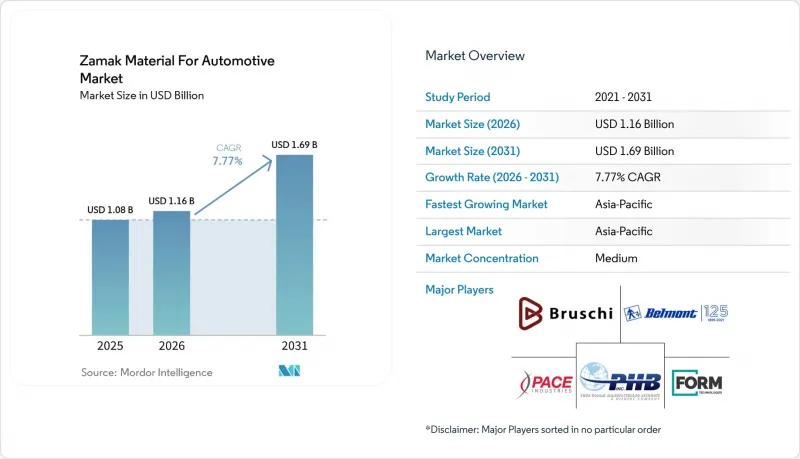
According to Mordor Intelligence, the zamak material for Automotive Market size was valued at USD 1.08 billion in 2025 and is estimated to grow from USD 1.16 billion in 2026 to reach USD 1.69 billion by 2031, at a CAGR of 7.77% during the forecast period (2026-2031).
Global Zamak Material For Automotive Market Trends and Insights
Electrification of Vehicle Electrical and Electronic Systems
Battery electric vehicles, plug-in hybrid electric vehicles, and hybrid electric vehicles use more electromagnetic interference-sensitive enclosures, connector housings, and control-unit covers than comparable internal combustion engine vehicles. This increases component demand across the Zamak material for automotive market, particularly where battery-management and onboard-charging systems require compact shielded covers. Zinc die-cast components provide electromagnetic interference and radio-frequency interference shielding above 150 kHz, reducing the need for metallized coatings on plastic housings. The International Automotive Task Force 16949 quality-management standard supports traceability in high-volume automotive casting programs, which reduces requalification challenges for suppliers moving into electrified vehicle programs. Advanced driver assistance systems, including radar and light detection and ranging sensor housings, require tight dimensional control and can use walls below 0.5 mm in production castings. The International Lead and Zinc Study Group expected global zinc usage to rise 1.6% in 2025, with automotive and electronics demand among the main drivers.
OEM Lightweighting and Part-Integration Targets
Original equipment manufacturer (OEM) lightweighting programs increasingly focus on reducing part counts as well as mass. This favors near-net-shape castings that combine bracket, fastener, and connector functions within a single part and can reduce secondary assembly steps. A 10% reduction in vehicle weight has been associated with a 6% to 8% improvement in battery electric vehicle driving range. European Union carbon dioxide fleet requirements and Corporate Average Fuel Economy standards in North America have moved lightweighting into component specifications rather than treating it as a later optimization. The ZinkGuss project demonstrated the potential of Zamak 5 in seat belt pretensioner components subjected to high cyclic loads. The Automotive Component Manufacturers Association of India reported USD 2.5 billion to USD 3 billion of automotive component investments in fiscal year 2025, with lightweight materials identified as a strategic area that supports the Zamak material for automotive market.
Competition from Aluminum, Magnesium, Plastics and Composites
Zinc has a density of 6.6 g/cm3, compared with 2.7 g/cm3 for aluminum. This limits its role in large body-in-white structures where aluminum giga-castings can replace multiple stampings. Glass-fiber-reinforced polyamides also compete in low-load interior trim and bracket applications where weight and appearance govern specifications. Large one-piece aluminum castings increase substitution pressure in structural positions and reduce the addressable space for other materials. Zamak retains a role in sub-kilogram parts where thin walls, tooling longevity, and shielding performance are important. Early vehicle architecture decisions can determine material selection for a 7-to-10-year platform life, making design-stage engagement important for the Zamak material for automotive market.
Other drivers and restraints analyzed in the detailed report include:
- Demand for Thin-Wall, Complex, Near-Net-Shape Components
- Expansion of Localized Automotive Supplier Ecosystems
- Zinc-Price and Energy-Cost Volatility
For complete list of drivers and restraints, kindly check the Table Of Contents.
Segment Analysis
Zamak 3 held a 41.08% market share in 2025 and is projected to advance at an 8.25% CAGR through 2031. Its castability, dimensional stability, and electroplating compatibility supported use in exterior door handles, sensor connector bodies, and other automotive subcomponents. Its fine-grain structure supported chrome-alternative surface treatments and decorative finishes. Zamak 5 contains 1% copper and offers a higher tensile strength of 330 MPa with improved creep resistance. The grade serves high-stress applications such as seat belt pretensioners and door-latch mechanisms.
Fraunhofer Institute for Structural Durability and System Reliability validated Zamak 5 fatigue-strength data under high cyclic loads in October 2025. Zamak 7 has lower copper and magnesium content, which supports thin-wall flow in connector housings and advanced driver assistance system sensor covers where fill uniformity is important. Zamak 2 has higher copper content and the highest hardness among standard grades, supporting selected high-wear bracket uses where surface durability is required. Other alloy types include high-strength and creep-resistant grades such as EZAC, which has a yield strength up to 396 MPa and was designed by Eastern Alloys Inc. for more demanding parts previously served by cold-chamber alloys. European original equipment manufacturer qualification continues to rely on Deutsches Institut fur Normung European Norm 1774, supporting consistent alloy specifications across suppliers and confidence in approved material grades within the Zamak material for automotive market.
Complete Report Scope:
- By Alloy Type
- Zamak 2
- Zamak 3
- Zamak 5
- Zamak 7
- Other Alloy Types
- By Vehicle Type
- Passenger Vehicles
- Light Commercial Vehicles (LCVs)
- Heavy Commercial Vehicles (HCVs)
- Two-Wheelers
- Electric Vehicles (BEV, PHEV, and HEV)
- By Application
- Exterior Hardware
- Interior Hardware
- Electrical and Electronic Components
- Locking and Safety Systems
- Other Applications (Powertrain and Engine Components)
- By Geography
- Asia-Pacific
- China
- India
- Japan
- South Korea
- ASEAN Countries
- Rest of Asia-Pacific
- North America
- United States
- Canada
- Mexico
- Europe
- Germany
- United Kingdom
- France
- Italy
- NORDIC Countries
- Rest of Europe
- South America
- Brazil
- Argentina
- Rest of South America
- Middle-East and Africa
- Saudi Arabia
- South Africa
- Rest of Middle-East and Africa
- Asia-Pacific
Geography Analysis
Asia-Pacific held 37.02% market share in 2025 and is projected to advance at an 8.19% CAGR through 2031. China combines large vehicle production with a major zinc-smelting base. The International Lead and Zinc Study Group reported that Chinese passenger car production rose 10.5% year over year in 2024 and 17.2% in the first 2 months of 2025. India received USD 2.5 billion to USD 3 billion of auto component investment in fiscal year 2025. Local alloy procurement can reduce lead times and import costs for Indian foundries.
South Korea and Japan support demand for high-purity grades through their established original equipment manufacturer and Tier-1 supplier bases. Smart-factory retrofits at South Korean foundries focus on yield and energy management. Thailand and Indonesia are adding demand as Japanese and Korean vehicle makers expand regional assembly capacity. North America supports high-volume connector and bracket programs through Corporate Average Fuel Economy standards and Environmental Protection Agency requirements, while Mexico-based Tier-1 suppliers serve assembly plants in the United States. Europe remains important for precision electric vehicle connector and sensor applications because of its dense original equipment manufacturer and supplier ecosystem.
France, Italy, and the United Kingdom contribute through their established foundry industries, while Nordic procurement standards place greater emphasis on recyclability and lifecycle information. Secondary Zamak with 10% primary zinc had a footprint below 671 kg carbon dioxide per metric ton, compared with 3,610 kg carbon dioxide per metric ton for primary alloy. REAZN S.A. participated in the EMEA Automotive Carbon Neutral Summit in November 2025, while GRILLO-Werke AG promoted its Low Carbon Zinc offering. Brazil anchors demand in South America, while Argentina's recovering vehicle production adds demand for locally assembled vehicles, and Saudi Arabia's Vision 2030 program and South Africa's assembly sector support a smaller Middle-East and Africa application base for the Zamak material for automotive market.
- Belmont Metals
- BN Industries
- Bruschi Srl
- Chem Zinc Die Casting Alloys
- Eastern Alloys Inc.
- Form Technologies
- GRILLO-Werke AG
- Hindustan Zinc
- Ital Leghe S.r.l.
- Nyrstar
- Pace Industries
- PHB Corporation
- Phoenix Industries Ltd.
- Radiant Metals and Alloys Pvt. Ltd.
- REAZN S.A.
Additional Benefits:
- The market estimate (ME) sheet in Excel format
- 3 months of analyst support
TABLE OF CONTENTS
1 Introduction
- 1.1 Study Assumptions and Market Definition
- 1.2 Scope of the Study
2 Research Methodology
3 Executive Summary
4 Market Landscape
- 4.1 Market Overview
- 4.2 Market Drivers
- 4.2.1 Electrification of Vehicle Electrical and Electronic Systems
- 4.2.2 OEM Lightweighting and Part-Integration Targets
- 4.2.3 Demand for Thin-Wall, Complex, Near-Net-Shape Components
- 4.2.4 Expansion of Localized Automotive Supplier Ecosystems
- 4.2.5 Recyclability and Lower Energy Requirements of Zamak Processing
- 4.3 Market Restraints
- 4.3.1 Competition from Aluminum, Magnesium, Plastics and Composites
- 4.3.2 Zinc-Price and Energy-Cost Volatility
- 4.3.3 Tooling, Die-Life and Qualification Costs for Low-Volume Programs
- 4.4 Value Chain Analysis
- 4.5 Porter's Five Forces Analysis
- 4.5.1 Threat of New Entrants
- 4.5.2 Bargaining Power of Suppliers
- 4.5.3 Bargaining Power of Buyers
- 4.5.4 Threat of Substitutes
- 4.5.5 Competitive Rivalry
5 Market Size and Growth Forecasts (Value)
- 5.1 By Alloy Type
- 5.1.1 Zamak 2
- 5.1.2 Zamak 3
- 5.1.3 Zamak 5
- 5.1.4 Zamak 7
- 5.1.5 Other Alloy Types
- 5.2 By Vehicle Type
- 5.2.1 Passenger Vehicles
- 5.2.2 Light Commercial Vehicles (LCVs)
- 5.2.3 Heavy Commercial Vehicles (HCVs)
- 5.2.4 Two-Wheelers
- 5.2.5 Electric Vehicles (BEV, PHEV, and HEV)
- 5.3 By Application
- 5.3.1 Exterior Hardware
- 5.3.2 Interior Hardware
- 5.3.3 Electrical and Electronic Components
- 5.3.4 Locking and Safety Systems
- 5.3.5 Other Applications (Powertrain and Engine Components)
- 5.4 By Geography
- 5.4.1 Asia-Pacific
- 5.4.1.1 China
- 5.4.1.2 India
- 5.4.1.3 Japan
- 5.4.1.4 South Korea
- 5.4.1.5 ASEAN Countries
- 5.4.1.6 Rest of Asia-Pacific
- 5.4.2 North America
- 5.4.2.1 United States
- 5.4.2.2 Canada
- 5.4.2.3 Mexico
- 5.4.3 Europe
- 5.4.3.1 Germany
- 5.4.3.2 United Kingdom
- 5.4.3.3 France
- 5.4.3.4 Italy
- 5.4.3.5 NORDIC Countries
- 5.4.3.6 Rest of Europe
- 5.4.4 South America
- 5.4.4.1 Brazil
- 5.4.4.2 Argentina
- 5.4.4.3 Rest of South America
- 5.4.5 Middle-East and Africa
- 5.4.5.1 Saudi Arabia
- 5.4.5.2 South Africa
- 5.4.5.3 Rest of Middle-East and Africa
- 5.4.1 Asia-Pacific
6 Competitive Landscape
- 6.1 Market Concentration
- 6.2 Strategic Moves
- 6.3 Market Share (%)/Ranking Analysis
- 6.4 Company Profiles (includes Global Overview, Market Overview, Core Segments, Financials as available, Strategic Information, Products and Services, and Recent Developments)
- 6.4.1 Belmont Metals
- 6.4.2 BN Industries
- 6.4.3 Bruschi Srl
- 6.4.4 Chem Zinc Die Casting Alloys
- 6.4.5 Eastern Alloys Inc.
- 6.4.6 Form Technologies
- 6.4.7 GRILLO-Werke AG
- 6.4.8 Hindustan Zinc
- 6.4.9 Ital Leghe S.r.l.
- 6.4.10 Nyrstar
- 6.4.11 Pace Industries
- 6.4.12 PHB Corporation
- 6.4.13 Phoenix Industries Ltd.
- 6.4.14 Radiant Metals and Alloys Pvt. Ltd.
- 6.4.15 REAZN S.A.
7 Market Opportunities and Future Outlook
- 7.1 White-Space and Unmet-Need Assessment

