PUBLISHER: Mordor Intelligence | PRODUCT CODE: 2154419

PUBLISHER: Mordor Intelligence | PRODUCT CODE: 2154419
Vietnam Textile Machinery - Market Share Analysis, Industry Trends & Statistics, Growth Forecasts (2026 - 2031)
According to Mordor Intelligence, the Vietnam textile machinery market size is expected to grow from USD 0.75 billion in 2025 to USD 0.79 billion in 2026 and is forecast to reach USD 1.05 billion by 2031 at 5.86% CAGR over 2026-2031.
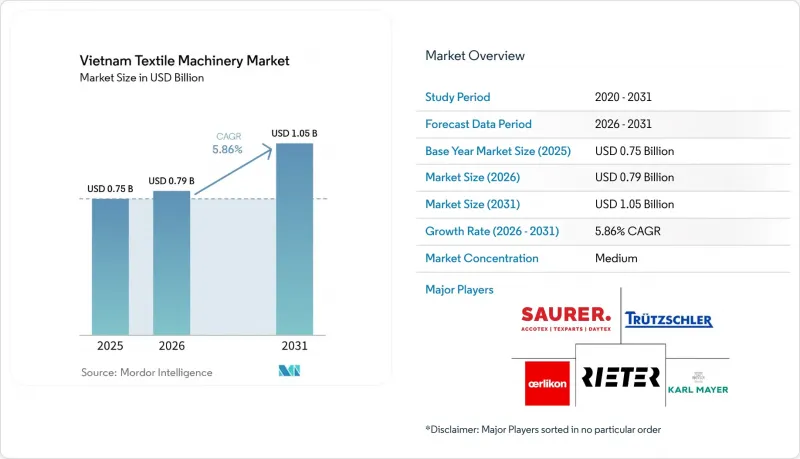
Vietnam Textile Machinery Market Trends and Insights
Export-Oriented Textile Capacity Expansion
Vietnam's export-led manufacturing model supports capital spending on textile production equipment. Textile and garment exports reached USD 46 billion in 2025, and the 2026 target is USD 48 billion to USD 49 billion. Higher order volumes require greater throughput, more consistent delivery performance, and better product traceability across spinning, fabric formation, garment production, and finishing. Vietnam was among the world's top 3 investors in open-end rotors in 2025, as shipments rose 17% even as investment in several global machinery categories weakened. The country's United States garment share rose to 19.9% in 2025, while its share in Japan remained 18.5%, supporting longer-term buyer commitments.
Factory Automation to Offset Rising Labor Costs
Rising labor costs and pressure to improve productivity are strengthening the case for automation among Vietnam textile producers. In 2025, average nominal monthly wages in Vietnam textile market were approximately USD 275, increasing the incentive for manufacturers to reduce labor dependency and improve operational efficiency. Rather than applying a single production-cost premium across Indonesia, Malaysia, and Myanmar, cost competitiveness should be assessed separately because labor and operating-cost structures differ substantially across these markets. This pressure is making advanced machinery increasingly important for improving labor productivity. A reported 50,000-spindle spinning facility that adopted Industry 4.0 technologies reduced its operating workforce from approximately 200-300 workers to 30-40 workers, demonstrating the potential for substantial labor savings. Industry sources also report 20%-30% productivity gains from automated production systems. However, automation adoption remains at an early stage, with only around 30% of textile businesses reported to have introduced automation at some stage of production, while connected-system adoption remains limited.
High Upfront Cost and Extended Payback for Integrated Lines
Capital intensity remains the main constraint on modernization, especially for small and medium-sized enterprises that account for more than 70% of Vietnam's textile production capacity. European and Japanese integrated spinning or weaving systems can require USD 20 million to USD 50 million or more at a meaningful scale. In contrast, lower-cost Chinese alternatives still require difficult financial planning for mills with short order books. The Vietnam textile machinery market has strong modernization demand, but many potential buyers cannot make an immediate purchase when projects combine spinning, weaving, dyeing, finishing, and automation. APO found that real capital investment rose 169% from 2012 to 2022 but was concentrated among large state-linked groups and foreign-invested enterprises. Wage pressure makes automation more necessary while reducing the cash flow available to fund it, and the fifth consecutive minimum wage increase in 2026 narrows the decision window for mills that delayed investment. Smaller mills may select partial automation or upgrades instead of integrated lines, extending replacement cycles for high-value equipment.
Other drivers and restraints analyzed in the detailed report include:
- Green and Smart-Factory Investment for Buyer Compliance
- Localized Upstream Capacity to Satisfy Rules of Origin
- Dependence on Imported Machinery, Parts, and Technical Service
For complete list of drivers and restraints, kindly check the Table Of Contents.
Segment Analysis
Spinning and yarn manufacturing machinery held 29.95% of the Vietnam textile machinery market share in 2025. Its position reflects upstream investment needed to meet the CPTPP rules of origin. Vietnam also ranked among the world's top 3 destinations for open-end rotor investment in 2025, as shipments rose 17% year over year. The category includes ring spinning, open-end rotor, and air-jet systems, which differ in supplier base and operating requirements. Mills select these systems based on yarn quality, output, energy use, automation needs, and intended product mix.
Textile printing machinery is forecast to record the fastest product growth at a 6.95% CAGR through 2031, as mills move from analog screen and rotary systems to digital inkjet platforms. Shorter buyer order cycles, on-demand customization, improved color management, and chemical traceability support this shift. Weaving and weaving-preparation machinery is the second-largest product category, with rapier and air-jet looms prominent in new woven-fabric installations. Vietnam received 1,800 large circular knitting machines in 2025 and ranked third after China and India, despite a 13% decline in global shipments. Flat-bed knitting, nonwoven machinery, and testing and quality-control equipment are also gaining relevance as technical-textile, hygiene, medical, buyer-audit, and certification requirements increase.
Complete Report Scope:
- By Product and Process Equipment
- Spinning and Yarn Manufacturing Machinery
- Weaving and Weaving Preparation Machinery
- Knitting Machinery
- Nonwoven Machinery
- Textile Dyeing, Processing and Finishing Machinery
- Textile Printing Machinery
- Textile Testing, Inspection and Quality-Control Equipment
- Others (Textile Material Handling Equipment, Humidification Systems, fibre-recovery machinery, doffing and packaging systems, etc.)
- By Source of Supply
- Domestically Manufactured Machinery
- Imported Machinery
- By End-Use Application
- Apparel and Fashion
- Home Textiles
- Industrial and Technical Textiles
- Others (Automotive Textiles, Medical and Hygiene Textiles, Geotextiles, Agrotextiles, Protective Textiles, Carpets and Floor Coverings, and Specialty Textile Applications)
List of Companies Covered in this Report:
- Rieter Holding AG
- Trutzschler Group SE
- Saurer Intelligent Technology AG
- OC Oerlikon
- KARL MAYER
- Picanol NV
- Itema S.p.A.
- Thies GmbH & Co. KG
- Murata Machinery, Ltd.
- Toyota Industries Corporation
- Savio Macchine Tessili S.p.A.
- Santoni S.p.A.
- Mayer & Cie. GmbH & Co. KG
- Shima Seiki Mfg., Ltd.
- Lakshmi Machine Works Limited
- TMT Machinery, Inc.
- ILLIES ENGINEERING VIETNAM
- PEJA VIETNAM
- Phon Thịnh - Tae Gwang
- Vietnam National Textile and Garment Group
Additional Benefits:
- The market estimate (ME) sheet in Excel format
- 3 months of analyst support
TABLE OF CONTENTS
1 Introduction
- 1.1 Study Assumptions and Market Definition
- 1.2 Scope of the Study
2 Research Methodology
3 Executive Summary
4 Market Landscape
- 4.1 Market Overview
- 4.2 Market Drivers
- 4.2.1 Export-Oriented Textile Capacity Expansion
- 4.2.2 Factory Automation to Offset Rising Labor Costs
- 4.2.3 Green and Smart-Factory Investment for Buyer Compliance
- 4.2.4 Localized Upstream Capacity to Satisfy Rules of Origin
- 4.2.5 Retrofit Demand for Energy and Water Efficiency
- 4.2.6 Shorter Production Runs Increasing Demand for Flexible Digital Equipment
- 4.3 Market Restraints
- 4.3.1 High Upfront Cost and Extended Payback for Integrated Lines
- 4.3.2 Dependence on Imported Machinery, Parts and Technical Service
- 4.3.3 Fragmented Mill-Supplier Data and Limited Digital Interoperability
- 4.3.4 Operator and Maintenance Skills Bottleneck for Advanced Equipment
- 4.4 Value / Supply-Chain Analysis
- 4.4.1 Raw Materials and Critical Components
- 4.4.2 Domestic textile machinery manufacturers
- 4.4.3 Importers, Distributors, and Technology Representatives
- 4.4.4 System Integration and Installation
- 4.4.5 Spares, Retrofit Kits, and After-Sales Service
- 4.4.6 Used Machinery Refurbishment and Resale
- 4.5 Regulatory Landscape
- 4.5.1 Environmental Discharge and Water-Use Requirements
- 4.5.2 Energy-Efficiency and Carbon-Reporting Requirements
- 4.5.3 Product Safety, Electrical Compliance and Import Rules
- 4.5.4 Extended Producer Responsibility and Textile Traceability
- 4.6 Technological Outlook
- 4.6.1 Industry 4.0 and Connected Machinery
- 4.6.2 Artificial Intelligence and Predictive Maintenance
- 4.6.3 Robotics and Automated Material Handling
- 4.6.4 Spotlight on Smart Manufacturing and Digital Transformation
- 4.6.5 Textile-to-Textile Recycling Equipment
- 4.6.6 High-Speed Weaving and Advanced Knitting
- 4.7 Regional Textile Manufacturing Clusters and Machinery Demand
- 4.8 Sustainability and Circular Textile Manufacturing
- 4.9 Vietnam's Position in the Global Textile Machinery Value Chain
- 4.10 Insights on Machinery Procurement Trends and Purchasing Criteria
- 4.11 Machinery Import-Source Country Analysis
- 4.12 Upcoming Textile Projects Pipeline
- 4.13 Impact Assessment of Geopolitical Events
5 Market Size & Growth Forecasts
- 5.1 By Product and Process Equipment
- 5.1.1 Spinning and Yarn Manufacturing Machinery
- 5.1.2 Weaving and Weaving Preparation Machinery
- 5.1.3 Knitting Machinery
- 5.1.4 Nonwoven Machinery
- 5.1.5 Textile Dyeing, Processing and Finishing Machinery
- 5.1.6 Textile Printing Machinery
- 5.1.7 Textile Testing, Inspection and Quality-Control Equipment
- 5.1.8 Others (Textile Material Handling Equipment, Humidification Systems, fibre-recovery machinery, doffing and packaging systems, etc.)
- 5.2 By Source of Supply
- 5.2.1 Domestically Manufactured Machinery
- 5.2.2 Imported Machinery
- 5.3 By End-Use Application
- 5.3.1 Apparel and Fashion
- 5.3.2 Home Textiles
- 5.3.3 Industrial and Technical Textiles
- 5.3.4 Others (Automotive Textiles, Medical and Hygiene Textiles, Geotextiles, Agrotextiles, Protective Textiles, Carpets and Floor Coverings, and Specialty Textile Applications)
6 Competitive Landscape
- 6.1 Market Concentration
- 6.2 Strategic Moves
- 6.3 Market Share Analysis
- 6.4 Company Profiles (includes Global Level Overview, Market Level Overview, Core Segments, Financials as available, Strategic Information, Products and Services, Recent Developments)
- 6.4.1 Rieter Holding AG
- 6.4.2 Trutzschler Group SE
- 6.4.3 Saurer Intelligent Technology AG
- 6.4.4 OC Oerlikon
- 6.4.5 KARL MAYER
- 6.4.6 Picanol NV
- 6.4.7 Itema S.p.A.
- 6.4.8 Thies GmbH & Co. KG
- 6.4.9 Murata Machinery, Ltd.
- 6.4.10 Toyota Industries Corporation
- 6.4.11 Savio Macchine Tessili S.p.A.
- 6.4.12 Santoni S.p.A.
- 6.4.13 Mayer & Cie. GmbH & Co. KG
- 6.4.14 Shima Seiki Mfg., Ltd.
- 6.4.15 Lakshmi Machine Works Limited
- 6.4.16 TMT Machinery, Inc.
- 6.4.17 ILLIES ENGINEERING VIETNAM
- 6.4.18 PEJA VIETNAM
- 6.4.19 Phon Thịnh - Tae Gwang
- 6.4.20 Vietnam National Textile and Garment Group
7 Market Opportunities & Future Outlook
- 7.1 White-Space and Unmet-Need Assessment
- 7.2 Strategic Recommendations

