PUBLISHER: Mordor Intelligence | PRODUCT CODE: 2154441

PUBLISHER: Mordor Intelligence | PRODUCT CODE: 2154441
AI Audit Platforms - Market Share Analysis, Industry Trends & Statistics, Growth Forecasts (2026 - 2031)
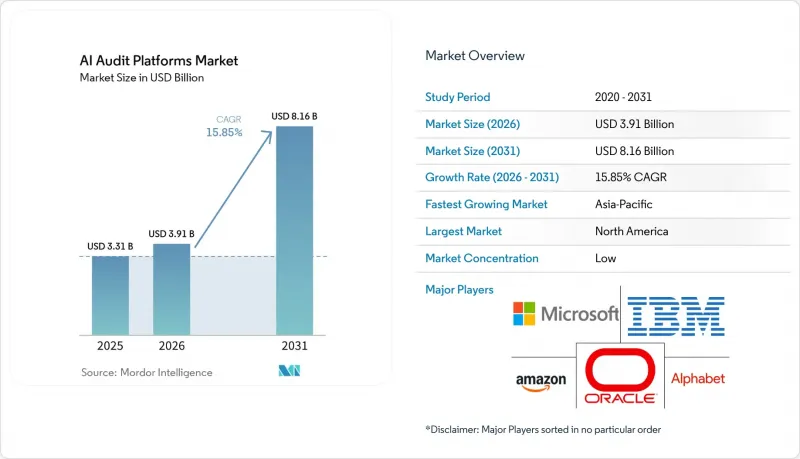
According to Mordor Intelligence, the AI audit platforms market size is expected to grow from USD 3.31 billion in 2025 to USD 3.91 billion in 2026, and is forecast to reach USD 8.16 billion by 2031, at a 15.85% CAGR over 2026-2031.
Global AI Audit Platforms Market Trends and Insights
Phased AI Regulation and Mandatory Audit Evidence
The AI Audit Platforms Market is supported by regulations requiring documented controls for high-risk systems. The EU AI Act entered its full enforcement stage for high-risk AI systems in August 2026, requiring risk management, technical documentation, and post-market monitoring. The Federal Reserve, the OCC, and the FDIC issued SR 26-2 in April 2026, updating United States bank model risk guidance to cover generative and agentic AI. South Korea's Basic AI Act also took effect in January 2026 with risk-based duties and assessment requirements for high-risk systems. These concurrent requirements favor platforms with reusable controls that work across regulatory frameworks. The AI Audit Platforms Market benefits because compliance teams need evidence that remains available after a model or agent enters production.
Expansion of Generative AI and Agentic AI Deployments
Agentic systems can plan tasks, use external tools, and act without confirmation at each step. Their context, memory, and tool state can change the decision path, making retrospective review incomplete for important actions. IBM states that agentic AI requires AI assurance to operate as a continuous capability rather than a periodic review process. Singapore's Model AI Governance Framework for Agentic AI outlines human approval checkpoints for high-stakes, irreversible actions. This architecture creates demand for logging, policy checks, and traceability across each action in a workflow. The AI Audit Platforms Market, therefore, gains from organizations that need oversight systems designed for changing agent behavior.
Fragmented Accountability Across AI Providers and Deployers
AI workflows often combine cloud infrastructure, foundation models, business applications, and downstream user actions. This structure makes it difficult to establish a single complete audit trail or to allocate responsibility for control failures. The Financial Stability Board identified third-party AI dependencies and service-provider concentration as material vulnerabilities in responsible AI adoption. Organizations may not have contractual rights to receive training data, lineage, or performance evidence in formats their internal tools can use. The problem is more pronounced in multi-agent workflows that connect 5 or more services, each with separate logging and liability rules. The AI Audit Platforms Market must address this constraint by adopting interoperable evidence formats and clarifying provider-deployer control boundaries.
Other drivers and restraints analyzed in the detailed report include:
- Shift From Sample-Based Testing to Continuous Full-Population Monitoring
- Demand for Explainability, Fairness, and Model Accountability
- Shortage of AI Governance and Conformity-Assessment Specialists
For complete list of drivers and restraints, kindly check the Table Of Contents.
Segment Analysis
Software platforms held 64.23% of the AI Audit Platforms Market share in 2025, reflecting enterprise demand for policy-based tools that operate at inference speed and provide a common record across models, agents, and business uses. These systems collect operational data from MLOps pipelines, agent orchestration tools, and deployment registries, and high switching effort can reinforce their position once connected to core workflows. Platforms can update policy libraries as requirements change, reducing duplicated work across legal, risk, technical, and audit teams. The segment benefits when buyers need repeatable evidence rather than manual reports, with vendors competing on integrations, control coverage, and the usability of their evidence records. Software, therefore, remains the central procurement choice for organizations with broad AI portfolios in the AI Audit Platforms Market.
Professional and managed services are forecast to grow at 17.24% CAGR through 2031 because organizations need support for conformity assessment, bias-testing design, and documentation across multiple regulators. Deloitte, KPMG, Accenture, and PwC are building work around EU AI Act readiness, SR 26-2 compliance, and agentic AI risk assessment, often alongside specialized software. ModelOp's August 2025 partnership with Angularis.ai combined lifecycle management with governance-as-a-service delivery. This model responds to the shortage of governance specialists and can range from full platform deployment to recurring audit packages. The AI Audit Platforms Market is likely to see closer links between subscriptions and managed support as buyers seek practical capacity.
Compliance evidence and reporting accounted for 38.71% of revenue in 2025, making it the largest audit function, as regulators and internal risk teams require structured documentation. This function records policies, approvals, controls, and evidence demonstrating whether high-risk systems were governed throughout their lifecycle. The AI Audit Platforms Market uses reporting as an entry point for first-time buyers and a common record for senior management. Strong reporting capabilities can reduce duplicated work between legal, risk, and technical teams while keeping records consistent across use cases. Its leading 2025 share reflects the priority that buyers place on organized compliance evidence.
Bias, fairness, and explainability auditing is forecast to grow at 17.68% CAGR through 2031, while model and data lineage and runtime decision logging are also expanding. ISO/IEC TS 6254:2025 provides a common reference for explainability and interpretability practices. OWASP's agentic application risk taxonomy has increased attention on tool misuse and memory poisoning. The AI Audit Platforms Market supports these functions by linking an inference, a tool call, and a policy decision into a single evidence record, while pure-play vendors retain technical strength. Demand is shifting from basic reporting to records that explain what happened and why.
Complete Report Scope:
- By Component
- Software Platforms
- Professional and Managed Services
- By Audit Function
- Compliance Evidence and Reporting
- Model and Data Lineage
- Runtime Decision Logging
- Bias, Fairness, and Explainability Auditing
- Other Audit Functions
- By Deployment
- Cloud-Based
- Hybrid
- On-Premises
- By Organization Size
- Large Enterprises
- Small and Medium-Sized Enterprises
- By End-User Industry
- Banking, Financial Services, and Insurance
- Healthcare and Life Sciences
- Information Technology and Telecommunications
- Government and Public Sector
- Retail and E-Commerce
- Manufacturing and Automotive
- Other End-User Industries
- By Geography
- North America
- United States
- Canada
- Mexico
- South America
- Brazil
- Argentina
- Chile
- Rest of South America
- Europe
- Germany
- United Kingdom
- France
- Italy
- Spain
- Rest of Europe
- Asia-Pacific
- China
- Japan
- India
- South Korea
- Australia
- Rest of Asia-Pacific
- Middle East
- United Arab Emirates
- Saudi Arabia
- Qatar
- Rest of Middle East
- Africa
- South Africa
- Egypt
- Nigeria
- Rest of Africa
- North America
Geography Analysis
North America accounted for 42.87% of regional revenue in 2025, supported by a large base of AI deployments and established model risk practices. The Federal Reserve, OCC, and the FDIC issued SR 26-2 in April 2026, prompting financial institutions to assess gaps in their governance programs. The FDA also started a pilot program in April 2026 that connects AI governance practices in clinical trials with the NIST AI Risk Management Framework. These actions support buyer interest in auditable governance infrastructure across financial and health applications.
Europe held the second-largest regional position in 2025. The EU AI Act's August 2026 enforcement milestone requires high-risk AI systems to meet documentation and monitoring duties. Germany, the United Kingdom, and France have active AI governance bodies and sector-specific requirements that add to regional demand. The European AI Office can request technical documentation and impose penalties under the EU AI Act. South America is a growing opportunity, led by Brazil's data-protection compliance culture and early-stage national AI governance frameworks.
Asia-Pacific is forecast to grow at 16.91% CAGR through 2031, the highest regional rate in the AI Audit Platforms Market. South Korea's Basic AI Act took effect in January 2026 and introduced risk-tiered obligations and pre-deployment assessments. Singapore's agentic AI governance framework and financial-sector AI risk management work provide additional regional reference points. Japan's AI Promotion Act came fully into force in September 2025, while its Cabinet published a revised draft AI Basic Plan in June 2026. India established the AI Governance and Economic Group in April 2026, following the national guidelines that were issued in November 2025. Demand in the Middle East and Africa is increasing as national AI strategies in the United Arab Emirates and Saudi Arabia impose governance requirements on public AI programs.
- International Business Machines Corporation
- Microsoft Corporation
- Alphabet Inc.
- Amazon.com, Inc.
- Oracle Corporation
- Salesforce, Inc.
- SAP SE
- SAS Institute Inc.
- FICO
- Accenture plc
- Deloitte Touche Tohmatsu Limited
- PricewaterhouseCoopers International Limited
- Ernst & Young Global Limited
- KPMG International Cooperative
- Credo AI, Inc.
- Holistic AI, Inc.
- Fiddler Labs, Inc.
- ModelOp, Inc.
- Monitaur, Inc.
- FairNow, Inc.
- Saidot Oy
- DataRobot, Inc.
- Arize AI, Inc.
- Arthur AI, Inc.
- H2O.ai, Inc.
Additional Benefits:
- The market estimate (ME) sheet in Excel format
- 3 months of analyst support
TABLE OF CONTENTS
1 INTRODUCTION
- 1.1 Study Assumptions and Market Definition
- 1.2 Scope of the Study
2 RESEARCH METHODOLOGY
3 EXECUTIVE SUMMARY
4 MARKET LANDSCAPE
- 4.1 Market Overview
- 4.2 Market Drivers
- 4.2.1 Phased AI Regulation and Mandatory Audit Evidence
- 4.2.2 Expansion of Generative AI and Agentic AI Deployments
- 4.2.3 Shift From Sample-Based Testing to Continuous Full-Population Monitoring
- 4.2.4 Demand for Explainability, Fairness, and Model Accountability
- 4.2.5 Integration of AI Audit Controls Into Enterprise Procurement
- 4.2.6 Machine-Readable Regulatory Control Mapping
- 4.3 Market Restraints
- 4.3.1 Fragmented Accountability Across AI Providers and Deployers
- 4.3.2 Shortage of AI Governance and Conformity-Assessment Specialists
- 4.3.3 Integration Friction Across Shadow AI and Legacy MLOps Estates
- 4.3.4 Privacy and Data-Residency Restrictions on Audit Telemetry
- 4.4 Impact of Macroeconomic Factors on the Market
- 4.5 Industry Value-Chain Analysis
- 4.6 Technology Outlook
- 4.7 Regulatory Landscape
- 4.8 Porter's Five Forces Analysis
- 4.8.1 Threat of New Entrants
- 4.8.2 Bargaining Power of Suppliers
- 4.8.3 Bargaining Power of Buyers
- 4.8.4 Threat of Substitutes
- 4.8.5 Intensity of Competitive Rivalry
5 MARKET SIZE AND GROWTH FORECASTS (VALUE)
- 5.1 By Component
- 5.1.1 Software Platforms
- 5.1.2 Professional and Managed Services
- 5.2 By Audit Function
- 5.2.1 Compliance Evidence and Reporting
- 5.2.2 Model and Data Lineage
- 5.2.3 Runtime Decision Logging
- 5.2.4 Bias, Fairness, and Explainability Auditing
- 5.2.5 Other Audit Functions
- 5.3 By Deployment
- 5.3.1 Cloud-Based
- 5.3.2 Hybrid
- 5.3.3 On-Premises
- 5.4 By Organization Size
- 5.4.1 Large Enterprises
- 5.4.2 Small and Medium-Sized Enterprises
- 5.5 By End-User Industry
- 5.5.1 Banking, Financial Services, and Insurance
- 5.5.2 Healthcare and Life Sciences
- 5.5.3 Information Technology and Telecommunications
- 5.5.4 Government and Public Sector
- 5.5.5 Retail and E-Commerce
- 5.5.6 Manufacturing and Automotive
- 5.5.7 Other End-User Industries
- 5.6 By Geography
- 5.6.1 North America
- 5.6.1.1 United States
- 5.6.1.2 Canada
- 5.6.1.3 Mexico
- 5.6.2 South America
- 5.6.2.1 Brazil
- 5.6.2.2 Argentina
- 5.6.2.3 Chile
- 5.6.2.4 Rest of South America
- 5.6.3 Europe
- 5.6.3.1 Germany
- 5.6.3.2 United Kingdom
- 5.6.3.3 France
- 5.6.3.4 Italy
- 5.6.3.5 Spain
- 5.6.3.6 Rest of Europe
- 5.6.4 Asia-Pacific
- 5.6.4.1 China
- 5.6.4.2 Japan
- 5.6.4.3 India
- 5.6.4.4 South Korea
- 5.6.4.5 Australia
- 5.6.4.6 Rest of Asia-Pacific
- 5.6.5 Middle East
- 5.6.5.1 United Arab Emirates
- 5.6.5.2 Saudi Arabia
- 5.6.5.3 Qatar
- 5.6.5.4 Rest of Middle East
- 5.6.6 Africa
- 5.6.6.1 South Africa
- 5.6.6.2 Egypt
- 5.6.6.3 Nigeria
- 5.6.6.4 Rest of Africa
- 5.6.1 North America
6 COMPETITIVE LANDSCAPE
- 6.1 Market Concentration
- 6.2 Strategic Moves
- 6.3 Market Share Analysis
- 6.4 Company Profiles (includes Global Level Overview, Market Level Overview, Core Segments, Financials as available, Strategic Information, Market Rank/Share, Products and Services, Recent Developments)
- 6.4.1 International Business Machines Corporation
- 6.4.2 Microsoft Corporation
- 6.4.3 Alphabet Inc.
- 6.4.4 Amazon.com, Inc.
- 6.4.5 Oracle Corporation
- 6.4.6 Salesforce, Inc.
- 6.4.7 SAP SE
- 6.4.8 SAS Institute Inc.
- 6.4.9 FICO
- 6.4.10 Accenture plc
- 6.4.11 Deloitte Touche Tohmatsu Limited
- 6.4.12 PricewaterhouseCoopers International Limited
- 6.4.13 Ernst & Young Global Limited
- 6.4.14 KPMG International Cooperative
- 6.4.15 Credo AI, Inc.
- 6.4.16 Holistic AI, Inc.
- 6.4.17 Fiddler Labs, Inc.
- 6.4.18 ModelOp, Inc.
- 6.4.19 Monitaur, Inc.
- 6.4.20 FairNow, Inc.
- 6.4.21 Saidot Oy
- 6.4.22 DataRobot, Inc.
- 6.4.23 Arize AI, Inc.
- 6.4.24 Arthur AI, Inc.
- 6.4.25 H2O.ai, Inc.
7 MARKET OPPORTUNITIES AND FUTURE OUTLOOK
- 7.1 White-Space and Unmet-Need Assessment

