PUBLISHER: Mordor Intelligence | PRODUCT CODE: 2154460

PUBLISHER: Mordor Intelligence | PRODUCT CODE: 2154460
Biometrics and Spatial Privacy Identity Management - Market Share Analysis, Industry Trends & Statistics, Growth Forecasts (2026 - 2031)
According to Mordor Intelligence, the biometrics and Spatial Privacy Identity Management Market size is expected to increase from USD 37.51 billion in 2025 to USD 44.22 billion in 2026 and reach USD 88.91 billion by 2031, registering a CAGR of 14.99% between 2026 and 2031.
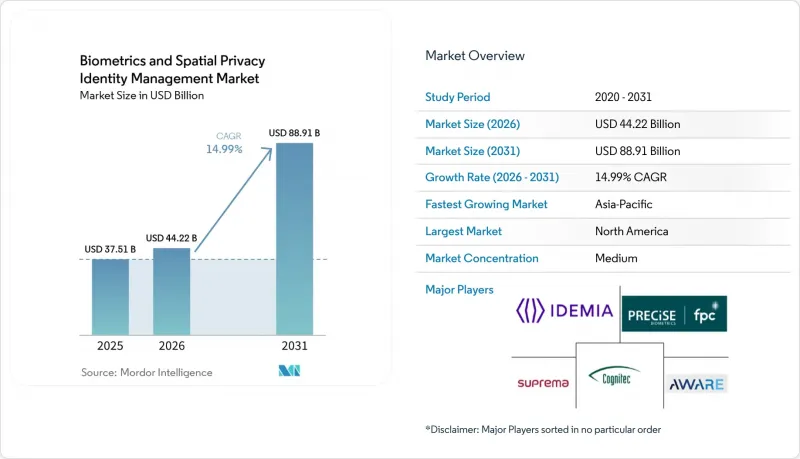
Global Biometrics and Spatial Privacy Identity Management Market Trends and Insights
Government Digital Identity Mandates
Sovereign digital identity programs are moving biometrics from a verification tool into core civil infrastructure. Regulation (EU) 2024/1183 requires each European Union member state to make at least 1 European Digital Identity Wallet available by December 2026. The regulation and its implementation work make secure identity attributes central to wallet enrollment and use. India's Aadhaar enrollment and update rules in 2026 also strengthened requirements around enrollment quality and verification. These programs create standards that private banks, travel providers, and service platforms must often support after public systems are deployed. This raises recurring demand across the Biometrics and Spatial Privacy Identity Management Market rather than limiting spending to a single government contract.
Digital Fraud and Synthetic Identity Escalation
Synthetic identity fraud is increasing the need for behavioral and multimodal verification. LexisNexis Risk Solutions reported that synthetic identity represented 11% of reported fraud globally in 2026, while South America recorded the highest regional concentration at 48.3%. Veriff reported that 4.18% of global identity-verification attempts in 2025 were fraudulent and that AI-generated media appeared in attacks 300% more often than in 2024. This threat is difficult to address through document checks alone because fabricated documents can be designed to pass a static review. Behavioral signals and continuous session monitoring add evidence that a document cannot provide. Visa's August 2026 agreement to acquire BioCatch shows that payment networks view these controls as a core part of fraud prevention.
Biometric Consent and Data-Residency Restrictions
Privacy requirements can limit the use of biometric systems and raise the cost of deployment. The General Data Protection Regulation treats biometric data as a special category, while the European Union AI Act restricts real-time remote biometric identification in publicly accessible spaces under Article 5.India's data protection rules also add consent obligations for biometric processing. Data-residency rules in China, India, and GCC countries can require in-country storage and processing. This can be difficult for smaller suppliers that lack local infrastructure. Buyers in Germany, France, and the Netherlands have consequently placed greater weight on on-premises and hybrid designs, limiting the margin expansion otherwise associated with cloud deployment.
Other drivers and restraints analyzed in the detailed report include:
- Contactless Border and Airport Modernization
- Passwordless Authentication and Payment Tokenization
- Spoofing, Deepfakes and Presentation-Attack Risk
For complete list of drivers and restraints, kindly check the Table Of Contents.
Segment Analysis
Facial recognition held 32.36% of the Biometrics and Spatial Privacy Identity Management Market share in 2025. Its position reflects passive enrollment, established camera networks, and use in border management and consumer authentication. Existing facial databases also give large deployments a practical advantage during upgrades. Iris recognition remains important in high-security government and health care access settings, while voice recognition is used in contact centers and smart-speaker authentication. Vein and palm recognition are finding use in retail checkout and hospitals where contactless alternatives are preferred.
Behavioral biometrics is projected to expand at a 15.31% CAGR through 2031, the fastest rate among modalities. It evaluates session behavior that static document reviews may miss, and Visa's planned USD 2.4 billion acquisition of BioCatch in August 2026 supports its commercial importance. Multimodal systems combine face, fingerprint, iris, or behavioral signals when higher assurance is required. These systems can command premium pricing because they reduce reliance on a single biometric trait. Research on adaptive multimodal liveness detection also supports their use where spoofing resistance is a priority.
Software accounted for 42.64% of the biometrics and spatial privacy identity management market share in 2025. It is also forecast to expand at a 16.02% CAGR through 2031. Identity orchestration platforms connect data, verification engines, and decision rules across different systems. Algorithm licensing and managed-service models are gaining relevance as customers seek flexible integration, while services remain important because large deployments need implementation, support, and ongoing management.
Hardware remains necessary for enrollment kiosks, biometric cards, and access-control terminals. However, it is ceding a greater share of value to the software that manages identity workflows above the device layer. Cloud delivery supports subscription pricing, application programming interface integration, and regular algorithm updates. This provides suppliers with a more durable revenue base than a one-time hardware sale. Fingerprint Cards' June 2026 distribution agreement for AllKey Ultra shows how hardware vendors are adding biometric processing and secure-element functions to their products. The Biometrics and Spatial Privacy Identity Management Market is therefore becoming more dependent on software-led system design.
Contactless biometrics held 58.62% of the biometrics and spatial privacy identity management market share in 2025 and is forecast to expand at a 15.72% CAGR through 2031. Hygiene preferences and quicker user flows have made contactless capture a normal requirement across many deployments. Facial capture is widely used in airports, while contactless fingerprint and palm systems are also used in selected settings. The European Union Entry/Exit System requires facial images and fingerprints at Schengen borders. Airport programs in Indonesia, the Philippines, Singapore, and Dubai are supporting wider contactless-corridor deployment, while contact-based biometrics still serves high-security access control and government document enrollment.
Fingerprint sensors embedded in smart cards can support on-card matching without sending a biometric template to a central system. IDEX Biometrics received a USD 1.75 million binding order in May 2026 for biometric payment-card sensors. This shows that card-based applications remain commercially relevant. ISO/IEC 19794 data-interchange standards support compatibility between enrollment and verification systems. The two contact types will continue to serve different operational and regulatory needs across the Biometrics and Spatial Privacy Identity Management Market.
Complete Report Scope:
- By Biometric Modality
- Fingerprint Recognition
- Facial Recognition
- Iris Recognition
- Voice Recognition
- Vein and Palm Recognition
- Behavioral Biometrics
- Multimodal Biometrics
- Other Biometric Modalities
- By Component
- Hardware
- Software
- Services
- By Contact Type
- Contact-Based
- Contactless
- By Application
- Digital Identity Verification and eKYC
- Physical and Logical Access Control
- Payment and Transaction Authentication
- Border Control and Immigration
- Law Enforcement and Public Safety
- Other Applications
- By End-Use Industry
- Government and Law Enforcement
- Banking, Financial Services and Insurance
- Healthcare
- Travel and Transportation
- Retail and E-Commerce
- Other End-Use Industries
- By Deployment Mode
- On-Premises
- Cloud
- By Spatial Privacy Function
- Location Obfuscation and Generalization
- Differential Privacy for Mobility Data
- K-Anonymity and Crowd-Blending
- Geofencing and Purpose Limitation
- Secure Multi-Party Computation and Private Set Intersection
- Consent, Preference and Data-Subject Control
- By Geography
- North America
- United States
- Canada
- Mexico
- South America
- Brazil
- Argentina
- Rest of South America
- Europe
- Germany
- United Kingdom
- France
- Russia
- Rest of Europe
- Asia-Pacific
- China
- India
- Japan
- South Korea
- Rest of Asia-Pacific
- Middle East
- Saudi Arabia
- United Arab Emirates
- Israel
- Rest of Middle East
- Africa
- South Africa
- Nigeria
- Egypt
- Rest of Africa
- North America
Geography Analysis
North America held 34.38% of the Biometrics and Spatial Privacy Identity Management Market share in 2025. United States demand is supported by biometric programs at air, land, and sea ports of entry. Federal identity systems, commercial platform suppliers, and a large banking sector create a diverse buyer base. Payment passkeys are also being introduced to reduce dependence on one-time-password authentication. Canada and Mexico add volume through cross-border travel programs and national identity modernization. South America has a smaller base, but biometric voter registration in Brazil and high reported synthetic fraud levels support demand for both public and commercial identity controls.
Europe is shaped by large public system deployments and detailed privacy requirements. The EU Entry/Exit System completed its roll-out in April 2026, and the European Digital Identity Wallet framework requires wallet availability by December 2026. Germany, France, and the United Kingdom have substantial government identity spending and enterprise adoption in banking and financial services. Russia has a more limited role because sanctions and geopolitical conditions restrict links with Western vendor systems. The Middle East has a different policy approach, with the United Arab Emirates and Saudi Arabia pursuing national digital identity programs. Africa remains early in its adoption cycle, although South Africa, Nigeria, and Egypt support voter and civil identity programs.
Asia-Pacific is expected to expand at a 15.89% CAGR through 2031, the fastest regional rate. India provides a large enrollment base through Aadhaar and its continuing regulatory development. China supports high volumes in transportation, financial services, and public-sector facial recognition, while privacy rules affect vendor deployment models. Japan and South Korea are mature markets for contactless border control and biometric payment cards. Southeast Asian airports are also using full contactless corridors rather than incremental upgrades. Manila's planned deployment of 78 biometric eGates within a USD 3 billion modernization program illustrates this model.
- Fingerprint Cards AB
- IDEMIA France SAS
- Precise Biometrics AB
- NEXT Biometrics Group ASA
- IDEX Biometrics ASA
- BIO-key International, Inc.
- Suprema Inc.
- Aware, Inc.
- ImageWare Systems, Inc.
- Innovatrics, s.r.o.
- Cognitec Systems GmbH
- FacePhi Biometria, S.A.
- Veridium IP Limited
- iProov Limited
- FaceTec, Inc.
- nVIAsoft Corporation
- Neurotechnology, UAB
- Herta Security, S.L.
- RecFaces, LLC
- IdentyTech Solutions America Inc.
- M2SYS LLC
- Fulcrum Biometrics, LLC
- Iris ID Systems, Inc.
- SecuGen Corporation
Additional Benefits:
- The market estimate (ME) sheet in Excel format
- 3 months of analyst support
TABLE OF CONTENTS
1 INTRODUCTION
- 1.1 Study Assumptions and Market Definition
- 1.2 Scope of the Study
2 RESEARCH METHODOLOGY
3 EXECUTIVE SUMMARY
4 MARKET LANDSCAPE
- 4.1 Market Overview
- 4.2 Market Drivers
- 4.2.1 Government Digital Identity Mandates
- 4.2.2 Digital Fraud and Synthetic Identity Escalation
- 4.2.3 Contactless Border and Airport Modernization
- 4.2.4 Passwordless Authentication and Payment Tokenization
- 4.2.5 Privacy-Preserving Biometrics for Regulated Deployments
- 4.2.6 Edge AI and Multimodal Sensor Fusion
- 4.3 Market Restraints
- 4.3.1 Biometric Consent and Data-Residency Restrictions
- 4.3.2 Spoofing, Deepfakes and Presentation-Attack Risk
- 4.3.3 Legacy-System Integration and Interoperability Cost
- 4.3.4 Accuracy, Bias and Unequal Performance Across Populations
- 4.4 Impact of Macroeconomic Factors on the Market
- 4.5 Industry Value Chain Analysis
- 4.6 Regulatory Landscape
- 4.7 Technological Outlook
- 4.8 Porter's Five Forces Analysis
- 4.8.1 Competitive Rivalry
- 4.8.2 Threat of New Entrants
- 4.8.3 Bargaining Power of Suppliers
- 4.8.4 Bargaining Power of Buyers
- 4.8.5 Threat of Substitutes
5 MARKET SIZE AND GROWTH FORECASTS (VALUE)
- 5.1 By Biometric Modality
- 5.1.1 Fingerprint Recognition
- 5.1.2 Facial Recognition
- 5.1.3 Iris Recognition
- 5.1.4 Voice Recognition
- 5.1.5 Vein and Palm Recognition
- 5.1.6 Behavioral Biometrics
- 5.1.7 Multimodal Biometrics
- 5.1.8 Other Biometric Modalities
- 5.2 By Component
- 5.2.1 Hardware
- 5.2.2 Software
- 5.2.3 Services
- 5.3 By Contact Type
- 5.3.1 Contact-Based
- 5.3.2 Contactless
- 5.4 By Application
- 5.4.1 Digital Identity Verification and eKYC
- 5.4.2 Physical and Logical Access Control
- 5.4.3 Payment and Transaction Authentication
- 5.4.4 Border Control and Immigration
- 5.4.5 Law Enforcement and Public Safety
- 5.4.6 Other Applications
- 5.5 By End-Use Industry
- 5.5.1 Government and Law Enforcement
- 5.5.2 Banking, Financial Services and Insurance
- 5.5.3 Healthcare
- 5.5.4 Travel and Transportation
- 5.5.5 Retail and E-Commerce
- 5.5.6 Other End-Use Industries
- 5.6 By Deployment Mode
- 5.6.1 On-Premises
- 5.6.2 Cloud
- 5.7 By Spatial Privacy Function
- 5.7.1 Location Obfuscation and Generalization
- 5.7.2 Differential Privacy for Mobility Data
- 5.7.3 K-Anonymity and Crowd-Blending
- 5.7.4 Geofencing and Purpose Limitation
- 5.7.5 Secure Multi-Party Computation and Private Set Intersection
- 5.7.6 Consent, Preference and Data-Subject Control
- 5.8 By Geography
- 5.8.1 North America
- 5.8.1.1 United States
- 5.8.1.2 Canada
- 5.8.1.3 Mexico
- 5.8.2 South America
- 5.8.2.1 Brazil
- 5.8.2.2 Argentina
- 5.8.2.3 Rest of South America
- 5.8.3 Europe
- 5.8.3.1 Germany
- 5.8.3.2 United Kingdom
- 5.8.3.3 France
- 5.8.3.4 Russia
- 5.8.3.5 Rest of Europe
- 5.8.4 Asia-Pacific
- 5.8.4.1 China
- 5.8.4.2 India
- 5.8.4.3 Japan
- 5.8.4.4 South Korea
- 5.8.4.5 Rest of Asia-Pacific
- 5.8.5 Middle East
- 5.8.5.1 Saudi Arabia
- 5.8.5.2 United Arab Emirates
- 5.8.5.3 Israel
- 5.8.5.4 Rest of Middle East
- 5.8.6 Africa
- 5.8.6.1 South Africa
- 5.8.6.2 Nigeria
- 5.8.6.3 Egypt
- 5.8.6.4 Rest of Africa
- 5.8.1 North America
6 COMPETITIVE LANDSCAPE
- 6.1 Market Concentration
- 6.2 Strategic Moves
- 6.3 Market Share Analysis
- 6.4 Company Profiles (includes Global Level Overview, Market Level Overview, Core Segments, Financials as available, Strategic Information, Market Rank/Share, Products and Services, Recent Developments)
- 6.4.1 Fingerprint Cards AB
- 6.4.2 IDEMIA France SAS
- 6.4.3 Precise Biometrics AB
- 6.4.4 NEXT Biometrics Group ASA
- 6.4.5 IDEX Biometrics ASA
- 6.4.6 BIO-key International, Inc.
- 6.4.7 Suprema Inc.
- 6.4.8 Aware, Inc.
- 6.4.9 ImageWare Systems, Inc.
- 6.4.10 Innovatrics, s.r.o.
- 6.4.11 Cognitec Systems GmbH
- 6.4.12 FacePhi Biometria, S.A.
- 6.4.13 Veridium IP Limited
- 6.4.14 iProov Limited
- 6.4.15 FaceTec, Inc.
- 6.4.16 nVIAsoft Corporation
- 6.4.17 Neurotechnology, UAB
- 6.4.18 Herta Security, S.L.
- 6.4.19 RecFaces, LLC
- 6.4.20 IdentyTech Solutions America Inc.
- 6.4.21 M2SYS LLC
- 6.4.22 Fulcrum Biometrics, LLC
- 6.4.23 Iris ID Systems, Inc.
- 6.4.24 SecuGen Corporation
7 MARKET OPPORTUNITIES AND FUTURE OUTLOOK
- 7.1 White-Space and Unmet-Need Assessment

