PUBLISHER: Mordor Intelligence | PRODUCT CODE: 2154461

PUBLISHER: Mordor Intelligence | PRODUCT CODE: 2154461
Hypopituitarism Diagnostics - Market Share Analysis, Industry Trends & Statistics, Growth Forecasts (2026 - 2031)
According to Mordor Intelligence, the hypopituitarism diagnostics market is projected to expand from USD 280.90 million in 2025 and USD 298.13 million in 2026 to USD 409.54 million by 2031, registering a CAGR of 6.56% between 2026 and 2031.
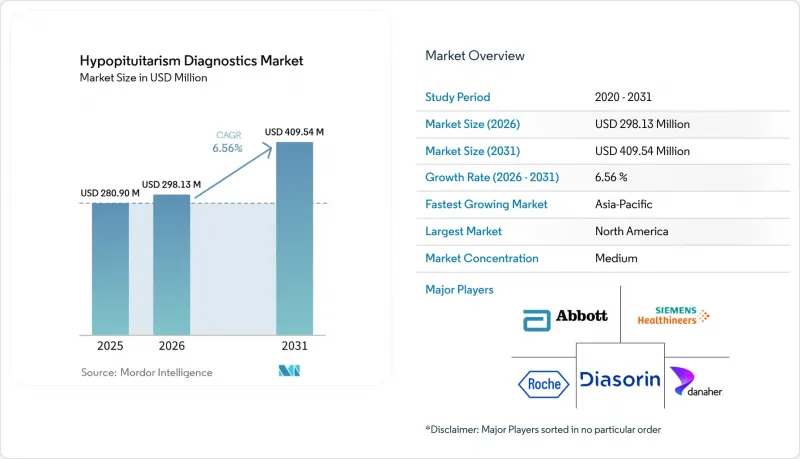
Global Hypopituitarism Diagnostics Market Trends and Insights
Rising Identification of Pituitary Hormone Deficiencies
Hypopituitarism is often missed rather than inherently rare, which leaves a substantial group of patients without a confirmed diagnosis or an appropriate hormone workup. Adult prevalence of 37.5 to 45.5 cases per 100,000 people indicates a meaningful pool for the hypopituitarism diagnostics market, especially because untreated disease carries a standardized mortality rate nearly 8 times that of the general population. Increased use of MRI for headaches and neurological assessment also identifies pituitary incidentalomas that require biochemical follow-up, even when imaging was ordered for a separate clinical concern. Sellar tumors and other space-occupying lesions account for nearly 50% of acquired cases, so broader MRI availability can bring more patients into assessment earlier. Routine basal panels can measure cortisol, ACTH, TSH, free T4, IGF-1, and gonadotropins together, which makes comprehensive evaluation more practical within referral pathways.
Expanding Screening of Traumatic Brain Injury and Post-Radiation Populations
Traumatic brain injury and radiation-related pituitary insufficiency represent clinically significant groups that have historically received inconsistent screening after the initial episode of care. A 2024 meta-analysis found any pituitary insufficiency in 61% of adults treated with radiation for brain, head, and neck tumors, with growth hormone deficiency reported most often at 40%. Clinical follow-up guidance calls for structured assessment after moderate to severe brain injury, with testing at defined intervals when symptoms or risk factors remain present. These care pathways create repeat testing over several years instead of a single diagnostic encounter. The hypopituitarism diagnostics market therefore gains from hospital systems that connect neurotrauma, oncology, endocrinology, and laboratory services through a consistent follow-up pathway.
Complex Interpretation of Basal and Dynamic Hormone Tests
Hypopituitarism testing requires careful interpretation because errors can arise before analysis, during measurement, and when results are applied to a clinical decision. A 2024 review identified cross-reactions, interfering antibodies, nutritional supplement interactions, and poorly standardized analytical cutoffs as recurring causes of misleading laboratory results. Insulin tolerance, glucagon stimulation, and ACTH stimulation testing can take considerable time and require clinical supervision. Their results also vary with the assay platform and cutoff applied, limiting direct comparison across laboratories. This complexity slows the hypopituitarism diagnostics market because laboratories need specialized protocols, clinical teams may seek confirmation, and the total diagnostic episode becomes more resource intensive.
Other drivers and restraints analyzed in the detailed report include:
- Growth of Automated Hormone Immunoassay and Pituitary Imaging Workflows
- Improved Detection of Immune Checkpoint Inhibitor-Associated Hypophysitis
- Limited Endocrinology Expertise Outside Specialist Centers
For complete list of drivers and restraints, kindly check the Table Of Contents.
Segment Analysis
Hormone blood tests held 40.26% revenue share in 2025, making them the largest test type in the hypopituitarism diagnostics market. Basal multi-hormone panels are usually the first step because clinicians need to evaluate several pituitary axes before confirming the source of a deficiency. ECLIA and other automated immunoassay methods allow hospital laboratories to process those measurements within routine workflows.
Dynamic and stimulation tests form the next layer when basal values are unclear or when confirmation of growth hormone and ACTH deficiency is needed. Insulin tolerance, glucagon stimulation, and ACTH stimulation protocols require supervised sampling, so they remain concentrated in hospitals and specialist centers. Imaging diagnostics is forecasted to grow at a 7.16% CAGR through 2031, supported by pituitary MRI use in suspected structural disease and treatment-related hypophysitis. AI-assisted MRI methods are being examined for higher-resolution detection of pituitary microadenomas and structural change, which can strengthen the role of imaging in complex workups.
Clinical diagnosis represented 44.32% of revenue in 2025, reflecting the continued role of symptom-led referrals in the hypopituitarism diagnostics market. Fatigue, hypogonadism, growth failure, visual symptoms, and other endocrine concerns often lead clinicians to request initial testing. Clinical diagnosis will therefore continue to supply the main testing base across hospital endocrinology and specialist services.
Screening is expected to grow at a 8.24% CAGR through 2031, making it the fastest-growing application. Structured follow-up for traumatic brain injury, cranial radiation, and checkpoint inhibitor treatment creates known at-risk groups that can be assessed on scheduled intervals. Monitoring remains a steady application for people receiving hormone replacement therapy, because periodic testing is needed to evaluate treatment adequacy.
Complete Report Scope:
- By Test Type
- Hormone Blood Tests
- Dynamic/Stimulation Tests
- Imaging Diagnostics
- Other Test Types
- By Application
- Clinical Diagnosis
- Screening
- Monitoring
- By Technology
- Immunoassay
- Molecular Diagnostics
- Imaging Technology
- By End-User
- Hospitals
- Diagnostic Laboratories
- Specialty Endocrinology Clinics
- Other End-Users
- By Geography
- North America
- United States
- Canada
- Mexico
- Europe
- Germany
- United Kingdom
- France
- Italy
- Spain
- Rest of Europe
- Asia-Pacific
- China
- Japan
- India
- Australia
- South Korea
- Rest of Asia-Pacific
- Middle East and Africa
- GCC
- South Africa
- Rest of Middle East and Africa
- South America
- Brazil
- Argentina
- Rest of South America
- North America
Geography Analysis
North America held 46.31% revenue share in 2025, giving it the largest regional position in the hypopituitarism diagnostics market. The United States has concentrated pituitary centers at academic medical institutions, including Mayo Clinic, Barrow Neurological Institute, and Johns Hopkins, which support high-complexity testing and multidisciplinary referrals. Canada adds volume through provincial healthcare systems that are formalizing links between brain injury care and endocrinology follow-up. The region also has a dense installed base of immunoassay platforms from Roche, Siemens Healthineers, and Abbott, which supports routine endocrine workflow capacity.
Europe is the second-largest regional block, supported by mature specialist networks and national reference laboratories in Germany, the United Kingdom, France, Italy, and Spain. The European Union In Vitro Diagnostics Regulation is changing validation requirements and can favor established platforms that have strong regulatory documentation. Structured brain injury follow-up and endocrine referral practices support demand for dynamic testing where specialist capacity is available. Germany, France, Italy, Spain, and the United Kingdom have established endocrinology networks that can process complex referrals within tertiary care pathways. Eastern European countries, including Poland and the Czech Republic, show growing need for specialized testing, although procurement cycles for advanced platforms can delay near-term uptake. These differences create a mixed opportunity across the regional hypopituitarism diagnostics market.
Asia-Pacific is projected to grow at a 9.23% CAGR through 2031, the fastest regional rate in the hypopituitarism diagnostics market size. Healthcare infrastructure investment, increasing specialist training, and wider awareness of endocrine disorders are supporting adoption in China, India, Japan, and South Korea. Japan classifies anterior pituitary hypofunction as a designated intractable disease, which provides insurance coverage for diagnostic workups and requires multi-axis hormone evaluation under published criteria. China benefits from centralized hospital procurement and increasing use of chemiluminescent immunoassay systems. India and South Korea are expanding endocrine services in urban tertiary centers, although access remains uneven beyond those locations. South America, the Middle East, and Africa are growing from a lower base, with Brazil and Saudi Arabia as key access points. Limited specialist density and fragmented laboratory infrastructure continue to slow adoption in these regions.
- Abbott Laboratories
- ARUP Laboratories
- Beckton Dickinson
- bioMerieux
- Bio-Rad Laboratories
- Danaher
- DiaSorin
- Roche
- Fujirebio Holdings, Inc.
- Hologic
- Immunodiagnostic Systems Holdings PLC
- LabCorp
- Mayo Clinic Laboratories
- Mindray
- QIAGEN
- Quest Diagnostics
- Revvity, Inc.
- Siemens Healthineers
- Thermo Fisher Scientific
- Tosoh
Additional Benefits:
- The market estimate (ME) sheet in Excel format
- 3 months of analyst support
TABLE OF CONTENTS
1 Introduction
- 1.1 Study Assumptions and Market Definition
- 1.2 Scope of the Study
2 Research Methodology
3 Executive Summary
4 Market Landscape
- 4.1 Market Overview
- 4.2 Market Drivers
- 4.2.1 Rising Identification of Pituitary Hormone Deficiencies
- 4.2.2 Increasing Testing of Patients with Pituitary Tumors and Treatment-Related Dysfunction
- 4.2.3 Expanding Screening of Traumatic Brain Injury and Post-Radiation Populations
- 4.2.4 Growth of Automated Hormone Immunoassay and Pituitary Imaging Workflows
- 4.2.5 Improved Detection of Immune Checkpoint Inhibitor-Associated Hypophysitis
- 4.2.6 Increasing Use of Copeptin and Multiplex Endocrine Testing in Ambiguous Cases
- 4.3 Market Restraints
- 4.3.1 Complex Interpretation of Basal and Dynamic Hormone Tests
- 4.3.2 Limited Endocrinology Expertise Outside Specialist Centers
- 4.3.3 Interassay Variability and Hormone Replacement Interference
- 4.3.4 Fragmented Adoption of Copeptin and Advanced Dynamic Testing
- 4.4 Supply/Value Chain Analysis
- 4.5 Regulatory Landscape
- 4.6 Technological Outlook
- 4.7 Porter's Five Forces Analysis
- 4.7.1 Threat of New Entrants
- 4.7.2 Bargaining Power of Suppliers
- 4.7.3 Bargaining Power of Buyers
- 4.7.4 Threat of Substitutes
- 4.7.5 Competitive Rivalry
5 Market Size & Growth Forecasts (Value, USD)
- 5.1 By Test Type
- 5.1.1 Hormone Blood Tests
- 5.1.2 Dynamic/Stimulation Tests
- 5.1.3 Imaging Diagnostics
- 5.1.4 Other Test Types
- 5.2 By Application
- 5.2.1 Clinical Diagnosis
- 5.2.2 Screening
- 5.2.3 Monitoring
- 5.3 By Technology
- 5.3.1 Immunoassay
- 5.3.2 Molecular Diagnostics
- 5.3.3 Imaging Technology
- 5.4 By End-User
- 5.4.1 Hospitals
- 5.4.2 Diagnostic Laboratories
- 5.4.3 Specialty Endocrinology Clinics
- 5.4.4 Other End-Users
- 5.5 By Geography
- 5.5.1 North America
- 5.5.1.1 United States
- 5.5.1.2 Canada
- 5.5.1.3 Mexico
- 5.5.2 Europe
- 5.5.2.1 Germany
- 5.5.2.2 United Kingdom
- 5.5.2.3 France
- 5.5.2.4 Italy
- 5.5.2.5 Spain
- 5.5.2.6 Rest of Europe
- 5.5.3 Asia-Pacific
- 5.5.3.1 China
- 5.5.3.2 Japan
- 5.5.3.3 India
- 5.5.3.4 Australia
- 5.5.3.5 South Korea
- 5.5.3.6 Rest of Asia-Pacific
- 5.5.4 Middle East and Africa
- 5.5.4.1 GCC
- 5.5.4.2 South Africa
- 5.5.4.3 Rest of Middle East and Africa
- 5.5.5 South America
- 5.5.5.1 Brazil
- 5.5.5.2 Argentina
- 5.5.5.3 Rest of South America
- 5.5.1 North America
6 Competitive Landscape
- 6.1 Market Concentration
- 6.2 Market Share Analysis
- 6.3 Company Profiles (includes Global level Overview, Market level overview, Core Segments, Financials as available, Strategic Information, Market Rank/Share for key companies, Products & Services, Recent Developments)
- 6.3.1 Abbott Laboratories
- 6.3.2 ARUP Laboratories
- 6.3.3 Beckman Coulter, Inc.
- 6.3.4 bioMerieux SA
- 6.3.5 Bio-Rad Laboratories, Inc.
- 6.3.6 Danaher Corporation
- 6.3.7 DiaSorin S.p.A.
- 6.3.8 F. Hoffmann-La Roche Ltd
- 6.3.9 Fujirebio Holdings, Inc.
- 6.3.10 Hologic, Inc.
- 6.3.11 Immunodiagnostic Systems Holdings PLC
- 6.3.12 Laboratory Corporation of America Holdings
- 6.3.13 Mayo Clinic Laboratories
- 6.3.14 Mindray Medical International Limited
- 6.3.15 QIAGEN N.V.
- 6.3.16 Quest Diagnostics Incorporated
- 6.3.17 Revvity, Inc.
- 6.3.18 Siemens Healthineers AG
- 6.3.19 Thermo Fisher Scientific Inc.
- 6.3.20 Tosoh Corporation
7 Market Opportunities & Future Outlook
- 7.1 White-space & Unmet-need Assessment

