PUBLISHER: Mordor Intelligence | PRODUCT CODE: 2154471

PUBLISHER: Mordor Intelligence | PRODUCT CODE: 2154471
Architectural PTFE Membrane Materials - Market Share Analysis, Industry Trends & Statistics, Growth Forecasts (2026 - 2031)
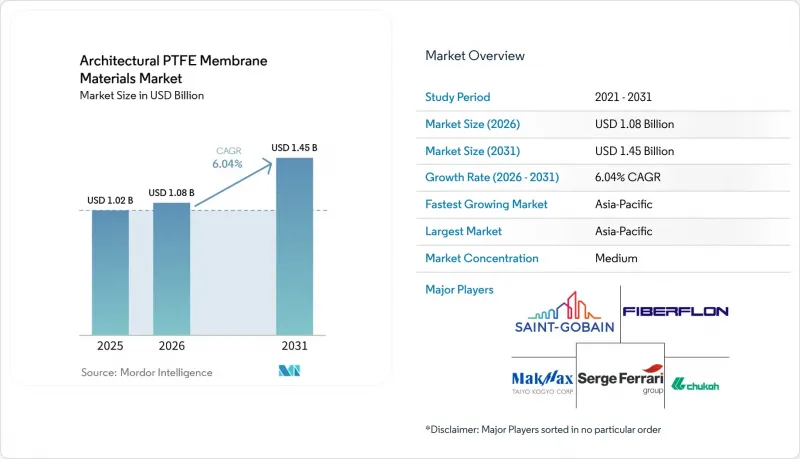
According to Mordor Intelligence, the architectural PTFE membrane materials market size was valued at USD 1.02 billion in 2025 and is estimated to grow from USD 1.08 billion in 2026 to reach USD 1.45 billion by 2031, at a CAGR of 6.04% during the forecast period (2026-2031).
Global Architectural PTFE Membrane Materials Market Trends and Insights
Sustainable Building and Green Certification Demand
Leadership in Energy and Environmental Design (LEED), Building Research Establishment Environmental Assessment Method (BREEAM), and Germany's Deutsche Gesellschaft fur Nachhaltiges Bauen (DGNB) frameworks have become procurement requirements in many large public projects. These frameworks assess daylighting, thermal performance, and material durability, which increases scrutiny of roof material specifications. PTFE-coated fiberglass provides 15% to 25% diffuse transmittance and 70% +- 10% solar reflectance, supporting envelope energy-performance requirements. The architectural PTFE membrane materials market benefits when public buyers require documented lifecycle performance rather than initial-cost comparisons alone. CHUKOH CHEMICAL INDUSTRIES, LTD. received an Environmental Product Declaration (EPD) from EPD Hub in April 2025 for its FGT series, including FGT-600, FGT-800, and FGT-1000, which supports tender qualification where lifecycle documentation is required. EPD availability can remove materials without comparable documentation at the schematic design stage.
Infrastructure Modernization and Mega-Venue Construction
Transit authorities and sporting bodies are specifying PTFE-coated fiberglass for permanent, large-span structures. This supports demand in the architectural PTFE membrane materials market because such projects require qualified materials and involve multi-year delivery schedules. TAIYO KOGYO CORPORATION's U.S. subsidiary, Birdair Inc., received a May 2025 contract to replace the PTFE membrane roof at NRG Stadium in Houston, a 2026 Federation Internationale de Football Association (FIFA) World Cup venue. The original roof membrane had been installed 20 years earlier, and micrographic comparisons found no structural degradation. TAIYO KOGYO CORPORATION also installed the PTFE membrane roof at Yumeshima Station on the Osaka Metro in January 2025. Fixed event schedules can accelerate procurement because replacement work must be completed before venue operations begin.
High Upfront Material and Installation Cost
PTFE-coated fiberglass membranes carry a 30% to 50% material-cost premium over polyvinyl chloride (PVC)-coated polyester. The difference grows when fluorinated ethylene propylene (FEP) welding, precision tensioning, and custom steel connectors are included. This cost can be a significant barrier for budget-constrained municipal projects in South and Southeast Asia. Specifiers can select PVC during concept design before lifecycle-cost considerations are evaluated. Limited local PTFE installation capacity also discourages investment in the specialized workforce required for these projects. The architectural PTFE membrane materials market, therefore, remains concentrated in airports, transit stations, and permanent sports venues with lifecycle-cost mandates.
Other drivers and restraints analyzed in the detailed report include:
- Daylighting and Energy Performance
- BIM-to-Fabrication Precision and Parametric Design
- PTFE-ETFE Substitution in Daylight-First Designs
For complete list of drivers and restraints, kindly check the Table Of Contents.
Segment Analysis
Tensile membrane structures held 45.23% of the architectural PTFE membrane materials market in 2025. Their position reflects biaxial tension, which distributes loads across the surface and allows column-free spans of 30 meters or more. This structural approach can achieve long spans at a lower material weight than comparable rigid structures. Tensile systems are suited to airports, transit facilities, stadiums, and permanent public spaces. Requirements for structural permanence and lower maintenance support the architectural PTFE membrane materials market size for tensile membrane structures. Project owners also value the material's 20- to 30-year service-life fit for long-lived public assets.
Pneumatic and air-supported membrane structures are projected to advance at a 7.12% CAGR through 2031. Their growth is linked to air-dome use in logistics warehouses, indoor sports facilities in northern China and Central Asia, and Gulf Cooperation Council amenity spaces requiring year-round climate control. TAIYO KOGYO CORPORATION launched TensoDiaRoof in November 2025, a Building Center of Japan (BCJ)-rated lattice-purlin membrane roof system that uses 10% less steel and requires no scaffolding. The system targets retrofit applications beyond large venue contracts. Other structure types benefit from photocatalytic PTFE surfaces that help retain aesthetic performance in polluted locations. Digital design-to-fabrication workflows also raise the technical requirements for complex structures.
Complete Report Scope:
- By Structure Type
- Tensile Membrane Structures
- Pneumatic and Air-Supported Membrane Structures
- Other Structure Types
- By Application
- Stadiums and Sports Venues
- Airport Terminals and Transportation Hubs
- Exhibition and Convention Centers
- Commercial Facades and Retail Structures
- Educational and Institutional Buildings
- Other Applications
- By End-Use Sector
- Commercial
- Industrial and Institutional
- Infrastructure
- Residential
- By Geography
- Asia-Pacific
- China
- India
- Japan
- South Korea
- ASEAN Countries
- Rest of Asia-Pacific
- North America
- United States
- Canada
- Mexico
- Europe
- Germany
- United Kingdom
- France
- Italy
- Spain
- NORDIC Countries
- Rest of Europe
- South America
- Brazil
- Argentina
- Rest of South America
- Middle-East and Africa
- Saudi Arabia
- United Arab Emirates
- South Africa
- Rest of Middle-East and Africa
- Asia-Pacific
Geography Analysis
Asia-Pacific held 38.57% of the architectural PTFE membrane materials market share in 2025 and is projected to advance at a 6.95% CAGR through 2031. China's urbanization program is supporting PTFE roofing at metro stations and intermodal terminals in the Yangtze River Delta and Pearl River Delta. Zhejiang Huifeng Holding Group Co., Ltd. supplied membrane material for the Vietnam Exhibition Center in September 2025, marking a major overseas deployment of a Chinese PTFE product in a flagship public building. TAIYO KOGYO CORPORATION's work at Yumeshima Station and Mitsui Outlet Park Kisarazu showed continued activity in Japanese transit and commercial sites. India and the Association of Southeast Asian Nations (ASEAN) countries offer opportunities through airport expansions and mass-transit extensions.
North American demand centers on stadium refurbishment, where Tropicana Field and NRG Stadium combine climate-related repairs with sporting deadlines. Europe is influenced by the European Green Deal and EN 15804 lifecycle requirements. The Dresden Hauptbahnhof renovation used 33,000 square meters of Serge Ferrari GF-7000 PTFE membrane over 3 phases completed between 2022 and 2025. Nordic countries are adopting adaptive membrane facade modules tested through Germany's Zukunft Bau program. Germany and the Netherlands have a strong demand for EPD-documented materials in public procurement.
South America, and Middle-East and Africa show different demand conditions. The Gulf Cooperation Council is a high-value opportunity outside Asia-Pacific because Saudi Arabia and the United Arab Emirates are developing stadiums, transport hubs, and public spaces that require durable long-span coverings in the architectural PTFE membrane materials market. PTFE's ultraviolet stability is important for desert conditions. Brazil and Argentina are supporting South American demand through stadium modernization and logistics air domes. Mexico's co-host role for the 2026 FIFA World Cup provided a near-term project catalyst. African procurement remains focused on government projects because installation capability constraints limit broader adoption.
- CHUKOH CHEMICAL INDUSTRIES, LTD.
- FIBERFLON
- Haining Duletai New Material Co., Ltd.
- HIRAOKA & Co., Ltd.
- Jiangsu VEIK Technology & Materials Co., Ltd.
- Keli New Materials Co., Ltd.
- NINGBO WELLFLON NEW MATERIALS TECHNOLOGY CO., LTD.
- Saint-Gobain
- Serge Ferrari
- TACONIC
- TAIYO KOGYO CORPORATION
- Zhejiang Huifeng Holding Group Co., Ltd.
- Zhejiang Kaiao New Material Co., Ltd.
Additional Benefits:
- The market estimate (ME) sheet in Excel format
- 3 months of analyst support
TABLE OF CONTENTS
1 Introduction
- 1.1 Study Assumptions and Market Definition
- 1.2 Scope of the Study
2 Research Methodology
3 Executive Summary
4 Market Landscape
- 4.1 Market Overview
- 4.2 Market Drivers
- 4.2.1 Sustainable Building and Green Certification Demand
- 4.2.2 Infrastructure Modernization and Mega-Venue Construction
- 4.2.3 Long Service Life and Low Maintenance
- 4.2.4 Daylighting and Energy Performance
- 4.2.5 BIM-to-Fabrication Precision and Parametric Design
- 4.2.6 Retrofit Replacement of Aging Textile Roofs
- 4.3 Market Restraints
- 4.3.1 High Upfront Material and Installation Cost
- 4.3.2 Specialized Engineering and Installation Capability
- 4.3.3 PTFE-ETFE Substitution in Daylight-First Designs
- 4.3.4 End-of-Life Recycling and Embodied-Carbon Scrutiny
- 4.4 Value Chain Analysis
- 4.5 Porter's Five Forces Analysis
- 4.5.1 Threat of New Entrants
- 4.5.2 Bargaining Power of Suppliers
- 4.5.3 Bargaining Power of Buyers
- 4.5.4 Threat of Substitutes
- 4.5.5 Competitive Rivalry
5 Market Size and Growth Forecasts (Value)
- 5.1 By Structure Type
- 5.1.1 Tensile Membrane Structures
- 5.1.2 Pneumatic and Air-Supported Membrane Structures
- 5.1.3 Other Structure Types
- 5.2 By Application
- 5.2.1 Stadiums and Sports Venues
- 5.2.2 Airport Terminals and Transportation Hubs
- 5.2.3 Exhibition and Convention Centers
- 5.2.4 Commercial Facades and Retail Structures
- 5.2.5 Educational and Institutional Buildings
- 5.2.6 Other Applications
- 5.3 By End-Use Sector
- 5.3.1 Commercial
- 5.3.2 Industrial and Institutional
- 5.3.3 Infrastructure
- 5.3.4 Residential
- 5.4 By Geography
- 5.4.1 Asia-Pacific
- 5.4.1.1 China
- 5.4.1.2 India
- 5.4.1.3 Japan
- 5.4.1.4 South Korea
- 5.4.1.5 ASEAN Countries
- 5.4.1.6 Rest of Asia-Pacific
- 5.4.2 North America
- 5.4.2.1 United States
- 5.4.2.2 Canada
- 5.4.2.3 Mexico
- 5.4.3 Europe
- 5.4.3.1 Germany
- 5.4.3.2 United Kingdom
- 5.4.3.3 France
- 5.4.3.4 Italy
- 5.4.3.5 Spain
- 5.4.3.6 NORDIC Countries
- 5.4.3.7 Rest of Europe
- 5.4.4 South America
- 5.4.4.1 Brazil
- 5.4.4.2 Argentina
- 5.4.4.3 Rest of South America
- 5.4.5 Middle-East and Africa
- 5.4.5.1 Saudi Arabia
- 5.4.5.2 United Arab Emirates
- 5.4.5.3 South Africa
- 5.4.5.4 Rest of Middle-East and Africa
- 5.4.1 Asia-Pacific
6 Competitive Landscape
- 6.1 Market Concentration
- 6.2 Strategic Moves
- 6.3 Market Share (%)/Ranking Analysis
- 6.4 Company Profiles (includes Global Overview, Market Overview, Core Segments, Financials as available, Strategic Information, Products and Services, and Recent Developments)
- 6.4.1 CHUKOH CHEMICAL INDUSTRIES, LTD.
- 6.4.2 FIBERFLON
- 6.4.3 Haining Duletai New Material Co., Ltd.
- 6.4.4 HIRAOKA & Co., Ltd.
- 6.4.5 Jiangsu VEIK Technology & Materials Co., Ltd.
- 6.4.6 Keli New Materials Co., Ltd.
- 6.4.7 NINGBO WELLFLON NEW MATERIALS TECHNOLOGY CO., LTD.
- 6.4.8 Saint-Gobain
- 6.4.9 Serge Ferrari
- 6.4.10 TACONIC
- 6.4.11 TAIYO KOGYO CORPORATION
- 6.4.12 Zhejiang Huifeng Holding Group Co., Ltd.
- 6.4.13 Zhejiang Kaiao New Material Co., Ltd.
7 Market Opportunities and Future Outlook
- 7.1 White-Space and Unmet-Need Assessment

