PUBLISHER: Mordor Intelligence | PRODUCT CODE: 2154480

PUBLISHER: Mordor Intelligence | PRODUCT CODE: 2154480
Model Risk Management Software For AI - Market Share Analysis, Industry Trends & Statistics, Growth Forecasts (2026 - 2031)
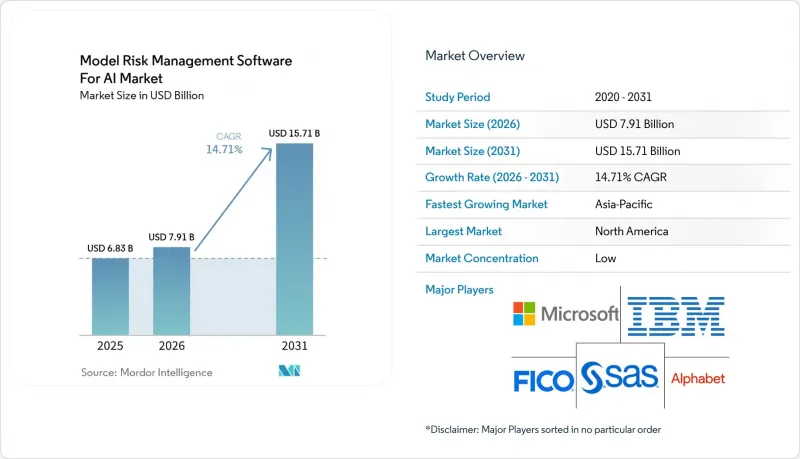
According to Mordor Intelligence, the model risk management software for AI Market size was valued at USD 6.83 billion in 2025 and is estimated to grow from USD 7.91 billion in 2026 to reach USD 15.71 billion by 2031, at a CAGR of 14.71% during the forecast period (2026-2031).
Global Model Risk Management Software For AI Market Trends and Insights
Enterprise Adoption of Generative AI and Large Language Models
The Model Risk Management Software for AI Market benefits as generative AI moves from tests into production systems. Organizations increasingly use AI in business functions, but governance controls are not always applied consistently. Large language models can produce different results under changing prompts and context, so a single approval before launch is rarely sufficient. Financial institutions, health systems, and other regulated users need records that show how a model was tested, monitored, and changed. Teams also need clear escalation paths when an output raises a safety, fairness, or customer service concern. That requirement increases demand for centralized inventories, approval workflows, and runtime evidence across the Model Risk Management Software for AI Market.
Expanding Regulatory and Supervisory Requirements
The Model Risk Management Software for AI Market is supported by the move from voluntary principles toward formal AI governance requirements. The EU AI Act makes traceable lifecycle records more important for organizations operating in Europe. Institutions working across borders often need to map 1 model to several control sets rather than create separate records for every jurisdiction. This favors platforms that can link validation results, approvals, and monitoring evidence to different requirements. ISO/IEC 42001 gives procurement teams a structured reference point for assessing AI management practices. The resulting demand favors products that can update control mappings without requiring teams to rebuild the underlying model record.
High Implementation Cost and Integration Complexity
A full deployment can require connections to development tools, data pipelines, validation processes, audit systems, and reporting records. That work is difficult for organizations with legacy spreadsheets, separate databases, and manual exception logs. Costs can also increase when teams need advisory support to define ownership and control requirements. Mid-market institutions may find it difficult to justify enterprise platforms when their model portfolios are smaller. Longer integration cycles can delay the value expected from a Model Risk Management Software for AI Market purchase. Buyers may therefore begin with a narrower workflow before extending the platform across their organization.
Other drivers and restraints analyzed in the detailed report include:
- Rising Demand for Automated Model Lifecycle Controls
- Increasing Cyberattacks and Adversarial AI Exposure
- Limited Explainability of Advanced Foundation Models
For complete list of drivers and restraints, kindly check the Table Of Contents.
Segment Analysis
Software accounted for 68.24% of the Model Risk Management Software for AI Market share in 2025. Licensed platforms are the primary entry point because they centralize model inventory, validation, documentation, and monitoring. Established suites and specialized vendors offer these functions through structured workflows instead of isolated spreadsheets. Buyers use them to create a common record for models used across financial services, healthcare, and regulated technology operations. A shared platform can also make overdue reviews and ownership gaps easier to identify in the Model Risk Management Software for AI Market.
Services are projected to grow at a 16.83% CAGR from 2026 to 2031. Many institutions still need help interpreting requirements, connecting systems, and designing controls for their own risk profile. Consulting teams can help translate policy expectations into procedures that the platform can support. Implementation services are also needed when firms must integrate legacy records into new governance workflows. Services, therefore, complement software rather than replace it, especially when an organization is establishing a formal Model Risk Management Software for AI Market program.
Model Management held 32.17% revenue share in 2025. Centralized inventory systems give organizations a record of each model's purpose, owner, status, performance, and risk classification. That visibility supports validation planning and makes it easier to identify models that have changed or lack current evidence. It also provides a practical starting point for firms that are moving beyond scattered business-unit records. A complete inventory helps Model Risk Management Software for AI Market teams set priorities according to risk and use.
Explainable AI Tools are forecast to expand at a 17.62% CAGR through 2031. Demand is driven by the need to explain model outcomes to reviewers, operators, and affected individuals across different circumstances. Bias Detection and Fairness Tools also support governance programs where automated decisions require closer review. Risk Scoring and Stress Testing Tools continue to meet performance testing needs, while Security and Privacy Management Tools address new concerns related to inference activity and supply chains. Regulatory reporting automation creates additional demand for Model Risk Management Software in the AI Market, where teams must prepare repeatable evidence for audits or internal committees.
Complete Report Scope:
- By Offering
- Software
- Services
- By Software Type
- Model Management
- Bias Detection and Fairness Tools
- Explainable AI Tools
- Risk Scoring and Stress Testing Tools
- Security and Privacy Management Tools
- Other Software Types
- By Deployment Mode
- Cloud
- On-Premises
- Hybrid
- By Risk Type
- Operational Risk
- Compliance Risk
- Security Risk
- Other Risk Types
- By End User
- Banking, Financial Services and Insurance
- IT and Telecommunications
- Healthcare and Life Sciences
- Government and Public Sector
- Retail and E-Commerce
- Manufacturing
- Media and Entertainment
- Other End Users
- By Geography
- North America
- United States
- Canada
- Mexico
- South America
- Brazil
- Argentina
- Chile
- Rest of South America
- Europe
- Germany
- United Kingdom
- France
- Italy
- Spain
- Rest of Europe
- Asia-Pacific
- China
- Japan
- India
- South Korea
- Australia
- Rest of Asia-Pacific
- Middle East
- United Arab Emirates
- Saudi Arabia
- Qatar
- Rest of Middle East
- Africa
- South Africa
- Egypt
- Nigeria
- Rest of Africa
- North America
Geography Analysis
North America held 42.73% of the Model Risk Management Software for AI Market share in 2025. The region benefits from high AI use across financial services, health care, and technology companies. The NIST AI Risk Management Framework provides a reference point for structuring AI risk activities and communication across internal teams. Canada adds demand through its financial services and fintech sectors, while Mexico is developing earlier-stage demand through digital.
Europe was the second-largest regional market in 2025. The EU AI Act raises the importance of ongoing risk management, transparency, and human oversight for relevant AI systems. This drives demand for tools that can connect model evidence to compliance requirements throughout the lifecycle. Cross-border banks can benefit from systems that avoid duplicate documentation across regional requirements.
Asia-Pacific is forecast to grow at a 20.16% CAGR from 2026 to 2031. China, India, Japan, and South Korea are expanding the use of enterprise AI across financial services, manufacturing, and health care. India's digital lending activity supports demand for bias detection and operational monitoring in AI credit decisions. Japan and South Korea add to demand through financial services and the use of AI-enabled medical technology. Australia's prudential environment provides another reason for banks to formalize AI risk controls. South America, the Middle East, and Africa remain smaller markets, but national AI programs and evolving data rules create longer-term opportunities for vendors that build local partnerships.
- International Business Machines Corporation
- Microsoft Corporation
- Alphabet Inc.
- SAS Institute Inc.
- Fair Isaac Corporation
- Amazon Web Services, Inc.
- Accenture plc
- Oracle Corporation
- Salesforce, Inc.
- ServiceNow, Inc.
- DataRobot, Inc.
- Databricks, Inc.
- H2O.ai, Inc.
- ModelOp, Inc.
- ValidMind Inc.
- Credo AI, Inc.
- Monitaur, Inc.
- Fiddler AI, Inc.
- Holistic AI
- OneTrust, LLC
- Collibra NV
- Domino Data Lab, Inc.
- ArthurAI
- Fairly AI
Additional Benefits:
- The market estimate (ME) sheet in Excel format
- 3 months of analyst support
TABLE OF CONTENTS
1 INTRODUCTION
- 1.1 Study Assumptions and Market Definition
- 1.2 Scope of the Study
2 RESEARCH METHODOLOGY
3 EXECUTIVE SUMMARY
4 MARKET LANDSCAPE
- 4.1 Market Overview
- 4.2 Market Drivers
- 4.2.1 Enterprise Adoption of Generative AI and Large Language Models
- 4.2.2 Expanding Regulatory and Supervisory Requirements
- 4.2.3 Rising Demand for Automated Model Lifecycle Controls
- 4.2.4 Increasing Cyberattacks and Adversarial AI Exposure
- 4.2.5 Automated Evidence Generation for Multi-Framework Compliance
- 4.2.6 Governance Requirements for Agentic AI and Autonomous Workflows
- 4.3 Market Restraints
- 4.3.1 High Implementation Cost and Integration Complexity
- 4.3.2 Limited Explainability of Advanced Foundation Models
- 4.3.3 Fragmented Cross-Border AI Regulation
- 4.3.4 Model Risk Ownership Gaps Across the Three Lines of Defense
- 4.4 Impact of Macroeconomic Factors on the Market
- 4.5 Industry Value-Chain Analysis
- 4.6 Technology Outlook
- 4.7 Regulatory Landscape
- 4.8 Porter's Five Forces Analysis
- 4.8.1 Threat of New Entrants
- 4.8.2 Bargaining Power of Suppliers
- 4.8.3 Bargaining Power of Buyers
- 4.8.4 Threat of Substitutes
- 4.8.5 Intensity of Competitive Rivalry
5 MARKET SIZE AND GROWTH FORECASTS (VALUE)
- 5.1 By Offering
- 5.1.1 Software
- 5.1.2 Services
- 5.2 By Software Type
- 5.2.1 Model Management
- 5.2.2 Bias Detection and Fairness Tools
- 5.2.3 Explainable AI Tools
- 5.2.4 Risk Scoring and Stress Testing Tools
- 5.2.5 Security and Privacy Management Tools
- 5.2.6 Other Software Types
- 5.3 By Deployment Mode
- 5.3.1 Cloud
- 5.3.2 On-Premises
- 5.3.3 Hybrid
- 5.4 By Risk Type
- 5.4.1 Operational Risk
- 5.4.2 Compliance Risk
- 5.4.3 Security Risk
- 5.4.4 Other Risk Types
- 5.5 By End User
- 5.5.1 Banking, Financial Services and Insurance
- 5.5.2 IT and Telecommunications
- 5.5.3 Healthcare and Life Sciences
- 5.5.4 Government and Public Sector
- 5.5.5 Retail and E-Commerce
- 5.5.6 Manufacturing
- 5.5.7 Media and Entertainment
- 5.5.8 Other End Users
- 5.6 By Geography
- 5.6.1 North America
- 5.6.1.1 United States
- 5.6.1.2 Canada
- 5.6.1.3 Mexico
- 5.6.2 South America
- 5.6.2.1 Brazil
- 5.6.2.2 Argentina
- 5.6.2.3 Chile
- 5.6.2.4 Rest of South America
- 5.6.3 Europe
- 5.6.3.1 Germany
- 5.6.3.2 United Kingdom
- 5.6.3.3 France
- 5.6.3.4 Italy
- 5.6.3.5 Spain
- 5.6.3.6 Rest of Europe
- 5.6.4 Asia-Pacific
- 5.6.4.1 China
- 5.6.4.2 Japan
- 5.6.4.3 India
- 5.6.4.4 South Korea
- 5.6.4.5 Australia
- 5.6.4.6 Rest of Asia-Pacific
- 5.6.5 Middle East
- 5.6.5.1 United Arab Emirates
- 5.6.5.2 Saudi Arabia
- 5.6.5.3 Qatar
- 5.6.5.4 Rest of Middle East
- 5.6.6 Africa
- 5.6.6.1 South Africa
- 5.6.6.2 Egypt
- 5.6.6.3 Nigeria
- 5.6.6.4 Rest of Africa
- 5.6.1 North America
6 COMPETITIVE LANDSCAPE
- 6.1 Market Concentration
- 6.2 Strategic Moves
- 6.3 Market Share Analysis
- 6.4 Company Profiles (includes Global Level Overview, Market Level Overview, Core Segments, Financials as available, Strategic Information, Market Rank/Share, Products and Services, Recent Developments)
- 6.4.1 International Business Machines Corporation
- 6.4.2 Microsoft Corporation
- 6.4.3 Alphabet Inc.
- 6.4.4 SAS Institute Inc.
- 6.4.5 Fair Isaac Corporation
- 6.4.6 Amazon Web Services, Inc.
- 6.4.7 Accenture plc
- 6.4.8 Oracle Corporation
- 6.4.9 Salesforce, Inc.
- 6.4.10 ServiceNow, Inc.
- 6.4.11 DataRobot, Inc.
- 6.4.12 Databricks, Inc.
- 6.4.13 H2O.ai, Inc.
- 6.4.14 ModelOp, Inc.
- 6.4.15 ValidMind Inc.
- 6.4.16 Credo AI, Inc.
- 6.4.17 Monitaur, Inc.
- 6.4.18 Fiddler AI, Inc.
- 6.4.19 Holistic AI
- 6.4.20 OneTrust, LLC
- 6.4.21 Collibra NV
- 6.4.22 Domino Data Lab, Inc.
- 6.4.23 ArthurAI
- 6.4.24 Fairly AI
7 MARKET OPPORTUNITIES AND FUTURE OUTLOOK
- 7.1 White-Space and Unmet-Need Assessment

