PUBLISHER: Mordor Intelligence | PRODUCT CODE: 2154483

PUBLISHER: Mordor Intelligence | PRODUCT CODE: 2154483
Disposable Hospital Gowns - Market Share Analysis, Industry Trends & Statistics, Growth Forecasts (2026 - 2031)
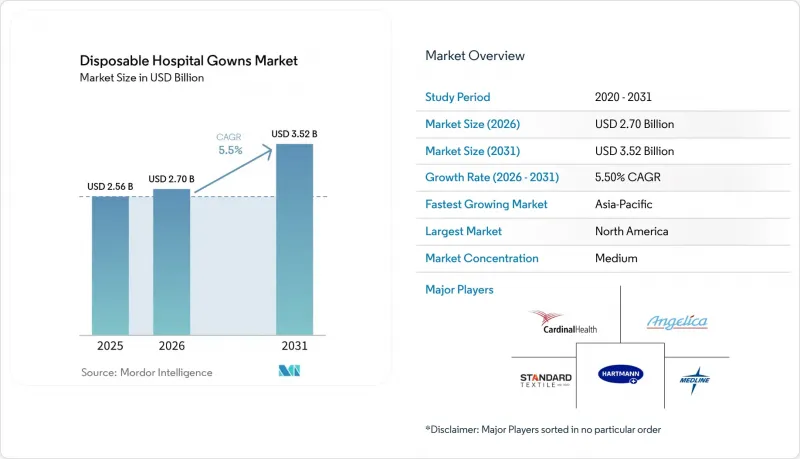
According to Mordor Intelligence, the disposable hospital gowns market size is projected to expand from USD 2.56 billion in 2025 and USD 2.70 billion in 2026 to USD 3.52 billion by 2031, registering a CAGR of 5.5% between 2026 to 2031.
Global Disposable Hospital Gowns Market Trends and Insights
Rising Surgical and Interventional Procedure Volumes
Surgical activity remains a key demand driver for the disposable hospital gowns market, as each procedure requires defined protective apparel. The outpatient channel is gaining importance as procedures shift from acute-care hospitals to ambulatory surgery centers (ASCs). CMS added 560 procedure codes to the ASC Covered Procedures List in its CY 2026 final rule, including cardiovascular, orthopedic, and spinal procedures. CMS also began a three-year phaseout of the Inpatient-Only List in 2026, supporting the migration of suitable procedures to outpatient facilities. These facilities require product assortments, packaging formats, and delivery schedules that differ from traditional hospital purchasing models. Higher-acuity procedures performed outside inpatient hospitals may require Level 3 or Level 4 barrier protection.
Persistent Infection-Prevention and HAI-Control Requirements
Infection prevention continues to support demand in the disposable hospital gowns market, as gown performance remains central to clinical protection protocols. ANSI/AAMI PB70:2022 classifies protective apparel and drapes based on liquid barrier performance for healthcare facilities. The standard has increased the focus on documented barrier performance during product selection. Hospitals may place greater emphasis on test evidence and product certification when evaluating suppliers. A 2025 peer-reviewed study evaluated methods for testing the liquid barrier performance of disposable isolation gowns. Its findings reinforced the distinction between laboratory evaluations and real-world clinical use. Infection-control teams may require suppliers to provide stronger evidence of gown performance. This strengthens the role of testing, traceability, regulatory documentation, and quality systems in the disposable hospital gowns market.
Volatility in Polypropylene and Other Nonwoven Input Costs
Polypropylene resin accounts for 60% to 70% of nonwoven conversion costs for manufacturers in the disposable hospital gowns market. Resin price volatility can compress margins under fixed-price supply contracts, particularly when converters cannot pass higher material costs to hospital customers. Long-term group purchasing organization contracts can restrict price revisions, while spot-market purchases can increase short-term costs during supply disruptions. Smaller regional manufacturers are more exposed due to limited purchasing scale and reduced access to long-term supply arrangements. Product performance variability creates an additional commercial constraint in the disposable hospital gowns market. Low-cost products with inconsistent barrier performance can increase buyer testing and qualification requirements.
Other drivers and restraints analyzed in the detailed report include:
- Domestic PPE-Resilience Policies and Strategic Stockpiling
- Procurement Shift Toward Verified Barrier Performance and Traceability
- Sustainability Pressure From Single-Use Medical Waste
For complete list of drivers and restraints, kindly check the Table Of Contents.
Segment Analysis
Surgical gowns held 49.88% of global revenue in 2025, making them the leading product category in the disposable hospital gowns market. Their use spans elective orthopedic procedures, emergency interventions, cardiovascular care, and other surgical settings requiring higher barrier protection to maintain a sterile field. ANSI/AAMI PB70:2022 provides the liquid barrier classification framework for protective healthcare apparel. Non-surgical isolation, patient, examination, and dignity gowns remain essential for routine procurement across general wards, outpatient clinics, long-term care facilities, diagnostic settings, and patient-contact environments.
Chemotherapy gowns are the fastest-growing product category, with a forecast CAGR of 14.52% during 2026-2031. USP <800> identifies polyethylene-coated polypropylene or equivalent materials tested under ASTM D6978 for hazardous-drug handling, differentiating these gowns from standard surgical and isolation products. As oncology services expand, hospitals and community care settings are formalizing hazardous-drug safety procedures beyond specialized cancer centers. This trend increases demand for compliant gowns and creates a premium product category with specific material and testing requirements.
Sterile disposable gowns held 64.67% of revenue in 2025 and led the sterility category. Healthcare providers use them in procedures requiring aseptic conditions and enhanced protection against fluid and microbial penetration, particularly Level 3 and Level 4 barrier procedures. Their performance requirements and sterilization processes support higher unit prices. Non-sterile gowns remain necessary in general wards, diagnostic laboratories, and long-term care settings, particularly in budget-sensitive procurement environments.
Sterile disposable gowns are forecast to grow at a 15.20% CAGR during 2026-2031, the highest rate in the sterility category. EN 13795-1:2025 covers surgical drapes, gowns, and clean air suits used as medical devices and introduced a high-performance tier. The tier requires a wet microbial penetration barrier index IB of at least 6.0 and liquid penetration resistance of at least 100 cm H2O in critical zones. European hospitals renewing supply contracts after the 2025 regulatory update need to assess compliance, supporting demand for higher-value sterile gowns.
Complete Report Scope:
- By Product Type
- Surgical Gowns
- Non-Surgical Isolation Gowns
- Patient Gowns
- Chemotherapy Gowns
- Dignity and Examination Gowns
- By Sterility
- Sterile Disposable Gowns
- Non-Sterile Disposable Gowns
- By Material
- Polypropylene Nonwoven
- Polyethylene-Coated Nonwoven
- Polyethylene Film
- Microporous Film Laminate
- Polyethylene-Polypropylene Composite
- Others
- By End User
- Hospitals
- Ambulatory Surgery Centers
- Physician Offices and Outpatient Clinics
- Diagnostic and Testing Laboratories
- Long-Term Care and Nursing Facilities
- Others
- By Geography
- North America
- United States
- Canada
- Mexico
- Europe
- Germany
- United Kingdom
- France
- Italy
- Spain
- Rest of Europe
- Asia-Pacific
- China
- India
- Japan
- Australia
- South Korea
- Rest of Asia-Pacific
- Middle East and Africa
- GCC
- South Africa
- Rest of Middle East and Africa
- South America
- Brazil
- Argentina
- Rest of South America
- North America
Geography Analysis
North America held 39.56% of global revenue in 2025, making it the largest regional market. High gown usage per procedure, established group purchasing systems, stringent barrier-performance requirements, and the concentration of complex surgical care supported demand. In January 2026, CMS sought comments on strengthening domestic supply chains for PPE and essential medicines, including the Secure American Medical Supplies designation and potential Medicare payment incentives. The VA also applied domestic-content requirements through its Medical and Surgical Prime Vendor Program, while Canada and Mexico contributed through publicly funded healthcare systems and expanding outpatient surgical capacity.
Europe's disposable hospital gowns market was shaped by evolving technical standards and waste-management policies. Commission Implementing Decision (EU) 2025/2078 addressed harmonized standards for surgical clothing, drapes, medical face masks, and sterilizers in October 2025, increasing compliance requirements for sterile surgical gowns marketed as medical devices. Germany, France, and the United Kingdom faced supply contract renewals, while the revised Waste Framework Directive increased the focus on producer responsibility for textile products. Hospital construction supported demand in Saudi Arabia and the UAE, while public hospital investments supported Brazil and Argentina despite currency volatility and reliance on imported nonwoven inputs.
Asia-Pacific is forecast to grow at a CAGR of 14.77% from 2026 to 2031, making it the fastest-growing region. China and India are expanding hospital infrastructure and domestic manufacturing capacity for operating room consumables. China's GB 19082-2024 standard aligned with AAMI Level 4 requirements, raising the quality baseline for protective products. In May 2026, Winner Medical broke ground on a USD 60 million, 93,000-square-meter production facility in Quang Ninh Province, Vietnam, with Phase I focused on advanced medical dressings and operating room consumables. Japan and South Korea remain key premium markets, where public tenders increasingly prioritize quality-system certification and performance specifications.
- Angelica Corporation
- Ansell
- B. Braun
- Bellcross Industries Pvt. Ltd.
- Cardinal Health
- Dynarex
- Hogy Medical Co., Ltd.
- Kimberly-Clark Worldwide
- Lohmann & Rauscher
- Medline Industries
- MedSource Labs Pvt. Ltd.
- Molnlycke Health Care
- Owens & Minor, Inc.
- Hartmann Group
- Priontex Ltd.
- Sara Healthcare Pvt. Ltd.
- Solventum Corporation
- Standard Textile Co., Inc.
- Surgiene Healthcare (India) Private Limited
- Winner Medical Co., Ltd.
Additional Benefits:
- The market estimate (ME) sheet in Excel format
- 3 months of analyst support
TABLE OF CONTENTS
1 Introduction
- 1.1 Study Assumptions and Market Definition
- 1.2 Scope of the Study
2 Research Methodology
3 Executive Summary
4 Market Landscape
- 4.1 Market Overview
- 4.2 Market Drivers
- 4.2.1 Rising Surgical and Interventional Procedure Volumes
- 4.2.2 Persistent Infection-Prevention and Healthcare-Associated Infection-Control Requirements
- 4.2.3 Domestic PPE-Resilience Policies and Strategic Stockpiling
- 4.2.4 Procurement Shift Toward Verified Barrier Performance Rather Than Lowest Unit Price
- 4.2.5 Digitally Traceable, Lower-Waste Gown Specifications in Public Healthcare Tenders
- 4.3 Market Restraints
- 4.3.1 Volatility in Polypropylene and Other Nonwoven Input Costs
- 4.3.2 Sustainability Pressure From Single-Use Medical Waste
- 4.3.3 Performance Variability Across Low-Cost Disposable Gown Products
- 4.4 Value and Supply-Chain Analysis
- 4.5 Regulatory Landscape
- 4.6 Technological Outlook
- 4.7 Porter's Five Forces
- 4.7.1 Threat of New Entrants
- 4.7.2 Bargaining Power of Suppliers
- 4.7.3 Bargaining Power of Buyers
- 4.7.4 Threat of Substitutes
- 4.7.5 Competitive Rivalry
5 Market Size and Growth Forecasts (Value, USD)
- 5.1 By Product Type
- 5.1.1 Surgical Gowns
- 5.1.2 Non-Surgical Isolation Gowns
- 5.1.3 Patient Gowns
- 5.1.4 Chemotherapy Gowns
- 5.1.5 Dignity and Examination Gowns
- 5.2 By Sterility
- 5.2.1 Sterile Disposable Gowns
- 5.2.2 Non-Sterile Disposable Gowns
- 5.3 By Material
- 5.3.1 Polypropylene Nonwoven
- 5.3.2 Polyethylene-Coated Nonwoven
- 5.3.3 Polyethylene Film
- 5.3.4 Microporous Film Laminate
- 5.3.5 Polyethylene-Polypropylene Composite
- 5.3.6 Others
- 5.4 By End User
- 5.4.1 Hospitals
- 5.4.2 Ambulatory Surgery Centers
- 5.4.3 Physician Offices and Outpatient Clinics
- 5.4.4 Diagnostic and Testing Laboratories
- 5.4.5 Long-Term Care and Nursing Facilities
- 5.4.6 Others
- 5.5 By Geography
- 5.5.1 North America
- 5.5.1.1 United States
- 5.5.1.2 Canada
- 5.5.1.3 Mexico
- 5.5.2 Europe
- 5.5.2.1 Germany
- 5.5.2.2 United Kingdom
- 5.5.2.3 France
- 5.5.2.4 Italy
- 5.5.2.5 Spain
- 5.5.2.6 Rest of Europe
- 5.5.3 Asia-Pacific
- 5.5.3.1 China
- 5.5.3.2 India
- 5.5.3.3 Japan
- 5.5.3.4 Australia
- 5.5.3.5 South Korea
- 5.5.3.6 Rest of Asia-Pacific
- 5.5.4 Middle East and Africa
- 5.5.4.1 GCC
- 5.5.4.2 South Africa
- 5.5.4.3 Rest of Middle East and Africa
- 5.5.5 South America
- 5.5.5.1 Brazil
- 5.5.5.2 Argentina
- 5.5.5.3 Rest of South America
- 5.5.1 North America
6 Competitive Landscape
- 6.1 Market Concentration
- 6.2 Market Share Analysis
- 6.3 Company Profiles (includes Global Level Overview, Market Level Overview, Core Segments, Financials as available, Strategic Information, Market Rank/Share, Products and Services, Recent Developments)
- 6.3.1 Angelica Corporation
- 6.3.2 Ansell Limited
- 6.3.3 B. Braun SE
- 6.3.4 Bellcross Industries Pvt. Ltd.
- 6.3.5 Cardinal Health, Inc.
- 6.3.6 Dynarex Corporation
- 6.3.7 Hogy Medical Co., Ltd.
- 6.3.8 Kimberly-Clark Corporation
- 6.3.9 Lohmann & Rauscher GmbH & Co. KG
- 6.3.10 Medline Industries, LP
- 6.3.11 MedSource Labs Pvt. Ltd.
- 6.3.12 Molnlycke Health Care AB
- 6.3.13 Owens & Minor, Inc.
- 6.3.14 PAUL HARTMANN AG
- 6.3.15 Priontex Ltd.
- 6.3.16 Sara Healthcare Pvt. Ltd.
- 6.3.17 Solventum Corporation
- 6.3.18 Standard Textile Co., Inc.
- 6.3.19 Surgiene Healthcare (India) Private Limited
- 6.3.20 Winner Medical Co., Ltd.
7 Market Opportunities and Future Outlook
- 7.1 White-Space and Unmet-Need Assessment

