PUBLISHER: Mordor Intelligence | PRODUCT CODE: 2154484

PUBLISHER: Mordor Intelligence | PRODUCT CODE: 2154484
Disposable IV Therapy Products - Market Share Analysis, Industry Trends & Statistics, Growth Forecasts (2026 - 2031)
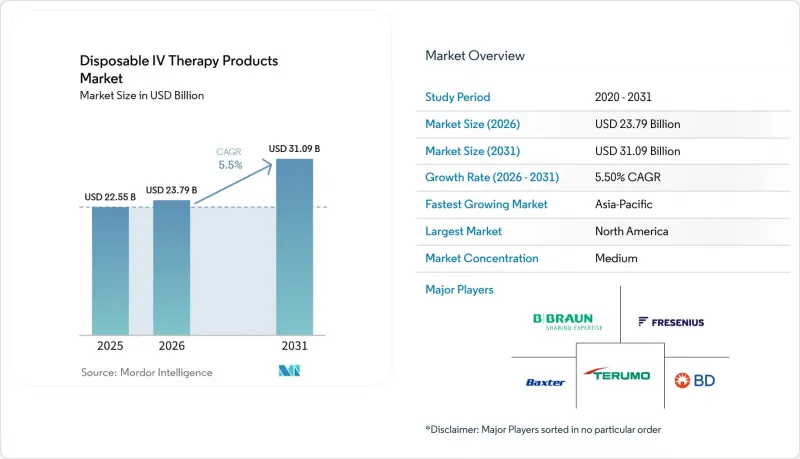
According to Mordor Intelligence, the disposable IV therapy products market size is expected to increase from USD 22.55 billion in 2025 to USD 23.79 billion in 2026 and reach USD 31.09 billion by 2031, growing at a CAGR of 5.5% over 2026-2031.
Global Disposable IV Therapy Products Market Trends and Insights
Rising Intravenous Medication and Nutrition Utilization
Intravenous administration remains essential for high-acuity medications, as it enables immediate delivery and continuous dose adjustment. It remains critical in intensive care, oncology, and nutritional support, where alternative routes may not meet clinical requirements. Fresenius Kabi reported more than 170 IV drug products in its portfolio and 15 new U.S. IV drug launches during fiscal year 2025. These launches continue to support demand for compatible administration sets and disposable IV therapy products.
Growth in Chronic Disease, Surgery, and Critical Care
Chronic diseases, surgical procedures, and critical care continue to increase the need for IV access across care settings. Australia recorded 12.8 million hospitalizations and 43.6 million outpatient services in 2024-2025. India's AB PM-JAY scheme had authorized 11.69 crore hospital admissions across 1,961 procedures by February 2026. Longer treatment cycles, including chemotherapy, dialysis, and IV diuretic therapy, support demand for catheters, connectors, and administration sets.
Pricing Pressure From Tendering and Volume-Based Procurement
Group purchasing organizations and public tenders place persistent pricing pressure on IV consumables. In China, volume-based procurement has extended to medical devices and sets price expectations for standard IV products. Domestic suppliers can often meet these expectations more easily than multinationals with higher cost structures. Commodity administration sets and basic peripheral catheters face the most direct pressure, while manufacturers are investing in antimicrobial coatings, closed systems, and connectivity features to support product differentiation. Longer hospital payment cycles also increase working capital pressure across the disposable IV therapy products market.
Other drivers and restraints analyzed in the detailed report include:
- Expansion of Home and Ambulatory Infusion Care
- Needleless Access and Infection Prevention Requirements
- Transition Risk From PVC, DEHP, and Other Material Restrictions
For complete list of drivers and restraints, kindly check the Table Of Contents.
Segment Analysis
IV catheters and cannulas accounted for 45.67% of the disposable IV therapy products market size in 2025, reflecting the widespread need for peripheral IV access in acute-care settings. In April 2026, BD launched the BD CentroVena One Insertion System following FDA 510(k) clearance and acceptance into the FDA Safer Technologies Program for Medical Devices. The system reduced insertion steps by 30% and simulation insertion time by 50%. BD also received FDA 510(k) clearance for its Insyte IV Catheter, supporting workflow efficiency and insertion safety.
Infusion pumps are forecast to grow at a 7.76% CAGR through 2031, the highest rate among product types. Pump replacement cycles drive recurring demand for compatible administration and extension sets, while needleless connectors and disinfection caps require frequent replacement. In 2025, B. Braun reported that 106 hospitals converted to its Introcan Safety catheter family and that it trained more than 31,000 clinicians. Specialty access sets, anti-siphon extension sets, and flow-regulation accessories are gaining relevance as home and ambulatory therapy protocols become more complex.
Disposable and single-use products held 76.55% of revenue in 2025 and are forecast to grow at an 8.20% CAGR through 2031. This category remains the largest and fastest-growing usability segment as providers move away from reusable products in specialty applications and emerging markets. Infection prevention supports this shift by eliminating cleaning and reprocessing requirements. A 2025 peer-reviewed review highlighted catheter-related infection prevention and the clinical consequences of catheter-related complications.
On July 22, 2026, Nipro began domestic sales of its ORCHID IV line connector in Japan. The connector disconnects safely when tubing is exposed to excessive pulling force, reducing accidental extubation and skin damage in nursing settings with reduced use of physical restraints. Reusable products retain relevance in cost-constrained locations with adequate sterilization infrastructure. However, declining single-use product costs and the focus on consistent infection-control practices continue to strengthen demand for disposable products.
Complete Report Scope:
- By Product Type
- IV Catheters and Cannulas
- IV Administration Sets
- Extension Sets and Accessories
- Infusion Pump
- Needleless Connectors and Disinfection Caps
- Others
- By Usability
- Disposable/Single-use
- Reusable
- By Application
- Fluid Replacement & Hydration
- Medication Administration
- Parenteral Nutrition
- Blood & Blood Product Administration
- Chemotherapy
- Antibiotic Administration
- Pain Management
- Dialysis and Renal Care
- Home and Specialty Infusion
- Others
- By End User
- Hospitals
- Specialty Clinics
- Ambulatory Surgical Centers
- Home Healthcare
- Long-term Care Facilities
- Other Healthcare Facilities
- By Geography
- North America
- United States
- Canada
- Mexico
- Europe
- Germany
- United Kingdom
- France
- Italy
- Spain
- Rest of Europe
- Asia-Pacific
- China
- India
- Japan
- Australia
- South Korea
- Rest of Asia-Pacific
- Middle East and Africa
- GCC
- South Africa
- Rest of Middle East and Africa
- South America
- Brazil
- Argentina
- Rest of South America
- North America
Geography Analysis
North America held a 40.56% revenue share in 2025, supported by robust acute-care infrastructure, high procedure volumes, and established adoption of safety-oriented IV consumables. On January 14, 2026, Health Canada cleared ICU Medical's Plum Solo and Plum Duo precision IV pumps, expanding access for Canadian healthcare organizations. The shift toward ambulatory and home-based care is increasing demand for specialized consumables with appropriate usability and pump compatibility.
Europe remained the second-largest regional market, led by Germany, the United Kingdom, and France. In September 2025, Fresenius Kabi secured a EUR 400 million loan from the European Investment Bank to expand medical product and biosimilar manufacturing capacity. The funding supported administration-set and infusion-system capacity, while the Medical Device Regulation and the DEHP sunset continued to reshape PVC-dependent portfolios. Asia-Pacific is forecast to grow at a 7.77% CAGR through 2031, supported by India's AB PM-JAY program, which had authorized 11.69 crore admissions across 1,961 procedures by February 2026.
China strengthened standards for single-use gravity-feed infusion sets through T/CAMDI 154-2025, aligning with the GB 8368 framework and ISO 8536-4. BD launched its Nexiva Closed IV Catheter System in Indonesia in December 2025. The Middle East and Africa expanded from a lower base as GCC countries developed tertiary-care facilities, while South America remained divided between larger hospital markets in Brazil and Argentina and price-constrained markets elsewhere. In 2025, Baxter and the Australian Government announced a AUD 40 million joint investment, equivalent to USD 25.8 million, to expand IV fluid manufacturing in Old Toongabbie, Western Sydney.
- AngioDynamics
- B. Braun Melsungen SE
- Baxter
- Beckton Dickinson
- Cardinal Health
- CODAN Medizinische Gerate GmbH
- Convatec
- Edward Lifesciences
- Fresenius
- ICU Medical
- JMS Co., Ltd.
- KORU Medical Systems, Inc.
- Lepu Medical Technology (Beijing) Co., Ltd.
- Merit Medical Systems
- Nipro
- Poly Medicure
- Smiths Group
- Teleflex
- Terumo
- Vygon
- WEGO Holding Company Limited
- Zhejiang Kindly Medical Devices Co., Ltd.
Additional Benefits:
- The market estimate (ME) sheet in Excel format
- 3 months of analyst support
TABLE OF CONTENTS
1 INTRODUCTION
- 1.1 Study Assumptions and Market Definition
- 1.2 Scope of the Study
2 RESEARCH METHODOLOGY
3 EXECUTIVE SUMMARY
4 MARKET LANDSCAPE
- 4.1 Market Overview
- 4.2 Market Drivers
- 4.2.1 Rising Intravenous Medication and Nutrition Utilization
- 4.2.2 Growth in Chronic Disease, Surgery and Critical Care
- 4.2.3 Expansion of Home and Ambulatory Infusion Care
- 4.2.4 Dedicated-Set Pull-Through From Installed Infusion Pumps
- 4.2.5 Needleless Access and Infection-Prevention Requirements
- 4.2.6 Closed-Loop Traceability of Set, Drug and Patient Identity
- 4.3 Market Restraints
- 4.3.1 Pricing Pressure From Tendering and Volume-Based Procurement
- 4.3.2 Material, Sterility and Chemical-Compatibility Qualification Burden
- 4.3.3 Transition Risk From PVC, DEHP and Other Material Restrictions
- 4.3.4 Procedure-Volume Volatility and Hospital Inventory Destocking
- 4.4 Value/Supply-Chain Analysis
- 4.5 Regulatory Landscape
- 4.6 Technological Outlook
- 4.7 Porter's Five Forces Analysis
- 4.7.1 Bargaining Power of Suppliers
- 4.7.2 Bargaining Power of Buyers
- 4.7.3 Threat of New Entrants
- 4.7.4 Threat of Substitutes
- 4.7.5 Rivalry Among Existing Competitors
5 MARKET SIZE AND GROWTH FORECASTS (VALUE, USD)
- 5.1 By Product Type
- 5.1.1 IV Catheters and Cannulas
- 5.1.2 IV Administration Sets
- 5.1.3 Extension Sets and Accessories
- 5.1.4 Infusion Pump
- 5.1.5 Needleless Connectors and Disinfection Caps
- 5.1.6 Others
- 5.2 By Usability
- 5.2.1 Disposable/Single-use
- 5.2.2 Reusable
- 5.3 By Application
- 5.3.1 Fluid Replacement & Hydration
- 5.3.2 Medication Administration
- 5.3.3 Parenteral Nutrition
- 5.3.4 Blood & Blood Product Administration
- 5.3.5 Chemotherapy
- 5.3.6 Antibiotic Administration
- 5.3.7 Pain Management
- 5.3.8 Dialysis and Renal Care
- 5.3.9 Home and Specialty Infusion
- 5.3.10 Others
- 5.4 By End User
- 5.4.1 Hospitals
- 5.4.2 Specialty Clinics
- 5.4.3 Ambulatory Surgical Centers
- 5.4.4 Home Healthcare
- 5.4.5 Long-term Care Facilities
- 5.4.6 Other Healthcare Facilities
- 5.5 By Geography
- 5.5.1 North America
- 5.5.1.1 United States
- 5.5.1.2 Canada
- 5.5.1.3 Mexico
- 5.5.2 Europe
- 5.5.2.1 Germany
- 5.5.2.2 United Kingdom
- 5.5.2.3 France
- 5.5.2.4 Italy
- 5.5.2.5 Spain
- 5.5.2.6 Rest of Europe
- 5.5.3 Asia-Pacific
- 5.5.3.1 China
- 5.5.3.2 India
- 5.5.3.3 Japan
- 5.5.3.4 Australia
- 5.5.3.5 South Korea
- 5.5.3.6 Rest of Asia-Pacific
- 5.5.4 Middle East and Africa
- 5.5.4.1 GCC
- 5.5.4.2 South Africa
- 5.5.4.3 Rest of Middle East and Africa
- 5.5.5 South America
- 5.5.5.1 Brazil
- 5.5.5.2 Argentina
- 5.5.5.3 Rest of South America
- 5.5.1 North America
6 COMPETITIVE LANDSCAPE
- 6.1 Market Concentration
- 6.2 Market Share Analysis
- 6.3 Company Profiles (includes Global Level Overview, Market Level Overview, Core Segments, Financials as available, Strategic Information, Market Rank/Share, Products and Services, Recent Developments)
- 6.3.1 AngioDynamics, Inc.
- 6.3.2 B. Braun Melsungen SE
- 6.3.3 Baxter International Inc.
- 6.3.4 Becton, Dickinson and Company
- 6.3.5 Cardinal Health, Inc.
- 6.3.6 CODAN Medizinische Gerate GmbH
- 6.3.7 ConvaTec Group Plc
- 6.3.8 Edwards Lifesciences Corporation
- 6.3.9 Fresenius SE & Co. KGaA
- 6.3.10 ICU Medical, Inc.
- 6.3.11 JMS Co., Ltd.
- 6.3.12 KORU Medical Systems, Inc.
- 6.3.13 Lepu Medical Technology (Beijing) Co., Ltd.
- 6.3.14 Merit Medical Systems, Inc.
- 6.3.15 Nipro Corporation
- 6.3.16 Poly Medicure Limited
- 6.3.17 Smiths Group plc
- 6.3.18 Teleflex Incorporated
- 6.3.19 Terumo Corporation
- 6.3.20 Vygon SA
- 6.3.21 WEGO Holding Company Limited
- 6.3.22 Zhejiang Kindly Medical Devices Co., Ltd.
7 MARKET OPPORTUNITIES AND FUTURE OUTLOOK
- 7.1 White-Space and Unmet-Need Assessment

