PUBLISHER: Mordor Intelligence | PRODUCT CODE: 2154492

PUBLISHER: Mordor Intelligence | PRODUCT CODE: 2154492
Agentic AI Governance Platforms In Healthcare - Market Share Analysis, Industry Trends & Statistics, Growth Forecasts (2026 - 2031)
According to Mordor Intelligence, the agentic AI governance platforms in Healthcare Market size is expected to grow from USD 5.51 billion in 2025 to USD 8.48 billion in 2026, and is forecast to reach USD 13.93 billion by 2031, at a 10.44% CAGR over 2026-2031.
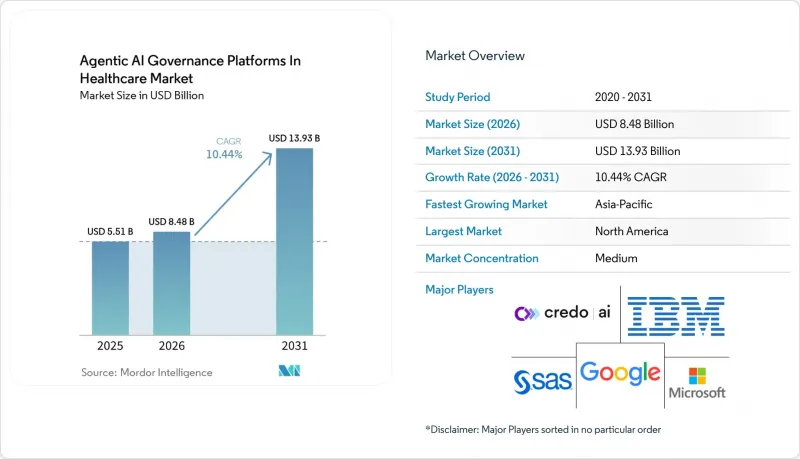
Global Agentic AI Governance Platforms In Healthcare Market Trends and Insights
Rising Healthcare AI Deployment and Accountability Requirements
Healthcare organizations are adopting AI faster than they are building formal governance processes. In July 2026, only 8% of the World Health Organization Regional Office for Europe's 53 member states had a health-specific AI governance strategy, although nearly two-thirds had deployed AI in diagnostics. A healthcare governance study based on engagement with 70 U.S. health-system leaders and more than 35 health delivery organizations found that effective oversight needs clinical, technical, informatics, operational, and regulatory expertise. Since January 2024, 22 U.S. states have enacted 38 laws addressing AI use in prior authorization and clinical decisions. The Agentic AI Governance Platforms in Healthcare Market benefit as buyers need documented accountability before AI reaches patient-facing workflows. Platforms can connect policies with approvals, evidence, exceptions, and human review.
Expansion of Agentic Workflows Across Clinical and Administrative Care
Agentic systems can access EHRs, clinical knowledge bases, scheduling platforms, and medication entry systems in sequence. These linked workflows require continuous control because each action can change the risk of the next action. The Healthcare AI Agents Regulatory Framework includes 42 requirements for tool use and integration security. Bluesight launched an agentic healthcare compliance product for 20 health systems in May 2026. The Agentic AI Governance Platforms in Healthcare Market grows as organizations deploy more connected workflows rather than single-purpose models. A common policy framework can also reduce the marginal governance cost of adding another agent.
Fragmented Cross-Border Health-Data and AI Regulation
Multinational healthcare organizations face different AI and data obligations in every major jurisdiction. This can require parallel documentation sets for the same system, increasing validation costs. The European Union AI Act follows a different timetable from the U.S. Food and Drug Administration lifecycle approach. Pharmaceutical sponsors and medical technology manufacturers are especially exposed because their systems span research, patient support, and commercial processes. Buyers may defer platform decisions while internal legal and clinical teams determine which obligations apply. The Agentic AI Governance Platforms in Healthcare Market can be slowed when no common evidence format is accepted by all jurisdictions.
Other drivers and restraints analyzed in the detailed report include:
- Increasing Regulatory Requirements for Lifecycle Evidence
- Growth of Cloud-Based AI Governance Infrastructure
- Shortage of Clinical AI Risk and Validation Specialists
For complete list of drivers and restraints, kindly check the Table Of Contents.
Segment Analysis
Software held 68.23% of the Agentic AI Governance Platforms in Healthcare Market share in 2025. Its position reflects the need for repeatable policy enforcement across models, agents, and data sources. Platform software can manage identities, authorized tools, approval rules, and bias monitoring dashboards. Healthcare organizations also need systems that preserve evidence for internal review and regulatory scrutiny. Software is central when buyers need direct control rather than advisory guidance.
Services is forecast to grow at 11.71% CAGR through 2031. Health systems need implementation support for EHRs, data warehouses, and multi-vendor AI environments. Service providers can translate regulatory duties into testing, approval, and monitoring processes. Governance sustainment accounted for 10%-15% of total AI program spending in a healthcare governance study. The Agentic AI Governance Platforms in Healthcare industry relies on services to turn platform features into working clinical controls.
Cloud-based deployment accounted for 54.12% of the Agentic AI Governance Platforms in Healthcare Market size in 2025. Cloud environments support scalable audit storage, policy updates, and integration with enterprise AI platforms. AWS described a HIPAA-ready healthcare architecture with inference, agent deployment, audit trails, and automated threat detection. Marketplace procurement can also reduce deployment work for customers. These features explain the leading role of cloud delivery.
Hybrid deployment is forecast to expand at 11.82% CAGR through 2031. Academic medical centers, government agencies, and delivery networks may retain protected health information locally because of residency obligations. They can still use cloud services for policy orchestration and audit aggregation. On-premises systems remain relevant in sovereign health networks across Asia-Pacific and the Middle East. The Agentic AI Governance Platforms in Healthcare Market favors vendors that apply the same policy across local and cloud environments.
Complete Report Scope:
- By Offering
- Software
- Services
- By Deployment Model
- Cloud-Based
- On-Premises
- Hybrid
- By Functions
- AI System Inventory and Registration
- Risk and Impact Assessment
- Policy and Control Management
- Model and Agent Validation
- Runtime Guardrails and Human Oversight
- Monitoring, Audit Trails, and Traceability
- Data Governance and Lifecycle Management
- Incident Management and Regulatory Reporting
- By Organization Size
- Large Organizations
- Small and Medium Organizations
- By End User
- Healthcare Providers
- Healthcare Payers and Insurers
- Pharmaceutical and Biotechnology Firms
- MedTech and Device Manufacturers
- Clinical Research Organizations
- Regulators and Public Agencies
- Research Institutions and Academic Medical Centers
- By Geography
- North America
- United States
- Canada
- Mexico
- South America
- Brazil
- Argentina
- Chile
- Rest of South America
- Europe
- Germany
- United Kingdom
- France
- Italy
- Spain
- Rest of Europe
- Asia-Pacific
- China
- Japan
- India
- South Korea
- Australia
- Rest of Asia-Pacific
- Middle East
- United Arab Emirates
- Saudi Arabia
- Qatar
- Rest of Middle East
- Africa
- South Africa
- Egypt
- Nigeria
- Rest of Africa
- North America
Geography Analysis
North America held 42.81% of the Agentic AI Governance Platforms in Healthcare Market share in 2025. The region has a high concentration of healthcare AI deployments, mature cloud infrastructure, and buyers capable of funding formal governance programs. The U.S. Food and Drug Administration's January 2026 guidance clarified lifecycle expectations for AI-enabled device software functions. The 38 laws enacted by 22 U.S. states since January 2024 add distinct obligations for clinical and prior-authorization use cases. These conditions increase demand for systems that link policies with documentation and post-deployment review.
Europe is shaped by the European Union's AI Act and medical device compliance requirements. The Act became fully applicable in August 2026 and requires documentation, audit records, and human oversight for high-risk AI systems. Medical device guidance confirmed that healthcare AI may need to comply with both regimes. South America remains earlier in adoption, with procurement focused on private hospital groups and multinational organizations using global standards.
Asia-Pacific is forecast to grow at 12.37% CAGR through 2031. The region combines fast AI adoption with evolving national governance frameworks. Health systems are likely to need tools that support local documentation and testing requirements. The Middle East is building governance capacity through public hospital procurement linked to national AI programs, while Africa remains nascent, with adoption largely tied to international development programs. The Agentic AI Governance Platforms in Healthcare Market can expand as more countries move from general policy guidance toward enforceable implementation requirements.
- Microsoft Corporation
- International Business Machines Corporation
- Google LLC
- SAS Institute Inc.
- Credo AI Corporation
- Collibra NV
- Oracle Corporation
- Amazon Web Services, Inc.
- NVIDIA Corporation
- DataRobot, Inc.
- H2O.ai, Inc.
- Fiddler AI, Inc.
- Arize AI, Inc.
- WhyLabs, Inc.
- ArthurAI, Inc.
- ValidMind Inc.
- Pacific AI, Inc.
- Orchestral Technologies Limited
- OnStak Inc.
- i-GENTIC AI, Inc.
- Inferenz AI, Inc.
- League, Inc.
- Aethryx AI Ltd.
- KLA Digital Ltd.
Additional Benefits:
- The market estimate (ME) sheet in Excel format
- 3 months of analyst support
TABLE OF CONTENTS
1 INTRODUCTION
- 1.1 Study Assumptions and Market Definition
- 1.2 Scope of the Study
2 RESEARCH METHODOLOGY
3 EXECUTIVE SUMMARY
4 MARKET LANDSCAPE
- 4.1 Market Overview
- 4.2 Market Drivers
- 4.2.1 Rising Healthcare AI Deployment and Accountability Requirements
- 4.2.2 Expansion of Agentic Workflows Across Clinical and Administrative Care
- 4.2.3 Increasing Regulatory Requirements for Lifecycle Evidence
- 4.2.4 Growth of Cloud-Based AI Governance Infrastructure
- 4.2.5 Pre-Execution Policy Enforcement for Autonomous Healthcare Agents
- 4.2.6 Synthetic-Population Testing for Rare and Vulnerable Patient Scenarios
- 4.3 Market Restraints
- 4.3.1 Fragmented Cross-Border Health-Data and AI Regulation
- 4.3.2 Shortage of Clinical AI Risk and Validation Specialists
- 4.3.3 Hidden Governance Cost of Legacy EHR Integration
- 4.3.4 Liability Ambiguity for Autonomous Agent Decisions
- 4.4 Impact of Macroeconomic Factors on the Market
- 4.5 Industry Value-Chain Analysis
- 4.6 Technology Outlook
- 4.7 Regulatory Landscape
- 4.8 Porter's Five Forces Analysis
- 4.8.1 Threat of New Entrants
- 4.8.2 Bargaining Power of Suppliers
- 4.8.3 Bargaining Power of Buyers
- 4.8.4 Threat of Substitutes
- 4.8.5 Intensity of Competitive Rivalry
5 MARKET SIZE AND GROWTH FORECASTS (VALUE)
- 5.1 By Offering
- 5.1.1 Software
- 5.1.2 Services
- 5.2 By Deployment Model
- 5.2.1 Cloud-Based
- 5.2.2 On-Premises
- 5.2.3 Hybrid
- 5.3 By Functions
- 5.3.1 AI System Inventory and Registration
- 5.3.2 Risk and Impact Assessment
- 5.3.3 Policy and Control Management
- 5.3.4 Model and Agent Validation
- 5.3.5 Runtime Guardrails and Human Oversight
- 5.3.6 Monitoring, Audit Trails, and Traceability
- 5.3.7 Data Governance and Lifecycle Management
- 5.3.8 Incident Management and Regulatory Reporting
- 5.4 By Organization Size
- 5.4.1 Large Organizations
- 5.4.2 Small and Medium Organizations
- 5.5 By End User
- 5.5.1 Healthcare Providers
- 5.5.2 Healthcare Payers and Insurers
- 5.5.3 Pharmaceutical and Biotechnology Firms
- 5.5.4 MedTech and Device Manufacturers
- 5.5.5 Clinical Research Organizations
- 5.5.6 Regulators and Public Agencies
- 5.5.7 Research Institutions and Academic Medical Centers
- 5.6 By Geography
- 5.6.1 North America
- 5.6.1.1 United States
- 5.6.1.2 Canada
- 5.6.1.3 Mexico
- 5.6.2 South America
- 5.6.2.1 Brazil
- 5.6.2.2 Argentina
- 5.6.2.3 Chile
- 5.6.2.4 Rest of South America
- 5.6.3 Europe
- 5.6.3.1 Germany
- 5.6.3.2 United Kingdom
- 5.6.3.3 France
- 5.6.3.4 Italy
- 5.6.3.5 Spain
- 5.6.3.6 Rest of Europe
- 5.6.4 Asia-Pacific
- 5.6.4.1 China
- 5.6.4.2 Japan
- 5.6.4.3 India
- 5.6.4.4 South Korea
- 5.6.4.5 Australia
- 5.6.4.6 Rest of Asia-Pacific
- 5.6.5 Middle East
- 5.6.5.1 United Arab Emirates
- 5.6.5.2 Saudi Arabia
- 5.6.5.3 Qatar
- 5.6.5.4 Rest of Middle East
- 5.6.6 Africa
- 5.6.6.1 South Africa
- 5.6.6.2 Egypt
- 5.6.6.3 Nigeria
- 5.6.6.4 Rest of Africa
- 5.6.1 North America
6 COMPETITIVE LANDSCAPE
- 6.1 Market Concentration
- 6.2 Strategic Moves
- 6.3 Market Share Analysis
- 6.4 Company Profiles (includes Global Level Overview, Market Level Overview, Core Segments, Financials as available, Strategic Information, Market Rank/Share, Products and Services, Recent Developments)
- 6.4.1 Microsoft Corporation
- 6.4.2 International Business Machines Corporation
- 6.4.3 Google LLC
- 6.4.4 SAS Institute Inc.
- 6.4.5 Credo AI Corporation
- 6.4.6 Collibra NV
- 6.4.7 Oracle Corporation
- 6.4.8 Amazon Web Services, Inc.
- 6.4.9 NVIDIA Corporation
- 6.4.10 DataRobot, Inc.
- 6.4.11 H2O.ai, Inc.
- 6.4.12 Fiddler AI, Inc.
- 6.4.13 Arize AI, Inc.
- 6.4.14 WhyLabs, Inc.
- 6.4.15 ArthurAI, Inc.
- 6.4.16 ValidMind Inc.
- 6.4.17 Pacific AI, Inc.
- 6.4.18 Orchestral Technologies Limited
- 6.4.19 OnStak Inc.
- 6.4.20 i-GENTIC AI, Inc.
- 6.4.21 Inferenz AI, Inc.
- 6.4.22 League, Inc.
- 6.4.23 Aethryx AI Ltd.
- 6.4.24 KLA Digital Ltd.
7 MARKET OPPORTUNITIES AND FUTURE OUTLOOK
- 7.1 White-Space and Unmet-Need Assessment

