PUBLISHER: Mordor Intelligence | PRODUCT CODE: 2154521

PUBLISHER: Mordor Intelligence | PRODUCT CODE: 2154521
Surface Modification Chemicals - Market Share Analysis, Industry Trends & Statistics, Growth Forecasts (2026 - 2031)
According to Mordor Intelligence, the surface modification chemicals market size was estimated at USD 3.86 billion in 2025 and is estimated to grow from USD 4.06 billion in 2026 to USD 5.35 billion by 2031, at a CAGR of 5.67% during the forecast period (2026-2031).
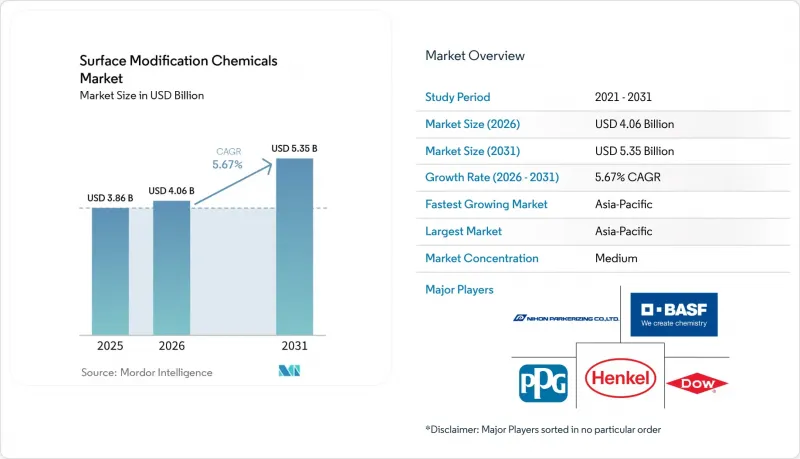
Global Surface Modification Chemicals Market Trends and Insights
EV Lightweighting and Multi-Metal Pretreatment: The Body-in-White Chemistry Shift
Electric vehicle body-in-white construction combines high-strength steel, aluminum alloys, magnesium die-castings, and glass-fiber-reinforced polymers on a single assembly line. This mix supports demand in the surface modification chemicals market for pretreatment systems that can handle different substrates in a single bath without chemistry changeovers. Zirconium-silane hybrid conversion coatings manage this requirement more effectively than zinc phosphating. They operate at lower temperatures and produce less phosphate sludge, which reduces waste-treatment work for automotive Tier 1 facilities. Chemetall, part of BASF Coatings, launched Gardolene D in October 2025 as a chromium-free and fluoride-free passivation technology for EV battery copper foils. The product delivered up to 6% longer battery life after 1,000 charge cycles at 25°C under the reported testing conditions.
The EU Battery Regulation requires digital battery passports and hazardous-substance declarations from 2027. These requirements increase the need for chromium-free surface chemistry across EV battery supply chains. OEMs are therefore moving more quickly to retrofit multi-metal lines and retire zinc-phosphate systems. This directs near-term capital spending toward silane and zirconium conversion chemical suppliers rather than commodity cleaning formulators. The surface modification chemicals market benefits where suppliers can meet both mixed-metal performance requirements and formal chemical disclosure needs. Suppliers that already support automotive line conversion can strengthen their position as battery material processing becomes more closely tied to vehicle assembly requirements.
Electronics Miniaturization and Precision Plating: Sub-5 nm Drives Chemistry Specificity
Semiconductor process nodes below 5 nm require higher purity and greater chemical input at every surface-treatment stage in advanced packaging. This supports the surface modification chemicals market for copper through-silicon-via metallization and micro-bump formation. Wafer-level packaging requires suppressors, levelers, and brighteners with sub-parts-per-billion consistency. A defect in a single through-silicon via within a chiplet stack can disable the entire module, making chemical specification a performance requirement rather than a routine cost decision. Aminosilane- and HMDS-based adhesion promoters remain important in the underlayer chemistry of extreme ultraviolet (EUV) lithography for advanced logic and memory production.
U.S. CHIPS and Science Act-supported fab expansions in Arizona, Ohio, and Texas are adding wafer-start capacity through 2028, creating demand for high-purity processing chemistries at new facilities. Research published in 2025 demonstrated autonomous optimization of an electroplating bath using a large language model (LLM) agent that selected current density, temperature, and additive concentration for nickel thin-film deposition, illustrating how precision plating control can be developed in advanced facilities. The 5G rollout also supports demand for alkoxysilane-modified epoxy resins in printed circuit boards that must retain dielectric stability at millimeter-wave frequencies under power-dense operation. These requirements give the surface modification chemicals market a role in both chip packaging and communications hardware.
Hexavalent Chromium Requalification and Compliance Costs: REACH Transition Uncertainty
In April 2025, the European Chemicals Agency published a restriction proposal for 13 hexavalent chromium compounds under the EU REACH Regulation EC No. 1907/2006. The proposal estimated compliance costs of EUR 314 million (~USD 363.80 million) to EUR 3.23 billion (~USD 3.74 billion) for affected European industries, covering substitution programs, worker exposure controls, and potential facility closures. Existing REACH Annex XIV authorization decisions have become less reliable planning tools for chemical users, with authorization processing averaging 14.5 months, compared with a statutory three-month period. This has reduced certainty for procurement teams managing chemistry changeovers and associated capital spending, which, in turn, can slow purchasing decisions in the surface-modification chemicals market.
Aerospace and defense users within the Aerospace and Defense Chromates Re-Authorization Consortium secured authorizations extending continued-use titles until December 2034, providing more time to manage the transition. Smaller automotive and general-industrial users outside such consortium arrangements face more immediate compliance needs, with surface-treatment research teams required to devote time to regulatory records and requalification work rather than new product development. This situation favors larger multinational formulators with established regulatory resources and may drive consolidation in the surface modification chemicals market.
Other drivers and restraints analyzed in the detailed report include:
- Infrastructure Corrosion Protection and Offshore Wind Expansion: Scale Drives Demand
- Chromium-Free and Low-VOC Formulation Innovation: Compliance as a Product Catalyst
- Specialty Raw-Material Price Volatility: Silicon Metal and Feedstock Concentration Risk
For complete list of drivers and restraints, kindly check the Table Of Contents.
Segment Analysis
Adhesion promoters are forecast to expand at a 6.45% CAGR from 2026 to 2031, making them the fastest-growing chemical type. They are used on difficult-to-bond polymer substrates in automotive body panels, consumer electronics housings, and structural assemblies. Conventional mechanical preparation cannot always provide durable interfacial bonds at the required tolerances. Chlorinated polyolefin and silane-modified primer systems are gaining use as automakers increase the use of low-surface-energy polypropylene and thermoplastic polyolefin (TPO). A 2024 study found that a covalent-bonding adhesion primer for polyolefins increased lap shear strength by 10% to 50% against plasma-treated substrates and remained effective after two months of storage. This durability has clear implications for assembly-line use.
Silane coupling agents accounted for 34.56% of the surface modification chemicals market share in 2025. Their position reflects functional versatility across tire-filler bonding, advanced printed circuit board laminates, and corrosion-inhibiting pretreatment for automotive and industrial applications. Surface-active and wetting agents are also expanding as coating systems shift from solventborne to waterborne formats. Evonik launched TEGO Wet 288 in April 2025 for waterborne and radiation-curing formulations where conventional wetting agents can lose effectiveness during storage. Conversion, etching, and oxidation chemicals are moving from zinc phosphate to zirconium-based nano-conversion layers. A 2025 study documented a complete phosphate-to-zirconium conversion at an automotive paint facility in 12 days.
Complete Report Scope:
- By Chemical Type
- Silane Coupling Agents
- Adhesion Promoters
- Surface-Active and Wetting Agents
- Conversion, Etching and Oxidation Chemicals
- Other Surface Modification Chemicals
- By Substrate Material
- Metals
- Plastics and Polymers
- Glass and Ceramics
- Composites
- Other Substrate Materials
- By Application
- Paints and Coatings
- Adhesives and Sealants
- Electronics and Semiconductors
- Automotive and Transportation Components
- Other Applications
- By Geography
- Asia-Pacific
- China
- India
- Japan
- South Korea
- ASEAN Countries
- Rest of Asia-Pacific
- North America
- United States
- Canada
- Mexico
- Europe
- Germany
- United Kingdom
- France
- Italy
- NORDIC Countries
- Rest of Europe
- South America
- Brazil
- Argentina
- Rest of South America
- Middle East and Africa
- Saudi Arabia
- South Africa
- Rest of Middle East and Africa
- Asia-Pacific
Geography Analysis
Asia-Pacific held 42.13% of the surface modification chemicals market share in 2025 and is forecast to grow at a 6.85% CAGR through 2031. The region has large bases for semiconductor fabrication, automotive assembly, and consumer electronics manufacturing. China is transitioning automotive coating lines from phosphate-based to zirconium-conversion pretreatment and expanding domestic silane and specialty chemical supply, as industrial policy emphasizes self-sufficiency in strategic electronics inputs. Japan and South Korea contribute premium demand for high-purity materials in semiconductor processing and display panel production. Vietnam, Thailand, and Malaysia are attracting investment in electronics assembly as companies diversify their supply chains.
India is developing as another demand center through investments in electronics assembly and packaging under the Production Linked Incentive scheme. Its surface-treatment chemical requirements are currently met largely through imports, although localized blending capacity is beginning to develop. High-purity formulations from Japan, the United States, and Germany will remain important for several years. North America is the second-largest regional market, with high-value demand in aerospace coatings, advanced semiconductor specialty chemicals, and automotive OEM pretreatment. New fabs in Arizona, Ohio, and Texas are supporting demand for high-purity adhesion promoters, plating additives, and conversion chemicals, broadening the regional base for the surface modification chemicals market.
Europe has regulation-driven demand for chromium- and PFAS-free products in the automotive, aerospace, and offshore wind sectors. REACH-related Cr(VI) compliance and substitution programs also create costs for line conversions and can restrain spending growth. South America remains a smaller market, with Brazil and Argentina supporting demand for automotive body-in-white pretreatment and industrial maintenance coatings. The Middle East and Africa are seeing increased demand driven by Saudi Arabia's industrial diversification programs and regional pipeline and upstream oil infrastructure development. In many regional submarkets, distribution-network capability, rather than product availability, remains the primary limitation, making local service coverage important for participants in the surface modification chemicals market.
- ALTANA
- BASF
- Dow
- Element Solutions Inc
- Evonik Industries AG
- Henkel AG and Co. KGaA
- JCU CORPORATION
- Lamberti S.p.A.
- Momentive
- Nihon Parkerizing Co., Ltd.
- NOF CORPORATION
- PPG Industries, Inc.
- Quaker Chemical Corporation
- Shin-Etsu Chemical Co., Ltd.
- Wacker Chemie AG
Additional Benefits:
- The market estimate (ME) sheet in Excel format
- 3 months of analyst support
TABLE OF CONTENTS
1 Introduction
- 1.1 Study Assumptions and Market Definition
- 1.2 Scope of the Study
2 Research Methodology
3 Executive Summary
4 Market Landscape
- 4.1 Market Overview
- 4.2 Market Drivers
- 4.2.1 EV Lightweighting and Multi-Metal Pretreatment
- 4.2.2 Electronics Miniaturization and Precision Plating
- 4.2.3 Infrastructure Corrosion Protection and Offshore Wind Expansion
- 4.2.4 Additive Manufacturing Surface Finishing
- 4.2.5 Closed-Loop, AI-Controlled Bath Management
- 4.2.6 Chromium-Free and Low-VOC Formulation Innovation
- 4.3 Market Restraints
- 4.3.1 Hexavalent Chromium Requalification and Compliance Costs
- 4.3.2 Specialty Raw-Material Price Volatility
- 4.3.3 Captive-Line Total Cost and Waste-Management Burden
- 4.3.4 Qualification Gaps for Bio-Based and Nanostructured Alternatives
- 4.4 Value and Supply-Chain Analysis
- 4.5 Porter's Five Forces Analysis
- 4.5.1 Bargaining Power of Suppliers
- 4.5.2 Bargaining Power of Buyers
- 4.5.3 Threat of New Entrants
- 4.5.4 Threat of Substitutes
- 4.5.5 Competitive Rivalry
5 Market Size and Growth Forecasts (Value)
- 5.1 By Chemical Type
- 5.1.1 Silane Coupling Agents
- 5.1.2 Adhesion Promoters
- 5.1.3 Surface-Active and Wetting Agents
- 5.1.4 Conversion, Etching and Oxidation Chemicals
- 5.1.5 Other Surface Modification Chemicals
- 5.2 By Substrate Material
- 5.2.1 Metals
- 5.2.2 Plastics and Polymers
- 5.2.3 Glass and Ceramics
- 5.2.4 Composites
- 5.2.5 Other Substrate Materials
- 5.3 By Application
- 5.3.1 Paints and Coatings
- 5.3.2 Adhesives and Sealants
- 5.3.3 Electronics and Semiconductors
- 5.3.4 Automotive and Transportation Components
- 5.3.5 Other Applications
- 5.4 By Geography
- 5.4.1 Asia-Pacific
- 5.4.1.1 China
- 5.4.1.2 India
- 5.4.1.3 Japan
- 5.4.1.4 South Korea
- 5.4.1.5 ASEAN Countries
- 5.4.1.6 Rest of Asia-Pacific
- 5.4.2 North America
- 5.4.2.1 United States
- 5.4.2.2 Canada
- 5.4.2.3 Mexico
- 5.4.3 Europe
- 5.4.3.1 Germany
- 5.4.3.2 United Kingdom
- 5.4.3.3 France
- 5.4.3.4 Italy
- 5.4.3.5 NORDIC Countries
- 5.4.3.6 Rest of Europe
- 5.4.4 South America
- 5.4.4.1 Brazil
- 5.4.4.2 Argentina
- 5.4.4.3 Rest of South America
- 5.4.5 Middle East and Africa
- 5.4.5.1 Saudi Arabia
- 5.4.5.2 South Africa
- 5.4.5.3 Rest of Middle East and Africa
- 5.4.1 Asia-Pacific
6 Competitive Landscape
- 6.1 Market Concentration
- 6.2 Strategic Moves
- 6.3 Market Share (%)/Ranking Analysis
- 6.4 Company Profiles (includes Global Overview, Market Overview, Core Segments, Financials as available, Strategic Information, Products and Services, and Recent Developments)
- 6.4.1 ALTANA
- 6.4.2 BASF
- 6.4.3 Dow
- 6.4.4 Element Solutions Inc
- 6.4.5 Evonik Industries AG
- 6.4.6 Henkel AG and Co. KGaA
- 6.4.7 JCU CORPORATION
- 6.4.8 Lamberti S.p.A.
- 6.4.9 Momentive
- 6.4.10 Nihon Parkerizing Co., Ltd.
- 6.4.11 NOF CORPORATION
- 6.4.12 PPG Industries, Inc.
- 6.4.13 Quaker Chemical Corporation
- 6.4.14 Shin-Etsu Chemical Co., Ltd.
- 6.4.15 Wacker Chemie AG
7 Market Opportunities and Future Outlook
- 7.1 White-Space and Unmet-Need Assessment

