PUBLISHER: Mordor Intelligence | PRODUCT CODE: 2154717

PUBLISHER: Mordor Intelligence | PRODUCT CODE: 2154717
India Textile Manufacturing - Market Share Analysis, Industry Trends & Statistics, Growth Forecasts (2026 - 2031)
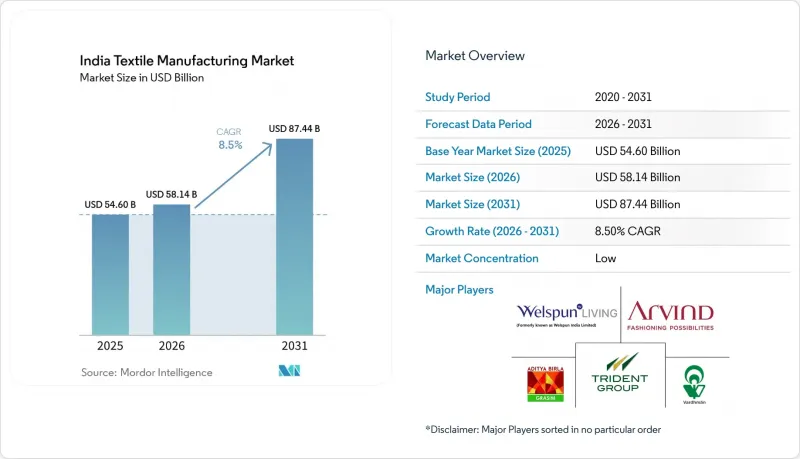
According to Mordor Intelligence, the India textile manufacturing market size is expected to grow from USD 54.60 billion in 2025 to USD 58.14 billion in 2026 and is forecast to reach USD 87.44 billion by 2031 at 8.5% CAGR over 2026-2031.
India Textile Manufacturing Market Trends and Insights
China-Plus-One Sourcing and FTA-Led Export Access
The India textile manufacturing market can benefit as buyers reduce reliance on a single sourcing country. The India-United Kingdom Comprehensive Economic and Trade Agreement (CETA), which entered into force on July 15, 2026, provides duty-free access for covered Indian textile and clothing tariff lines in the United Kingdom market. This access is most valuable when manufacturers meet buyer requirements for quality, documentation, and delivery. According to the Ministry of Textiles, textile exports, including handicrafts, stood at INR 3,16,334.9 crore (USD 36,304.8 million) in FY2025-26, while artificial textile exports rose 3.6%. Mid-sized knitwear, performance-fabric, and made-up suppliers can use this access, but they still need coordinated production and strong compliance records. The India textile manufacturing market can convert more trade access into orders when clusters supply textile materials and processed fabrics within buyer lead times.
PM MITRA Integrated Park Build-Out and Value-Chain Localization
PM MITRA parks are intended to reduce the distance between major textile production stages. The government has sanctioned 7 parks with an outlay of INR 4,445 crore (USD 510.1 million) for the program period. The sites combine manufacturing areas with common infrastructure and support services, which can improve coordination between fiber, yarn, fabric, and processing activity. A parliamentary response stated that land acquisition was complete across the 7 sites and Development Capital Support had been released by December 2025. Integrated sites can reduce separate utility arrangements and give manufacturers a more practical setting for buyer audits and digital systems. The India textile manufacturing market should see the strongest benefit where park tenants connect established clusters to downstream processing and material-conversion capacity.
Fragmented Supplier Interfaces and Weak End-to-End Coordination
The India textile manufacturing market remains dispersed across spinning, weaving, processing, coating, and finishing units. The government has responded with the PM MITRA program, which aims to create integrated facilities and shared infrastructure. Separate locations can complicate scheduling, quality coordination, and delivery of materials and processed fabric for smaller firms. The 7 project sites provide a public framework for bringing value-chain stages closer together, and land acquisition was complete by December 2025. Infrastructure completion alone will not create operating links, as firms also need shared planning, reliable specifications, and buyer-facing delivery systems. The India textile manufacturing market needs stronger coordination across production stages to obtain more value from its manufacturing base.
Other drivers and restraints analyzed in the detailed report include:
- MMF and Technical-Textile Capacity Incentives
- Domestic Demand for Athleisure, Affordable Fashion, and Functional Textiles
- Cotton and MMF Input-Price Volatility
For complete list of drivers and restraints, kindly check the Table Of Contents.
Segment Analysis
Commodity synthetics held 46.8% of the India textile manufacturing market share in 2025. Polyester, nylon or polyamide, polypropylene, acrylic, and elastane serve apparel, home textiles, and technical uses. This position reflects the country's established capacity in synthetic fiber and yarn production, including the preparation and transformation steps that supply weaving, knitting, nonwoven formation, coating, and fabric processing. Natural fibers formed the next major group and continued to support domestic apparel and textile exports. Artificial cellulosic fibers, including viscose, rayon, lyocell, modal, and acetate, occupied an important middle position. Their relevance has grown as customers seek alternatives that combine cellulose content with performance properties, including fabric feel, drape, and sustainability-related product positioning. Their use across several downstream applications supports the India textile manufacturing market size for commodity synthetics. The material mix also gives manufacturers flexibility to serve price-sensitive and performance-led demand through intermediate materials rather than final consumer products. It also allows processors to select inputs suited to strength, stretch, durability, texture, and finishing requirements.
Specialty and high-performance fibers are projected to grow at an 11.9% CAGR through 2031. These materials include aramid, ultra-high-molecular-weight polyethylene (UHMWPE), and other high-performance fibers used in defense, automotive, construction, and medical applications. The National Technical Textiles Mission has funded work in specialty fiber applications, which supports technology development in this area. Grasim approved INR 3,094 crore (USD 355.1 million) for the second phase of its lyocell expansion at Harihar in June 2026. The company stated that the additional capacity would be developed in 2 lines of 55,000 TPA each. Animal-based fibers remained smaller in volume but served premium wool and silk applications. The India textile manufacturing market is moving toward a wider fiber basket as producers address both conventional and specialized requirements.
Fabric manufacturing accounted for 42.5% of the India textile manufacturing market share in 2025. The category includes weaving, knitting, crocheting, nonwoven and felt manufacturing, and other fabric-forming processes. Weaving remained important because of the large established loom base. Knitting gained relevance as demand for sportswear, casualwear, and performance fabrics increased. Nonwoven and felt production also serves medical, agricultural, and construction uses. Vardhman Textiles began commercial production at a 31-million-meter processed fabric unit and an 18-million-meter performance fabric unit in March 2026. These additions show continued investment in fabric capacity with defined performance characteristics. The India textile manufacturing market relies on fabric manufacturing as a central link between upstream fiber capacity and processed textile materials.
Textile finishing and surface treatment is forecast to grow at a 9.8% CAGR through 2031. This process covers pre-treatment, bleaching, dyeing, printing, and functional finishes. It converts greige fabrics and other textile substrates into materials with the appearance, performance, and consistency required by industrial buyers and downstream converters. Buyers increasingly require uniform color, fabric feel, durability, and documented chemical management. Those demands raise the importance of finishing capabilities for exporters and domestic suppliers alike, especially where customers require repeatable results across larger production runs. The availability of water, effluent treatment, and compliance systems also shapes the size of the India textile manufacturing market for finishing. Larger, organized facilities can more readily operate in-house treatment infrastructure and meet technical standards. Yarn and thread production remains a substantial category because India has deep cotton and polyester yarn capability. These intermediate outputs feed weaving, knitting, nonwoven activity, and other covered material-production processes. Growth is likely to be stronger downstream, where fabric quality and material specifications create more differentiation.
Complete Report Scope:
- By Raw Material
- Natural Fibers
- Plant-Based Fibers
- Cotton
- Others (Jute, Flax, Hemp, Ramie, Coir)
- Animal-Based Fibers (wool, silk and other animal fibers)
- Plant-Based Fibers
- Man-Made Cellulosic Fibers (Viscose/Rayon, Lyocell, Modal and Acetate)
- Commodity Synthetics (Polyester, Nylon/Polyamide, Polypropylene, Acrylic and Elastane)
- Specialty and High-Performance Fibers (Aramid, UHMWPE, etc.)
- Natural Fibers
- By Manufacturing Process and Product Type
- Yarn and Thread Manufacturing
- Fabric Manufacturing
- Weaving
- Knitting and Crocheting
- Nonwoven and Felt Manufacturing
- Other Fabric-Formation Processes
- Textile Finishing and Surface Treatment (Pretreatment, Bleaching, Dyeing, Printing, etc.)
- By End Use Industry
- Apparel and Fashion
- Home and Household Textiles
- Technical and Industrial Textiles
- Transportation and Mobility
- Medical and Hygiene
- Industrial Processing and Filtration
- Construction and Geotextiles
- Protective and Safety
- Packaging
- Other Technical Applications - Agriculture, etc.
- Other End Uses
- By Enterprise Scale
- Large Organized Manufacturers
- Micro, Small, and Medium Enterprises (MSMEs) and the unorganized sector
- By Geography
- North India (Punjab, Haryana, Delhi, Himachal Pradesh, Uttarakhand, Uttar Pradesh, Jammu & Kashmir, Rajasthan)
- West India (Maharashtra, Gujarat, Goa)
- South India (Tamil Nadu, Karnataka, Telangana, Andhra Pradesh, Kerala)
- East India (West Bengal, Odisha, Bihar, Jharkhand, Chhattisgarh, Assam and Rest of North East India)
List of Companies Covered in this Report:
- Grasim Industries Limited
- Vardhman Textiles Limited
- Welspun Living Limited
- Arvind Limited
- Trident Limited
- Reliance Industries Limited
- Raymond Lifestyle Limited
- Filatex India Limited
- K.P.R. Mill Limited
- Indo Rama Synthetics (India) Limited
- Indo Count Industries Limited
- Nahar Spinning Mills Limited
- RSWM Limited
- Page Industries Limited
- Alok Industries Limited
- Siyaram Silk Mills Limited
- Sutlej Textiles and Industries Limited
- Century Textiles and Industries Limited
- Himatsingka Seide Limited
- Gokaldas Exports Limited
- Sanathan Textiles
- Garden Silk Mills Limited
Additional Benefits:
- The market estimate (ME) sheet in Excel format
- 3 months of analyst support
TABLE OF CONTENTS
1 Introduction
- 1.1 Study Assumptions and Market Definition
- 1.2 Scope of the Study
2 Research Methodology
3 Executive Summary
4 Market Landscape
- 4.1 Market Overview
- 4.2 Market Drivers
- 4.2.1 China-Plus-One Sourcing and FTA-Led Export Access
- 4.2.2 PM MITRA Integrated Park Build-Out and Value-Chain Localization
- 4.2.3 MMF and Technical-Textile Capacity Incentives
- 4.2.4 Domestic Demand for Athleisure, Affordable Fashion, and Functional Textiles
- 4.2.5 AI-Enabled Short-Order and Quality-Certified Manufacturing
- 4.2.6 Circularity, Traceability, and Digital Product Passport Readiness
- 4.3 Market Restraints
- 4.3.1 Fragmented Supplier Interfaces and Weak End-to-End Coordination
- 4.3.2 Cotton and MMF Input-Price Volatility
- 4.3.3 Processing-Capacity, Water, Effluent, and Compliance Bottlenecks
- 4.3.4 Low Value Capture from Exporting Semi-Processed Fabric
- 4.4 Value and Supply-Chain Analysis
- 4.5 Regulatory Landscape
- 4.5.1 Insights on Government Policies and Industry Support
- 4.5.2 Quality and Product Standards
- 4.5.3 Spotlight on ESG, Traceability, and Regulatory Compliance
- 4.5.4 Export and Trade Rules
- 4.6 Technological Outlook
- 4.6.1 Industry 4.0 in Spinning, Weaving, and Processing
- 4.6.2 AI Demand Forecasting and Production Planning
- 4.6.3 Digital Quality Inspection and Predictive Maintenance
- 4.6.4 Digital Product Passports and Batch Traceability
- 4.6.5 Textile Recycling and Fibre-to-Fibre Recovery
- 4.7 Insights on Domestic Consumption and Export Competitiveness
- 4.8 Insights on Textile Manufacturing Clusters in India
- 4.9 Analysis - Raw Material Availability and Pricing Trends
- 4.10 Investments and Expansion Activities
- 4.11 Insights on Sustainable and Circular Textile Manufacturing
- 4.12 Impact Assessment of Geopolitical Events on the India Textile Manufacturing Market
5 Market Size & Growth Forecasts
- 5.1 By Raw Material
- 5.1.1 Natural Fibers
- 5.1.1.1 Plant-Based Fibers
- 5.1.1.1.1 Cotton
- 5.1.1.1.2 Others (Jute, Flax, Hemp, Ramie, Coir)
- 5.1.1.2 Animal-Based Fibers (wool, silk and other animal fibers)
- 5.1.1.1 Plant-Based Fibers
- 5.1.2 Man-Made Cellulosic Fibers (Viscose/Rayon, Lyocell, Modal and Acetate)
- 5.1.3 Commodity Synthetics (Polyester, Nylon/Polyamide, Polypropylene, Acrylic and Elastane)
- 5.1.4 Specialty and High-Performance Fibers (Aramid, UHMWPE, etc.)
- 5.1.1 Natural Fibers
- 5.2 By Manufacturing Process and Product Type
- 5.2.1 Yarn and Thread Manufacturing
- 5.2.2 Fabric Manufacturing
- 5.2.2.1 Weaving
- 5.2.2.2 Knitting and Crocheting
- 5.2.2.3 Nonwoven and Felt Manufacturing
- 5.2.2.4 Other Fabric-Formation Processes
- 5.2.3 Textile Finishing and Surface Treatment (Pretreatment, Bleaching, Dyeing, Printing, etc.)
- 5.3 By End Use Industry
- 5.3.1 Apparel and Fashion
- 5.3.2 Home and Household Textiles
- 5.3.3 Technical and Industrial Textiles
- 5.3.3.1 Transportation and Mobility
- 5.3.3.2 Medical and Hygiene
- 5.3.3.3 Industrial Processing and Filtration
- 5.3.3.4 Construction and Geotextiles
- 5.3.3.5 Protective and Safety
- 5.3.3.6 Packaging
- 5.3.3.7 Other Technical Applications - Agriculture, etc.
- 5.3.4 Other End Uses
- 5.4 By Enterprise Scale
- 5.4.1 Large Organized Manufacturers
- 5.4.2 Micro, Small, and Medium Enterprises (MSMEs) and the unorganized sector
- 5.5 By Geography
- 5.5.1 North India (Punjab, Haryana, Delhi, Himachal Pradesh, Uttarakhand, Uttar Pradesh, Jammu & Kashmir, Rajasthan)
- 5.5.2 West India (Maharashtra, Gujarat, Goa)
- 5.5.3 South India (Tamil Nadu, Karnataka, Telangana, Andhra Pradesh, Kerala)
- 5.5.4 East India (West Bengal, Odisha, Bihar, Jharkhand, Chhattisgarh, Assam and Rest of North East India)
6 Competitive Landscape
- 6.1 Market Concentration
- 6.2 Strategic Moves
- 6.3 Market Share Analysis
- 6.4 Company Profiles (Includes Global Level Overview, Market Level Overview, Core Segments, Financials as Available, Strategic Information, Products and Services, Recent Developments)
- 6.4.1 Grasim Industries Limited
- 6.4.2 Vardhman Textiles Limited
- 6.4.3 Welspun Living Limited
- 6.4.4 Arvind Limited
- 6.4.5 Trident Limited
- 6.4.6 Reliance Industries Limited
- 6.4.7 Raymond Lifestyle Limited
- 6.4.8 Filatex India Limited
- 6.4.9 K.P.R. Mill Limited
- 6.4.10 Indo Rama Synthetics (India) Limited
- 6.4.11 Indo Count Industries Limited
- 6.4.12 Nahar Spinning Mills Limited
- 6.4.13 RSWM Limited
- 6.4.14 Page Industries Limited
- 6.4.15 Alok Industries Limited
- 6.4.16 Siyaram Silk Mills Limited
- 6.4.17 Sutlej Textiles and Industries Limited
- 6.4.18 Century Textiles and Industries Limited
- 6.4.19 Himatsingka Seide Limited
- 6.4.20 Gokaldas Exports Limited
- 6.4.21 Sanathan Textiles
- 6.4.22 Garden Silk Mills Limited
7 Market Opportunities & Future Outlook
- 7.1 White-Space and Unmet-Need Assessment

