PUBLISHER: Mordor Intelligence | PRODUCT CODE: 2154719

PUBLISHER: Mordor Intelligence | PRODUCT CODE: 2154719
South America General Surgical Devices - Market Share Analysis, Industry Trends & Statistics, Growth Forecasts (2026 - 2031)
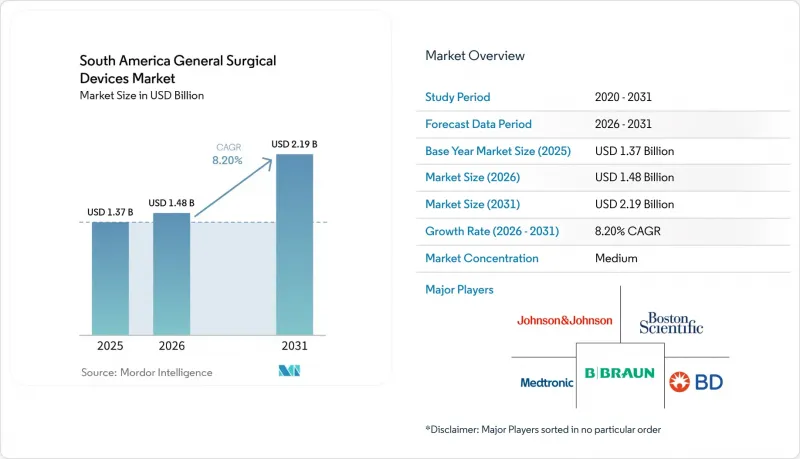
According to Mordor Intelligence, the South America general surgical devices market size is expected to grow from USD 1.37 billion in 2025 to USD 1.48 billion in 2026 and is forecast to reach USD 2.19 billion by 2031 at 8.20% CAGR over 2026-2031.
South America General Surgical Devices Market Trends and Insights
Expansion of Public-System Surgical Capacity
Public-sector capacity expansion is a major demand driver for the South American general surgical devices market. In June 2026, Brazil's Ministry of Health signed a BRL 460 million contract, equivalent to USD 92 million, for 300 surgical equipment kits under the Mais Cirurgias program. The program was projected to support 428,000 additional procedures annually, increasing demand for operating-room equipment and recurring surgical supplies. Peru also advanced a USD 353 million modernization agreement for the Manuel Nunez Butron Regional Hospital in Puno, including 7 operating rooms and 296 beds, creating opportunities for suppliers that meet public procurement requirements.
Growth in Minimally Invasive Procedures and Operating-Room Efficiency
Minimally invasive procedures are reshaping demand in the South American general surgical devices market. Hospitals are increasing the use of laparoscopic tools, energy devices, and robotic platforms to improve procedural efficiency and support shorter recovery pathways. A prospective study conducted from March 2025 through January 2026 found that Brazil's public system lacked a nationally supervised robotic training program for general surgeons. This gap strengthens the position of manufacturers that provide structured clinical training, while demand for workflow-enhancing operating-room technologies continues to grow.
Foreign-Exchange Exposure on Imported Devices
Import dependence is a persistent limitation for the South American general surgical devices market. Advanced instruments are often sourced from outside the region, which makes their local cost sensitive to currency movements. In Argentina, periods of peso depreciation can interrupt supply and lead hospitals to choose lower-cost alternatives. This shift does not remove the need for surgery, but it can reduce spending on premium device categories. Suppliers with local-currency pricing, regional inventory, or hybrid manufacturing arrangements are better placed to manage this risk. Currency conditions can therefore influence which suppliers retain access to hospital purchasing budgets.
Other drivers and restraints analyzed in the detailed report include:
- Rising Chronic Disease Burden
- Conversion of Elective Surgery Backlogs
- Uneven Reimbursement for Advanced Technologies
For complete list of drivers and restraints, kindly check the Table Of Contents.
Segment Analysis
Disposable and single-use surgical supplies held 43.76% of the South America general surgical devices market share in 2025. The category supports daily surgical activity through sterile, single-use, and infection-control products, including gowns, drapes, trocars, sutures, and electrosurgical pencils. Infection-control requirements drive recurring demand, while public tenders in Brazil support high volumes and maintain competitive pricing among local and multinational suppliers.
The South America general surgical devices market size for minimally invasive surgery instruments is projected to grow at a 9.22% CAGR through 2031. Tertiary private hospitals in Sao Paulo, Buenos Aires, and Santiago primarily use robotic-assisted and sensor-enabled instruments, while open surgical and energy-based instruments serve the broader mid-market segment. Reusable laparoscopic accessories remain relevant in public hospitals with limited budgets, although the product mix is shifting toward higher-value systems.
Complete Report Scope:
- By Product Type
- Minimally Invasive Surgery Instruments
- Robotic-Assisted Surgery Instruments
- Energy-Based Surgery Instruments (RF, Ultrasonic, Laser)
- Open Surgery Instruments
- Disposable / Single-Use Surgical Supplies
- Smart / Sensor-Enabled Instruments
- Other Product Types
- By Application
- Orthopaedic
- Cardiovascular
- Gynaecology & Urology
- Neurosurgery
- Gastrointestinal / Colorectal
- Bariatric & Metabolic
- Plastic & Reconstructive
- Other Applications
- By End User
- Hospitals
- Ambulatory Surgical Centers
- Specialty Clinics
- Academic & Research Institutes
- By Geography
- Brazil
- Argentina
- Colombia
- Chile
- Peru
- Rest of South America
List of Companies Covered in this Report:
- Aspen Surgical Products, Inc.
- B. Braun
- Beckton Dickinson
- Boston Scientific
- Conmed
- Cook Group
- Getinge
- Industrias Barone
- Intuitive Surgical, Inc.
- Johnson & Johnson
- Karl Storz
- Medtronic
- Olympus
- Point Suture do Brasil
- Richard Wolf
- Smiths Group
- Stryker
- Teleflex
- Terumo
- Zimmer Biomet
Additional Benefits:
- The market estimate (ME) sheet in Excel format
- 3 months of analyst support
TABLE OF CONTENTS
1 INTRODUCTION
- 1.1 Study Assumptions and Market Definition
- 1.2 Scope of the Study
2 RESEARCH METHODOLOGY
3 EXECUTIVE SUMMARY
4 MARKET LANDSCAPE
- 4.1 Market Overview
- 4.2 Market Drivers
- 4.2.1 Expansion of Public-System Surgical Capacity
- 4.2.2 Growth in Minimally Invasive and Laparoscopic Procedures
- 4.2.3 Rising Burden of Obesity, Cancer, and Chronic Disease
- 4.2.4 Increasing Elective Surgery Backlog Conversion
- 4.2.5 Hospital Investment in Operating-Room Efficiency
- 4.2.6 Expansion of Robotic and Computer-Assisted Surgery
- 4.3 Market Restraints
- 4.3.1 Foreign-Exchange Exposure on Imported Devices
- 4.3.2 Uneven Reimbursement for Advanced Surgical Technologies
- 4.3.3 Shortage of Trained Minimally Invasive Surgery Teams
- 4.3.4 Fragmented Regulatory and Procurement Requirements
- 4.4 Value/Supply-Chain Analysis
- 4.5 Regulatory Landscape
- 4.6 Technological Outlook
- 4.7 Porter's Five Forces Analysis
- 4.7.1 Bargaining Power of Suppliers
- 4.7.2 Bargaining Power of Buyers
- 4.7.3 Threat of New Entrants
- 4.7.4 Threat of Substitutes
- 4.7.5 Competitive Rivalry
5 MARKET SIZE AND GROWTH FORECASTS (VALUE, USD)
- 5.1 By Product Type
- 5.1.1 Minimally Invasive Surgery Instruments
- 5.1.2 Robotic-Assisted Surgery Instruments
- 5.1.3 Energy-Based Surgery Instruments (RF, Ultrasonic, Laser)
- 5.1.4 Open Surgery Instruments
- 5.1.5 Disposable / Single-Use Surgical Supplies
- 5.1.6 Smart / Sensor-Enabled Instruments
- 5.1.7 Other Product Types
- 5.2 By Application
- 5.2.1 Orthopaedic
- 5.2.2 Cardiovascular
- 5.2.3 Gynaecology & Urology
- 5.2.4 Neurosurgery
- 5.2.5 Gastrointestinal / Colorectal
- 5.2.6 Bariatric & Metabolic
- 5.2.7 Plastic & Reconstructive
- 5.2.8 Other Applications
- 5.3 By End User
- 5.3.1 Hospitals
- 5.3.2 Ambulatory Surgical Centers
- 5.3.3 Specialty Clinics
- 5.3.4 Academic & Research Institutes
- 5.4 By Geography
- 5.4.1 Brazil
- 5.4.2 Argentina
- 5.4.3 Colombia
- 5.4.4 Chile
- 5.4.5 Peru
- 5.4.6 Rest of South America
6 COMPETITIVE LANDSCAPE
- 6.1 Market Concentration
- 6.2 Market Share Analysis
- 6.3 Company Profiles (includes Global Level Overview, Market Level Overview, Core Segments, Financials as available, Strategic Information, Market Rank/Share, Products and Services, Recent Developments)
- 6.3.1 Aspen Surgical Products, Inc.
- 6.3.2 B. Braun Melsungen AG
- 6.3.3 Becton, Dickinson and Company
- 6.3.4 Boston Scientific Corporation
- 6.3.5 CONMED Corporation
- 6.3.6 Cook Group Incorporated
- 6.3.7 Getinge AB
- 6.3.8 Industrias Barone
- 6.3.9 Intuitive Surgical, Inc.
- 6.3.10 Johnson & Johnson
- 6.3.11 Karl Storz SE & Co. KG
- 6.3.12 Medtronic plc
- 6.3.13 Olympus Corporation
- 6.3.14 Point Suture do Brasil
- 6.3.15 Richard Wolf GmbH
- 6.3.16 Smith & Nephew plc
- 6.3.17 Stryker Corporation
- 6.3.18 Teleflex Incorporated
- 6.3.19 Terumo Corporation
- 6.3.20 Zimmer Biomet Holdings, Inc.
7 MARKET OPPORTUNITIES AND FUTURE OUTLOOK
- 7.1 White-Space and Unmet-Need Assessment

