PUBLISHER: Mordor Intelligence | PRODUCT CODE: 2154722

PUBLISHER: Mordor Intelligence | PRODUCT CODE: 2154722
South America Dental Devices - Market Share Analysis, Industry Trends & Statistics, Growth Forecasts (2026 - 2031)
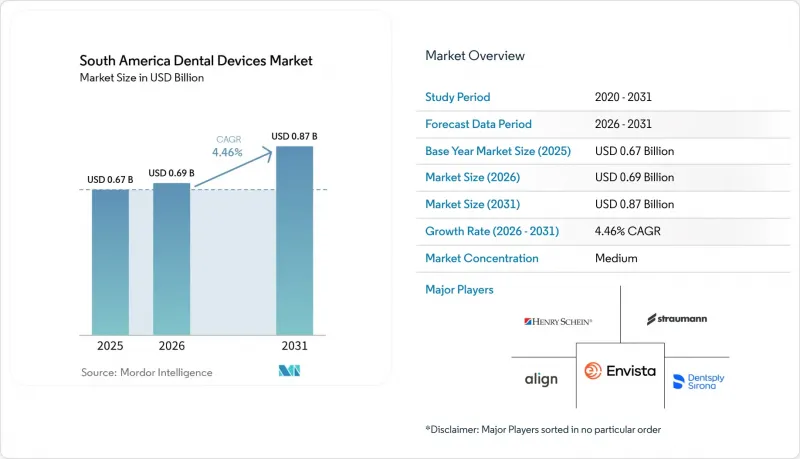
According to Mordor Intelligence, the South America dental devices market size was valued at USD 0.67 billion in 2025 and is estimated to grow from USD 0.69 billion in 2026 to reach USD 0.87 billion by 2031, at a CAGR of 4.46% during the forecast period (2026-2031).
South America Dental Devices Market Trends and Insights
Expansion of Private Dental Clinic Networks
Private clinic networks are reshaping equipment selection and purchasing across the South American dental devices market. In Brazil, the franchise model has shifted purchasing decisions from individual dentists to centralized dental service organizations, providing suppliers with larger and more predictable orders. However, suppliers must maintain standardized pricing, training, service, and inventory controls across each network. Networks also require device and consumable traceability, supported by Brazil's ANVISA Unique Device Identification system. Standardized scanners, implant platforms, and dental chairs generate recurring demand for compatible consumables, software, and maintenance services.
Adoption of Digital Dentistry Workflows
Digital dentistry remained a major growth opportunity for the South American dental devices market, as adoption in routine clinical settings was limited. A 2025 study of Brazilian dentists found that 73% performed intraoral radiographs, while only 21% used digital systems. High acquisition and maintenance costs affected 40% of respondents, while 30% cited inadequate equipment infrastructure. In 2026, Dentsply Sirona introduced DS Core Diagnose in Brazil, adding AI-supported analysis of 3D CBCT and 2D X-ray data to connected clinical workflows. Adoption depended on patient volumes, private insurance coverage, financing, technical support, staff capabilities, and regulatory documentation requirements.
Foreign-Exchange Exposure for Imported Equipment
Foreign exchange volatility constrains imported system purchases in the South America dental devices market. Brazil's federal tariffs, state ICMS levies, and COFINS contributions increase the effective cost of foreign equipment by 20-35%. A weaker Brazilian real raises supplier costs or local prices, limiting financing for CBCT and CAD/CAM systems among smaller practices. Peso instability complicates multi-year investment planning in Argentina, while Chile's managed peso and Ecuador's dollarized economy provide relatively stable conditions. ANVISA's device identification requirements and local distribution needs favor companies that effectively manage compliance, inventory, payment terms, and currency exposure.
Other drivers and restraints analyzed in the detailed report include:
- Growth of Implant and Restorative Procedures
- Dental Tourism and Cross-Border Treatment Demand
- Unequal Access to Dental Care and Equipment Financing
For complete list of drivers and restraints, kindly check the Table Of Contents.
Segment Analysis
Dental consumables held 53.01% of the South America dental devices market size in 2025, supported by recurring demand for implant components, biomaterials, crowns, bridges, and restorative materials. FGM Dental Group reported exports of 30% of its production to more than 100 countries in 2026. ANVISA's Unique Device Identification initiatives increased traceability requirements for high-risk consumables and implants, while local manufacturing and standardized clinical platforms supported stable supplier revenue.
General and diagnostic equipment is forecast to grow at a 6.33% CAGR through 2031, making it the fastest-growing product category. CBCT systems, intraoral scanners, digital radiography, and AI-supported diagnostic tools are driving growth. Dentsply Sirona's 2026 DS Core Diagnose launch in Brazil reflected the shift toward connected imaging and automated clinical visualization. Periodontal instruments and sterilization systems remain essential for public procurement programs and smaller clinics, creating opportunities for bundled offerings, training, and service support.
Complete Report Scope:
- By Product Type
- General and Diagnostic Equipment
- Dental Lasers
- Soft Tissue Dental Lasers
- Hard Tissue Dental Lasers
- Radiology Equipment
- Dental Chair and Equipment
- Other General and Diagnostic Equipment
- Dental Lasers
- Dental Consumables
- Dental Biomaterial
- Dental Implants
- Crowns and Bridges
- Other Dental Consumables
- Other Dental Devices
- General and Diagnostic Equipment
- By Treatment
- Orthodontic
- Endodontic
- Periodontic
- Prosthodontic
- By End User
- Dental Hospitals
- Dental Clinics
- Academic and Research Institutions
- Other End Users
- By Geography
- Brazil
- Argentina
- Colombia
- Chile
- Peru
- Rest of South America
List of Companies Covered in this Report:
- 3M
- A-dec
- Align Technology
- Alliage S.A.
- Angelus Dental
- BIOLASE
- Bionnovation Biomedical
- Carestream Dental
- Coltene Holding
- Dental Morelli Ltda.
- Dentsply Sirona
- Envista
- FGM Dental Group
- GC Corporation
- Henry Schein
- Ivoclar Vivadent
- Kopp Produtos Odontologicos
- Olsen Industria e Comercio S.A.
- Osstem Implant Co., Ltd.
- Planmeca
- Plenum Bioengenharia
- S.I.N. Implant System
- Straumann Group
- Vatech Co., Ltd.
- ZimVie
Additional Benefits:
- The market estimate (ME) sheet in Excel format
- 3 months of analyst support
TABLE OF CONTENTS
1 INTRODUCTION
- 1.1 Study Assumptions and Market Definition
- 1.2 Scope of the Study
2 RESEARCH METHODOLOGY
3 EXECUTIVE SUMMARY
4 MARKET LANDSCAPE
- 4.1 Market Overview
- 4.2 Market Drivers
- 4.2.1 Expansion of Private Dental Clinic Networks
- 4.2.2 Adoption of Digital Dentistry Workflows
- 4.2.3 Growth of Implant and Restorative Procedures
- 4.2.4 Public Oral-Health and Primary-Care Expansion
- 4.2.5 Dental Tourism and Cross-Border Treatment Demand
- 4.2.6 Local Manufacturing and Regional Service-Center Expansion
- 4.3 Market Restraints
- 4.3.1 Foreign-Exchange Exposure for Imported Equipment
- 4.3.2 Unequal Access to Dental Care and Equipment Financing
- 4.3.3 Limited Availability of Specialist Digital-Dentistry Training
- 4.3.4 Fragmented After-Sales Service and Consumables Supply
- 4.4 Value/Supply-Chain Analysis
- 4.5 Regulatory Landscape
- 4.6 Technological Outlook
- 4.7 Porter's Five Forces
- 4.7.1 Bargaining Power of Suppliers
- 4.7.2 Bargaining Power of Buyers
- 4.7.3 Threat of New Entrants
- 4.7.4 Threat of Substitutes
- 4.7.5 Competitive Rivalry
5 MARKET SIZE AND GROWTH FORECASTS (VALUE, USD)
- 5.1 By Product Type
- 5.1.1 General and Diagnostic Equipment
- 5.1.1.1 Dental Lasers
- 5.1.1.1.1 Soft Tissue Dental Lasers
- 5.1.1.1.2 Hard Tissue Dental Lasers
- 5.1.1.2 Radiology Equipment
- 5.1.1.3 Dental Chair and Equipment
- 5.1.1.4 Other General and Diagnostic Equipment
- 5.1.1.1 Dental Lasers
- 5.1.2 Dental Consumables
- 5.1.2.1 Dental Biomaterial
- 5.1.2.2 Dental Implants
- 5.1.2.3 Crowns and Bridges
- 5.1.2.4 Other Dental Consumables
- 5.1.3 Other Dental Devices
- 5.1.1 General and Diagnostic Equipment
- 5.2 By Treatment
- 5.2.1 Orthodontic
- 5.2.2 Endodontic
- 5.2.3 Periodontic
- 5.2.4 Prosthodontic
- 5.3 By End User
- 5.3.1 Dental Hospitals
- 5.3.2 Dental Clinics
- 5.3.3 Academic and Research Institutions
- 5.3.4 Other End Users
- 5.4 By Geography
- 5.4.1 Brazil
- 5.4.2 Argentina
- 5.4.3 Colombia
- 5.4.4 Chile
- 5.4.5 Peru
- 5.4.6 Rest of South America
6 COMPETITIVE LANDSCAPE
- 6.1 Market Concentration
- 6.2 Market Share Analysis
- 6.3 Company Profiles (includes Global Level Overview, Market Level Overview, Core Segments, Financials as available, Strategic Information, Market Rank/Share, Products and Services, Recent Developments)
- 6.3.1 3M Company
- 6.3.2 A-dec, Inc.
- 6.3.3 Align Technology, Inc.
- 6.3.4 Alliage S.A.
- 6.3.5 Angelus Dental
- 6.3.6 BIOLASE, Inc.
- 6.3.7 Bionnovation Biomedical
- 6.3.8 Carestream Dental LLC
- 6.3.9 COLTENE Holding AG
- 6.3.10 Dental Morelli Ltda.
- 6.3.11 DENTSPLY SIRONA Inc.
- 6.3.12 Envista Holdings Corporation
- 6.3.13 FGM Dental Group
- 6.3.14 GC Corporation
- 6.3.15 Henry Schein, Inc.
- 6.3.16 Ivoclar Vivadent AG
- 6.3.17 Kopp Produtos Odontologicos
- 6.3.18 Olsen Industria e Comercio S.A.
- 6.3.19 Osstem Implant Co., Ltd.
- 6.3.20 Planmeca Oy
- 6.3.21 Plenum Bioengenharia
- 6.3.22 S.I.N. Implant System
- 6.3.23 Straumann Holding AG
- 6.3.24 Vatech Co., Ltd.
- 6.3.25 ZimVie Inc.
7 MARKET OPPORTUNITIES AND FUTURE OUTLOOK
- 7.1 White-Space and Unmet-Need Assessment

