PUBLISHER: Mordor Intelligence | PRODUCT CODE: 2154726

PUBLISHER: Mordor Intelligence | PRODUCT CODE: 2154726
South America Public Safety - Market Share Analysis, Industry Trends & Statistics, Growth Forecasts (2026 - 2031)
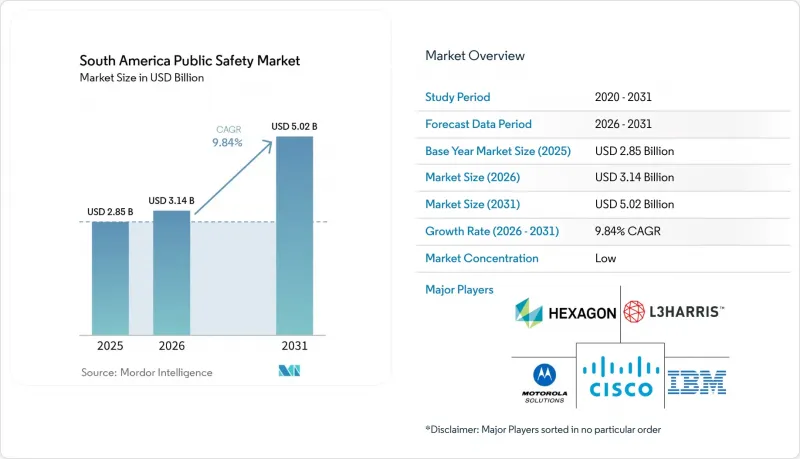
According to Mordor Intelligence, the South America public safety market size was valued at USD 2.85 billion in 2025 and is estimated to grow from USD 3.14 billion in 2026 to reach USD 5.02 billion by 2031, at a CAGR of 9.84% during the forecast period (2026-2031).
South America Public Safety Market Trends and Insights
Urban Crime Concentration and Integrated City Surveillance Investment
High crime density in major cities is creating direct demand for the South America Public Safety Market. Sao Paulo operates Smart Sampa, which uses 50,000 cameras supported by AI analytics, expanding the operating base for connected urban surveillance. Rio de Janeiro launched the Sentinela tender in January 2026 for 200,000 cameras across the state, valued at BRL 2 billion (USD 345 million). Coverage in one municipality can shift crime toward nearby areas without comparable systems. This makes shared platforms and multi-jurisdiction contracts more relevant than isolated city deployments. It also supports managed service agreements that can cover operations, connectivity, and technical support.
Climate-Related Disaster Exposure and Emergency Response Modernization
Floods, droughts, wildfires, and El Nino cycles are reshaping emergency-response procurement in the South America Public Safety Market. Brazil announced BRL 9.8 billion (USD 1.7 billion) through 2035 for disaster medicine infrastructure, with bases to be added in Salvador, Porto Alegre, and Rio de Janeiro in 2026, and 5 more planned for 2027. The World Bank approved support in July 2026 for flood resilience in Santa Catarina, including early-warning systems linked to civil defense agencies. The World Meteorological Organization is developing a regional severe weather forecasting program for the La Plata Basin in 2026. Agencies, therefore, need command systems that can coordinate different hazards through a common interface. This favors platforms that combine alerts, dispatch, response coordination, and information sharing.
Municipal Budget Volatility and Long Public Procurement Cycles
Municipal fiscal instability is a major restraint on the South America Public Safety Market. In Brazil, city tenders can be reviewed by state courts of accounts and may be suspended during the procurement process. In August 2026, the Sao Jose dos Campos court suspended a security services tender, after which the municipality issued an emergency contract worth BRL 45.3 million, equivalent to USD 7.8 million. Argentina's fiscal constraints and currency instability can similarly delay multiyear equipment tenders. Mid-sized municipalities often lack the specialized staff required to manage complex technical procurement. Managed service providers can benefit once a relationship is established because they can support both delivery and procurement execution.
Other drivers and restraints analyzed in the detailed report include:
- Mission-Critical Broadband Migration and Interoperable Communications
- Brazil-Led Smart-City and Critical Infrastructure Digitization
- Import-Cost Exposure from Currency Volatility and Local-Content Requirements
For complete list of drivers and restraints, kindly check the Table Of Contents.
Segment Analysis
Solutions held 72.13% of the South America Public Safety Market share in 2025. This category includes surveillance and analytics systems, critical communications, biometric security and authentication, emergency and disaster management platforms, and incident and evidence management software. Early-warning expansion supports demand for emergency systems, while body-camera programs create a need for connected evidence management. Buyers increasingly evaluate these tools as integrated operational systems rather than separate products.
Services are forecast to grow at an 11.23% CAGR from 2026 to 2031. Five-year contracts can move procurement risk from a public buyer to the supplier while giving smaller municipalities access to advanced platforms. Parana piloted Axon Body 4 cameras with simultaneous translation, GPS, and live streaming in 2025, with 1,400 units planned for near-term police deployment. The project connects body-worn cameras to evidence management and analytics. This integration supports bundled contracts where the operating service matters as much as the device.
On-premise systems accounted for 61.84% of the South America Public Safety Market share in 2025. Law enforcement agencies retain local installations for classified information and for operations that cannot depend on uninterrupted external connectivity. Mission-critical command functions require continuity even when network access is disrupted. Hybrid systems provide a middle path by keeping sensitive workloads locally while moving historical analysis and reporting to cloud environments. This structure allows agencies to modernize without moving every function at once.
Cloud deployment is forecast to grow at a 10.91% CAGR from 2026 to 2031. It provides greater scale for cross-agency information correlation and allows dispersed teams to access systems remotely. Rio de Janeiro's CIVITAS uses the IRIS engine to assess time, location, incident type, and behavioral patterns for crime hotspot analysis. Brazil's data protection requirements affect vendor selection and favor providers with suitable local infrastructure. The South America Public Safety Market, therefore, continues to support hybrid adoption rather than a full replacement of on-premise systems.
Complete Report Scope:
- By Component
- Solution
- Critical Communication Network
- Surveillance and Analytics Systems
- Biometric Security and Authentication Systems
- Emergency and Disaster Management Platforms
- Incident and Evidence Management Software
- Services
- Professional Services
- Managed Services
- Solution
- By Deployment Type
- On-Premise
- Cloud
- Hybrid
- By End-User Vertical
- Law Enforcement Agencies
- Firefighting Departments
- Emergency Medical Services
- Transportation and Critical Infrastructure Operators
- Disaster and Rescue Management Authorities
- Other End-User Verticals
- By Technology
- Artificial Intelligence and Predictive Analytics
- Internet of Things Sensors and Gateways
- Cloud and Edge Computing
- Big-Data and GIS Analytics
- 5G and Mission-Critical LTE Networks
- By Agency Type
- Federal / National
- State and Provincial
- Municipal / Local
- By Geography
- Brazil
- Argentina
- Colombia
- Chile
- Rest of South America
List of Companies Covered in this Report:
- Motorola Solutions, Inc.
- Cisco Systems, Inc.
- L3Harris Technologies, Inc.
- Hexagon AB
- IBM Corporation
- JVCKENWOOD Corporation
- Sonim Technologies, Inc.
- Getac Technology Corporation
- Panasonic Connect Co., Ltd.
- Reveal Media Limited
- Digital Ally, Inc.
- Utility, Inc.
- PRO-VISION Video Systems
- Safe Fleet Holdings LLC
- Zetron, Inc.
- Riedel Communications GmbH & Co. KG
- Rohde & Schwarz GmbH & Co. KG
- BK Technologies Corporation
- Silvus Technologies, Inc.
- Persistent Systems, LLC
- Sogeti S.A.
Additional Benefits:
- The market estimate (ME) sheet in Excel format
- 3 months of analyst support
TABLE OF CONTENTS
1 INTRODUCTION
- 1.1 Study Assumptions and Market Definition
- 1.2 Scope of the Study
2 RESEARCH METHODOLOGY
3 EXECUTIVE SUMMARY
4 MARKET LANDSCAPE
- 4.1 Market Overview
- 4.2 Market Drivers
- 4.2.1 Climate-Related Disaster Exposure and Emergency-Response Modernization
- 4.2.2 Urban Crime Concentration and Integrated City-Surveillance Investment
- 4.2.3 Mission-Critical Broadband Migration and Interoperable Communications
- 4.2.4 Brazil-Led Smart-City and Critical-Infrastructure Digitization
- 4.2.5 Fragmented Agency Data Creating Demand for Federated Public-Safety Platforms
- 4.2.6 Local-Language AI and Edge Analytics Reducing Connectivity Dependence
- 4.3 Market Restraints
- 4.3.1 Municipal Budget Volatility and Long Public-Procurement Cycles
- 4.3.2 Fragmented Spectrum, Standards and Agency Interoperability
- 4.3.3 Import-Cost Exposure from Currency Volatility and Local-Content Requirements
- 4.3.4 Evidence-Chain, Privacy and Facial-Recognition Governance Gaps
- 4.4 Impact of Macroeconomic Factors on the Market
- 4.5 Industry Supply-Chain Analysis
- 4.6 Regulatory Landscape
- 4.7 Porter's Five Forces Analysis
- 4.7.1 Threat of New Entrants
- 4.7.2 Bargaining Power of Suppliers
- 4.7.3 Bargaining Power of Buyers
- 4.7.4 Threat of Substitutes
- 4.7.5 Intensity of Competitive Rivalry
5 MARKET SIZE AND GROWTH FORECASTS (VALUE)
- 5.1 By Component
- 5.1.1 Solution
- 5.1.1.1 Critical Communication Network
- 5.1.1.2 Surveillance and Analytics Systems
- 5.1.1.3 Biometric Security and Authentication Systems
- 5.1.1.4 Emergency and Disaster Management Platforms
- 5.1.1.5 Incident and Evidence Management Software
- 5.1.2 Services
- 5.1.2.1 Professional Services
- 5.1.2.2 Managed Services
- 5.1.1 Solution
- 5.2 By Deployment Type
- 5.2.1 On-Premise
- 5.2.2 Cloud
- 5.2.3 Hybrid
- 5.3 By End-User Vertical
- 5.3.1 Law Enforcement Agencies
- 5.3.2 Firefighting Departments
- 5.3.3 Emergency Medical Services
- 5.3.4 Transportation and Critical Infrastructure Operators
- 5.3.5 Disaster and Rescue Management Authorities
- 5.3.6 Other End-User Verticals
- 5.4 By Technology
- 5.4.1 Artificial Intelligence and Predictive Analytics
- 5.4.2 Internet of Things Sensors and Gateways
- 5.4.3 Cloud and Edge Computing
- 5.4.4 Big-Data and GIS Analytics
- 5.4.5 5G and Mission-Critical LTE Networks
- 5.5 By Agency Type
- 5.5.1 Federal / National
- 5.5.2 State and Provincial
- 5.5.3 Municipal / Local
- 5.6 By Geography
- 5.6.1 Brazil
- 5.6.2 Argentina
- 5.6.3 Colombia
- 5.6.4 Chile
- 5.6.5 Rest of South America
6 COMPETITIVE LANDSCAPE
- 6.1 Market Concentration
- 6.2 Strategic Moves
- 6.3 Market Share Analysis
- 6.4 Company Profiles (includes Global Level Overview, Market Level Overview, Core Segments, Financials as available, Strategic Information, Market Rank/Share, Products and Services, Recent Developments)
- 6.4.1 Motorola Solutions, Inc.
- 6.4.2 Cisco Systems, Inc.
- 6.4.3 L3Harris Technologies, Inc.
- 6.4.4 Hexagon AB
- 6.4.5 IBM Corporation
- 6.4.6 JVCKENWOOD Corporation
- 6.4.7 Sonim Technologies, Inc.
- 6.4.8 Getac Technology Corporation
- 6.4.9 Panasonic Connect Co., Ltd.
- 6.4.10 Reveal Media Limited
- 6.4.11 Digital Ally, Inc.
- 6.4.12 Utility, Inc.
- 6.4.13 PRO-VISION Video Systems
- 6.4.14 Safe Fleet Holdings LLC
- 6.4.15 Zetron, Inc.
- 6.4.16 Riedel Communications GmbH & Co. KG
- 6.4.17 Rohde & Schwarz GmbH & Co. KG
- 6.4.18 BK Technologies Corporation
- 6.4.19 Silvus Technologies, Inc.
- 6.4.20 Persistent Systems, LLC
- 6.4.21 Sogeti S.A.
7 MARKET OPPORTUNITIES AND FUTURE OUTLOOK
- 7.1 White-Space and Unmet-Need Assessment

