PUBLISHER: Mordor Intelligence | PRODUCT CODE: 2154728

PUBLISHER: Mordor Intelligence | PRODUCT CODE: 2154728
South America Government and Security Biometrics - Market Share Analysis, Industry Trends & Statistics, Growth Forecasts (2026 - 2031)
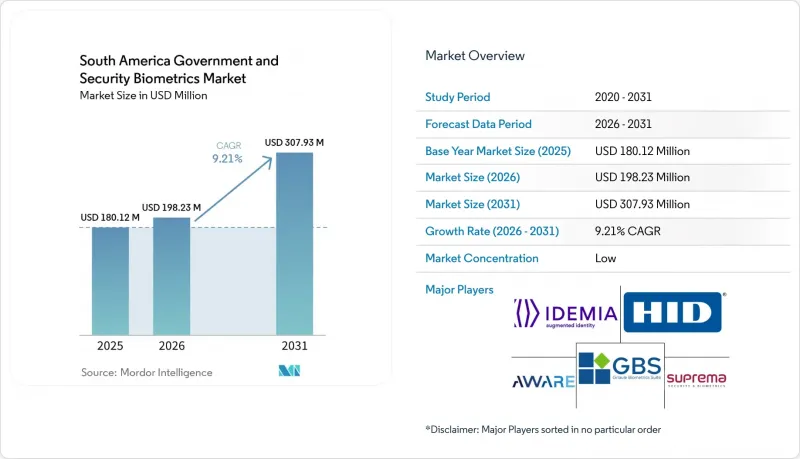
According to Mordor Intelligence, the South America government and Security Biometrics Market size was USD 180.12 million in 2025 and is projected to reach USD 307.93 million by 2031, at a CAGR of 9.21% during the forecast period from 2026 to 2031.
South America Government and Security Biometrics Market Trends and Insights
Government Digital Identity and National ID Expansion
Brazil's plan to make the Carteira de Identidade Nacional, or CIN, the single biometric national identity credential by 2032 is a major driver of demand for the South America Government and Security Biometrics Market. The country had issued CIN credentials to 49 million people by early 2026. In March 2026, the Ministry of Management and Innovation in Public Services launched PROCIN and committed BRL 44.25 million (USD 7.78 million) to support issuance in Bahia, Amapa, Amazonas, and Maranhao. The program requires enrollment capacity, biometric capture, data management, and identity verification systems across participating states. Brazil's Federal Biometric Service, created in February 2025, supports centralized many-to-many matching and makes biometric identity data more useful for fraud detection. Argentina also began issuing its electronic Documento Nacional de Identidad in February 2026, featuring a contactless chip and ICAO 9303-aligned features, thereby expanding the need for compatible enrollment and verification tools.
Border Control Modernization and Biometric E-Gates
Border programs are extending demand in the South America Government and Security Biometrics Market beyond civil registration. Airports, land crossings, and migration agencies need identity checks that can validate travel documents and compare biometric data with authorized watchlists. Chile signed the Biometric Identification Transnational Migration Alert Program letter of intent with the United States in July 2025. The arrangement provides for the exchange of fingerprint and iris data to identify people connected with transnational crime and high-risk migration flows. This type of cooperation increases the importance of data capture quality, interoperable biometric templates, and secure matching processes. It also favors providers with demonstrated experience integrating software, travel documents, and checkpoint equipment. Border agencies are likely to give greater weight to operational reliability because failures can disrupt passenger processing and security workflows.
High Upfront Infrastructure and Integration Costs
The South America Government and Security Biometrics Market requires substantial investment before a national system becomes operational. Projects can include enrollment kits, capture stations, servers, software licenses, staff training, and migration of legacy records. Civil registries and police systems often store fingerprint templates in formats that are difficult to transfer between platforms. Moving these records to ISO/IEC-compliant formats can add time and cost to modernization programs. Annual technology budgets can also be misaligned with the longer delivery schedules of national identity or automated biometric identification systems. Modular procurement can help agencies add software functions before completing all hardware installations, but it does not remove the need for local integration and support.
Other drivers and restraints analyzed in the detailed report include:
- Public-Sector Demand for Fraud-Resistant Service Delivery
- AI-Enabled Multimodal Identification for Law Enforcement
- Data Privacy, Bias, and Public Acceptance Risks
For complete list of drivers and restraints, kindly check the Table Of Contents.
Segment Analysis
Multi-Factor Authentication held 64.23% of the South America Government and Security Biometrics Market share in 2025 and is forecast to grow at a 10.84% CAGR through 2031. It is used where agencies need to link a live person with a trusted credential and a biometric record. A common design combines a smart card or electronic document with fingerprint or facial capture. This reduces reliance on a single biometric sample when presentation attacks or document fraud are a concern. Civil registration, border control, and law enforcement agencies use this approach for higher-assurance workflows.
Brazil's Federal Biometric Service requires agencies accessing the CIN database to support multi-factor matching. That requirement encourages broader adoption of systems that can verify both credentials and individuals. Single Authentication Factor systems remain relevant for lower-risk and high-throughput uses, including transit access. However, they are less suitable where an agency must confirm identity before issuing benefits, documents, or investigative results. The South America Government and Security Biometrics Market is therefore moving toward layered verification for core government functions.
Contact-Based solutions held 71.38% share in 2025, while Non-Contact-Based solutions are forecast to grow at a 10.67% CAGR through 2031. Facial recognition supports faster processing at airports, border posts, and public transport locations because users do not need to touch a sensor. Contact-Based systems still have a large installed base in civil registries, electoral databases, and automated fingerprint identification systems. Many agencies maintain extensive fingerprint archives that cannot be quickly replaced. Re-enrollment campaigns also require funding, equipment, and local administrative capacity.
The installed base keeps contact-based technology relevant in the South America Government and Security Biometrics Market. Griaule ranked sixth globally in NIST's MINEX III fingerprint recognition evaluation in July 2026 and first among South American providers, demonstrating continuing performance improvements in fingerprint matching. Contactless fingerprint capture is also narrowing the distinction between the two approaches. Agencies can select non-contact systems for speed while retaining fingerprint systems for de-duplication and forensic work. ISO/IEC standards for fingerprint image data remain important for interoperability in both approaches.
Complete Report Scope:
- By Authentication Type
- Single Authentication Factor
- Multi-Factor Authentication
- By Contact Type
- Contact-Based
- Non-Contact-Based
- By Product Type
- Voice Recognition
- Facial Recognition
- Fingerprint Identification
- Vein Recognition
- Iris Recognition
- By Component
- Hardware
- Software
- Services
- By Application
- Border Control
- E-Passport
- E-Visa
- National ID
- Healthcare and Welfare
- Other Applications
- By End User
- Civil Government
- Military and Defense
- Law Enforcement
- E-Passport and E-Visa Authorities
- Healthcare and Welfare Agencies
- Commercial and Regulated Organizations
- By Geography
- Brazil
- Argentina
- Colombia
- Chile
- Venezuela
- Rest of South America
List of Companies Covered in this Report:
- IDEMIA Identity and Security France S.A.S.
- HID Global Corporation
- Aware, Inc.
- Griaule Biometrics, LLC
- Suprema Inc.
- Precise Biometrics AB
- BIO-key International, Inc.
- Innovatrics, s.r.o.
- Integrated Biometrics, LLC
- Iris ID Systems, Inc.
- TECH5 Group B.V.
- M2SYS LLC
- Aratek Biometrics Co., Ltd.
- Dermalog Identification Systems GmbH
- Jenetric GmbH
- Xperix Inc.
- Neurotechnology UAB
- Mantra Softech (India) Private Limited
- FacePhi Biometria, S.A.
- Veridos GmbH
- IrisGuard, Inc.
Additional Benefits:
- The market estimate (ME) sheet in Excel format
- 3 months of analyst support
TABLE OF CONTENTS
1 INTRODUCTION
- 1.1 Study Assumptions and Market Definition
- 1.2 Scope of the Study
2 RESEARCH METHODOLOGY
3 EXECUTIVE SUMMARY
4 MARKET LANDSCAPE
- 4.1 Market Overview
- 4.2 Market Drivers
- 4.2.1 Government Digital Identity and National ID Expansion
- 4.2.2 Border Control Modernization and Biometric E-Gates
- 4.2.3 Rising Public-Sector Demand for Fraud-Resistant Service Delivery
- 4.2.4 AI-Enabled Multimodal Identification for Law Enforcement
- 4.2.5 Mercosur Cross-Border Digital Identity Interoperability
- 4.2.6 Brazilian Biometric Boarding and Port Modernization
- 4.3 Market Restraints
- 4.3.1 High Upfront Infrastructure and Integration Costs
- 4.3.2 Data Privacy, Bias, and Public Acceptance Risks
- 4.3.3 Fragmented Procurement and Interoperability Across National Systems
- 4.3.4 Connectivity and Power Reliability Constraints Outside Major Urban Centers
- 4.4 Impact of Macroeconomic Factors on the Market
- 4.5 Industry Value-Chain Analysis
- 4.6 Technology Outlook
- 4.7 Regulatory Landscape
- 4.8 Porter's Five Forces Analysis
- 4.8.1 Threat of New Entrants
- 4.8.2 Bargaining Power of Suppliers
- 4.8.3 Bargaining Power of Buyers
- 4.8.4 Threat of Substitutes
- 4.8.5 Intensity of Competitive Rivalry
5 MARKET SIZE AND GROWTH FORECASTS (VALUE)
- 5.1 By Authentication Type
- 5.1.1 Single Authentication Factor
- 5.1.2 Multi-Factor Authentication
- 5.2 By Contact Type
- 5.2.1 Contact-Based
- 5.2.2 Non-Contact-Based
- 5.3 By Product Type
- 5.3.1 Voice Recognition
- 5.3.2 Facial Recognition
- 5.3.3 Fingerprint Identification
- 5.3.4 Vein Recognition
- 5.3.5 Iris Recognition
- 5.4 By Component
- 5.4.1 Hardware
- 5.4.2 Software
- 5.4.3 Services
- 5.5 By Application
- 5.5.1 Border Control
- 5.5.2 E-Passport
- 5.5.3 E-Visa
- 5.5.4 National ID
- 5.5.5 Healthcare and Welfare
- 5.5.6 Other Applications
- 5.6 By End User
- 5.6.1 Civil Government
- 5.6.2 Military and Defense
- 5.6.3 Law Enforcement
- 5.6.4 E-Passport and E-Visa Authorities
- 5.6.5 Healthcare and Welfare Agencies
- 5.6.6 Commercial and Regulated Organizations
- 5.7 By Geography
- 5.7.1 Brazil
- 5.7.2 Argentina
- 5.7.3 Colombia
- 5.7.4 Chile
- 5.7.5 Venezuela
- 5.7.6 Rest of South America
6 COMPETITIVE LANDSCAPE
- 6.1 Market Concentration
- 6.2 Strategic Moves
- 6.3 Market Share Analysis
- 6.4 Company Profiles (includes Global Level Overview, Market Level Overview, Core Segments, Financials as available, Strategic Information, Market Rank/Share, Products and Services, Recent Developments)
- 6.4.1 IDEMIA Identity and Security France S.A.S.
- 6.4.2 HID Global Corporation
- 6.4.3 Aware, Inc.
- 6.4.4 Griaule Biometrics, LLC
- 6.4.5 Suprema Inc.
- 6.4.6 Precise Biometrics AB
- 6.4.7 BIO-key International, Inc.
- 6.4.8 Innovatrics, s.r.o.
- 6.4.9 Integrated Biometrics, LLC
- 6.4.10 Iris ID Systems, Inc.
- 6.4.11 TECH5 Group B.V.
- 6.4.12 M2SYS LLC
- 6.4.13 Aratek Biometrics Co., Ltd.
- 6.4.14 Dermalog Identification Systems GmbH
- 6.4.15 Jenetric GmbH
- 6.4.16 Xperix Inc.
- 6.4.17 Neurotechnology UAB
- 6.4.18 Mantra Softech (India) Private Limited
- 6.4.19 FacePhi Biometria, S.A.
- 6.4.20 Veridos GmbH
- 6.4.21 IrisGuard, Inc.
7 MARKET OPPORTUNITIES AND FUTURE OUTLOOK
- 7.1 White-Space and Unmet-Need Assessment

