PUBLISHER: Mordor Intelligence | PRODUCT CODE: 2154745

PUBLISHER: Mordor Intelligence | PRODUCT CODE: 2154745
Battery Thermal Management Materials - Market Share Analysis, Industry Trends & Statistics, Growth Forecasts (2026 - 2031)
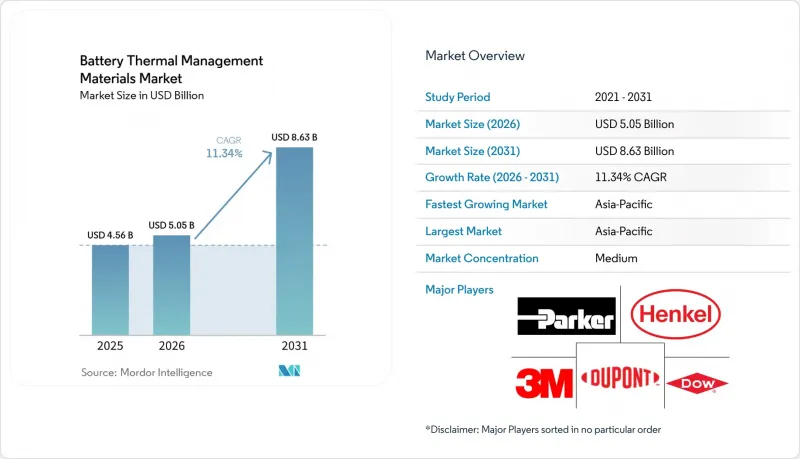
According to Mordor Intelligence, the battery thermal management materials market size was valued at USD 4.56 billion in 2025 and is estimated to grow from USD 5.05 billion in 2026 to reach USD 8.63 billion by 2031, at a CAGR of 11.34% during the forecast period (2026-2031).
Global Battery Thermal Management Materials Market Trends and Insights
Rising Electric Vehicle Production and Battery Manufacturing Capacity
Electric vehicle production is a key driver of demand in the battery thermal management materials market, as each battery pack requires materials at the cell, module, and pack interfaces. Battery installations reached 1,187 GWh in 2025, up from 901.4 GWh in 2024, increasing demand for gap fillers, potting compounds, thermal adhesives, and protective barriers. China remained the main production and sales hub for electric vehicles in 2025, influencing material procurement, design decisions, and supplier qualification. Excess gigafactory capacity in China may pressure material prices; however, additional battery capacity continues to support demand in the battery thermal management materials market. North American and European original equipment manufacturers (OEMs) are localizing battery assembly, creating demand for suppliers with qualified regional production capabilities and technical support. Companies with application laboratories and qualification data in Asia can support customers adapting Asian battery pack designs for facilities in other regions.
Higher Battery Energy Density and Faster Charging Requirements
Higher energy density and faster charging increase heat generation within battery packs, requiring materials with higher thermal conductivity, thinner bondlines, and reliable temperature-cycling performance. Cell-to-pack designs increase volumetric energy density by reducing cell-to-cell spacing and eliminating the heat-buffering effect of module housings. The transition to 800 V vehicle platforms increases thermal gradients during ultra-fast charging events that can last less than 15 minutes. Research on paraffin-impregnated nanoporous copper current collectors demonstrated self-regulated overheating protection in lithium iron phosphate (LFP) and nickel manganese cobalt (NMC) pouch cells. This research indicates a shift in thermal control from pack-level gap fillers toward cell-level protection. In the battery thermal management materials market, dual-function products that combine structural bonding and heat transfer can reduce the number of layers and assembly steps without compromising thermal control.
High Cost and Technical Complexity of Advanced Thermal Materials
Advanced thermal materials often cost more than conventional silicone pads and may require specialized processing, limiting adoption in price-sensitive battery programs. Aerogel composites, high-conductivity gap fillers, and micro-encapsulated phase change materials rely on material systems and production methods with higher manufacturing and application requirements. Advanced gap fillers require thermally conductive fillers, such as boron nitride, aluminum nitride, and silicon carbide, to achieve high thermal conductivity. In cell-to-pack assembly, thermally conductive structural adhesives require precise dispensing equipment and tighter process controls than simpler pad insertion. Vehicle manufacturers in China may select polyurethane materials instead of silicone-based gap fillers when thermal performance requirements permit. These factors create cost and performance tiers within the battery thermal management materials market and affect the adoption of higher-performance formulations.
Other drivers and restraints analyzed in the detailed report include:
- Thermal-Runaway Prevention and Battery-Safety Requirements
- Growth of Energy Storage Systems and Renewable-Power Integration
- Qualification Cycles and Diverse OEM Battery-Pack Requirements
For complete list of drivers and restraints, kindly check the Table Of Contents.
Segment Analysis
Thermal interface materials accounted for 37.45% of revenue in 2025, making them the largest material category in the battery thermal management materials market. These materials are deployed at cell-to-cooling-plate contact points in liquid-cooled battery packs. They transfer heat across uneven surfaces while preventing air gaps that can reduce cooling efficiency. Thermally conductive adhesives are increasingly replacing certain gap fillers in cell-to-pack systems because they provide structural bonding and heat transfer in a single dispensed layer, eliminating the assembly stage required for pad insertion. In May 2026, Henkel introduced Bergquist TGF 2030APS, a silicone-free, two-component thermal gap filler with thermal conductivity of 1.7 W/m*K and dispensing rates above 40 cm3/s. The company also introduced Loctite TLB 9270APS, a polyurethane thermally conductive adhesive with thermal conductivity of 2 W/m*K for cell-to-pack designs.
Gap fillers and thermal pads remain relevant in applications where pack rework and non-destructive cell access are important. Meanwhile, potting and encapsulation products are gaining adoption in stationary energy storage applications, where protection from mechanical damage and chemical ingress can take priority over disassembly. Phase change materials are forecast to grow at a CAGR of 12.56% through 2031 because they absorb and release latent heat without requiring active pumping systems. According to research on passive battery thermal management, composite phase change material (PCM) coatings containing expanded graphite reduced average peak cell temperature increases by 7°C at a thickness of 3 mm during standard drive cycles. The battery thermal management materials industry requires products that balance thermal conductivity, dispensing speed, curing behavior, rework requirements, and passive safety performance. This requirement supports broad product portfolios and closer collaboration with battery pack designers during early-stage development.
Complete Report Scope:
- By Material Type
- Thermal Interface Materials
- Gap Fillers and Thermal Pads
- Phase Change Materials
- Thermal Conductive Adhesives
- Potting and Encapsulation Materials
- Thermal Insulation and Fire-Protection Materials
- Others
- By Application
- Electric Vehicles
- Energy Storage Systems
- Consumer Electronics
- Industrial Equipment
- Others
- By Geography
- Asia-Pacific
- China
- India
- Japan
- South Korea
- Rest of Asia-Pacific
- North America
- United States
- Canada
- Mexico
- Europe
- Germany
- United Kingdom
- France
- Italy
- Russia
- Rest of Europe
- South America
- Brazil
- Argentina
- Rest of South America
- Middle East and Africa
- Saudi Arabia
- South Africa
- Rest of Middle East and Africa
- Asia-Pacific
Geography Analysis
Asia-Pacific holds 45.13% of the battery thermal management materials market in 2025 and is forecast to grow at a CAGR of 12.62% through 2031. The region combines battery production, electric vehicle (EV) assembly, cell research, and energy storage deployment, generating material demand and supporting a broad base of qualified manufacturers. China accounts for 62% of global light-duty EV sales and 71% of global EV production in 2025. This scale drives demand for thermal interface materials, phase-change products, and fire-protection grades across EV, stationary storage, and industrial applications. China's GB 38031-2025, which took effect in July 2026 for new vehicle declarations, requires batteries to prevent fire and explosion for two hours after thermal runaway begins.
South Korea provides an additional regional demand base through its battery materials ecosystem and domestic thermal management product specialists. Wacker Chemie AG has expanded specialty silicone production in Tsukuba, Japan, and Jincheon, South Korea, enabling the company to serve Asian automotive customers with locally produced thermal interface material grades and shorter supply routes. India is an emerging demand center, as its electric two- and three-wheeler fleets require battery thermal management solutions that meet safety requirements. Expanding domestic battery assembly capacity also creates demand beyond imported battery packs. Asia-Pacific cell manufacturers are adopting cell-to-pack and cell-to-chassis architectures more rapidly than many Western markets, shortening material qualification timelines and supporting suppliers with established regional application laboratories.
North America and Europe represent the next-largest geographic revenue blocks, although their demand drivers differ. Europe's battery-electric vehicle share of new car sales reached 18% in 2025, up from 14% in 2024. The EU Battery Regulation 2023/1542 increases demand for materials that support safety, disassembly, and end-of-life battery handling. In North America, ANSI/CAN/UL 9540A and ANSI/CAN/UL 1487 requirements for grid-scale energy storage containment support demand. South America, the Middle East, and Africa remain smaller markets, with demand concentrated in Brazil, Argentina, Saudi Arabia, and South Africa, where energy storage and electrification projects provide diversification opportunities for global suppliers.
- 3M
- Asahi Kasei Corporation
- Aspen Aerogels, Inc.
- Dow
- DuPont
- Elkem ASA
- GrafTech International
- H.B. Fuller Company
- Henkel AG & Co. KGaA
- Momentive
- PARKER HANNIFIN CORP
- Saint-Gobain
- Shin-Etsu Chemical Co., Ltd.
- Sika AG
- Wacker Chemie AG
Additional Benefits:
- The market estimate (ME) sheet in Excel format
- 3 months of analyst support
TABLE OF CONTENTS
1 Introduction
- 1.1 Study Assumptions and Market Definition
- 1.2 Scope of the Study
2 Research Methodology
3 Executive Summary
4 Market Landscape
- 4.1 Market Overview
- 4.2 Market Drivers
- 4.2.1 Rising Electric Vehicle Production and Battery Manufacturing Capacity
- 4.2.2 Higher Battery Energy Density and Faster Charging Requirements
- 4.2.3 Thermal-Runaway Prevention and Battery-Safety Requirements
- 4.2.4 Growth of Energy Storage Systems and Renewable-Power Integration
- 4.2.5 Cell-to-Pack and Cell-to-Chassis Architectures Increasing Material Intensity
- 4.3 Market Restraints
- 4.3.1 High Cost and Technical Complexity of Advanced Thermal Materials
- 4.3.2 Qualification Cycles and Diverse OEM Battery-Pack Requirements
- 4.3.3 Recyclability Challenges for Cured TIMs, Encapsulants, and Adhesive-Bonded Packs
- 4.4 Value Chain Analysis
- 4.5 Porter's Five Forces Analysis
- 4.5.1 Threat of New Entrants
- 4.5.2 Bargaining Power of Suppliers
- 4.5.3 Bargaining Power of Buyers
- 4.5.4 Threat of Substitutes
- 4.5.5 Competitive Rivalry
5 Market Size and Growth Forecasts (Value)
- 5.1 By Material Type
- 5.1.1 Thermal Interface Materials
- 5.1.2 Gap Fillers and Thermal Pads
- 5.1.3 Phase Change Materials
- 5.1.4 Thermal Conductive Adhesives
- 5.1.5 Potting and Encapsulation Materials
- 5.1.6 Thermal Insulation and Fire-Protection Materials
- 5.1.7 Others
- 5.2 By Application
- 5.2.1 Electric Vehicles
- 5.2.2 Energy Storage Systems
- 5.2.3 Consumer Electronics
- 5.2.4 Industrial Equipment
- 5.2.5 Others
- 5.3 By Geography
- 5.3.1 Asia-Pacific
- 5.3.1.1 China
- 5.3.1.2 India
- 5.3.1.3 Japan
- 5.3.1.4 South Korea
- 5.3.1.5 Rest of Asia-Pacific
- 5.3.2 North America
- 5.3.2.1 United States
- 5.3.2.2 Canada
- 5.3.2.3 Mexico
- 5.3.3 Europe
- 5.3.3.1 Germany
- 5.3.3.2 United Kingdom
- 5.3.3.3 France
- 5.3.3.4 Italy
- 5.3.3.5 Russia
- 5.3.3.6 Rest of Europe
- 5.3.4 South America
- 5.3.4.1 Brazil
- 5.3.4.2 Argentina
- 5.3.4.3 Rest of South America
- 5.3.5 Middle East and Africa
- 5.3.5.1 Saudi Arabia
- 5.3.5.2 South Africa
- 5.3.5.3 Rest of Middle East and Africa
- 5.3.1 Asia-Pacific
6 Competitive Landscape
- 6.1 Market Concentration
- 6.2 Strategic Moves
- 6.3 Market Share (%)/Ranking Analysis
- 6.4 Company Profiles (includes Global Overview, Market Overview, Core Segments, Financials as available, Strategic Information, Products and Services, and Recent Developments)
- 6.4.1 3M
- 6.4.2 Asahi Kasei Corporation
- 6.4.3 Aspen Aerogels, Inc.
- 6.4.4 Dow
- 6.4.5 DuPont
- 6.4.6 Elkem ASA
- 6.4.7 GrafTech International
- 6.4.8 H.B. Fuller Company
- 6.4.9 Henkel AG & Co. KGaA
- 6.4.10 Momentive
- 6.4.11 PARKER HANNIFIN CORP
- 6.4.12 Saint-Gobain
- 6.4.13 Shin-Etsu Chemical Co., Ltd.
- 6.4.14 Sika AG
- 6.4.15 Wacker Chemie AG
7 Market Opportunities and Future Outlook
- 7.1 White-Space and Unmet-Need Assessment

