PUBLISHER: Mordor Intelligence | PRODUCT CODE: 2154746

PUBLISHER: Mordor Intelligence | PRODUCT CODE: 2154746
Middle East and Africa Farm Implements - Market Share Analysis, Industry Trends & Statistics, Growth Forecasts (2026 - 2031)
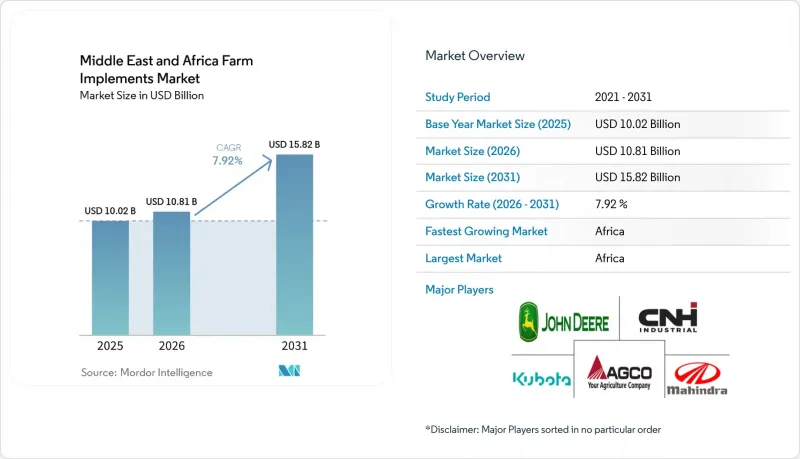
According to Mordor Intelligence, the Middle East and Africa farm implements market size was valued at USD 10.02 billion in 2025 and is forecast to grow from USD 10.81 billion in 2026 to USD 15.82 billion by 2031, at a CAGR of 7.92% from 2026 to 2031.
Middle East and Africa Farm Implements Market Trends and Insights
Food-Security-Led Mechanization Programs
Government food security programs are a major driver of demand for farm implements in the Middle East and Africa. In February 2026, the Food and Agriculture Organization of the United Nations and the Government of Tanzania held a regional mechanization conference, where Tanzania launched its National Agricultural Mechanization Strategy 2026-2036. The strategy aligns with the sustainable agricultural mechanization in Africa framework and supports a move from public machinery depots toward private mechanization service providers. Private operators have a stronger incentive to keep machinery in use, which supports recurring purchases of implements and parts, as well as maintenance services. In January 2026, Deere & Company, through AGCOMS International Trading Limited under the Nigerian National Agricultural Development Fund framework, signed a USD 70 million agreement for 2,000 tractors and 100 combine harvesters, including commitments for local assembly and support. These programs provide a more stable source of demand for equipment than isolated subsidy programs. These initiatives are intended to improve agricultural productivity and domestic food production, thereby increasing demand for farm implements across the region.
Smallholder Access Through Equipment-Hire Platforms
Equipment-hire platforms are expanding access to mechanization for smallholder farms that cannot afford to purchase machinery and implements outright. Hello Tractor connects more than 2.5 million smallholder farmers with over 6,500 equipment owners across more than 20 African countries. The company also reports a non-performing loan rate of below 2% for its pay-as-you-go financing portfolio, indicating that service-based access and equipment financing can support machinery utilization where conventional lending is limited.Higher utilization improves equipment owners' asset economics and can encourage fleet expansion, creating additional demand for compatible farm implements. Research covering Kenya, Zambia, and Zimbabwe found that hired mechanization services generated statistically significant income gains, particularly among lower-income farm households. As mechanization services expand, demand for implements used in key operations such as soil preparation, planting, fertilization, and crop protection increases, including plows, harrows, cultivators, seeders, planters, fertilizer spreaders, and tractor-mounted or trailed sprayers. This allows smallholders to access mechanized farm operations without having to purchase and maintain a complete set of implements individually.
High Upfront Cost and Limited Smallholder Credit
High equipment costs remain an immediate constraint on the Middle East and Africa farm implements market. Tractors in the 31-70 horsepower range require an upfront investment that can exceed the annual cash income of many smallholder households. Research on African agrifood systems identifies access to financial services for machinery purchases as a continuing structural barrier. Formal lending for machinery remains more available to commercial farms in South Africa and participants in specific government programs. Interest-rate risk and collateral requirements can limit equipment financing for women farmers who lack documented land tenure. Hire services and pay-as-you-go structures reduce the barrier, but do not fully address the cost of moving from basic tillage tools to multi-function precision equipment.
Other drivers and restraints analyzed in the detailed report include:
- Expansion of Commercial and Export-Oriented Farming
- Water-efficiency Requirements for Precision Implements
- Fragmented Rural Service and Spare-Parts Networks
For complete list of drivers and restraints, kindly check the Table Of Contents.
Segment Analysis
Tractors accounted for the largest Middle East and Africa farm implements market share in 2025, at 32.7%. Their role as the primary power source for towed and mounted tools supports demand for tillage equipment, planters, sprayers, and forage equipment. A tractor purchase can therefore lead to additional spending on compatible attachments. Harvesters remain an important category for South African grain and oilseed estates and government-backed combine procurement in Ethiopia. Soil preparation and cultivation equipment serve both commercial farms and smallholder upgrades. Planting, seeding, and fertilizing equipment gain relevance as producers shift from broadcast sowing toward row planting and more controlled input use. Irrigation and crop-protection implements serve Gulf markets with established drip and center-pivot systems. Haying and forage equipment retains demand in East Africa's pastoral livestock areas.
Precision and autonomous implements are forecast to be the fastest-growing product category, with a CAGR of 8.2% from 2026 to 2031. Their Middle East and Africa farm implements market size is supported by water-efficiency needs, labor costs, and smart-agriculture programs. Most adoption is occurring as an addition to existing machinery rather than as a replacement for conventional equipment. Sensor kits, variable-rate controls, drone-linked sprayers, and guidance modules can be installed with existing tractors and implements. This supports continued sales of conventional equipment while expanding the use of precision features. Egypt's Egrobots introduced an autonomous harvesting robot in 2025 that was developed by Egyptian engineers, according to the supplied material. Ghana's 3Farmate received government recognition in April 2026 for its Future Agricultural Machinery and Automation (FAMA) autonomous farming robot, also according to the supplied material. These examples indicate that locally developed solutions are emerging alongside imported technology.
Complete Report Scope:
- By Product Type
- Tractors
- Harvesters
- Soil Preparation and Cultivation Equipment
- Planting, Seeding, and Fertilizing Equipment
- Irrigation and Crop-Protection Implements
- Precision and Autonomous Implements
- Haying and Forage Equipment
- Other Implements
- By Mode of Operation
- Powered Implements
- Unpowered Implements
- By Power Output
- Below 30 HP
- 31-70 HP
- 71-130 HP
- Above 130 HP
- By Geography
- Middle East
- Saudi Arabia
- United Arab Emirates
- Turkey
- Israel
- Egypt
- Rest of Middle East
- Africa
- South Africa
- Nigeria
- Kenya
- Ethiopia
- Rest of Africa
- Middle East
List of Companies Covered in this Report:
- Deere & Company
- CNH Industrial N.V.
- AGCO Corporation
- Kubota Corporation
- Mahindra & Mahindra Limited
- CLAAS KGaA mbH
- SAME Deutz-Fahr (SDF Group)
- Yanmar Co. Ltd. (Yanmar Holdings Co., Ltd.)
- J.C. Bamford Excavators Ltd. - JCB (JCB Group)
- Weichai Lovol Intelligent Agricultural Technology Co., Ltd.
- Zoomlion Heavy Industry Science and Technology Co., Ltd.
- Dongfeng Agricultural Machinery Group Co., Ltd.
- Zetor Tractors a.s.
- Lindsay Corporation
- Alamo Group Inc.
Additional Benefits:
- The market estimate (ME) sheet in Excel format
- 3 months of analyst support
TABLE OF CONTENTS
1 Introduction
- 1.1 Study Assumptions and Market Definition
- 1.1.1 Scope of the Study
2 Research Methodology
3 Executive Summary
4 Market Landscape
- 4.1 Market Overview
- 4.1.1 Market Drivers
- 4.1.1.1 Food-security-led mechanization programs
- 4.1.1.2 Smallholder access through equipment-hire platforms
- 4.1.1.3 Expansion of commercial and export-oriented farming
- 4.1.1.4 Water-efficiency requirements for precision implements
- 4.1.1.5 Labor scarcity and rising farm labor costs
- 4.1.1.6 Local assembly and import-substitution incentives
- 4.1.2 Market Restraints
- 4.1.2.1 High upfront cost and limited smallholder credit
- 4.1.2.2 Fragmented rural service and spare-parts networks
- 4.1.2.3 Foreign-exchange and import-cost volatility
- 4.1.2.4 Land-tenure and plot-fragmentation constraints
- 4.1.3 Regulatory Landscape
- 4.1.4 Technological Outlook
- 4.1.5 Porter's Five Forces Analysis
- 4.1.5.1 Threat of New Entrants
- 4.1.5.2 Bargaining Power of Suppliers
- 4.1.5.3 Bargaining Power of Buyers
- 4.1.5.4 Threat of Substitutes
- 4.1.5.5 Intensity of Competitive Rivalry
- 4.1.1 Market Drivers
5 Market Size and Growth Forecasts (Value, USD)
- 5.1 By Product Type
- 5.1.1 Tractors
- 5.1.2 Harvesters
- 5.1.3 Soil Preparation and Cultivation Equipment
- 5.1.4 Planting, Seeding, and Fertilizing Equipment
- 5.1.5 Irrigation and Crop-Protection Implements
- 5.1.6 Precision and Autonomous Implements
- 5.1.7 Haying and Forage Equipment
- 5.1.8 Other Implements
- 5.2 By Mode of Operation
- 5.2.1 Powered Implements
- 5.2.2 Unpowered Implements
- 5.3 By Power Output
- 5.3.1 Below 30 HP
- 5.3.2 31-70 HP
- 5.3.3 71-130 HP
- 5.3.4 Above 130 HP
- 5.4 By Geography
- 5.4.1 Middle East
- 5.4.1.1 Saudi Arabia
- 5.4.1.2 United Arab Emirates
- 5.4.1.3 Turkey
- 5.4.1.4 Israel
- 5.4.1.5 Egypt
- 5.4.1.6 Rest of Middle East
- 5.4.2 Africa
- 5.4.2.1 South Africa
- 5.4.2.2 Nigeria
- 5.4.2.3 Kenya
- 5.4.2.4 Ethiopia
- 5.4.2.5 Rest of Africa
- 5.4.1 Middle East
6 Competitive Landscape
- 6.1 Market Concentration
- 6.2 Strategic Moves
- 6.3 Market Share Analysis
- 6.4 Company Profiles (includes Global-level Overview, Market-level Overview, Core Segments, Financials as available, Strategic Information, Market Rank/Share for key companies, Products and Services, and Recent Developments)
- 6.4.1 Deere & Company
- 6.4.2 CNH Industrial N.V.
- 6.4.3 AGCO Corporation
- 6.4.4 Kubota Corporation
- 6.4.5 Mahindra & Mahindra Limited
- 6.4.6 CLAAS KGaA mbH
- 6.4.7 SAME Deutz-Fahr (SDF Group)
- 6.4.8 Yanmar Co. Ltd. (Yanmar Holdings Co., Ltd.)
- 6.4.9 J.C. Bamford Excavators Ltd. - JCB (JCB Group)
- 6.4.10 Weichai Lovol Intelligent Agricultural Technology Co., Ltd.
- 6.4.11 Zoomlion Heavy Industry Science and Technology Co., Ltd.
- 6.4.12 Dongfeng Agricultural Machinery Group Co., Ltd.
- 6.4.13 Zetor Tractors a.s.
- 6.4.14 Lindsay Corporation
- 6.4.15 Alamo Group Inc.
7 Market Opportunities and Future Outlook

