PUBLISHER: Mordor Intelligence | PRODUCT CODE: 2154769

PUBLISHER: Mordor Intelligence | PRODUCT CODE: 2154769
Essential Thrombocythemia - Market Share Analysis, Industry Trends & Statistics, Growth Forecasts (2026 - 2031)
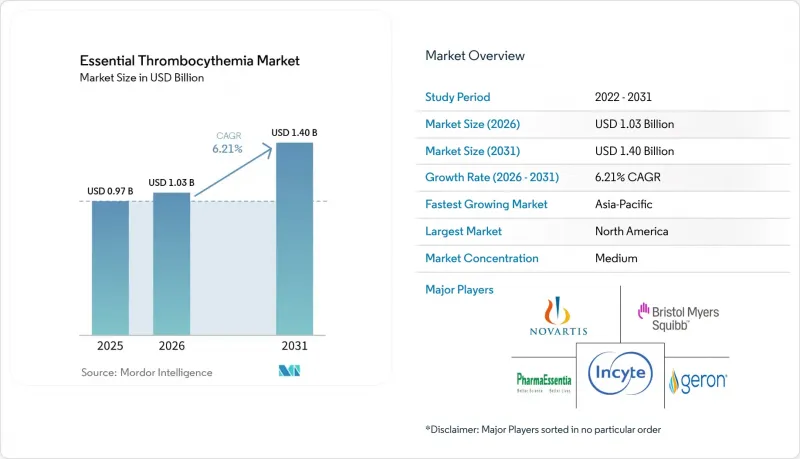
According to Mordor Intelligence, the essential thrombocythemia market size was valued at USD 0.97 billion in 2025 and is estimated to grow from USD 1.03 billion in 2026 to reach USD 1.40 billion by 2031, at a CAGR of 6.21% during the forecast period (2026-2031).
Global Essential Thrombocythemia Market Trends and Insights
Rising Diagnosed Prevalence of Essential Thrombocythemia
The essential thrombocythemia market is being supported by a broader diagnosed patient pool rather than by a change in disease biology. General practitioners are more likely to investigate persistent thrombocytosis, while automated complete blood count testing is more common in preventive care. These changes can identify cases that were previously attributed to inflammatory or reactive thrombocytosis. A retrospective Mayo Clinic cohort of 1,000 patients reported a median diagnosis age of 58 years and 63% female patients. The patient profile overlaps with groups that regularly use health screening in higher-income health systems. Because essential thrombocythemia is chronic and non-curative, each additional diagnosis can create a long treatment relationship.
Greater use of rare-disease registries can also improve visibility of diagnosed cases. The European Reference Network for Rare Hematological Diseases is helping to organize reporting and trial access in parts of Europe. The essential thrombocythemia market benefits when healthcare systems can identify patients earlier and connect them with specialist services. This process can reduce the time between an abnormal blood count and a confirmed diagnosis. It can also expand the pool eligible for cytoreductive therapy or clinical trials. The effect should be most visible where specialist hematology capacity is growing from a lower base.
Earlier Diagnosis Through Molecular Testing
Molecular testing is shortening the path from persistent thrombocytosis to a confirmed diagnosis. JAK2 V617F, CALR, and MPL testing supports more consistent classification of patients. WHO-based diagnostic practice calls for CALR and MPL testing when JAK2 V617F testing is negative. This sequence can reduce diagnostic uncertainty and help patients qualify for treatment and reimbursement. Broader testing also provides a clearer basis for clinical trial enrollment. The essential thrombocythemia market therefore depends increasingly on access to validated laboratory methods.
Next-generation sequencing can identify co-mutations in epigenetic regulators, including ASXL1, EZH2, and IDH2. These findings may help clinicians assess progression risk and consider treatment earlier in higher-risk groups. Mutation-defined populations are also increasingly important to drug-development programs. Standardized testing supports faster patient identification for these trials. Companies may have an advantage when their target can be identified through laboratory panels used in national guidelines. This relationship links diagnostic capacity with both drug access and the pace of clinical development.
Limited Disease-Modifying and Curative Options
No approved therapy currently removes the underlying clonal myeloproliferation in essential thrombocythemia. Progression to myelofibrosis was reported in 0.8%-5% of cases at 10 years and in up to 15% of cases at 15 years. This gap limits the premium that regulators and payers may accept for newer medicines. It also keeps many well-controlled patients on low-cost generic hydroxyurea. The essential thrombocythemia market therefore faces a persistent trade-off between unmet medical need and limited proof of disease modification. Stronger evidence of prevention of progression would change this assessment.
Bomedemstat has shown JAK2 allele-burden reduction alongside platelet normalization in its development program. INCA033989 was designed to suppress mutant CALR-driven malignant hematopoiesis while sparing normal progenitors. Both approaches aim to move beyond symptom and blood-count control, but confirmatory Phase 3 data remain pending. Reimbursement discussions will continue to depend on whether clinical benefit can be demonstrated in a sustained way. Until then, generic treatments retain an important role. The essential thrombocythemia market will grow more slowly than it would under a clearly validated disease-modifying claim.
Other drivers and restraints analyzed in the detailed report include:
- Uptake of Long-Acting and Targeted Therapies
- Expansion of Clinical Trials and Orphan-Drug Development
- Treatment-Related Cytopenia and Cardiovascular Toxicity
For complete list of drivers and restraints, kindly check the Table Of Contents.
Segment Analysis
Hydroxyurea held 38.5% of the essential thrombocythemia market size in 2025. Its position reflects decades of first-line use, familiar safety management, and low cost where generics are available. The drug remains central to treatment pathways even as newer mechanisms move forward. JAK inhibitors are forecast to grow at an 8.5% CAGR through 2031, the fastest rate among drug classes. OB756 produced a 65.6% complete hematologic response at week 24 in a Phase 2 study of patients resistant or intolerant to hydroxyurea or intolerant to interferon. This result shows the interest in selective JAK2 inhibition for difficult-to-treat patients.
Anagrelide remains an established second-line option, but ropeginterferon outperformed it across SURPASS-ET endpoints. The U.S. regulatory decision scheduled for August 2026 could influence its future use. Busulfan continues to serve a smaller group of older high-risk patients who cannot tolerate standard agents. Bomedemstat, iadademstat, and dencatistat represent higher-risk development programs with potential for differentiated use if pivotal data are positive. Their value depends on more than platelet control because generic drugs already address this need for many patients. The essential thrombocythemia market is likely to separate between low-cost established therapy and branded options for defined clinical settings.
Complete Report Scope:
- By Drug Type
- Aspirin
- Hydroxyurea
- Anagrelide
- Interferon
- Busulfan
- Other Drug Types
- By Route of Administration
- Oral
- Subcutaneous Injectable
- Intravenous
- By End User
- Hospitals
- Specialty Clinics
- Research Organizations
- Other End Users
- Geography
- North America
- United States
- Canada
- Mexico
- Europe
- Germany
- United Kingdom
- France
- Italy
- Spain
- Rest of Europe
- Asia-Pacific
- China
- Japan
- India
- Australia
- South Korea
- Rest of Asia-Pacific
- Middle East and Africa
- GCC
- South Africa
- Rest of Middle East and Africa
- South America
- Brazil
- Argentina
- Rest of South America
- North America
Geography Analysis
North America held 42.4% of the Essential thrombocythemia market share in 2025. The region benefits from a dense hematology specialist base, established reimbursement pathways for myeloproliferative neoplasm therapies, and higher pricing for branded drugs. The FDA's review of ropeginterferon alfa-2b is a near-term factor for the United States. NCCN guideline inclusion is important for managed-care formulary access. Europe is the second-largest regional block, with Germany, the United Kingdom, and France as primary contributors. ERN-EuroBloodNet supports diagnostic reporting and trial access across the region.
Asia-Pacific is forecast to grow at a 7.4% CAGR through 2031, the fastest geographic rate. Aging populations in Japan and South Korea, improved rare-disease access in China, and more specialist hematologists in India and Australia support this position. China's domestic OB756 program may offer a local alternative in more price-sensitive treatment settings. Japan's 2023 approval of BESREMi for polycythemia vera has created regulatory familiarity with ropeginterferon. India's generic manufacturing base supports wide access to low-cost hydroxyurea while limiting branded revenue. Wider JAK2 and CALR testing in tier-1 laboratories can turn previously unrecognized thrombocytosis into confirmed disease.
The Middle East and Africa and South America account for a smaller but strategically relevant share of the Essential thrombocythemia market. Saudi Arabia and the United Arab Emirates are investing in specialized oncology centers and rare-disease registries. Uneven hematologist density and molecular testing capacity continue to delay diagnosis across many settings. Brazil and Argentina lead the South American opportunity, while Brazil's public health system lists hydroxyurea as an essential medicine. Pricing controls and limited specialist networks constrain use of branded second-line therapies. Growth through 2031 will depend more on health infrastructure and rare-disease policy than on near-term drug launches.
- Abbvie
- AstraZeneca
- Bristol-Myers Squibb
- Geron Corporation
- Incyte
- Novartis
- Oryzon Genomics, S.A.
- Pfizer
- PharmaEssentia Corporation
- Roche
- Step Pharma, SAS
- Teva Pharmaceutical Industries
- Takeda Pharmaceuticals
- USV Private Limited
Additional Benefits:
- The market estimate (ME) sheet in Excel format
- 3 months of analyst support
TABLE OF CONTENTS
1 Introduction
- 1.1 Study Assumptions & Market Definition
- 1.2 Scope Of The Study
2 Research Methodology
3 Executive Summary
4 Market Landscape
- 4.1 Market Overview
- 4.2 Market Drivers
- 4.2.1 Rising Diagnosed Prevalence of Essential Thrombocythemia
- 4.2.2 Earlier Diagnosis Through Molecular Testing
- 4.2.3 Uptake of Long-Acting and Targeted Therapies
- 4.2.4 Expansion of Clinical Trials and Orphan-Drug Development
- 4.2.5 Persistent Treatment Need in Hydroxyurea-Resistant or Intolerant Patients
- 4.2.6 Increasing Use of Biomarker-Defined Treatment Selection
- 4.3 Market Restraints
- 4.3.1 Limited Disease-Modifying and Curative Options
- 4.3.2 Treatment-Related Cytopenia and Cardiovascular Toxicity
- 4.3.3 Diagnostic Delay From Asymptomatic or Incidental Presentation
- 4.3.4 Small, Geographically Dispersed Trial-Eligible Population
- 4.4 Supply-Chain Analysis
- 4.5 Regulatory Landscape
- 4.6 Porter's Five Forces
- 4.6.1 Threat Of New Entrants
- 4.6.2 Bargaining Power Of Buyers
- 4.6.3 Bargaining Power Of Suppliers
- 4.6.4 Threat Of Substitutes
- 4.6.5 Competitive Rivalry
5 Market Size & Growth Forecasts (Value, USD)
- 5.1 By Drug Type
- 5.1.1 Aspirin
- 5.1.2 Hydroxyurea
- 5.1.3 Anagrelide
- 5.1.4 Interferon
- 5.1.5 Busulfan
- 5.1.6 Other Drug Types
- 5.2 By Route of Administration
- 5.2.1 Oral
- 5.2.2 Subcutaneous Injectable
- 5.2.3 Intravenous
- 5.3 By End User
- 5.3.1 Hospitals
- 5.3.2 Specialty Clinics
- 5.3.3 Research Organizations
- 5.3.4 Other End Users
- 5.4 Geography
- 5.4.1 North America
- 5.4.1.1 United States
- 5.4.1.2 Canada
- 5.4.1.3 Mexico
- 5.4.2 Europe
- 5.4.2.1 Germany
- 5.4.2.2 United Kingdom
- 5.4.2.3 France
- 5.4.2.4 Italy
- 5.4.2.5 Spain
- 5.4.2.6 Rest of Europe
- 5.4.3 Asia-Pacific
- 5.4.3.1 China
- 5.4.3.2 Japan
- 5.4.3.3 India
- 5.4.3.4 Australia
- 5.4.3.5 South Korea
- 5.4.3.6 Rest of Asia-Pacific
- 5.4.4 Middle East and Africa
- 5.4.4.1 GCC
- 5.4.4.2 South Africa
- 5.4.4.3 Rest of Middle East and Africa
- 5.4.5 South America
- 5.4.5.1 Brazil
- 5.4.5.2 Argentina
- 5.4.5.3 Rest of South America
- 5.4.1 North America
6 Competitive Landscape
- 6.1 Market Concentration
- 6.2 Market Share Analysis
- 6.3 Company Profiles {(Includes Global Level Overview, Market Level Overview, Core Segments, Financials As Available, Strategic Information, Market Rank/Share For Key Companies, Products & Services, And Recent Developments)}
- 6.3.1 AbbVie Inc.
- 6.3.2 AstraZeneca
- 6.3.3 Bristol Myers Squibb Company
- 6.3.4 Geron Corporation
- 6.3.5 Incyte Corporation
- 6.3.6 Novartis AG
- 6.3.7 Oryzon Genomics, S.A.
- 6.3.8 Pfizer Inc.
- 6.3.9 PharmaEssentia Corporation
- 6.3.10 Roche Holding AG
- 6.3.11 Step Pharma, SAS
- 6.3.12 Teva Pharmaceutical Industries Ltd.
- 6.3.13 Takeda Pharmaceutical Company Limited
- 6.3.14 USV Private Limited
7 Market Opportunities & Future Outlook
- 7.1 White-Space & Unmet-Need Assessment

