PUBLISHER: Mordor Intelligence | PRODUCT CODE: 2154772

PUBLISHER: Mordor Intelligence | PRODUCT CODE: 2154772
South America Telecom Towers - Market Share Analysis, Industry Trends & Statistics, Growth Forecasts (2026 - 2031)
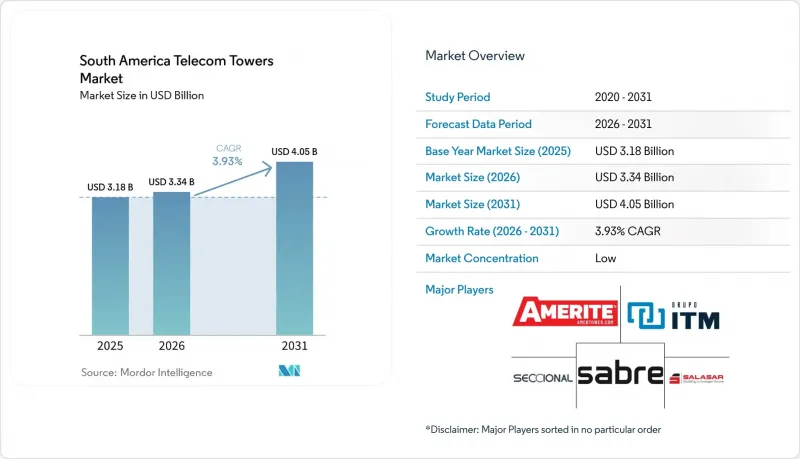
According to Mordor Intelligence, the South America telecom towers market size was valued at USD 3.18 billion in 2025 and is estimated to grow from USD 3.34 billion in 2026 to reach USD 4.05 billion by 2031, at a CAGR of 3.93% during the forecast period (2026-2031).
South America Telecom Towers Market Trends and Insights
5G and Private-Network Densification
5G deployment is creating a direct need for denser radio networks in the South America Telecom Towers Market. By August 2025, 37 operators across 18 countries had launched commercial 5G services, while adoption remained below 15% and 4G coverage exceeded 90% in most countries. Mid-band 3.5 GHz deployments need closer site spacing than many 4G deployments. This requirement supports new tower construction and antenna upgrades in cities and expansion corridors. Private 5G networks for mining, agriculture, and energy add demand that is less dependent on consumer mobile plans. Brazil's auction obligations also create a defined coverage pipeline for tower companies.
Rising Mobile Data and Smartphone Usage
Mobile traffic growth continues to raise capacity requirements across the South America Telecom Towers Market. Monthly mobile data traffic per connection rose from 7 GB in 2023 and is forecast to reach 32 GB by the end of the decade, while total regional traffic is projected to grow at a 25.5% CAGR from 2023 to 2030. Higher use of video, gaming, and enterprise applications can place added pressure on existing macro sites. Secondary cities and peri-urban corridors may need more new sites than mature downtown grids, where co-location can often add capacity. Average monthly traffic per smartphone is forecast to reach 35 GB by 2027. This traffic pattern supports both additional tenants on existing structures and new coverage locations.
Tower-Sharing Saturation and Carrier Network Rationalization
Carrier consolidation is a near-term restraint for the South America Telecom Towers Market. The Tigo-Movistar merger in Colombia was formally completed in February 2026, necessitating a review of overlapping network sites. TIM renegotiated tower contracts in Brazil during 2025, with more than 6,000 sites shut down or relocated. American Tower reported a net decline of 135 South American sites between the first and second quarters of 2026. Operators per tower range from 1.1 to 1.5 across countries, leaving many single-tenant assets exposed when networks are rationalized. Long-term inflation-linked leases can mitigate the revenue impact, while short-cycle agreements carry a higher churn risk.
Other drivers and restraints analyzed in the detailed report include:
- Rural Connectivity Programs and Universal-Service Funding
- MNO Passive-Asset Monetization and Independent TowerCo Expansion
- Environmental, Zoning, and Site-Acquisition Delays
For complete list of drivers and restraints, kindly check the Table Of Contents.
Segment Analysis
Grid/diesel hybrid configurations held 58.41% of the South America Telecom Towers Market share by fuel type in 2025. Their role is strongest where grid power is available but unreliable. Hybrid systems can keep sites operating without incurring the full upfront cost of a fully off-grid design. Brazil's less-electrified interior and Venezuela's unstable grid are important use cases. The configuration also gives operators flexibility when fuel delivery or grid availability changes.
Renewable-powered towers are forecast to grow at a 5.24% CAGR from 2026 to 2031. TIM Brasil operated 133 solar, wind, and biogas plants in the first quarter of 2026, serving more than 17,000 tower sites. The count had risen from 106 plants a year earlier. Claro Peru replaced 42 generator sets with 40 solar panels at base stations in 2024, reporting annual fuel savings of USD 1.46 million. Renewable sites can reduce dependence on diesel logistics and help operators serve remote communities.
Lattice towers accounted for 44.12% of the South America Telecom Towers Market revenue by tower type in 2025. Their structure remains cost-effective for rural, multi-tenant deployments with sufficient ground area. They can support multiple antenna arrays and are well-suited to broad-coverage corridors. Guyed towers continue to serve low-population areas where cost is the main consideration. Stealth designs serve smaller urban and heritage locations where visual concerns limit the use of conventional structures.
Monopole towers are forecast to grow at a 5.12% CAGR from 2026 to 2031. Their smaller footprint helps developers address municipal zoning limits in dense areas. The design can also host compact Massive MIMO antenna arrays used in 5G networks. Claro Peru and Huawei deployed an EcoMatrix single-pole site in December 2025 that supported multiple sub-3 GHz bands. The project reported 35% site-wide energy savings and a 30% reduction in antenna installation space.
Complete Report Scope:
- By Fuel Type
- Renewable-Powered
- Grid/Diesel Hybrid
- By Type of Tower
- Lattice Tower
- Guyed Tower
- Monopole Tower
- Stealth/Concealed Tower
- By Installation
- Rooftop
- Ground-Based
- By Ownership
- Operator-Owned
- Independent TowerCo
- Joint-Venture TowerCo
- MNO Captive
- By Geography
- Brazil
- Argentina
- Colombia
- Chile
- Rest of South America
List of Companies Covered in this Report:
- Sabre Industries, Inc.
- Scanmast AB
- Sa-Ra Enerji Insaat Ticaret ve San. A.S.
- Salasar Techno Engineering Ltd.
- TELCA ENGINEERING PVT LTD
- Monsud SpA
- Carl C. A/S
- MAFI
- VOERAL
- Nan'an Minyi Steel Tower Co., Ltd.
- Grupo ITM
- MER Group
- Captel
- Retis Construction
- Andel
- WIEGEL
- MTS Tower
- LARS Communications
- Estudener
- Amerite Towers
- Seccional Brasil
Additional Benefits:
- The market estimate (ME) sheet in Excel format
- 3 months of analyst support
TABLE OF CONTENTS
1 INTRODUCTION
- 1.1 Study Assumptions and Market Definition
- 1.2 Scope of the Study
2 RESEARCH METHODOLOGY
3 EXECUTIVE SUMMARY
4 MARKET LANDSCAPE
- 4.1 Market Overview
- 4.2 Market Drivers
- 4.2.1 5G and Private-Network Densification
- 4.2.2 Rising Mobile Data and Smartphone Usage
- 4.2.3 Rural Connectivity Programs and Universal-Service Funding
- 4.2.4 MNO Passive-Asset Monetization and Independent TowerCo Expansion
- 4.2.5 Edge Data-Center and Low-Latency Infrastructure Co-Location
- 4.2.6 Brazilian Local-Fabrication Incentives for Telecom Structures
- 4.3 Market Restraints
- 4.3.1 Tower-Sharing Saturation and Carrier Network Rationalization
- 4.3.2 Environmental, Zoning, and Site-Acquisition Delays
- 4.3.3 Amazon Environmental Licensing and Logistics Lead Times
- 4.3.4 Chilean Seismic Reinforcement Cost Premiums
- 4.4 Impact of Macroeconomic Factors on the Market
- 4.5 Industry Ecosystem Analysis
- 4.6 Technology Outlook
- 4.7 Regulatory Landscape Related to Telecom Infrastructure
- 4.8 Porter's Five Forces Analysis
- 4.8.1 Threat of New Entrants
- 4.8.2 Bargaining Power of Suppliers
- 4.8.3 Bargaining Power of Buyers
- 4.8.4 Threat of Substitutes
- 4.8.5 Intensity of Competitive Rivalry
5 MARKET SIZE AND GROWTH FORECASTS (VALUE AND VOLUME)
- 5.1 By Fuel Type
- 5.1.1 Renewable-Powered
- 5.1.2 Grid/Diesel Hybrid
- 5.2 By Type of Tower
- 5.2.1 Lattice Tower
- 5.2.2 Guyed Tower
- 5.2.3 Monopole Tower
- 5.2.4 Stealth/Concealed Tower
- 5.3 By Installation
- 5.3.1 Rooftop
- 5.3.2 Ground-Based
- 5.4 By Ownership
- 5.4.1 Operator-Owned
- 5.4.2 Independent TowerCo
- 5.4.3 Joint-Venture TowerCo
- 5.4.4 MNO Captive
- 5.5 By Geography
- 5.5.1 Brazil
- 5.5.2 Argentina
- 5.5.3 Colombia
- 5.5.4 Chile
- 5.5.5 Rest of South America
6 COMPETITIVE LANDSCAPE
- 6.1 Market Concentration
- 6.2 Strategic Moves
- 6.3 Market Share Analysis
- 6.4 Company Profiles (includes Global Level Overview, Market Level Overview, Core Segments, Financials as available, Strategic Information, Market Rank/Share, Products and Services, Recent Developments)
- 6.4.1 Sabre Industries, Inc.
- 6.4.2 Scanmast AB
- 6.4.3 Sa-Ra Enerji Insaat Ticaret ve San. A.S.
- 6.4.4 Salasar Techno Engineering Ltd.
- 6.4.5 TELCA ENGINEERING PVT LTD
- 6.4.6 Monsud SpA
- 6.4.7 Carl C. A/S
- 6.4.8 MAFI
- 6.4.9 VOERAL
- 6.4.10 Nan'an Minyi Steel Tower Co., Ltd.
- 6.4.11 Grupo ITM
- 6.4.12 MER Group
- 6.4.13 Captel
- 6.4.14 Retis Construction
- 6.4.15 Andel
- 6.4.16 WIEGEL
- 6.4.17 MTS Tower
- 6.4.18 LARS Communications
- 6.4.19 Estudener
- 6.4.20 Amerite Towers
- 6.4.21 Seccional Brasil
7 MARKET OPPORTUNITIES AND FUTURE OUTLOOK
- 7.1 White-Space and Unmet-Need Assessment

