PUBLISHER: Mordor Intelligence | PRODUCT CODE: 2154782

PUBLISHER: Mordor Intelligence | PRODUCT CODE: 2154782
Barley Tea - Market Share Analysis, Industry Trends & Statistics, Growth Forecasts (2026 - 2031)
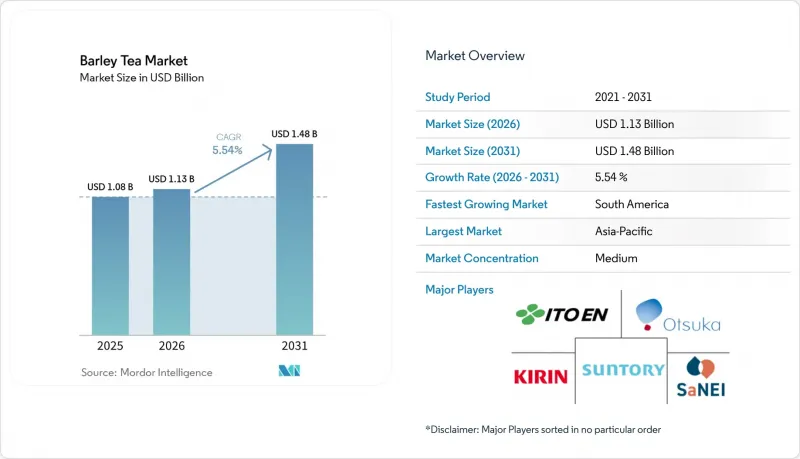
According to Mordor Intelligence, the barley tea market size is expected to grow from USD 1.08 billion in 2025 to USD 1.13 billion in 2026 and is forecast to reach USD 1.48 billion by 2031 at 5.54% CAGR over 2026-2031.
Global Barley Tea Market Trends and Insights
Growing Demand for Caffeine-free Beverages
The growing demand for caffeine-free beverages is driving interest in barley tea as consumers increasingly seek beverages that can be consumed throughout the day without the stimulating effects of caffeine. In 2024, 19% of U.S. consumers aware of specific food ingredients reported actively avoiding caffeine, highlighting a measurable preference for reducing caffeine intake. This shift is encouraging consumers to explore naturally caffeine-free alternatives to coffee, black tea, and energy drinks. Barley tea, traditionally consumed without caffeine, aligns well with this preference while offering a familiar tea-based beverage experience. Its suitability for both hot and cold consumption further supports its use across different occasions. Growing awareness of caffeine intake is therefore expanding the consumer base for barley tea, particularly among health- and wellness-conscious consumers seeking everyday beverage alternatives.
Rising Health and Wellness Consciousness
Increasing health and wellness consciousness is encouraging consumers to make healthier choices in their everyday beverage consumption. Growing awareness of excessive sugar, artificial ingredients, and the nutritional drawbacks of conventional soft drinks is shifting demand toward simpler beverage options. Barley tea aligns with this trend as it is naturally caffeine-free and can be consumed regularly without added sugar. Its mild taste and suitability for both hot and cold consumption further support its appeal as an everyday beverage. Consumers are also showing greater interest in traditional beverages that fit wellness-oriented lifestyles. This shift toward healthier and more mindful consumption is supporting the adoption of barley tea across households.
Limited Consumer Awareness Outside Asia
Limited consumer awareness outside Asia remains a restraint for the barley tea market, as the beverage has relatively low familiarity among consumers in Western and other non-Asian markets. Unlike coffee, black tea, and herbal infusions, barley tea has limited presence in mainstream beverage portfolios and everyday consumption habits in these regions. Consumers may also be unfamiliar with its roasted flavor profile and traditional preparation methods, creating barriers to product trial and repeat purchases. Limited retail shelf space and lower visibility across supermarkets, cafes, and foodservice outlets further restrict consumer exposure. In addition, manufacturers may face higher marketing and education costs to communicate the product's taste, caffeine-free profile, and consumption occasions.
Other drivers and restraints analyzed in the detailed report include:
- Strong Cultural consumption in East Asia
- Preference for Low- and Zero-sugar Beverages
- Gluten-related Dietary Limitations
For complete list of drivers and restraints, kindly check the Table Of Contents.
Segment Analysis
Roasted barley tea accounted for the largest share of the barley tea market by product type, representing 55.18% of revenue in 2025. Its leading position is supported by the established consumer familiarity with roasted barley tea across major Asian markets, where it is traditionally consumed as a daily beverage. The product's distinctive roasted flavor and naturally caffeine-free profile make it suitable for regular consumption across different age groups. Growing consumer interest in non-caffeinated and naturally positioned beverages is further supporting demand for roasted barley tea. In addition, its availability in convenient formats such as tea bags and ready-to-drink products is helping manufacturers reach a broader consumer base beyond traditional loose-leaf consumption.
Flavored barley tea is projected to be the fastest-growing product type, with revenue expected to expand at a 6.29% CAGR through 2031. The segment is benefiting from consumers' growing preference for novel and differentiated beverage experiences while retaining the perceived natural benefits associated with barley tea. Manufacturers are increasingly incorporating flavors to broaden the appeal of barley tea among younger consumers and those who may find traditional roasted barley tea less distinctive. Flavor variations can also support product premiumization by creating opportunities for more diverse and differentiated product offerings. The expansion of modern retail and e-commerce channels is improving consumer access to flavored barley tea and enabling brands to introduce a wider range of variants.
Complete Report Scope:
- By Product Type
- Roasted Barley Tea
- Flavored Barley Tea
- Other Product Types
- By Form
- Loose
- Tea Bags
- Others
- By Distribution Channel
- Supermarkets/Hypermarkets
- Convenience Stores
- Online Retail Stores
- Other Distribution Channels
- By Geography
- North America
- United States
- Canada
- Mexico
- Rest of North America
- Europe
- Germany
- United Kingdom
- Italy
- France
- Spain
- Rest of Europe
- Asia-Pacific
- China
- India
- Japan
- Australia
- South Korea
- Vietnam
- Indonesia
- Rest of Asia-Pacific
- South America
- Brazil
- Argentina
- Rest of South America
- Middle East and Africa
- South Africa
- Saudi Arabia
- United Arab Emirates
- Rest of Middle East and Africa
- North America
Geography Analysis
Asia-Pacific accounted for the largest share of the global barley tea market, representing 54.88% of revenue in 2025. The region's dominance is primarily attributed to the long-standing consumption of barley tea in countries such as Japan, South Korea, and China, where it is widely recognized as a traditional, caffeine-free beverage. Strong consumer familiarity with barley-based beverages supports recurring household consumption and provides a stable demand base for the market. In addition, growing health consciousness and interest in naturally positioned beverages are encouraging consumers to incorporate barley tea into their daily beverage routines.
South America is projected to be the fastest-growing regional market, with revenue expected to expand at a 6.54% CAGR through 2031. Growth is being supported by increasing consumer interest in functional and naturally positioned beverages as consumers seek alternatives to conventional caffeinated drinks. Rising exposure to Asian beverage products through international retail, e-commerce, and foodservice channels is also improving consumer awareness of barley tea across the region. The growing availability of imported and locally distributed specialty teas is making barley tea more accessible to consumers beyond traditional tea-drinking segments.
Europe, North America, and the Middle East & Africa represent emerging markets for barley tea, supported by increasing interest in caffeine-free, natural, and health-oriented beverages. Demand is particularly influenced by Asian consumer communities and growing exposure to international tea products through specialty retailers and online platforms. Product diversification into tea bags, flavored variants, and ready-to-drink formats is also helping broaden consumer appeal. However, comparatively lower consumer familiarity with barley tea than in Asia-Pacific limits the current market size of these regions.
- ITO EN, Ltd.
- Suntory Holdings Limited
- Kirin Holdings Company, Limited
- Otsuka Pharmaceutical Co., Ltd.
- Sanei Kosan Co., Ltd.
- Harada Tea Processing Co., Ltd.
- JIN-DA CO., LTD.
- Dongsuh Foods Corporation
- Nikken Foods Co., Ltd.
- Ten Ren Tea Company, Ltd.
- Hakubaku Co., Ltd.
- Odani Kokufun Co., Ltd.
- The Canadian Barley Tea Company
- New Mexico Tea Company
- The Republic of Tea, Inc.
- Sugimoto Tea Company
- Pokka Sapporo Food & Beverage Ltd.
- Lotte Corporation
- Kikkoman Corporation
- Uni-President Enterprises Corporation
Additional Benefits:
- The market estimate (ME) sheet in Excel format
- 3 months of analyst support
TABLE OF CONTENTS
1 INTRODUCTION
- 1.1 Study Assumptions and Market Definition
- 1.2 Scope of the Study
2 RESEARCH METHODOLOGY
3 EXECUTIVE SUMMARY
4 MARKET LANDSCAPE
- 4.1 Market Overview
- 4.2 Market Drivers
- 4.2.1 Growing Demand for Caffeine-free Beverages
- 4.2.2 Rising Health and Wellness Consciousness
- 4.2.3 Strong Cultural Consumption in East Asia
- 4.2.4 Growing Demand for Functional Beverages
- 4.2.5 Preference for Low- and Zero-sugar Beverages
- 4.2.6 Rising International Interest in Asian Beverages
- 4.3 Market Restraints
- 4.3.1 Limited Consumer Awareness Outside Asia
- 4.3.2 Gluten-related Dietary Limitations
- 4.3.3 Distinct Roasted Flavor Profile
- 4.3.4 Strong Competition from Substitute Beverages
- 4.4 Supply Chain Analysis
- 4.5 Regulatory Landscape
- 4.6 Technological Outlook
- 4.7 Porter's Five Forces Analysis
- 4.7.1 Bargaining Power of Suppliers
- 4.7.2 Bargaining Power of Buyers
- 4.7.3 Threat of New Entrants
- 4.7.4 Threat of Substitutes
- 4.7.5 Intensity of Competitive Rivalry
5 MARKET SIZE AND GROWTH FORECASTS (VALUE )
- 5.1 By Product Type
- 5.1.1 Roasted Barley Tea
- 5.1.2 Flavored Barley Tea
- 5.1.3 Other Product Types
- 5.2 By Form
- 5.2.1 Loose
- 5.2.2 Tea Bags
- 5.2.3 Others
- 5.3 By Distribution Channel
- 5.3.1 Supermarkets/Hypermarkets
- 5.3.2 Convenience Stores
- 5.3.3 Online Retail Stores
- 5.3.4 Other Distribution Channels
- 5.4 By Geography
- 5.4.1 North America
- 5.4.1.1 United States
- 5.4.1.2 Canada
- 5.4.1.3 Mexico
- 5.4.1.4 Rest of North America
- 5.4.2 Europe
- 5.4.2.1 Germany
- 5.4.2.2 United Kingdom
- 5.4.2.3 Italy
- 5.4.2.4 France
- 5.4.2.5 Spain
- 5.4.2.6 Rest of Europe
- 5.4.3 Asia-Pacific
- 5.4.3.1 China
- 5.4.3.2 India
- 5.4.3.3 Japan
- 5.4.3.4 Australia
- 5.4.3.5 South Korea
- 5.4.3.6 Vietnam
- 5.4.3.7 Indonesia
- 5.4.3.8 Rest of Asia-Pacific
- 5.4.4 South America
- 5.4.4.1 Brazil
- 5.4.4.2 Argentina
- 5.4.4.3 Rest of South America
- 5.4.5 Middle East and Africa
- 5.4.5.1 South Africa
- 5.4.5.2 Saudi Arabia
- 5.4.5.3 United Arab Emirates
- 5.4.5.4 Rest of Middle East and Africa
- 5.4.1 North America
6 COMPETITIVE LANDSCAPE
- 6.1 Market Concentration
- 6.2 Strategic Moves
- 6.3 Market Ranking Analysis
- 6.4 Company Profiles (Includes Company Highlights, Strategic Information, Core Segments, Financials, Products & Services, Recent Developments)
- 6.4.1 ITO EN, Ltd.
- 6.4.2 Suntory Holdings Limited
- 6.4.3 Kirin Holdings Company, Limited
- 6.4.4 Otsuka Pharmaceutical Co., Ltd.
- 6.4.5 Sanei Kosan Co., Ltd.
- 6.4.6 Harada Tea Processing Co., Ltd.
- 6.4.7 JIN-DA CO., LTD.
- 6.4.8 Dongsuh Foods Corporation
- 6.4.9 Nikken Foods Co., Ltd.
- 6.4.10 Ten Ren Tea Company, Ltd.
- 6.4.11 Hakubaku Co., Ltd.
- 6.4.12 Odani Kokufun Co., Ltd.
- 6.4.13 The Canadian Barley Tea Company
- 6.4.14 New Mexico Tea Company
- 6.4.15 The Republic of Tea, Inc.
- 6.4.16 Sugimoto Tea Company
- 6.4.17 Pokka Sapporo Food & Beverage Ltd.
- 6.4.18 Lotte Corporation
- 6.4.19 Kikkoman Corporation
- 6.4.20 Uni-President Enterprises Corporation
7 MARKET OPPORTUNITIES AND FUTURE OUTLOOK

