PUBLISHER: Mordor Intelligence | PRODUCT CODE: 2154786

PUBLISHER: Mordor Intelligence | PRODUCT CODE: 2154786
ENT Disorder Treatment - Market Share Analysis, Industry Trends & Statistics, Growth Forecasts (2026 - 2031)
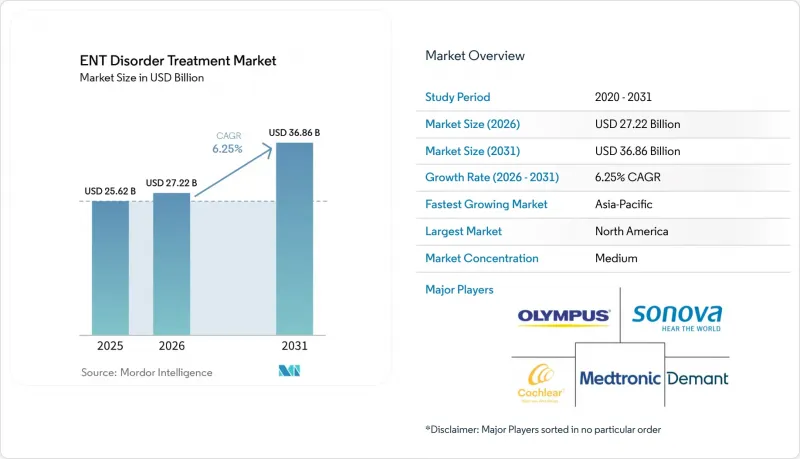
According to Mordor Intelligence, the ENT disorder treatment market size is expected to increase from USD 25.62 billion in 2025 to USD 27.22 billion in 2026 and reach USD 36.86 billion by 2031, growing at a CAGR of 6.25% over 2026-2031.
Global ENT Disorder Treatment Market Trends and Insights
Rising Aging-Related Hearing Loss and ENT Disease Burden
More than 430 million people globally require rehabilitation for disabling hearing loss. Hearing loss ranked as the third most common cause of years lived with disability among adults older than 60 in a 2025 analysis. This population requires more than hearing aids and cochlear implants. It also creates demand for tympanoplasty, balance rehabilitation, and vestibular pharmacotherapy. Cognitive decline, depression, and social isolation make earlier treatment more relevant for health systems. The ENT disorder treatment market, therefore, benefits when hearing care is treated as part of broader clinical management rather than as a discretionary audiology purchase.
Increasing Prevalence of Chronic Sinusitis, Rhinitis, and Otitis Media
Chronic rhinosinusitis affected an estimated 12% of adults in Western countries in a 2025 systematic review. Many patients still move between primary-care antibiotics and elective surgery without sustained evidence-based treatment. Tezepelumab became the first TSLP-targeting biologic approved for chronic rhinosinusitis with nasal polyps in October 2025. Dupilumab received U.S. approval for allergic fungal rhinosinusitis in February 2026. These approvals support a chronic disease management model for sinonasal inflammation within the ENT disorder treatment market. Companies with respiratory immunology platforms have an advantage in treating patients who need long-term biologic care.
High Cost of Advanced ENT Devices and Surgical Procedures
Cochlear implants, premium hearing aids, and image-guided sinus procedures remain costly for many patients. A PLOS analysis reported U.S. hearing-aid prices from USD 500 to USD 3,000. Total cochlear implant costs, including surgery and fitting, can reach USD 100,000 in some health systems. These price barriers are most significant in low- and middle-income countries where disease burdens are high. China's volume-based procurement policy is also compressing average selling prices for premium devices. Cochlear identified the policy as a headwind for premium cochlear implant sales in China in its FY2026 results.
Other drivers and restraints analyzed in the detailed report include:
- Adoption of Minimally Invasive ENT Procedures and Image-Guided Surgery
- Tele-Otoscopy and Remote ENT Consultations Extending Diagnosis to Underserved Areas
- Antimicrobial Resistance and Antibiotic-Stewardship Constraints
For complete list of drivers and restraints, kindly check the Table Of Contents.
Segment Analysis
Pharmaceuticals held 57.31% of the ENT disorder treatment market share in 2025. Their position reflected frequent prescribing of antibiotics, antihistamines, and corticosteroids in primary care. Medical Devices is forecast to grow at a CAGR of 7.58% between 2026 and 2031. Hearing implants, balloon dilation systems, navigation platforms, and advanced endoscopes support this faster expansion. Devices also capture a higher value per intervention than many established drug therapies.
Biologics are changing the pharmaceutical mix in the ENT disorder treatment market. Tezepelumab blocks TSLP, while dupilumab blocks IL-4 and IL-13 pathways. These mechanisms serve patients whose needs are not addressed by small-molecule ENT therapies. Medical device consumables and accessories provide recurring revenue linked to procedure activity. Hearing devices and implants retain the highest unit values within the device category. FDA 510(k) and PMA pathways continue to shape product-launch timing and research priorities.
Ear disorders commanded 38.24% of the ENT disorder treatment market size in 2025. Hearing loss, otitis media, and cochlear implant demand supported this leadership. The category also benefits from established audiometry, imaging, and implant technology. Its treatment pathways are supported by long-standing clinical evidence. The scale of hearing care gives the Ear category a durable base in the ENT disorder treatment market.
Throat, Larynx, and Related Structures is projected to grow at a CAGR of 7.22% through 2031. Higher obstructive sleep apnea diagnosis, hypoglossal nerve stimulation, and transoral robotic surgery support demand. The American Academy of Otolaryngology-Head and Neck Surgery recognizes several surgical options when CPAP therapy is insufficient. Nose and Sinuses also remains important because of chronic rhinosinusitis and allergic rhinitis. Biologic eligibility tied to nasal-polyp burden can increase use of diagnostic imaging. When biologics defer surgery, drug revenue can rise while near-term procedure volumes may slow.
Complete Report Scope:
- By Product Type
- Medical Devices
- Surgical and Interventional Devices
- Hearing Devices and Implants
- Consumables and Accessories
- Pharmaceuticals
- Antibiotics
- Analgesics and Nonsteroidal Anti-Inflammatory Drugs
- Antihistamines
- Corticosteroids
- Antivirals
- Decongestants
- Biologics
- Others
- Medical Devices
- By Organ Type
- Ear
- Nose and Sinuses
- Throat, Larynx, and Related Structures
- By Disease Type
- Infectious ENT Disorders
- Inflammatory and Allergic ENT Disorders
- Hearing and Balance Disorders
- Structural and Obstructive Disorders
- Sleep-Related Breathing Disorders
- Other Disease Types
- By Patient Age Group
- Pediatrics (0-12 Years)
- Adolescents (13-17 Years)
- Adults (18-64 Years)
- Geriatrics (65 Years and Older)
- By Distribution Channel
- Hospital Pharmacies
- Retail Pharmacies and Drug Stores
- Online Pharmacies and Digital Platforms
- Other Distribution Channels
- By Geography
- North America
- United States
- Canada
- Mexico
- Europe
- Germany
- United Kingdom
- France
- Italy
- Spain
- Rest of Europe
- Asia-Pacific
- China
- Japan
- India
- Australia
- South Korea
- Rest of Asia-Pacific
- Middle East and Africa
- GCC
- South Africa
- Rest of Middle East and Africa
- South America
- Brazil
- Argentina
- Rest of South America
- North America
Geography Analysis
North America held 42.61% of the ENT disorder treatment market share in 2025. Advanced reimbursement systems, specialist density, and high spending on hearing devices and biologics underpin its leading position. U.S. regulatory reviews supported the 2025 and 2026 approvals of tezepelumab and dupilumab for sinonasal conditions. Rural access remains a concern despite high overall spending. A 2024 JAMA study found that 75% of U.S. counties qualified as shortage areas for hearing health professionals.
Asia-Pacific is forecast to expand at a CAGR of 7.75% from 2026 to 2031. Japan's aging population, Chinese investment in ENT capacity, and Indian demand for specialist care support this pace. Japan approved the Cochlear Nucleus Nexa implant in June 2026. The source reported hearing loss in 11% of Japan's total population and more than 70% of adults aged 75 and older. China's volume-based procurement is constraining premium implant revenue, while community hospital expansion is lifting procedure volumes and generic drug use.
Europe maintained a substantial share in 2025 through established reimbursement pathways in Germany, the UK, France, Italy, and Spain. EU MDR 2017/745 CE-marking requirements remain central to device access in the region. Medtronic received CE mark approval for Stealth AXiS for ENT procedures on June 8, 2026. The Middle East and Africa combine private investment in GCC hospital care with significant workforce limitations in Sub-Saharan Africa. Global OHNS reported a clinician density of 0.18 per 100,000 people in Sub-Saharan Africa. South America is supported by hearing-aid programs and greater biologic access, although currency volatility and fragmented insurance slow adoption.
- Abbott Laboratories
- Acousia Therapeutics GmbH
- Ambu
- AstraZeneca
- Cochlear
- Demant
- GN Store Nord
- GlaxoSmithKline
- Johnson & Johnson
- Karl Storz
- MED-EL Elektromedizinische Gerate GmbH
- Medtronic
- Merck
- Novartis
- Olympus
- Pfizer
- Sanofi
- Sonova
- Spiral Therapeutics
- Stryker
- Teva Pharmaceutical Industries
- WS Audiology A/S
Additional Benefits:
- The market estimate (ME) sheet in Excel format
- 3 months of analyst support
TABLE OF CONTENTS
1 Introduction
- 1.1 Study Assumptions and Market Definition
- 1.2 Scope of the Study
2 Research Methodology
3 Executive Summary
4 Market Landscape
- 4.1 Market Overview
- 4.2 Market Drivers
- 4.2.1 Rising Aging-Related Hearing Loss and ENT Disease Burden
- 4.2.2 Increasing Prevalence of Chronic Sinusitis, Rhinitis, and Otitis Media
- 4.2.3 Adoption of Minimally Invasive ENT Procedures and Image-Guided Surgery
- 4.2.4 Expanding Healthcare Access, Reimbursement, and ENT Infrastructure
- 4.2.5 Tele-Otoscopy and Remote ENT Consultations Extending Diagnosis to Underserved Areas
- 4.2.6 Microbiome and Probiotic Therapies for Recurrent Pediatric Ear Infections
- 4.3 Market Restraints
- 4.3.1 High Cost of Advanced ENT Devices and Surgical Procedures
- 4.3.2 Antimicrobial Resistance and Antibiotic-Stewardship Constraints
- 4.3.3 Fragmented Reimbursement for Advanced Otic Devices in Emerging Markets
- 4.3.4 Shortage of ENT Specialists, Audiologists, and Device-Fitting Capacity
- 4.4 Supply-Chain Analysis
- 4.5 Regulatory Landscape
- 4.6 Technological Outlook
- 4.7 Porter's Five Forces Analysis
- 4.7.1 Bargaining Power of Suppliers
- 4.7.2 Bargaining Power of Buyers
- 4.7.3 Threat of New Entrants
- 4.7.4 Threat of Substitutes
- 4.7.5 Competitive Rivalry
5 Market Size & Growth Forecasts (Value, USD)
- 5.1 By Product Type
- 5.1.1 Medical Devices
- 5.1.1.1 Surgical and Interventional Devices
- 5.1.1.2 Hearing Devices and Implants
- 5.1.1.3 Consumables and Accessories
- 5.1.2 Pharmaceuticals
- 5.1.2.1 Antibiotics
- 5.1.2.2 Analgesics and Nonsteroidal Anti-Inflammatory Drugs
- 5.1.2.3 Antihistamines
- 5.1.2.4 Corticosteroids
- 5.1.2.5 Antivirals
- 5.1.2.6 Decongestants
- 5.1.2.7 Biologics
- 5.1.2.8 Others
- 5.1.1 Medical Devices
- 5.2 By Organ Type
- 5.2.1 Ear
- 5.2.2 Nose and Sinuses
- 5.2.3 Throat, Larynx, and Related Structures
- 5.3 By Disease Type
- 5.3.1 Infectious ENT Disorders
- 5.3.2 Inflammatory and Allergic ENT Disorders
- 5.3.3 Hearing and Balance Disorders
- 5.3.4 Structural and Obstructive Disorders
- 5.3.5 Sleep-Related Breathing Disorders
- 5.3.6 Other Disease Types
- 5.4 By Patient Age Group
- 5.4.1 Pediatrics (0-12 Years)
- 5.4.2 Adolescents (13-17 Years)
- 5.4.3 Adults (18-64 Years)
- 5.4.4 Geriatrics (65 Years and Older)
- 5.5 By Distribution Channel
- 5.5.1 Hospital Pharmacies
- 5.5.2 Retail Pharmacies and Drug Stores
- 5.5.3 Online Pharmacies and Digital Platforms
- 5.5.4 Other Distribution Channels
- 5.6 By Geography
- 5.6.1 North America
- 5.6.1.1 United States
- 5.6.1.2 Canada
- 5.6.1.3 Mexico
- 5.6.2 Europe
- 5.6.2.1 Germany
- 5.6.2.2 United Kingdom
- 5.6.2.3 France
- 5.6.2.4 Italy
- 5.6.2.5 Spain
- 5.6.2.6 Rest of Europe
- 5.6.3 Asia-Pacific
- 5.6.3.1 China
- 5.6.3.2 Japan
- 5.6.3.3 India
- 5.6.3.4 Australia
- 5.6.3.5 South Korea
- 5.6.3.6 Rest of Asia-Pacific
- 5.6.4 Middle East and Africa
- 5.6.4.1 GCC
- 5.6.4.2 South Africa
- 5.6.4.3 Rest of Middle East and Africa
- 5.6.5 South America
- 5.6.5.1 Brazil
- 5.6.5.2 Argentina
- 5.6.5.3 Rest of South America
- 5.6.1 North America
6 Competitive Landscape
- 6.1 Market Concentration
- 6.2 Market Share Analysis
- 6.3 Company Profiles (includes Global Level Overview, Market Level Overview, Core Segments, Financials as available, Strategic Information, Market Rank/Share, Products and Services, Recent Developments)
- 6.3.1 Abbott Laboratories
- 6.3.2 Acousia Therapeutics GmbH
- 6.3.3 Ambu A/S
- 6.3.4 AstraZeneca
- 6.3.5 Cochlear Limited
- 6.3.6 Demant A/S
- 6.3.7 GN Store Nord A/S
- 6.3.8 GSK plc
- 6.3.9 Johnson & Johnson
- 6.3.10 KARL STORZ SE & Co. KG
- 6.3.11 MED-EL Elektromedizinische Gerate GmbH
- 6.3.12 Medtronic plc
- 6.3.13 Merck & Co., Inc.
- 6.3.14 Novartis AG
- 6.3.15 Olympus Corporation
- 6.3.16 Pfizer Inc.
- 6.3.17 Sanofi
- 6.3.18 Sonova Holding AG
- 6.3.19 Spiral Therapeutics
- 6.3.20 Stryker Corporation
- 6.3.21 Teva Pharmaceutical Industries Ltd.
- 6.3.22 WS Audiology A/S
7 Market Opportunities and Future Outlook
- 7.1 White-Space and Unmet-Need Assessment

